
Biology · Energy and respiration
This chapter explores the fundamental need for energy in living organisms, focusing on ATP as the universal energy currency. It details the four stages of aerobic respiration and anaerobic respiration pathways, relating these processes to mitochondrial structure and adaptations. The chapter also covers the comparison of energy values, respiratory quotients, and practical investigations using respirometers and redox indicators.
respiration — The enzymatic release of energy from organic compounds in living cells.
Respiration is a catabolic process that breaks down organic molecules, such as glucose, to release chemical potential energy. This energy is then used to synthesise ATP, the cell's energy currency. It can occur aerobically (with oxygen) or anaerobically (without oxygen), much like a power plant burning fuel to generate electricity.
Students often think respiration is just breathing, but actually it's a cellular process of energy release, while breathing is gas exchange.
anabolic — A chemical reaction in which small molecules are built up into larger ones.
Anabolic reactions require energy input, often supplied by ATP, to synthesise complex molecules like proteins or DNA from simpler precursors. These reactions are essential for growth, repair, and storage in living organisms, similar to building a LEGO castle from individual bricks.
When asked to 'explain' the need for energy, link anabolic reactions directly to ATP hydrolysis and the formation of larger molecules.
phosphorylation — The addition of a phosphate group to a molecule.
In glycolysis, phosphorylation of glucose by ATP raises its energy level, making it more reactive and easier to split. This initial energy investment is crucial for the subsequent energy-releasing steps, much like 'priming the pump' to get a bigger process going.
ATP synthase — The enzyme that catalyses the phosphorylation of ADP to produce ATP.
ATP synthase is a large protein complex embedded in the inner mitochondrial membrane. It acts as a channel for protons to flow down their concentration gradient, using this energy to synthesise ATP from ADP and Pi, much like a molecular turbine generating ATP as protons flow through it.
substrate-linked reaction — In the context of ATP formation, the transfer of phosphate from a substrate molecule directly to ADP to produce ATP, using energy provided directly by another chemical reaction.
This is a direct method of ATP synthesis, occurring in glycolysis and the Krebs cycle, where an enzyme transfers a phosphate group from a high-energy intermediate molecule to ADP. It does not involve the electron transport chain, acting like a direct cash transfer rather than a complex investment scheme.
Students often think all ATP is made by chemiosmosis, but actually substrate-linked phosphorylation provides a small but crucial amount of ATP.
chemiosmosis — The synthesis of ATP using energy released by the movement of hydrogen ions down their concentration gradient, across a membrane in a mitochondrion or chloroplast.
In mitochondria, protons are pumped into the intermembrane space, creating a gradient. Their subsequent flow back into the matrix through ATP synthase drives ATP production. This is the primary method of ATP synthesis in aerobic respiration, similar to a dam where water flowing through turbines generates electricity.
Be precise when describing ATP synthesis; specify 'substrate-linked phosphorylation' for direct transfers and 'chemiosmosis' for the proton gradient mechanism.
Living organisms require a constant supply of energy to carry out essential life processes. This energy is primarily used for anabolic reactions, where small molecules are built up into larger, more complex ones, crucial for growth, repair, and storage. Adenosine triphosphate (ATP) serves as the universal energy currency, providing readily available energy for these cellular activities. ATP is synthesised through processes like substrate-linked reactions and chemiosmosis, ensuring a continuous energy supply.
NAD (nicotinamide adenine dinucleotide) — A hydrogen carrier used in respiration.
NAD accepts hydrogen atoms (protons and electrons) during glycolysis, the link reaction, and the Krebs cycle, becoming reduced NAD. It then transports these hydrogens to the electron transport chain for ATP synthesis, much like a taxi picking up passengers (hydrogens) and dropping them off at their destination.
oxidation — The addition of oxygen, or the removal of hydrogen or electrons from a substance.
In respiration, organic molecules are progressively oxidised, releasing energy. The removal of hydrogen atoms, which include electrons, is a key form of oxidation in metabolic pathways, similar to 'stripping' a molecule of its energy-rich components.
Students often think oxidation only involves oxygen, but actually it's a broader concept involving loss of electrons or hydrogen.
reduction — The removal of oxygen, or the addition of hydrogen or electrons to a substance.
In respiration, carrier molecules like NAD and FAD are reduced when they accept hydrogen atoms (protons and electrons). This allows them to transport energy to the electron transport chain, much like a battery getting charged by gaining energy-rich components.
redox reaction — A chemical reaction in which one substance is reduced and another is oxidised.
Redox reactions are fundamental to respiration, as electrons and hydrogen atoms are transferred between molecules. This transfer of energy is central to ATP production, acting like a 'give and take' relationship where one molecule gives up electrons while another takes them.
Always specify 'reduced NAD' when it has accepted hydrogens and 'oxidised NAD' when it has released them, to avoid ambiguity.
Aerobic respiration is the complete enzymatic release of energy from organic compounds in the presence of oxygen. It is a highly efficient process that occurs in four main stages: glycolysis, the link reaction, the Krebs cycle, and oxidative phosphorylation. This complex series of redox reactions progressively breaks down glucose, releasing chemical potential energy to synthesise a large amount of ATP.
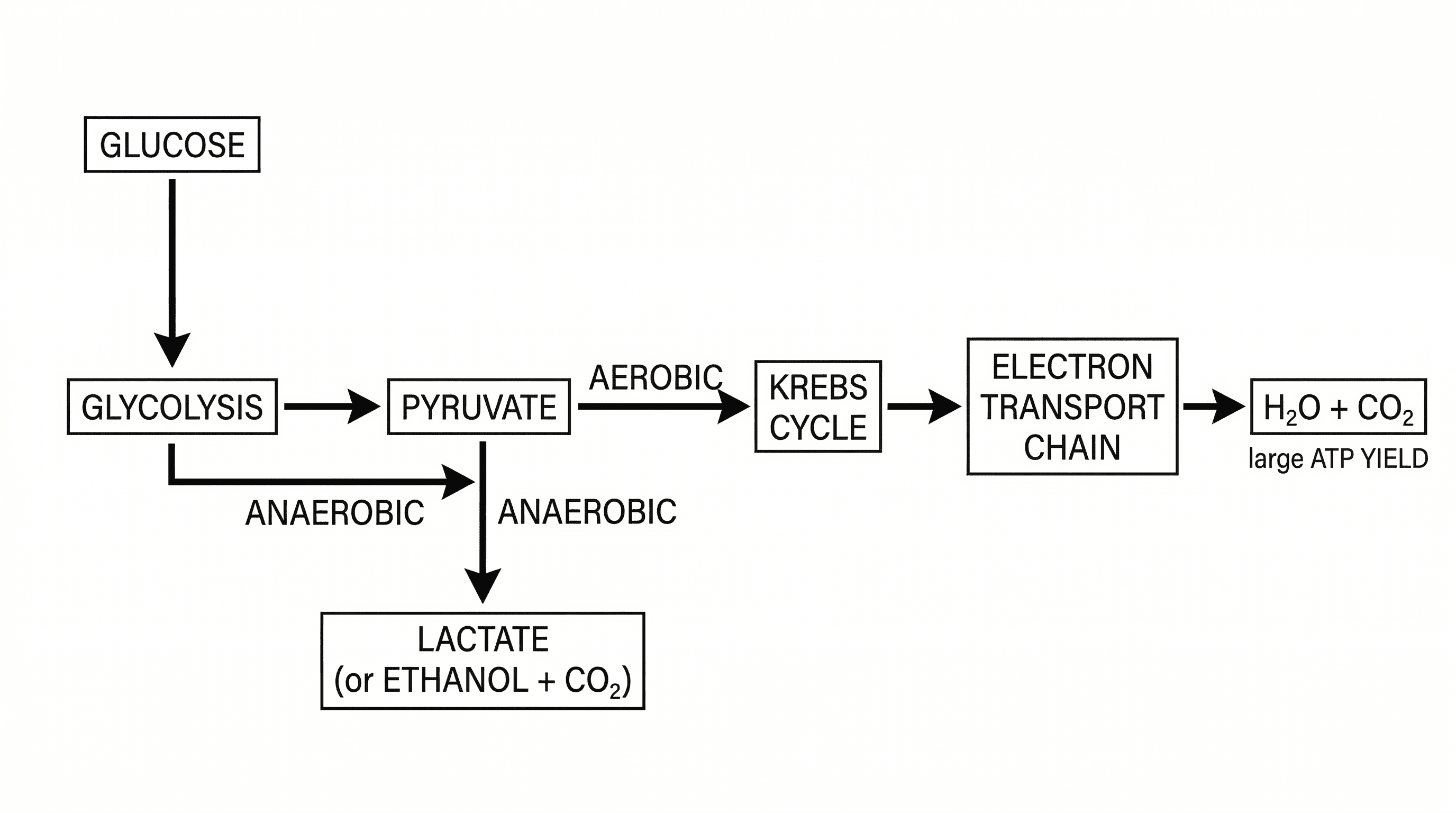
glycolysis — The splitting (lysis) of glucose; the first stage in aerobic respiration.
Glycolysis occurs in the cytoplasm and breaks down one molecule of glucose (6C) into two molecules of pyruvate (3C). This process produces a net gain of 2 ATP via substrate-linked phosphorylation and 2 reduced NAD. It can proceed in both aerobic and anaerobic conditions, much like breaking a large log into two smaller pieces for easier handling.
Students often think glycolysis requires oxygen, but actually it is an anaerobic process that can occur with or without oxygen.
link reaction — Decarboxylation and dehydrogenation of pyruvate, resulting in the formation of acetyl coenzyme A, linking glycolysis with the Krebs cycle.
This reaction occurs in the mitochondrial matrix. Pyruvate loses a carbon dioxide molecule (decarboxylation) and hydrogen atoms (dehydrogenation), which are picked up by NAD, forming acetyl CoA. It acts as the 'gateway' process preparing glycolysis products for the Krebs cycle.
decarboxylation — The removal of carbon dioxide from a substance.
Decarboxylation occurs in the link reaction and the Krebs cycle, where carbon atoms are removed from organic molecules and released as CO2. This is a key step in breaking down glucose completely, similar to 'venting' excess carbon from a molecule.
dehydrogenation — The removal of hydrogen from a substance.
Dehydrogenation reactions are crucial in glycolysis, the link reaction, and the Krebs cycle, as they provide hydrogen atoms (protons and electrons) to carrier molecules like NAD and FAD. These reduced carriers then fuel ATP synthesis in oxidative phosphorylation, much like 'harvesting' energy-rich hydrogen atoms from a fuel molecule.
coenzyme A (CoA) — A molecule that supplies acetyl groups required for the link reaction.
CoA is a complex coenzyme that combines with the 2-carbon acetyl group produced from pyruvate in the link reaction, forming acetyl coenzyme A. This molecule then delivers the acetyl group to the Krebs cycle, acting like a shuttle bus for the acetyl group.
acetyl coenzyme A — A molecule made up of CoA and a 2C acetyl group, important in the link reaction.
Formed from pyruvate and CoA in the link reaction, acetyl CoA is the entry molecule for the Krebs cycle. It delivers the 2-carbon acetyl group to oxaloacetate to form citrate, much like a delivery truck carrying a specific package to the next processing station.
Krebs cycle — A cycle of reactions in aerobic respiration in the matrix of a mitochondrion in which hydrogens pass to hydrogen carriers for subsequent ATP synthesis and some ATP is synthesised directly; also known as the citric acid cycle.
The Krebs cycle is a central metabolic pathway where acetyl CoA is completely oxidised, producing CO2, ATP (via substrate-linked phosphorylation), and a large amount of reduced NAD and FAD. These reduced carriers are essential for oxidative phosphorylation, much like a circular conveyor belt processing fuel and loading energy carriers.
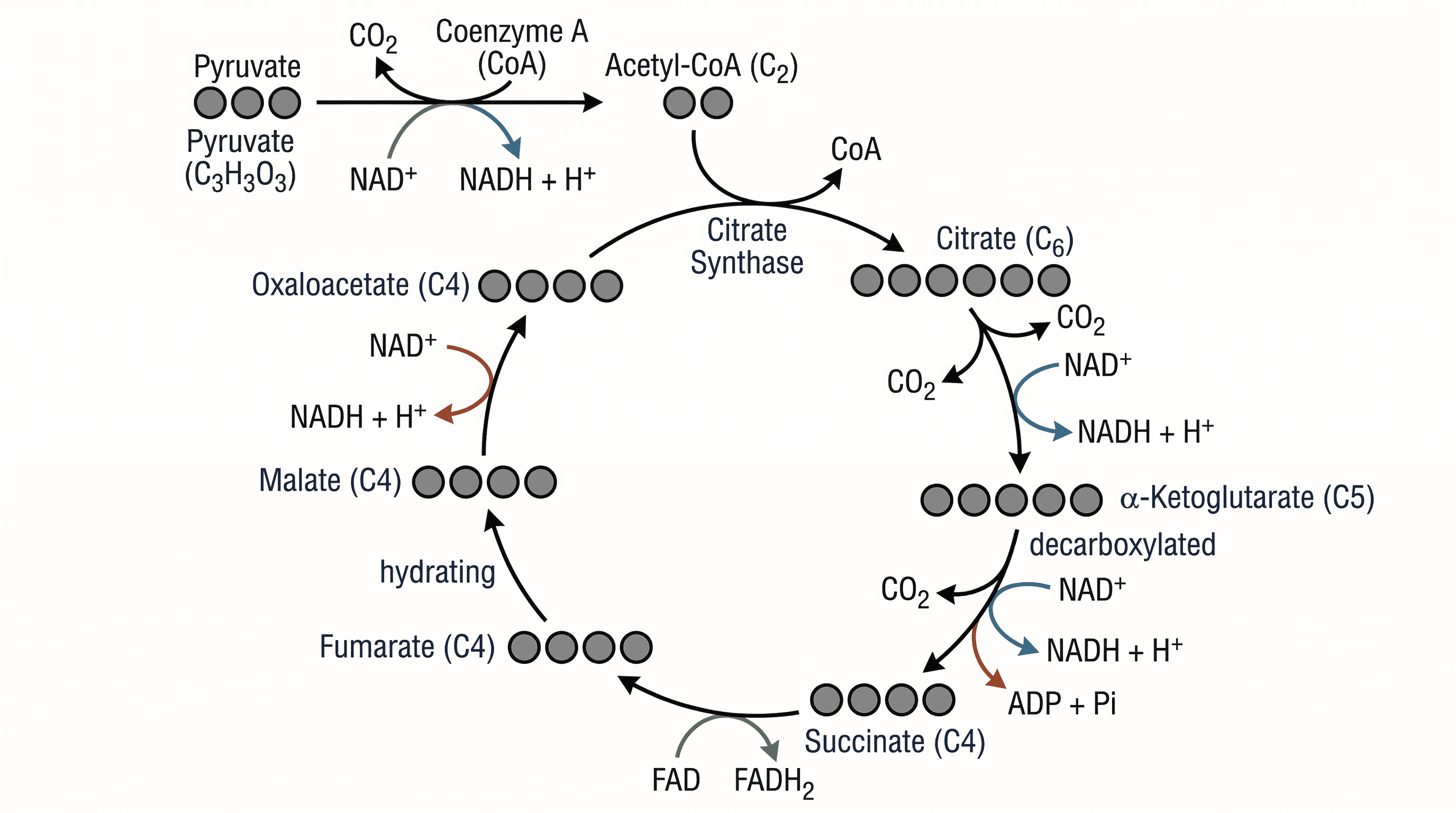
Students often think the Krebs cycle directly produces a lot of ATP, but actually its main output is reduced NAD and FAD for oxidative phosphorylation.
When describing the Krebs cycle, mention its cyclical nature, the regeneration of oxaloacetate, and the production of CO2, ATP, reduced NAD, and reduced FAD.
oxidative phosphorylation — The synthesis of ATP from ADP and Pi using energy from oxidation reactions in aerobic respiration.
This is the final and most productive stage of aerobic respiration, occurring on the inner mitochondrial membrane. It involves the electron transport chain and chemiosmosis, where oxygen acts as the final electron acceptor, much like the 'grand finale' of energy production.
electron transport chain — A chain of adjacently arranged carrier molecules in the inner mitochondrial membrane, along which electrons pass in redox reactions.
Electrons, derived from reduced NAD and FAD, move along this chain, releasing energy. This energy is used to pump protons into the intermembrane space, establishing the gradient for chemiosmosis, similar to a series of cascading waterfalls releasing energy.
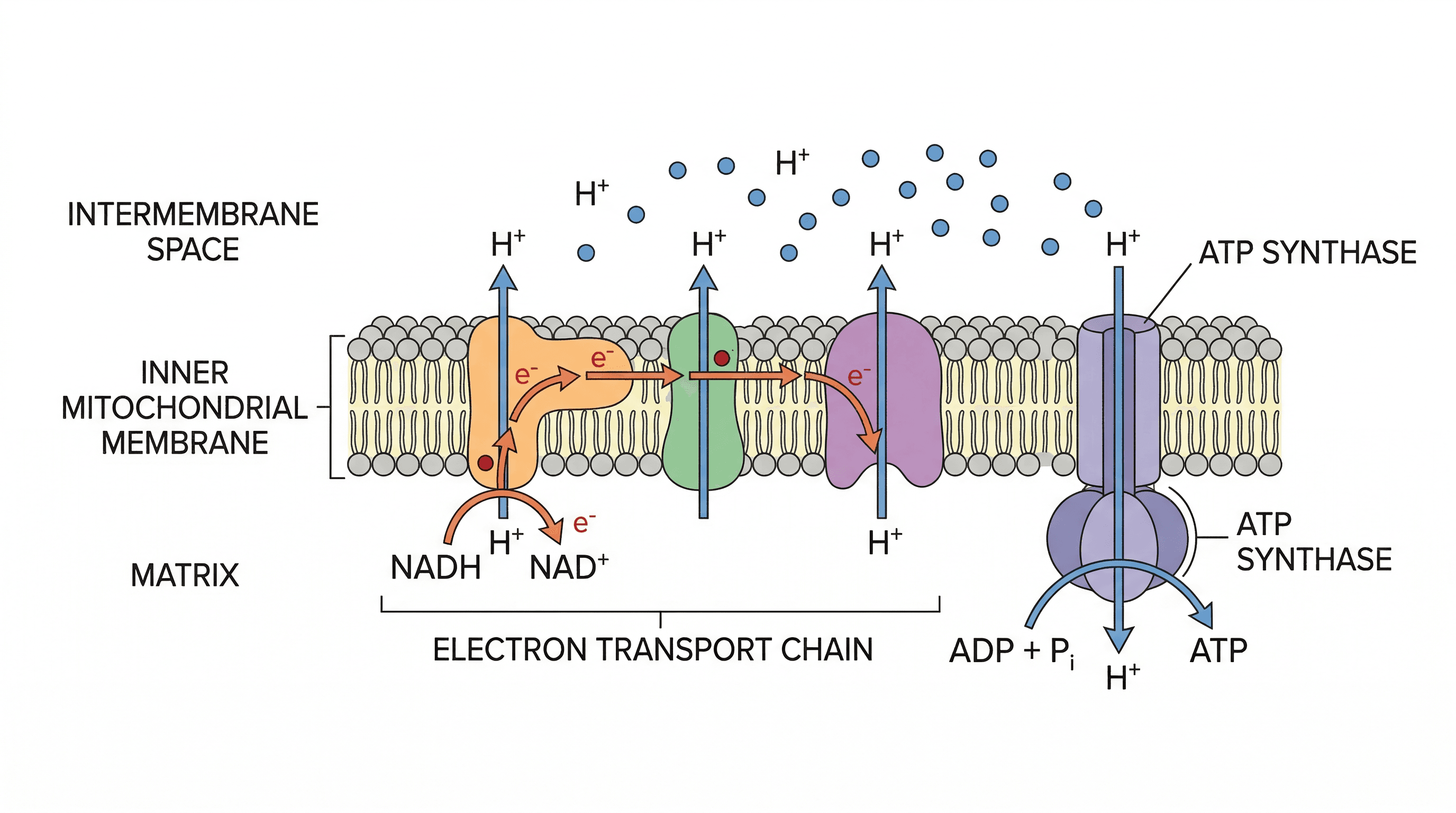
Clearly link oxidative phosphorylation to the inner mitochondrial membrane, the electron transport chain, proton gradient, ATP synthase, and the role of oxygen.
Mitochondria are often called the 'powerhouses' of the cell due to their central role in aerobic respiration. Their structure is highly adapted for this function. The inner mitochondrial membrane is extensively folded into cristae, which significantly increases the surface area for the electron transport chain and ATP synthase enzymes. The mitochondrial matrix, enclosed by the inner membrane, contains the enzymes for the link reaction and the Krebs cycle, facilitating these crucial stages of respiration.
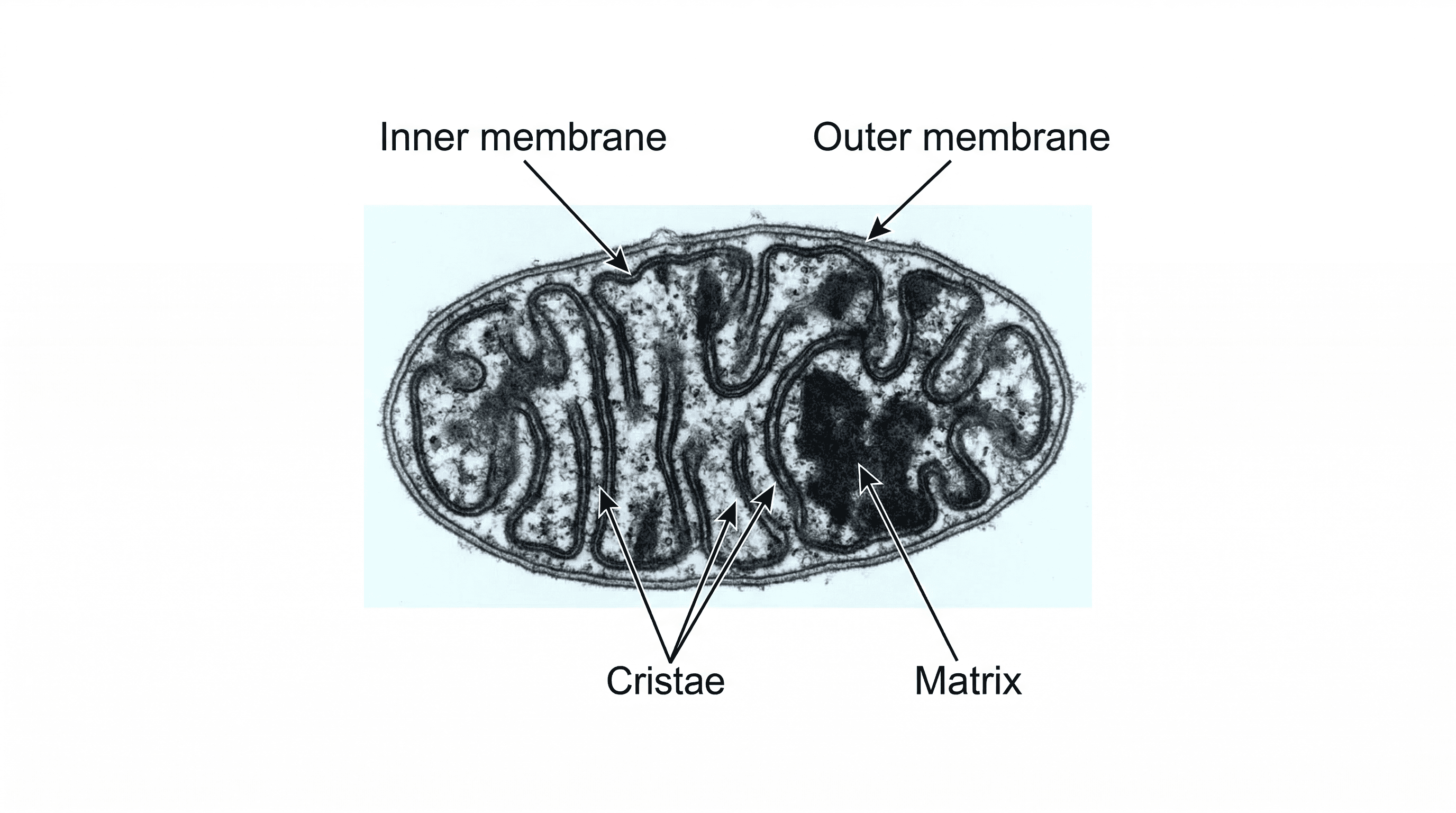
Explicitly link mitochondrial structure to function: cristae provide a large surface area for the electron transport chain and ATP synthase.
anaerobic — Without oxygen.
Anaerobic conditions mean that oxygen is not available as the final electron acceptor in respiration. This leads to alternative pathways like fermentation, which produce much less ATP than aerobic respiration, much like trying to run a car without enough air, resulting in inefficient operation.
ethanol fermentation — Anaerobic respiration in which pyruvate is converted to ethanol.
This pathway occurs in yeast and some plant tissues. Pyruvate is first decarboxylated to ethanal, then reduced by reduced NAD to ethanol, regenerating oxidised NAD for glycolysis to continue. It's like a temporary workaround when the main power grid (aerobic respiration) is down, allowing minimal energy production.
lactate fermentation — Anaerobic respiration in which pyruvate is converted to lactate.
This pathway occurs in mammalian muscles during intense exercise when oxygen supply is limited. Pyruvate is directly reduced by reduced NAD to lactate, regenerating oxidised NAD for glycolysis to continue. It acts as a short-term emergency power supply for muscles.
Students often think lactate is a waste product that cannot be used, but actually it can be converted back to pyruvate or glycogen in the liver.
aerenchyma — Plant tissue containing air spaces.
Aerenchyma tissue, found in plants like rice, provides a pathway for gases, including oxygen, to diffuse from aerial parts to submerged roots. This helps the roots respire aerobically even in flooded conditions, acting like a natural ventilation system within the plant.
While most organisms rely on aerobic respiration, some can adapt to or perform respiration in the absence of oxygen. For instance, rice plants, which often grow with their roots submerged in water, have evolved aerenchyma tissue. This specialised tissue contains air spaces that allow oxygen to diffuse from the aerial parts of the plant down to the submerged roots, enabling partial aerobic respiration even in flooded environments. This adaptation is crucial for their survival in such conditions.
respiratory quotient (RQ) — The ratio of the volume of carbon dioxide produced to the volume of oxygen used.
The RQ value indicates the type of respiratory substrate being used (carbohydrate ~1.0, lipid ~0.7, protein ~0.9) and can also signal anaerobic respiration (RQ > 1 or infinity). It's like a 'fuel gauge' for the cell, telling you what kind of fuel it's currently burning based on the gas exchange ratio.
Respiratory Quotient (RQ)
Used to determine the type of respiratory substrate or if anaerobic respiration is occurring.
Respiratory Quotient (RQ) from moles/molecules
Used when a balanced chemical equation for respiration is available.
For RQ calculations, always write the formula (RQ = CO2/O2), show your substitution, and then state the final calculated value.
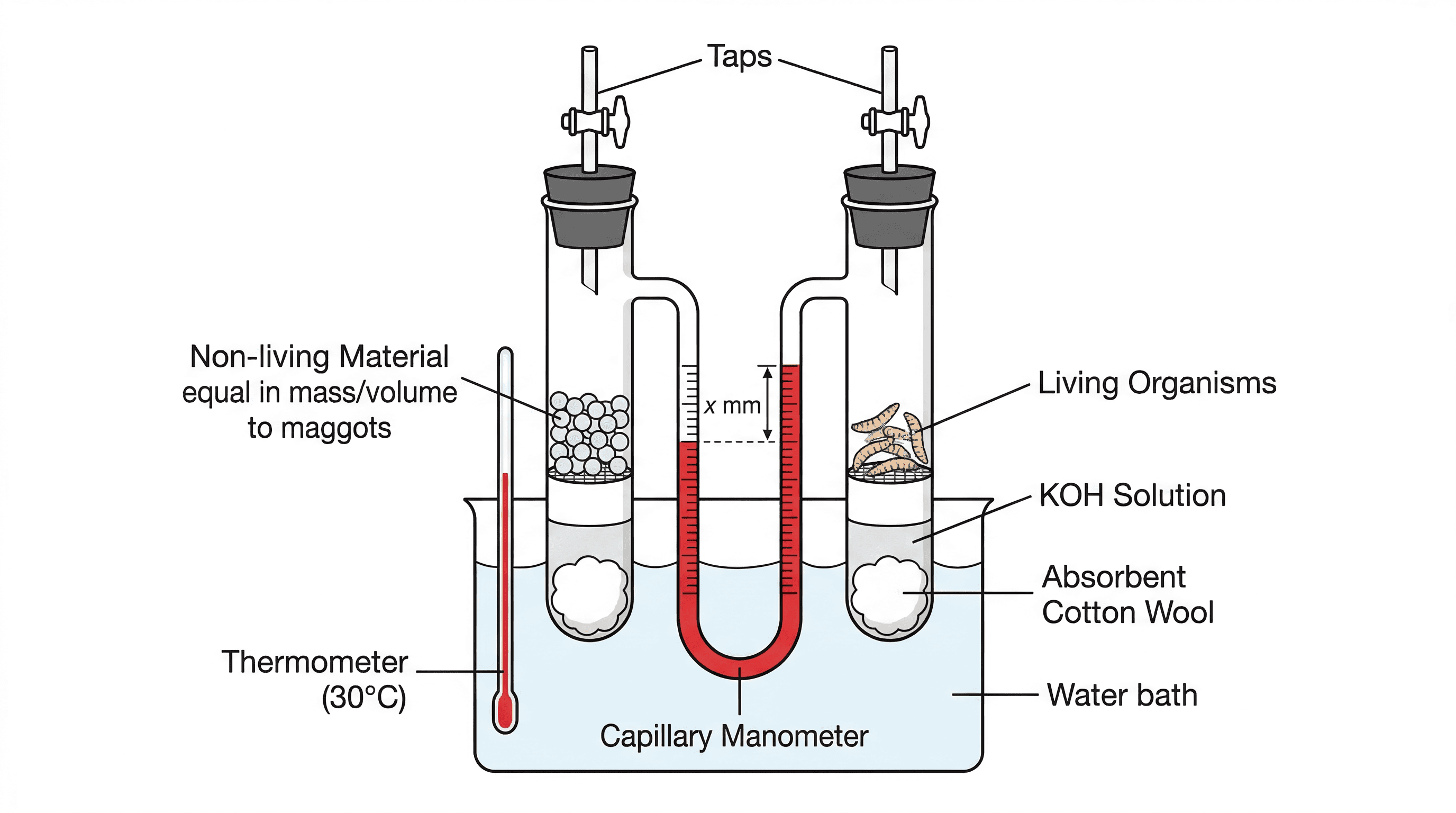
respirometer — A piece of apparatus that can be used to measure the rate of oxygen uptake by respiring organisms.
A respirometer typically consists of sealed tubes containing organisms and a CO2 absorbent, connected to a manometer. Changes in manometer fluid level indicate oxygen consumption, allowing calculation of respiration rate and RQ, much like a miniature sealed environment for observing gas exchange.
redox indicator — A substance that changes colour when it is oxidised or reduced.
Redox indicators like DCPIP or methylene blue can accept hydrogens from respiratory substrates, becoming reduced and changing colour (e.g., blue to colourless). The rate of colour change indicates the rate of respiration, acting like a chemical 'dipstick' for reaction speed.
The rate of respiration can be investigated using various methods. Respirometers are commonly used to measure the rate of oxygen uptake by respiring organisms. These setups typically include a CO2 absorbent to isolate oxygen consumption, and a manometer to quantify gas volume changes. Alternatively, redox indicators like DCPIP or methylene blue can be employed. These indicators change colour as they are reduced by hydrogen atoms released during respiration, providing a visual measure of the reaction rate.
Always state the precise location for each stage of respiration (e.g., 'mitochondrial matrix for the Krebs cycle').
Use specific terminology: 'dehydrogenation' for hydrogen removal, 'decarboxylation' for CO2 removal, and 'phosphorylation' for adding phosphate.
When describing oxidative phosphorylation, clearly state that oxygen is the 'final electron acceptor'.
anabolic
A chemical reaction in which small molecules are built up into larger ones.
respiration
The enzymatic release of energy from organic compounds in living cells.
substrate-linked reaction
In the context of ATP formation, the transfer of phosphate from a substrate molecule directly to ADP to produce ATP, using energy provided directly by another chemical reaction.
chemiosmosis
The synthesis of ATP using energy released by the movement of hydrogen ions down their concentration gradient, across a membrane in a mitochondrion or chloroplast.
glycolysis
The splitting (lysis) of glucose; the first stage in aerobic respiration.
phosphorylation
The addition of a phosphate group to a molecule.
NAD (nicotinamide adenine dinucleotide)
A hydrogen carrier used in respiration.
oxidation
The addition of oxygen, or the removal of hydrogen or electrons from a substance.
reduction
The removal of oxygen, or the addition of hydrogen or electrons to a substance.
decarboxylation
The removal of carbon dioxide from a substance.
dehydrogenation
The removal of hydrogen from a substance.
coenzyme A (CoA)
A molecule that supplies acetyl groups required for the link reaction.
acetyl coenzyme A
A molecule made up of CoA and a 2C acetyl group, important in the link reaction.
link reaction
Decarboxylation and dehydrogenation of pyruvate, resulting in the formation of acetyl coenzyme A, linking glycolysis with the Krebs cycle.
Krebs cycle
A cycle of reactions in aerobic respiration in the matrix of a mitochondrion in which hydrogens pass to hydrogen carriers for subsequent ATP synthesis and some ATP is synthesised directly; also known as the citric acid cycle.
oxidative phosphorylation
The synthesis of ATP from ADP and Pi using energy from oxidation reactions in aerobic respiration.
electron transport chain
A chain of adjacently arranged carrier molecules in the inner mitochondrial membrane, along which electrons pass in redox reactions.
redox reaction
A chemical reaction in which one substance is reduced and another is oxidised.
ATP synthase
The enzyme that catalyses the phosphorylation of ADP to produce ATP.
anaerobic
Without oxygen.
ethanol fermentation
Anaerobic respiration in which pyruvate is converted to ethanol.
lactate fermentation
Anaerobic respiration in which pyruvate is converted to lactate.
aerenchyma
Plant tissue containing air spaces.
respiratory quotient (RQ)
The ratio of the volume of carbon dioxide produced to the volume of oxygen used.
respirometer
A piece of apparatus that can be used to measure the rate of oxygen uptake by respiring organisms.
redox indicator
A substance that changes colour when it is oxidised or reduced.
| Command word | What examiners expect |
|---|---|
| Outline | Provide a brief summary of the main points without extensive detail. For 'Outline the need for energy', focus on anabolic reactions and ATP. |
| Explain | Give reasons or mechanisms for a phenomenon. For 'Explain how ATP is suited...', describe its properties like small, soluble, immediate energy release. For 'Explain how rice is adapted...', detail aerenchyma and its function. |
| Describe | Give a detailed account of a process or structure. For 'Describe the stages in aerobic respiration', list each stage, its location, key inputs/outputs, and the roles of specific molecules. |
| Compare | Identify similarities and differences between two or more things. For 'Compare energy values of different respiratory substrates', state typical RQ values and their implications. |
| Calculate | Work out the numerical value using a formula. For 'Calculate respiratory quotients', show the formula, substitution, and final answer with units if applicable. |
Mistake
Confusing cellular respiration (energy release in cells) with breathing (gas exchange).
Correction
Respiration is a cellular process of energy release from organic compounds, while breathing is the physical process of gas exchange (taking in oxygen, releasing carbon dioxide).
Mistake
Thinking glycolysis requires oxygen.
Correction
Glycolysis is an anaerobic process that occurs in the cytoplasm and does not require oxygen. It is the first stage of both aerobic and anaerobic respiration.
Mistake
Believing all ATP is made by chemiosmosis.
Correction
While chemiosmosis produces the majority of ATP in aerobic respiration, a small but crucial amount of ATP is also made directly by substrate-linked phosphorylation in glycolysis and the Krebs cycle.
Mistake
Thinking the Krebs cycle directly produces large amounts of ATP.
Correction
The main output of the Krebs cycle is reduced NAD and FAD, which carry hydrogens to the electron transport chain for oxidative phosphorylation. Only a small amount of ATP is produced directly by substrate-linked phosphorylation in the Krebs cycle.
Mistake
Defining oxidation as only the addition of oxygen.
Correction
Oxidation is a broader concept that includes the loss of electrons or hydrogen from a substance, as well as the addition of oxygen.
Mistake
Thinking lactate is a waste product that cannot be used.
Correction
Lactate produced during anaerobic respiration in muscles can be transported to the liver and converted back to pyruvate or glycogen, demonstrating it is not merely a waste product.