
Biology · Selection and evolution
This chapter explores how variation within species drives evolution through natural and artificial selection. It details the mechanisms of genetic change, including genetic drift and the Hardy-Weinberg principle, and explains how these processes lead to the formation of new species.
genetic variation — Differences between the DNA base sequences of individuals within a species.
This variation is the raw material for natural selection and can arise from independent assortment, crossing over, random gamete fusion, random mating, and mutation. It leads to phenotypic variation, much like having many different cards and shuffling them in countless ways to create unique hands.
phenotypic variation — Differences between the observable characteristics of individuals within a species.
This variation is a result of the interaction between genetic and environmental factors and is what natural selection acts upon. For example, siblings share genes but might have different heights or weights due to their diet or exercise, showing phenotypic variation.
Students often confuse genetic variation with environmentally induced variation. Remember that only genetic variation is heritable and can be acted upon by natural selection; environmentally-induced variation is not passed on to offspring.
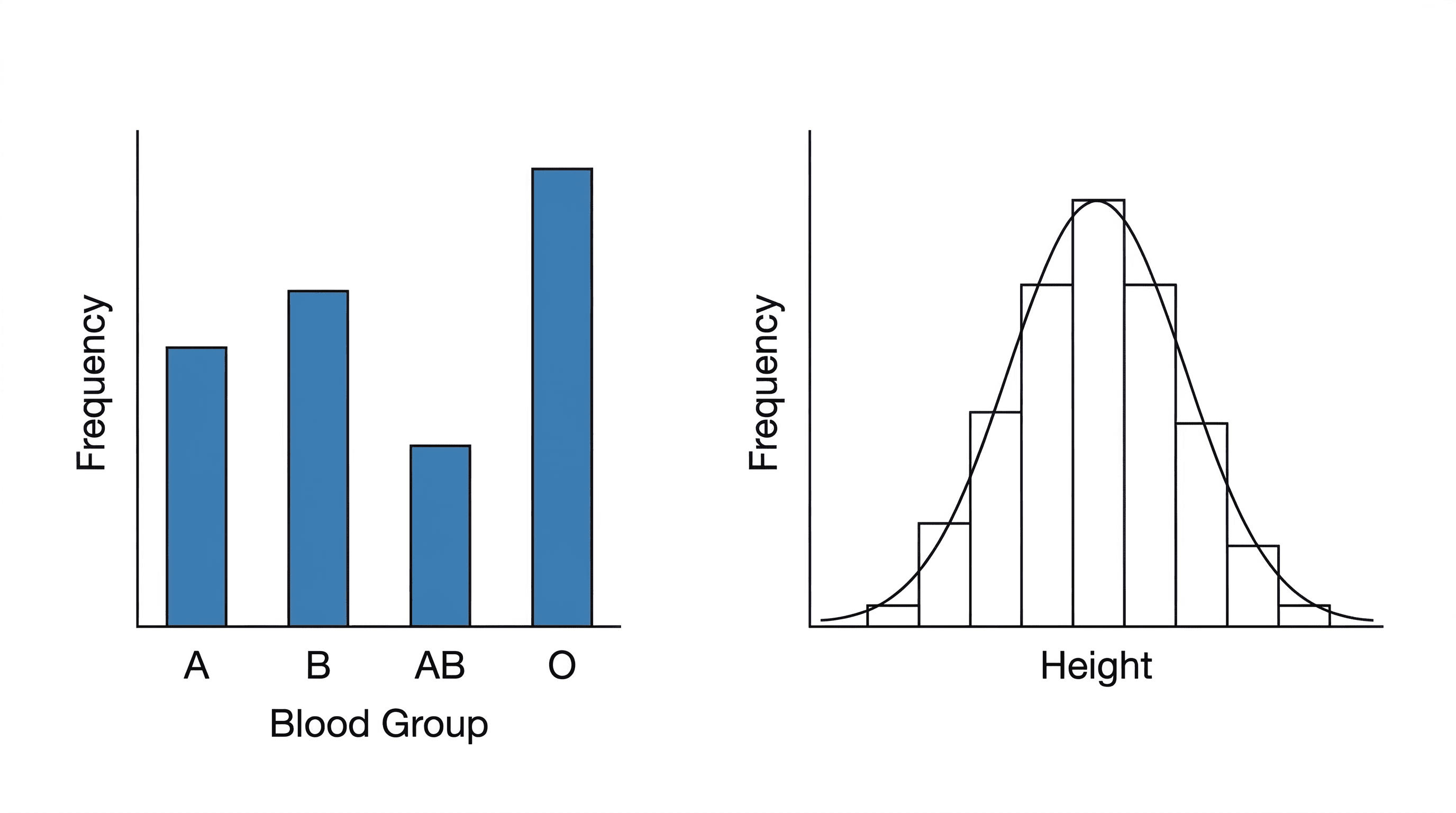
discontinuous variation — Differences between individuals of a species in which each one belongs to one of a small number of distinct categories, with no intermediates.
This type of variation is typically caused by different alleles at a single gene locus having large effects on the phenotype, with the environment having no effect. ABO blood groups are an example, much like choosing a shirt from a limited set of colours with no in-between shades.
continuous variation — Differences between individuals of a species in which each one can lie at any point in the range between the highest and lowest values.
This variation is affected by multiple genes (polygenes), each with small, often additive effects, and is also influenced by environmental factors. Height and mass are examples, similar to a dimmer switch for a light where you can set it to any brightness level.
polygenes — A number of different genes at different loci that all contribute to a particular aspect of phenotype.
These genes typically have small, often additive effects, leading to continuous variation in traits like height or mass. The combined effect of many such genes creates a wide range of possible phenotypes, much like many different ingredients each adding a little bit to the overall flavour.
For continuous variation, remember to mention both polygenic inheritance (many genes, small additive effects) and environmental influence, and that it results in a range of phenotypes.
environmental factor — A feature of the environment of an organism that affects its survival.
These factors can be biotic (living organisms) or abiotic (non-living components) and exert selection pressures that influence which individuals survive and reproduce. They contribute to phenotypic variation but are not heritable, like the amount of sunlight affecting a plant's final size.
biotic factor — An environmental factor that is caused by living organisms (e.g. predation, competition).
These factors are interactions between organisms that can act as selection pressures, influencing survival and reproduction rates within a population. For example, predators selecting against certain prey phenotypes, similar to deer eating certain plants in a garden.
competition — The need for a resource by two organisms, when that resource is in short supply.
Competition can be intraspecific (within a species) or interspecific (between species) and acts as a selection pressure, favouring individuals better able to acquire the limited resource. This is like two children wanting the last slice of cake.
abiotic factor — An environmental factor that is caused by non-living components (e.g. soil pH, light intensity).
These physical and chemical conditions of an environment act as selection pressures, favouring individuals with adaptations that allow them to survive and thrive under those specific conditions. The temperature and rainfall in a desert are examples.
fitness — The ability of an organism to survive and reproduce.
Fitness is a measure of an organism's reproductive success, specifically its capacity to survive and transmit its alleles to its offspring. Higher fitness means a greater contribution to the gene pool of the next generation, much like having the energy to run a race again and produce more runners.
Students often equate fitness solely with physical strength or survival, but it specifically refers to reproductive success and the ability to pass on alleles.
selection pressure — An environmental factor that affects the chance of survival of an organism; organisms with one phenotype are more likely to survive and reproduce than those with a different phenotype.
Selection pressures drive natural selection by differentially favouring certain alleles or phenotypes, leading to changes in allele frequencies over generations. They can be biotic or abiotic, like a strong wind favouring trees with stronger roots.
natural selection — The process by which individuals with a particular set of alleles are more likely to survive and reproduce than those with other alleles; over time and many generations, the advantageous alleles become more frequent in the population.
This is a key mechanism of evolution, where environmental selection pressures act on phenotypic variation, leading to a gradual increase in the frequency of advantageous alleles and a decrease in disadvantageous ones. It acts like a filter, letting through only the best-adapted individuals.
Students sometimes think natural selection is a conscious process or that organisms 'try' to adapt. Remember that it's a passive process where the environment selects existing advantageous traits.
Ensure your explanation of natural selection includes variation, selection pressure, differential survival/reproduction, and changes in allele frequency over generations.
stabilising selection — Natural selection that tends to keep allele frequencies relatively constant over many generations.
This occurs when environmental conditions are stable, favouring individuals with intermediate phenotypes and selecting against extreme variations. It reduces the range of variation in a population, much like quality control rejecting screws that are too long or too short.
directional selection — Natural selection that causes a gradual change in allele frequency over many generations.
This occurs when there is a change in environmental conditions or a new allele arises, favouring individuals at one extreme of the phenotypic range. It shifts the mean phenotype of the population in a particular direction, like adjusting a machine to produce progressively longer screws.
disruptive selection — Natural selection that maintains relatively high frequencies of two different sets of alleles; individuals with intermediate features and allele sets are not selected for.
This occurs when conditions favour individuals at both extremes of the phenotypic range, while selecting against intermediate phenotypes. It can lead to polymorphism within a population and potentially speciation, similar to a fishing net with only very small or very large holes.
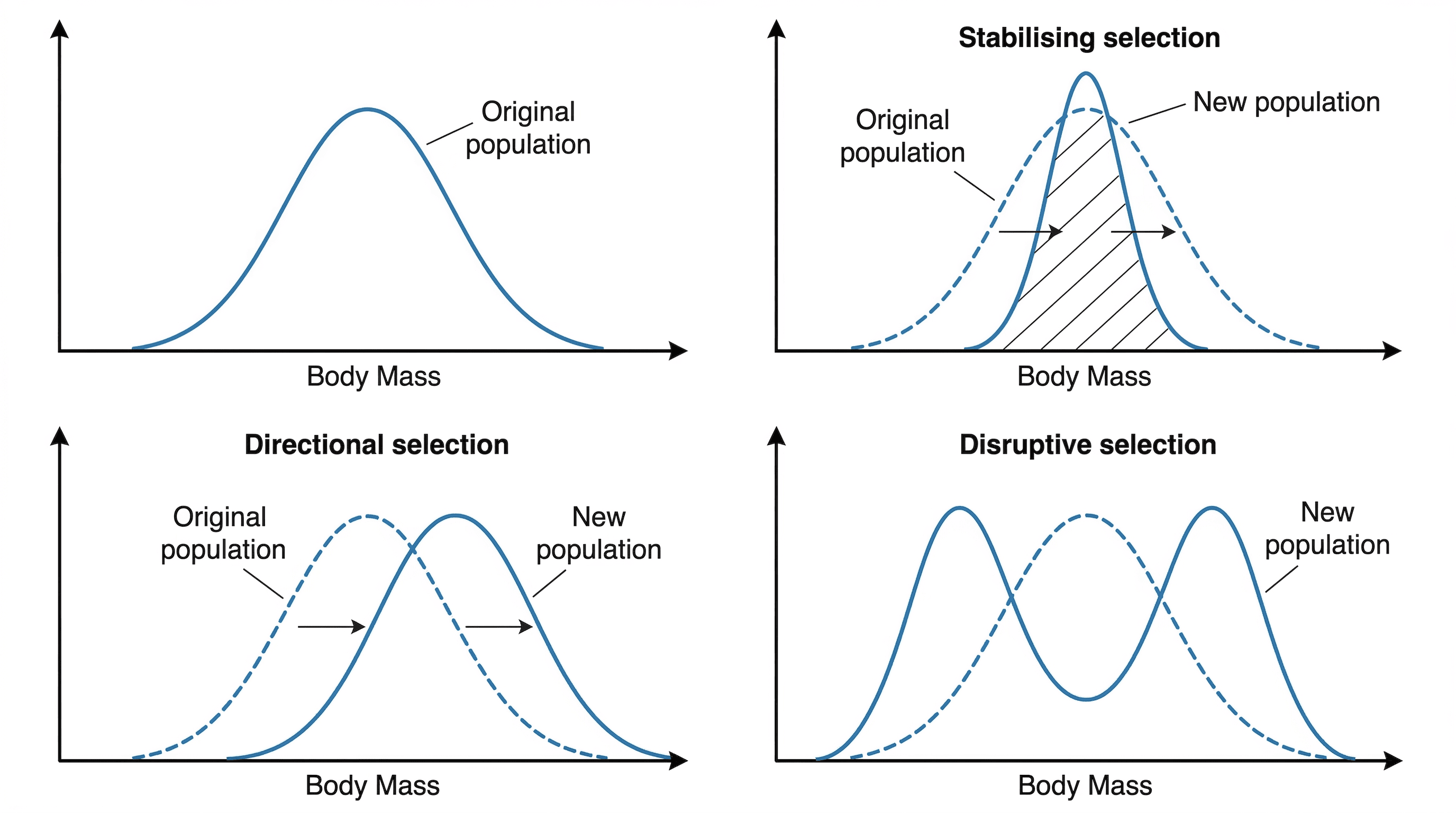
Directional selection drives changes in allele frequencies, leading to adaptations. A prominent example is the development of antibiotic resistance in bacteria. When antibiotics are used, they act as a selection pressure, killing susceptible bacteria. Any bacteria with pre-existing mutations that confer resistance survive and reproduce, passing on their advantageous alleles. Over generations, the frequency of resistant alleles increases, making the antibiotic less effective. Industrial melanism, exemplified by the peppered moth, is another case where environmental changes (soot pollution) favoured darker moths, shifting the population's phenotype.
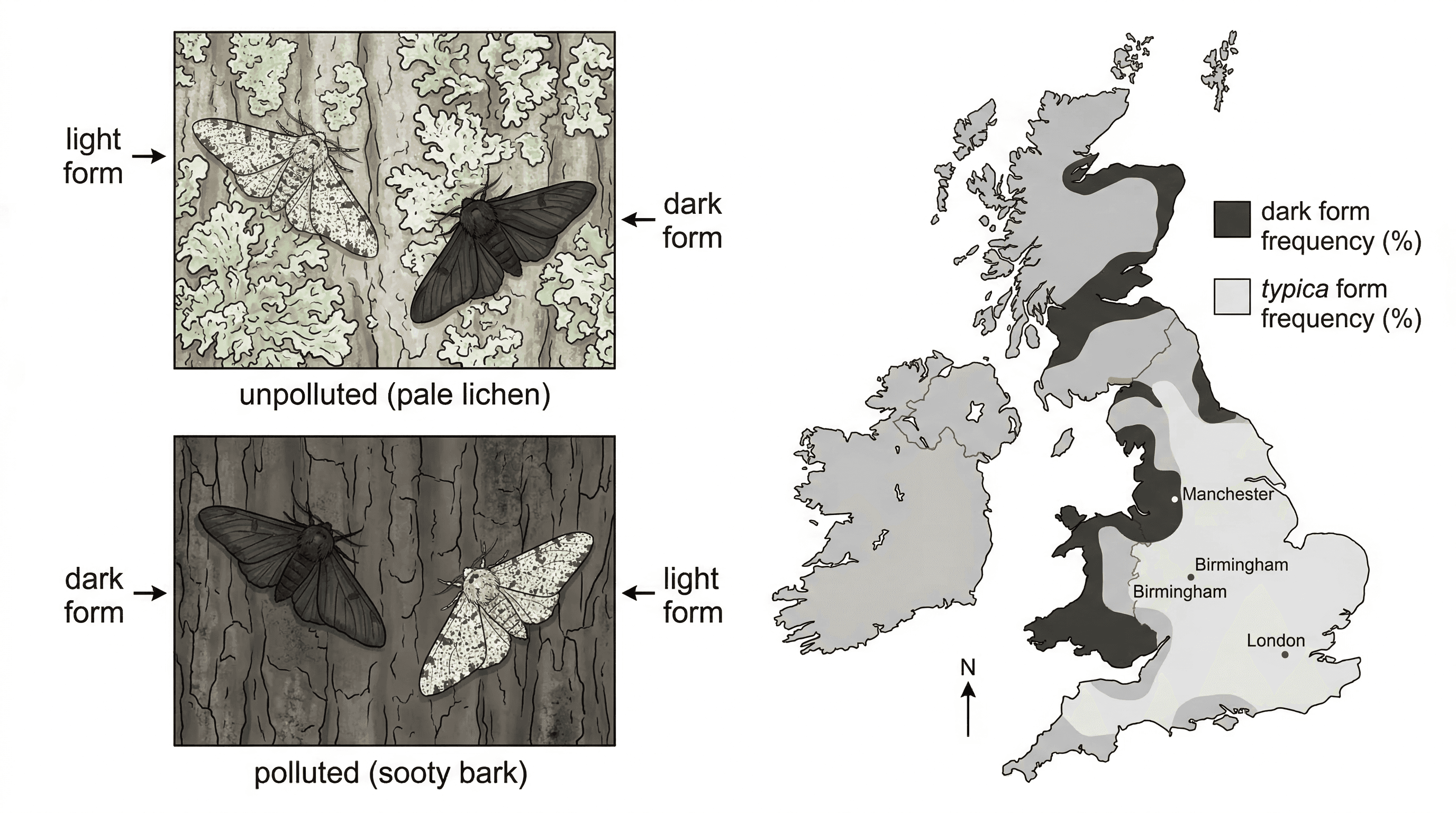
polymorphism — The continued existence of two or more different phenotypes in a species.
Polymorphism can be maintained by disruptive selection or other factors, ensuring genetic diversity within a population. It means that distinct forms of a trait coexist, like a species of flower that consistently produces both red and white blooms.
genetic drift — The gradual change in allele frequencies in a small population, where some alleles are lost or favoured just by chance and not by natural selection.
This random process has a more significant effect in small populations because chance events (e.g., which individuals happen to reproduce) can lead to disproportionate changes in allele frequencies, potentially leading to the loss of alleles. It's like randomly picking marbles from a small bag, where the proportions might change by chance.
Students may confuse genetic drift with natural selection. Remember that genetic drift is purely random, while natural selection is driven by environmental pressures.
gene pool — The complete range of DNA base sequences in all the organisms in a species or population.
It represents the total genetic diversity available within a population. Changes in allele frequencies within the gene pool are the basis of evolution, much like a library containing all the books and different editions available to a community.
founder effect — The reduction in a gene pool compared with the main populations of a species, resulting from only two or three individuals (with only a selection of the alleles in the gene pool) starting off a new population.
When a small group of individuals establishes a new population, the allele frequencies in this new population may differ significantly from the original population simply due to the limited genetic diversity of the founders. This is a form of genetic drift, similar to a new town's genetic makeup reflecting only its few founders.
evolutionary bottleneck — A period when the numbers of a species fall to a very low level, resulting in the loss of a large number of alleles and therefore a reduction in the gene pool of the species.
This event drastically reduces genetic diversity, making the surviving population more vulnerable to future environmental changes as it has fewer alleles to adapt with. It is a severe form of genetic drift, like pouring sand through a narrow bottleneck where only a fraction makes it through.
Emphasize that genetic drift is a 'chance' event and is most impactful in 'small populations', leading to random changes in allele frequencies. For the founder effect, highlight the 'small number of individuals' and the 'chance' selection of alleles they carry.
The Hardy-Weinberg principle provides a mathematical model to describe a population that is not evolving. It states that allele and genotype frequencies in a population will remain constant from generation to generation in the absence of other evolutionary influences. This principle serves as a null hypothesis against which to compare real populations to detect if evolution is occurring. The conditions for Hardy-Weinberg equilibrium include a large population size, random mating, no mutation, no gene flow (migration), and no natural selection.
Hardy–Weinberg Equation 1
Used to calculate allele frequencies in a population where only two alleles for a gene exist. 'p' is the frequency of the dominant allele, and 'q' is the frequency of the recessive allele.
Hardy–Weinberg Equation 2
Used to calculate genotype frequencies in a large, randomly mating population with no significant selective pressure, migration, or non-random mating. 'p^2' is the frequency of the homozygous dominant genotype, '2pq' is the frequency of the heterozygous genotype, and 'q^2' is the frequency of the homozygous recessive genotype.
For Hardy-Weinberg calculations, always start by identifying the frequency of the homozygous recessive phenotype, which is q². From q², you can calculate q, then p, and then all other frequencies.
artificial selection — The selection by humans of organisms with desired traits to survive and reproduce; also known as selective breeding.
Humans intentionally choose individuals with specific desirable characteristics to breed, aiming to enhance those traits in future generations. This process can lead to extreme phenotypes and reduced genetic diversity, much like a chef choosing specific ingredients to create a dish with a particular flavour.
Artificial selection, or selective breeding, involves humans acting as the selective agent to propagate desired traits. This has been used to improve milk yield in dairy cattle by breeding cows with high milk production. In crops, it's used to introduce disease resistance to varieties of wheat and rice. Inbreeding, breeding between close relatives, is often used to achieve homozygosity for desired traits, but it carries the risk of inbreeding depression. Outbreeding, breeding unrelated individuals, can lead to hybrid vigour, where offspring show increased ability to survive and grow well due to increased heterozygosity, as seen in maize hybridisation.
inbreeding — Breeding between organisms with similar genotypes, or that are closely related.
This practice increases the likelihood of offspring being homozygous for many genes, which can be used in selective breeding to fix desirable traits but also carries the risk of inbreeding depression. It's like a family only marrying within its own members, leading to a limited gene pool.
inbreeding depression — A loss of the ability to survive and grow well, due to breeding between close relatives; this increases the chance of harmful recessive alleles coming together in an individual and being expressed.
Repeated inbreeding increases homozygosity, which can expose deleterious recessive alleles that are normally masked in heterozygotes, leading to reduced vigour, fertility, and survival. This is similar to repeatedly copying a document from a copy, where errors accumulate.
Students might think inbreeding always produces weak offspring. Remember that it increases homozygosity which can fix desirable traits, though it also increases the risk of expressing harmful recessive alleles.
outbreeding — Breeding between individuals that are not closely related.
This practice increases heterozygosity in the offspring, which can lead to hybrid vigour and mask deleterious recessive alleles, improving overall fitness and yield. It's like bringing in new ingredients from different cuisines to create a more diverse and robust meal.
hybrid vigour — An increased ability to survive and grow well, as a result of outbreeding and therefore increased heterozygosity.
Also known as heterosis, it is the phenomenon where the offspring of genetically diverse parents show superior qualities (e.g., growth, yield, disease resistance) compared to either parent. This is often due to the masking of recessive deleterious alleles and the expression of advantageous dominant alleles, like mixing two different types of strong plants to get an even stronger one.
evolution — A process leading to the formation of new species from pre-existing species over time.
Evolution involves changes in the characteristics of species over time, primarily due to changes in allele frequencies within gene pools across many generations. Natural selection, genetic drift, and mutation are key mechanisms, much like a language slowly changing over centuries.
Students often think evolution is about individuals changing during their lifetime. Remember that it's about changes in populations over generations.
morphological — Relating to structural features.
Morphological features are observable physical characteristics of an organism, such as shape, size, and colour. They are often used in classification and to distinguish between species, like describing a car by its body shape and colour.
physiological — Relating to metabolic and other processes in a living organism.
Physiological features describe how an organism's body functions, including its metabolism, reproduction, and responses to the environment. These can also be used to differentiate species, similar to describing how a car's engine works.
reproductive isolation — The inability of two groups of organisms to breed with one another; two populations of the same species may be geographically separated, or two different species are unable to breed to produce fertile offspring.
This is a critical step in speciation, preventing gene flow between populations and allowing them to diverge genetically. It can arise from various pre-zygotic or post-zygotic barriers, like two groups of people who speak different languages and rarely intermarry.
genetically isolated — No longer able to breed together; there is no exchange of genes.
This is the ultimate outcome of reproductive isolation, where two populations or species cannot interbreed, meaning their gene pools are completely separate and they evolve independently. It's like two separate computer networks that cannot share files.
speciation — The production of new species.
Speciation is the evolutionary process by which new biological species arise. It occurs when populations become reproductively isolated, preventing gene flow and allowing them to diverge genetically over time.
geographical isolation — Separation by a geographical barrier, such as a stretch of water or a mountain range.
This physical barrier prevents gene flow between populations, leading to allopatric speciation. Over time, the separated populations experience different selection pressures and genetic drift, leading to genetic divergence.
allopatric speciation — The development of new species following geographical isolation.
In allopatric speciation, a physical barrier prevents gene flow between populations. Over time, these isolated populations accumulate genetic differences due to different selection pressures, mutations, and genetic drift, eventually leading to reproductive isolation and the formation of distinct species.
sympatric speciation — The development of new species without any geographical separation.
Sympatric speciation occurs when populations diverge into new species while inhabiting the same geographical area. This can happen due to ecological separation (e.g., different food sources) or behavioural separation (e.g., different mating rituals) that lead to reproductive isolation.
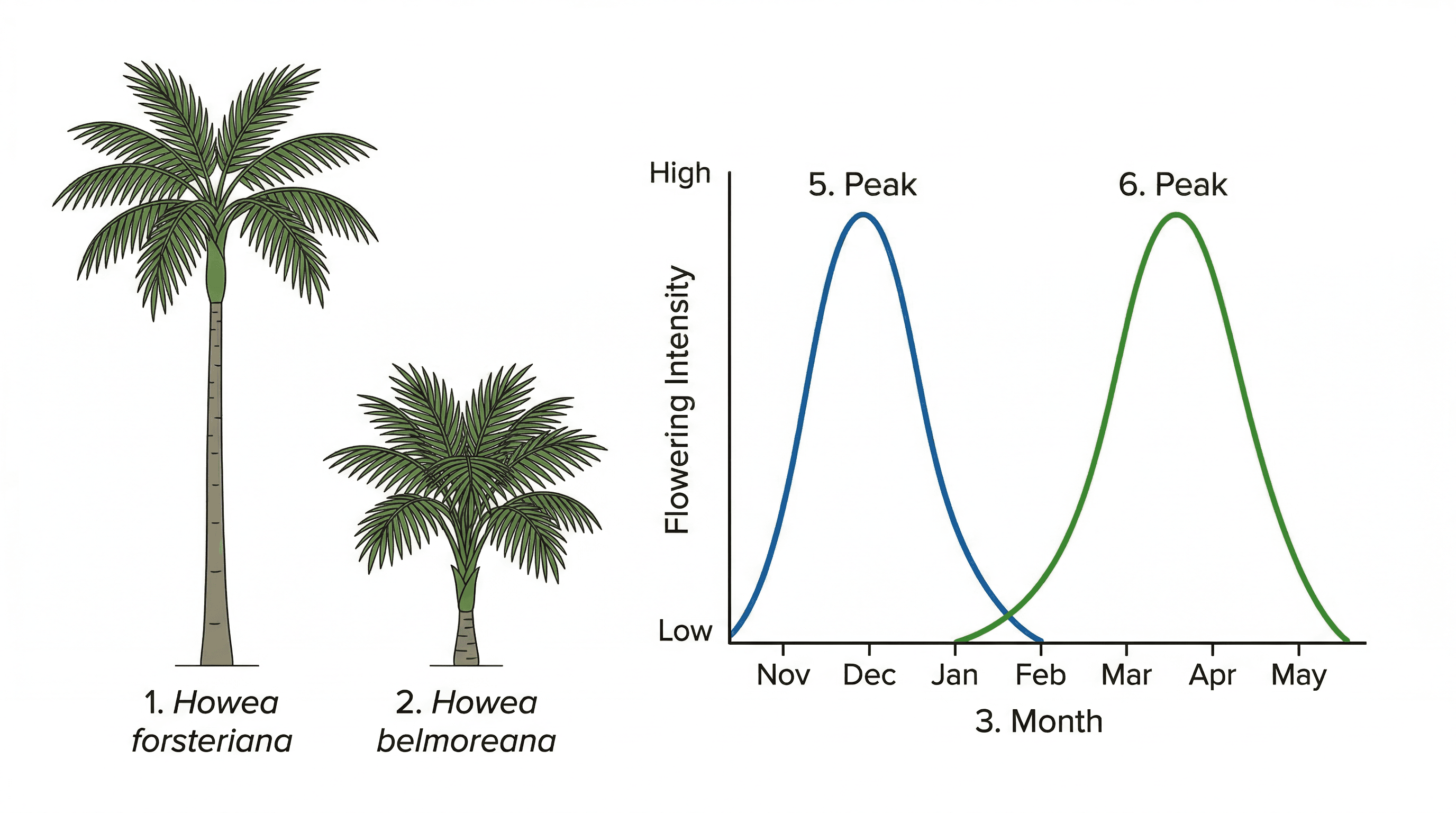
ecological separation — The separation of two populations because they live in different environments in the same area and so cannot breed together.
This is a mechanism for sympatric speciation, where populations within the same geographical region exploit different niches or habitats, reducing their chances of interbreeding and leading to genetic divergence.
behavioural separation — The separation of two populations because they have different behaviours which prevent them breeding together.
This is another mechanism for sympatric speciation, where differences in mating rituals, courtship displays, or activity times prevent interbreeding between populations, even if they are in the same area.
Students sometimes struggle to understand how sympatric speciation can occur without geographical isolation. Remember to consider ecological or behavioural separation as isolating mechanisms.
DNA sequencing provides a powerful tool for determining evolutionary relationships between species. By comparing the DNA base sequences of different organisms, scientists can identify similarities and differences. The more similar the DNA sequences, the more closely related the species are considered to be, indicating a more recent common ancestor. This molecular evidence complements morphological, physiological, and behavioural comparisons, offering a precise way to trace evolutionary lineages and construct phylogenetic trees.
In speciation questions, always state that 'reproductive isolation' is the key step that prevents gene flow between populations, leading to the evolution of separate species.
When comparing natural and artificial selection, clearly state the difference in the selection pressure (environment vs. humans) and the goal (survival vs. human benefit).
genetic variation
Differences between the DNA base sequences of individuals within a species.
phenotypic variation
Differences between the observable characteristics of individuals within a species.
discontinuous variation
Differences between individuals of a species in which each one belongs to one of a small number of distinct categories, with no intermediates.
continuous variation
Differences between individuals of a species in which each one can lie at any point in the range between the highest and lowest values.
polygenes
A number of different genes at different loci that all contribute to a particular aspect of phenotype.
environmental factor
A feature of the environment of an organism that affects its survival.
biotic factor
An environmental factor that is caused by living organisms (e.g. predation, competition).
competition
The need for a resource by two organisms, when that resource is in short supply.
abiotic factor
An environmental factor that is caused by non-living components (e.g. soil pH, light intensity).
fitness
The ability of an organism to survive and reproduce.
selection pressure
An environmental factor that affects the chance of survival of an organism; organisms with one phenotype are more likely to survive and reproduce than those with a different phenotype.
natural selection
The process by which individuals with a particular set of alleles are more likely to survive and reproduce than those with other alleles; over time and many generations, the advantageous alleles become more frequent in the population.
stabilising selection
Natural selection that tends to keep allele frequencies relatively constant over many generations.
directional selection
Natural selection that causes a gradual change in allele frequency over many generations.
disruptive selection
Natural selection that maintains relatively high frequencies of two different sets of alleles; individuals with intermediate features and allele sets are not selected for.
polymorphism
The continued existence of two or more different phenotypes in a species.
genetic drift
The gradual change in allele frequencies in a small population, where some alleles are lost or favoured just by chance and not by natural selection.
gene pool
The complete range of DNA base sequences in all the organisms in a species or population.
founder effect
The reduction in a gene pool compared with the main populations of a species, resulting from only two or three individuals (with only a selection of the alleles in the gene pool) starting off a new population.
evolutionary bottleneck
A period when the numbers of a species fall to a very low level, resulting in the loss of a large number of alleles and therefore a reduction in the gene pool of the species.
artificial selection
The selection by humans of organisms with desired traits to survive and reproduce; also known as selective breeding.
inbreeding depression
A loss of the ability to survive and grow well, due to breeding between close relatives; this increases the chance of harmful recessive alleles coming together in an individual and being expressed.
inbreeding
Breeding between organisms with similar genotypes, or that are closely related.
outbreeding
Breeding between individuals that are not closely related.
hybrid vigour
An increased ability to survive and grow well, as a result of outbreeding and therefore increased heterozygosity.
evolution
A process leading to the formation of new species from pre-existing species over time.
morphological
Relating to structural features.
physiological
Relating to metabolic and other processes in a living organism.
reproductive isolation
The inability of two groups of organisms to breed with one another; two populations of the same species may be geographically separated, or two different species are unable to breed to produce fertile offspring.
genetically isolated
No longer able to breed together; there is no exchange of genes.
speciation
The production of new species.
geographical isolation
Separation by a geographical barrier, such as a stretch of water or a mountain range.
allopatric speciation
The development of new species following geographical isolation.
sympatric speciation
The development of new species without any geographical separation.
ecological separation
The separation of two populations because they live in different environments in the same area and so cannot breed together.
behavioural separation
The separation of two populations because they have different behaviours which prevent them breeding together.
| Command word | What examiners expect |
|---|---|
| Explain | When explaining natural selection, ensure you include variation, selection pressure, differential survival/reproduction, and changes in allele frequency over generations. For speciation, clearly state how reproductive isolation prevents gene flow. |
| Describe | When describing continuous variation, mention both polygenic inheritance and environmental influence, and that it results in a range of phenotypes. For discontinuous variation, emphasize 'distinct categories' and 'no intermediates' and link to single gene control. |
| Discuss | When discussing artificial selection, include both its benefits (e.g., fixing desired traits) and drawbacks (e.g., inbreeding depression, reduced genetic diversity). For evolutionary relationships, mention DNA sequencing alongside morphological, physiological, and behavioural features. |
| Calculate | For Hardy-Weinberg calculations, show all steps clearly, starting from q² to find q, then p, and then p² and 2pq. Ensure the final sum of genotype frequencies equals 1. |
| Outline | When outlining the theory of evolution, refer to changes in gene pools and allele frequencies over time, leading to new species. |
Mistake
Confusing genetic variation with environmentally induced variation.
Correction
Only genetic variation is heritable and can be acted upon by natural selection. Environmentally-induced variation is not passed on to offspring.
Mistake
Thinking natural selection is a conscious process or that organisms 'try' to adapt.
Correction
Natural selection is a passive process where the environment selects pre-existing advantageous traits; organisms do not consciously adapt.
Mistake
Confusing genetic drift with natural selection.
Correction
Genetic drift is a random process due to chance, whereas natural selection is non-random, driven by environmental pressures.
Mistake
Equating biological 'fitness' solely with physical strength or survival.
Correction
Fitness refers specifically to an organism's reproductive success and its ability to pass alleles to the next generation.
Mistake
Believing inbreeding always produces weak offspring.
Correction
Inbreeding increases homozygosity, which can fix desirable traits in artificial selection, but it also raises the risk of expressing harmful recessive alleles (inbreeding depression).
Mistake
Struggling to understand how sympatric speciation can occur without geographical isolation.
Correction
Sympatric speciation can occur through ecological or behavioural separation, which act as isolating mechanisms even in the same geographical area.