
Biology · Inheritance
This chapter explores the fundamental principles of inheritance, detailing how genetic information is passed from parents to offspring through meiosis and sexual reproduction. It covers Mendelian genetics, including various inheritance patterns and the use of genetic diagrams and the chi-squared test, before examining the molecular basis of gene expression and its control in both prokaryotes and eukaryotes.
sexual reproduction — Reproduction involving the fusion of gametes (fertilisation) to produce a zygote.
This process combines genetic material from two parents, leading to offspring with unique combinations of alleles. It is a key source of genetic variation in populations, much like mixing two decks of cards to create a new, unique deck.
gamete — A sex cell; during sexual reproduction, two gametes fuse together to form a zygote; gametes are usually haploid.
Gametes carry half the genetic information of a somatic cell, ensuring that when two fuse during fertilisation, the resulting zygote has the correct diploid chromosome number. Examples include sperm and egg cells, acting like half-keys that combine to unlock full genetic potential.
Students often think gametes are diploid, but actually they are haploid, containing only one set of chromosomes.
Always specify that gametes are haploid (n) and contain one allele for each gene when discussing their role in inheritance.
fertilisation — The fusing of the nuclei of two gametes, to form a zygote.
This crucial event restores the diploid chromosome number and combines genetic material from both parents, initiating the development of a new individual. It is a random process, contributing to genetic variation, much like two puzzle pieces fitting together perfectly to complete a picture.
When defining fertilisation, explicitly mention the fusion of nuclei and the formation of a zygote to gain full marks.
zygote — A cell formed by the fusion of the nuclei of two gametes; most zygotes are diploid.
The zygote is the first diploid cell of a new organism, containing a complete set of chromosomes from both parents. It undergoes repeated mitotic divisions to develop into a multicellular organism, acting like the blueprint for a new building.
diploid — Containing two complete sets of chromosomes; can be signified by the symbol 2n.
Most somatic cells in sexually reproducing organisms are diploid, meaning they have two copies of each chromosome, one inherited from each parent. This provides a backup copy of genes and allows for greater genetic diversity, like having two identical instruction manuals.
haploid — Containing one complete set of chromosomes; can be signified by the symbol n.
Gametes are haploid cells, meaning they contain only one chromosome from each homologous pair. This ensures that upon fertilisation, the diploid number is restored in the zygote. If a diploid cell is a full deck of cards, a haploid cell is half a deck.
homologous chromosomes — Two chromosomes that carry the same genes in the same positions.
These pairs of chromosomes are similar in size and shape and carry alleles for the same traits at corresponding loci. One homologous chromosome is inherited from the mother and the other from the father, like a pair of matching shoes.
Students often confuse homologous chromosomes with sister chromatids; homologous chromosomes are a pair (one from each parent) carrying the same genes, while sister chromatids are identical copies of a single chromosome joined at the centromere.
Emphasise that homologous chromosomes carry the 'same genes in the same positions' but not necessarily the 'same alleles' when distinguishing them from sister chromatids.
meiosis — Nuclear division that results in the production of four daughter cells with half the chromosome number of the parent cell and with reshuffled alleles; in animals and plants it results in the formation of gametes.
Meiosis involves two rounds of division (Meiosis I and Meiosis II) and is essential for sexual reproduction, reducing the chromosome number by half and introducing genetic variation through crossing over and independent assortment. It's like a genetic lottery, shuffling and halving material.
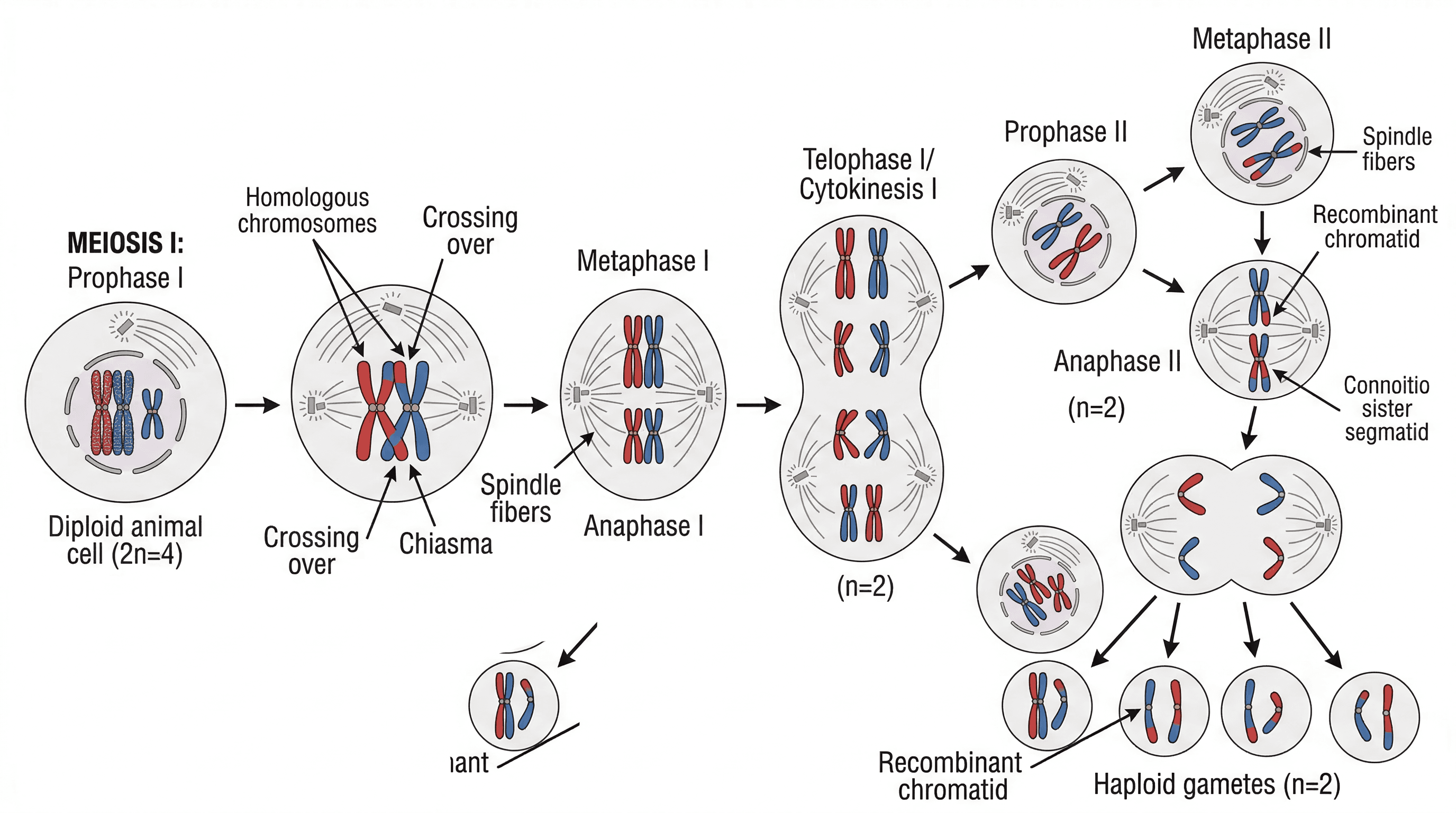
When describing meiosis, ensure you mention both the reduction in chromosome number and the generation of genetic variation, detailing the mechanisms (crossing over, independent assortment).
reduction division — Nuclear division that results in a reduction in chromosome number; the first division of meiosis is a reduction division.
Meiosis I is termed a reduction division because it separates homologous chromosomes, halving the chromosome number from diploid (2n) to haploid (n) in the daughter cells. This is crucial for maintaining a constant chromosome number across generations, like dividing a full set of tools into two half-sets.
Meiosis is fundamental to sexual reproduction, not only by producing haploid gametes but also by generating significant genetic variation among offspring. This variation is crucial for adaptation and evolution. Three primary mechanisms contribute to this genetic diversity: crossing over, independent assortment, and random fertilisation.
bivalent — Two homologous chromosomes lying alongside each other during meiosis I.
During prophase I of meiosis, homologous chromosomes pair up to form a bivalent, allowing for crossing over to occur between non-sister chromatids. This pairing is crucial for accurate segregation, like two dance partners holding hands.
chiasma (plural: chiasmata) — A position at which non-sister chromatids of homologous chromosomes cross over each other.
Chiasmata are visible manifestations of crossing over, where genetic material is exchanged between homologous chromosomes. They help hold homologous chromosomes together until anaphase I, like a knot tied between two ropes.
crossing over — The exchange of alleles between non-sister chromatids of homologous chromosomes during meiosis I.
This process shuffles alleles between homologous chromosomes, creating new combinations of alleles on the chromatids. It is a major source of genetic variation in gametes, like swapping pages between two identical books to create new versions.
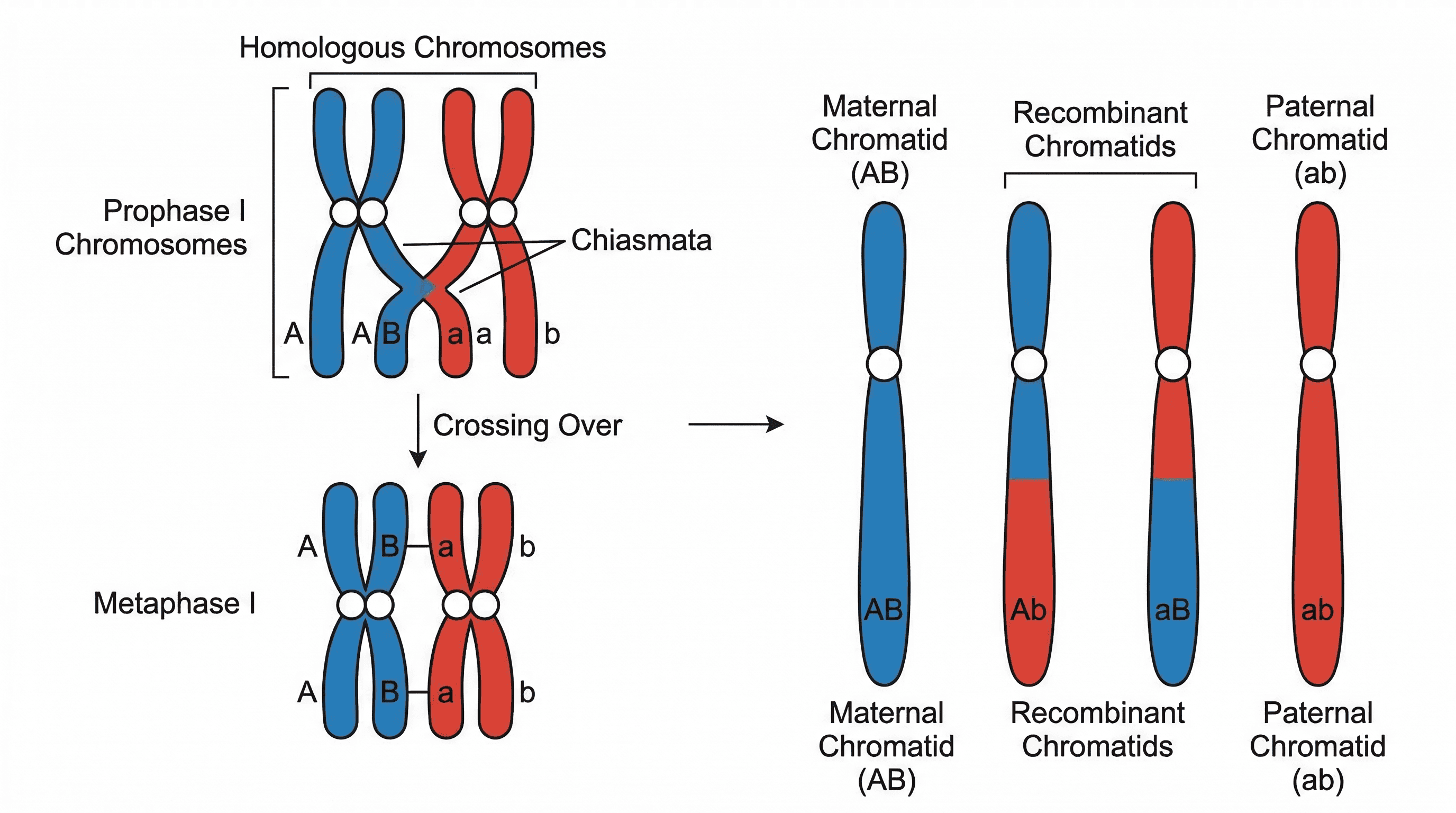
When explaining crossing over, specify 'non-sister chromatids' and 'homologous chromosomes' and link it to the production of 'genetic variation'.
independent assortment — The production of different combinations of alleles in daughter cells, as a result of the random alignment of bivalents on the equator of the spindle during metaphase I of meiosis.
The orientation of each homologous pair (bivalent) at the metaphase I plate is random and independent of other pairs. This leads to a vast number of possible combinations of chromosomes in the resulting gametes, contributing significantly to genetic variation, like randomly lining up different colored pairs of socks.
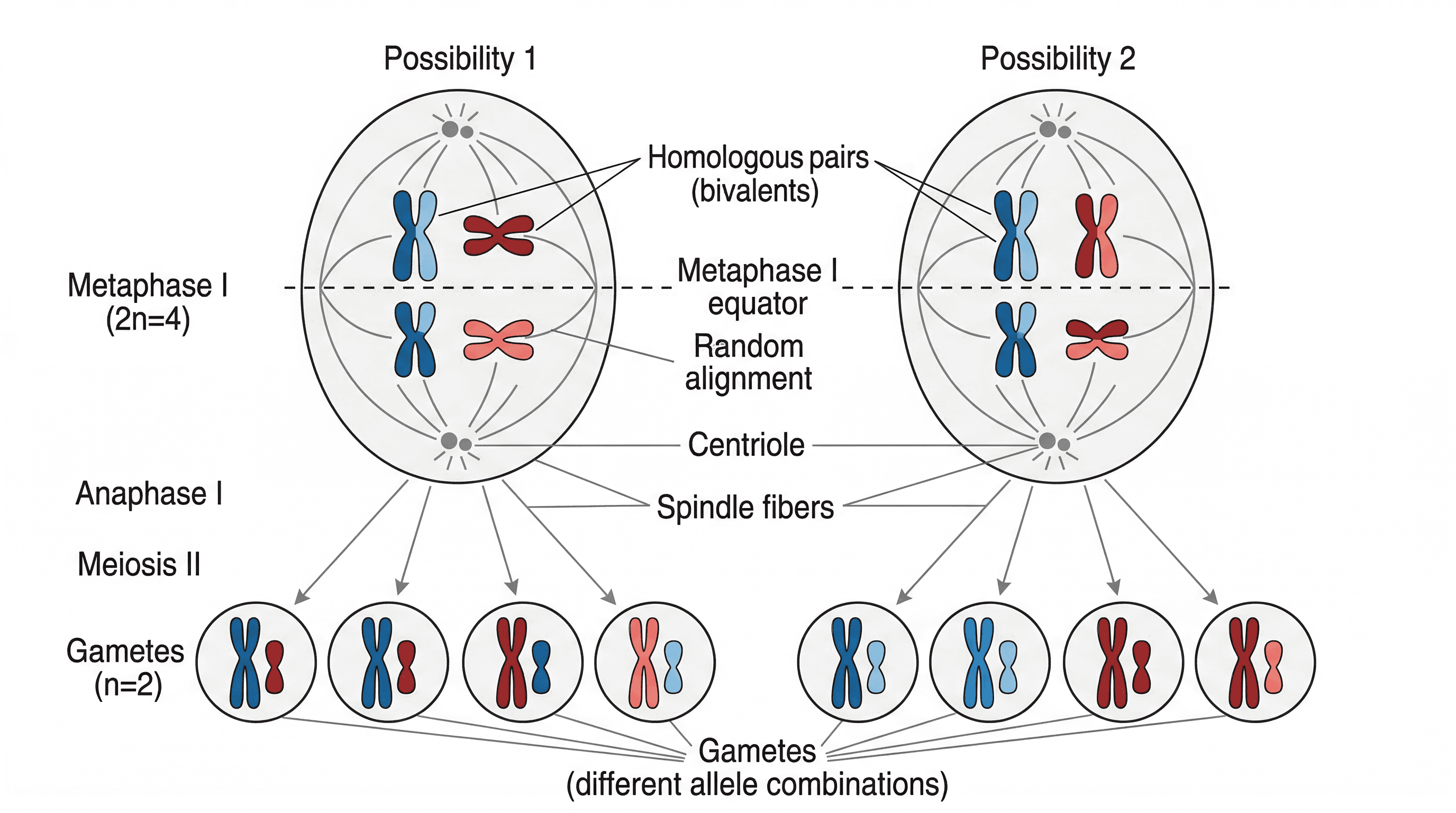
Students often confuse independent assortment with crossing over, but actually independent assortment refers to the random segregation of entire homologous chromosomes, while crossing over involves exchange of segments within chromosomes.
Link independent assortment directly to the 'random alignment of bivalents' in 'metaphase I' and its role in creating 'different combinations of alleles' in gametes.
Beyond meiosis, the random nature of fertilisation further enhances genetic variation. Any one of the genetically unique sperm cells can fertilise any one of the genetically unique egg cells. This random fusion of gametes ensures that each zygote formed is a unique combination of alleles from both parents, contributing to the diversity observed within a population.
locus (plural: loci) — The position of a gene on a chromosome.
Each gene occupies a specific locus on a particular chromosome. Homologous chromosomes have genes for the same traits at corresponding loci, though the alleles may differ, much like a specific address on a street.
allele — A variety of a gene.
Alleles are different forms of the same gene, arising from mutations, and they code for slightly different versions of a protein, leading to variations in a trait. For example, a gene for eye colour can have alleles for red or brown eyes, like different versions of a cake recipe.
genotype — The alleles possessed by an organism.
The genotype represents the genetic makeup of an individual for a particular trait, expressed using symbols (e.g., BB, Bb, bb). It determines the potential range of phenotypes, similar to the instruction code in a computer program.
phenotype — The observable features of an organism; it is affected by genes and also by environment.
The phenotype is the physical expression of an organism's genotype, influenced by both genetic factors and environmental conditions. Examples include coat colour, height, or blood group, much like the actual house built from a blueprint.
Students often confuse genotype with phenotype, but actually genotype is the genetic code, while phenotype is the observable characteristic.
When defining phenotype, always include that it is 'observable' and influenced by 'genes and environment' for a complete answer.
homozygous — Having two identical alleles of a gene.
An individual is homozygous for a gene if they have two copies of the same allele (e.g., BB or bb). This means they will express the trait associated with that allele, whether dominant or recessive, like having two scoops of the same ice cream flavor.
heterozygous — Having two different alleles of a gene.
An individual is heterozygous for a gene if they have two different alleles (e.g., Bb). In cases of complete dominance, the dominant allele's phenotype will be expressed, while the recessive allele is carried but not expressed, like having two scoops of different ice cream flavors.
dominant — A dominant allele has the same effect on phenotype, whether or not another allele is present.
A dominant allele expresses its trait even when only one copy is present in a heterozygous individual. It masks the effect of a recessive allele, like a loud voice in a conversation that is always heard.
Students often think that dominant alleles are always more common in a population, but dominance refers to the expression pattern of an allele, not its frequency.
recessive — A recessive allele only affects phenotype if no dominant allele is present.
A recessive allele only expresses its trait when two copies are present (homozygous recessive genotype). Its effect is masked by a dominant allele in a heterozygous individual, like a quiet voice that can only be heard if no loud voice is speaking.
multiple alleles — The existence of three or more alleles of a gene, as, for example, in the determination of A,B,O blood groups.
While an individual can only have two alleles for a given gene, a population can have multiple alleles for that gene. This increases the genetic diversity within the population, like having more than three different symbols that can appear in a slot machine.
When discussing multiple alleles, use the human ABO blood group system as a standard example, clearly showing the three alleles (IA, IB, IO).
codominant — Codominant alleles each affect phenotype when both of them are present.
In codominance, both alleles are fully expressed in the heterozygous individual, resulting in a phenotype that shows characteristics of both alleles, not an intermediate blend. The ABO blood group system (AB blood type) is a classic example, like two different colored paints both distinctly visible when mixed.
Students often confuse codominance with incomplete dominance; in codominance, both alleles are distinctly expressed, while in incomplete dominance, there is an intermediate phenotype.
When representing codominant alleles, use a capital letter for the gene and superscripts for the alleles (e.g., IA, IB) to clearly distinguish them from dominant/recessive alleles.
monohybrid inheritance — Inheritance of one gene.
Monohybrid crosses involve tracking the inheritance pattern of a single gene with two alleles. These crosses typically result in predictable phenotypic ratios (e.g., 3:1 in F2 generation for dominant/recessive traits), like focusing on just one specific feature of a car.
genetic diagram — A standard format in which the results of a genetic cross are predicted and explained.
Genetic diagrams, often incorporating Punnett squares, systematically illustrate the genotypes and phenotypes of parents, their gametes, and their potential offspring, along with expected ratios. They are essential tools for solving genetics problems, like a family tree that predicts traits.
Always include all headings (parental phenotypes, genotypes, gametes, offspring genotypes, phenotypes, and ratios) in a genetic diagram for full marks.
Punnett square — Part of a genetic diagram in which the genotypes of the offspring are worked out from the genotypes of the gametes.
The Punnett square is a grid used to combine the possible gametes from each parent to predict the genotypes and their frequencies in the offspring. It visually represents the random fusion of gametes, like a multiplication table for genetics.
Students often think a Punnett square is the entire genetic diagram, but actually it is only a component used to determine offspring genotypes.
F1 generation — The offspring resulting from the cross between individuals with a homozygous recessive and a homozygous dominant genotype.
The F1 generation (first filial generation) typically consists of all heterozygous individuals when the parental cross involves two pure-breeding (homozygous) parents with contrasting traits. These individuals are then often interbred to produce the F2 generation, like the puppies from a purebred black and white dog cross.
F2 generation — The offspring resulting from a cross between two F1 individuals.
The F2 generation (second filial generation) is produced by interbreeding individuals from the F1 generation. This generation typically exhibits the classic Mendelian ratios (e.g., 3:1 for monohybrid, 9:3:3:1 for dihybrid) due to the segregation and independent assortment of alleles, like the puppies produced when two F1 puppies breed.
test cross — A genetic cross in which an organism showing the dominant characteristic is crossed with a homozygous recessive organism; the phenotypes of the offspring can indicate whether the original organism is homozygous or heterozygous.
A test cross is used to determine the unknown genotype of an individual expressing a dominant phenotype. If any recessive offspring are produced, the unknown parent must be heterozygous; if all offspring show the dominant phenotype, the unknown parent is likely homozygous dominant, like a detective trying to figure out a secret ingredient.
sex chromosomes — The chromosomes that determine sex; in humans, these are the X and Y chromosomes.
Sex chromosomes carry genes that determine an individual's biological sex and also contain other genes unrelated to sex determination (sex-linked genes). In humans, XX results in female, and XY results in male, like the 'gender' setting on a device.
sex-linked gene — A gene found on a region of a sex chromosome that is not present on the other sex chromosome; in humans, most sex-linked genes are found on the X chromosome.
Sex-linked genes exhibit unique inheritance patterns because males only have one X chromosome, meaning they express any allele on their X chromosome, whether dominant or recessive. Females, with two X chromosomes, can be carriers for recessive sex-linked traits.
For sex-linked traits, always use X and Y notation with the allele as a superscript (e.g., X^H, X^h). Remember males only have one X chromosome.
carrier — An individual that possesses a particular allele as a single copy whose effect is masked by a dominant allele, so that the associated characteristic (such as a hereditary disease) is not displayed but may be passed to offspring.
Carriers are typically heterozygous for a recessive trait or disease. They do not express the phenotype themselves but can pass the recessive allele to their offspring, potentially leading to affected individuals in future generations.
dihybrid inheritance — The inheritance of two genes.
Dihybrid crosses involve tracking the inheritance patterns of two different genes simultaneously. When these genes are on different chromosomes, they assort independently, leading to characteristic phenotypic ratios like 9:3:3:1 in the F2 generation.
epistasis — The interaction of two genes at different loci; one gene may affect the expression of the other.
Epistasis occurs when the allele of one gene masks or modifies the phenotypic expression of alleles at a different gene locus. This interaction can lead to modified dihybrid ratios that deviate from the expected 9:3:3:1, as the genes do not act independently in determining the final phenotype.
autosomal linkage — The presence of two genes on the same autosome, (any chromosome other than a sex chromosome) so that they tend to be inherited together and do not assort independently.
When genes are located on the same chromosome, they are said to be linked. These genes tend to be inherited together because the chromosome is passed as a unit during meiosis. This means they do not assort independently, leading to different phenotypic ratios than expected for unlinked genes.
Students often assume independent assortment for all dihybrid crosses, but genes located on the same chromosome (linked genes) do not assort independently unless crossing over occurs.
While linked genes tend to be inherited together, crossing over can separate them. If crossing over occurs between two linked genes on homologous chromosomes, it can lead to the formation of recombinant gametes. The frequency of these recombinant gametes is proportional to the distance between the linked genes on the chromosome.
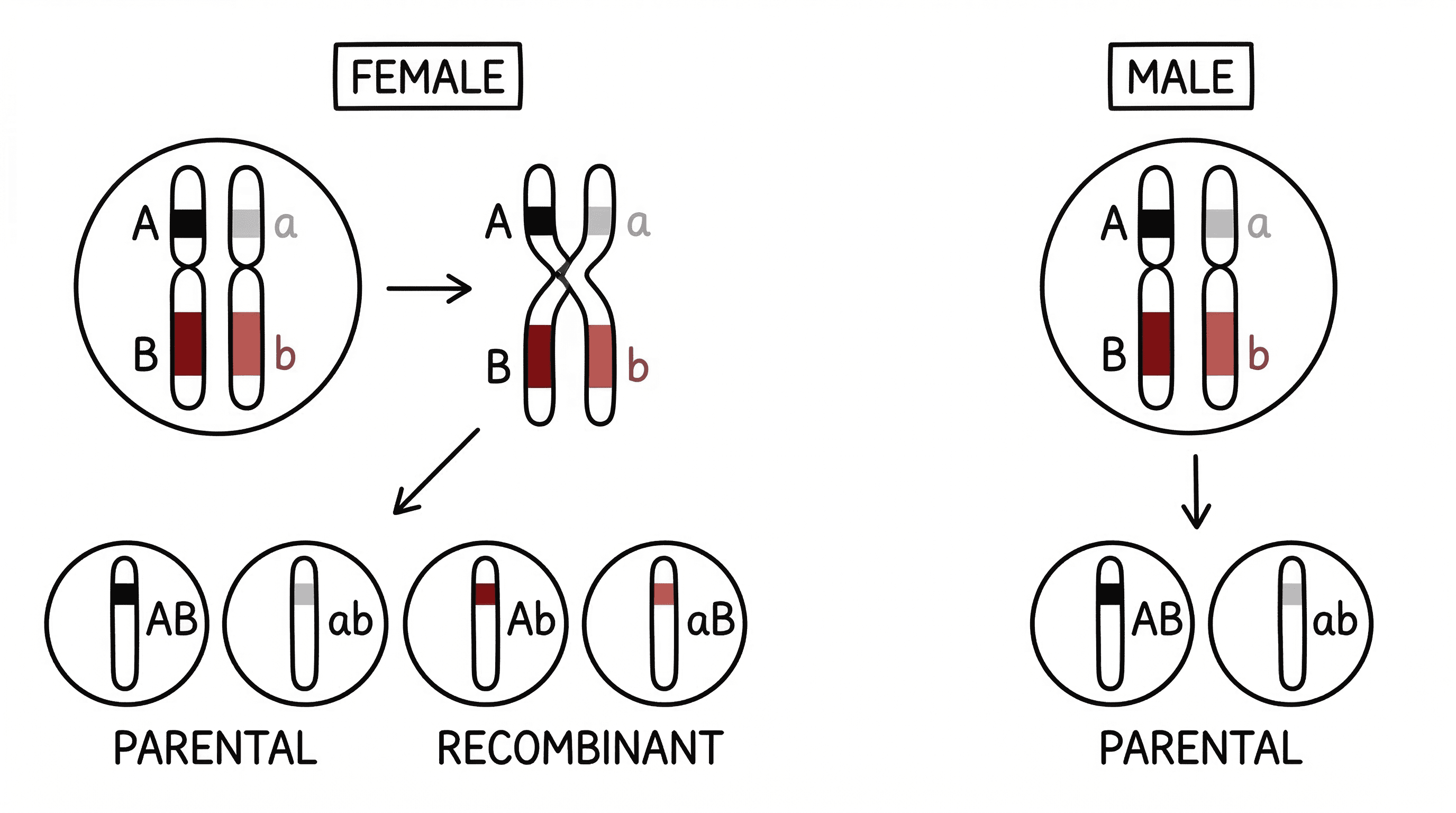
parental type — Offspring that show the same combinations of characteristics as their parents.
Parental types are offspring whose phenotypes match one of the parental phenotypes. In linkage studies, a higher proportion of parental types compared to recombinant types indicates that the genes are linked and crossing over is less frequent.
recombinant — Offspring that show different combinations of characteristics from their parents.
Recombinant offspring display new combinations of traits not seen in either parent. These arise from genetic recombination events, such as crossing over between linked genes or independent assortment of unlinked genes.
chi-squared (χ2) test — A statistical test that is used to determine whether differences between observed and expected results are significant.
The chi-squared test helps evaluate if observed phenotypic ratios in genetic crosses significantly deviate from expected Mendelian ratios, or if the differences are merely due to chance. It is a crucial tool for validating genetic hypotheses.
Chi-squared test
Used to determine if differences between observed and expected results are statistically significant. Compare calculated χ² value to critical value from a table based on degrees of freedom (number of classes - 1) and a chosen probability (e.g., 0.05).
When using the chi-squared test, always state your null hypothesis, show your calculation of the χ² value, determine degrees of freedom (n-1), and compare your value to the critical value to make a conclusion.
The relationship between genes, proteins, and phenotype is fundamental to understanding inheritance. Genes contain the instructions for making proteins, and these proteins then carry out various functions within the cell, ultimately determining an organism's observable characteristics. Mutations in genes can alter protein structure or function, leading to changes in phenotype, often resulting in genetic conditions.
Several human genetic conditions illustrate the gene-protein-phenotype link. The TYR gene codes for tyrosinase, an enzyme crucial for melanin production; mutations lead to albinism. The HBB gene codes for a subunit of haemoglobin; mutations cause sickle cell anaemia. The F8 gene codes for factor VIII, a clotting protein; mutations result in haemophilia. The HTT gene codes for huntingtin protein; mutations cause Huntington’s disease. In plants, the Le gene controls gibberellin production, influencing stem elongation.
Gene expression in prokaryotes is often controlled by operons, which are clusters of genes regulated by a single promoter. The lac operon in bacteria, for example, controls the production of enzymes needed for lactose metabolism. It is an inducible system, meaning the enzymes are only synthesised when lactose is present, ensuring efficient resource use.
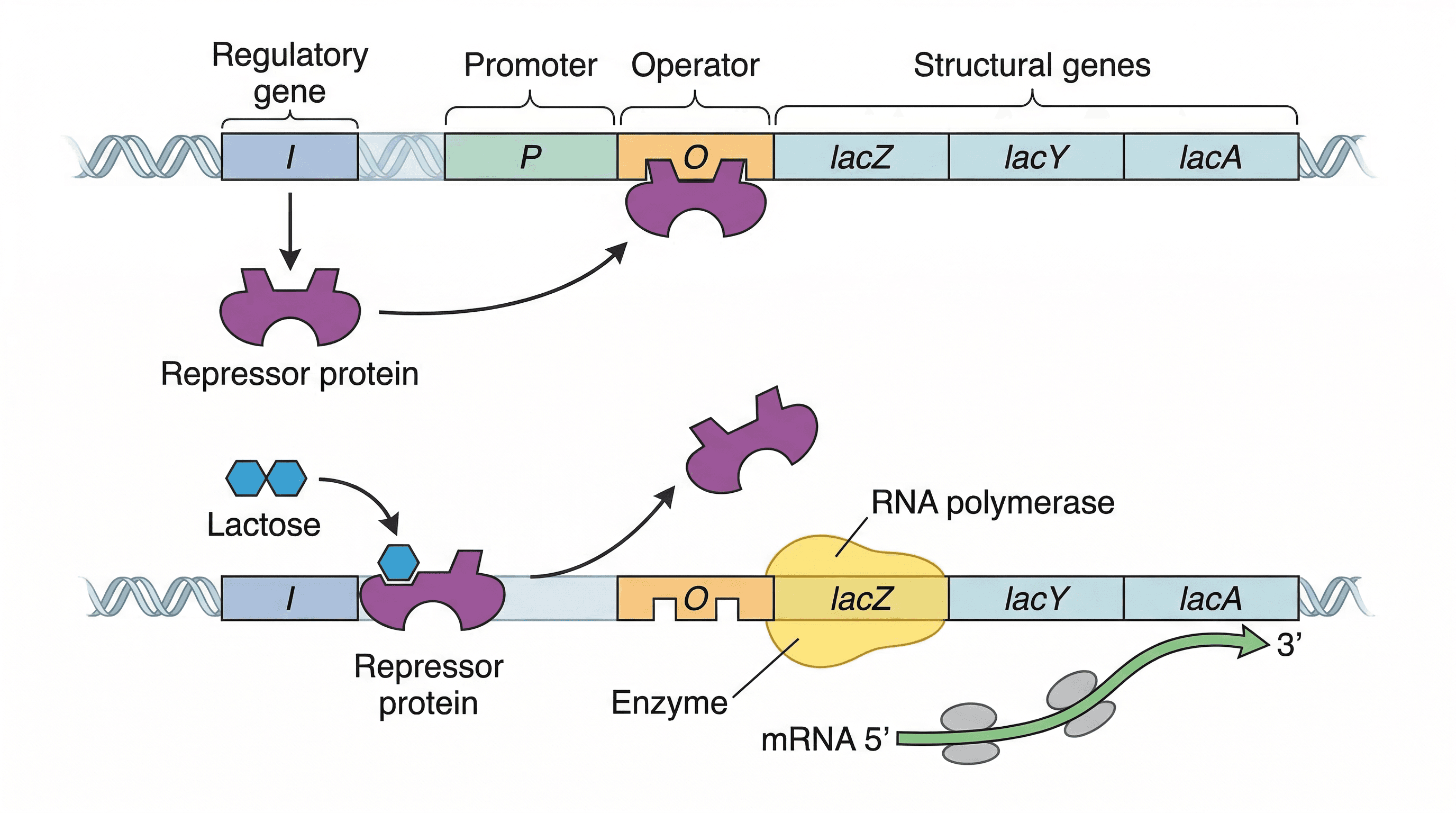
operon — A functional unit of transcription; a cluster of genes that are controlled by the same promoter.
Operons allow prokaryotes to efficiently regulate the expression of genes involved in a common metabolic pathway. All genes within an operon are transcribed together as a single mRNA molecule, ensuring coordinated protein production.
lac operon — An operon (see above) found in some bacteria that controls the production of β-galactosidase and two other structural proteins.
The lac operon is a classic example of an inducible operon. It contains structural genes for enzymes like β-galactosidase, which breaks down lactose, and is regulated by a repressor protein that binds to the operator in the absence of lactose.
β-galactosidase — An enzyme that catalyses the hydrolysis of lactose to glucose and galactose.
This enzyme is crucial for bacteria to utilise lactose as an energy source. Its production is regulated by the lac operon, ensuring it is only synthesised when lactose is available in the environment.
structural gene — A gene that codes for a protein that has a function within a cell.
Structural genes are the core components of operons, coding for the enzymes or proteins directly involved in a metabolic pathway or cellular process. Their expression is controlled by regulatory elements.
regulatory gene — A gene that codes for a protein that helps to control the expression of other genes.
Regulatory genes produce proteins, such as repressors or activators, that bind to specific DNA sequences to either inhibit or promote the transcription of structural genes. They are key to controlling gene expression.
inducible enzyme — An enzyme that is synthesised only when its substrate is present.
Inducible enzymes are part of metabolic pathways that are only required under specific environmental conditions. Their synthesis is 'induced' by the presence of their substrate, preventing wasteful production when not needed, as seen with β-galactosidase and lactose.
repressible enzyme — An enzyme that is normally produced, and whose synthesis is prevented by the presence of an effector.
Repressible enzymes are typically involved in anabolic pathways, where their product is continuously needed. Their synthesis is 'repressed' when the end-product accumulates, preventing overproduction and conserving energy.
Students often think operons are found in eukaryotes, but they are characteristic of prokaryotic gene regulation.
In eukaryotes, gene expression is controlled at multiple levels, with transcription factors playing a crucial role. These proteins bind to specific DNA sequences (promoters or enhancers) to either promote or inhibit the transcription of genes. This complex regulation allows for precise control over which genes are expressed, when, and in which cells.
transcription factor — A molecule that affects whether or not a gene is transcribed.
Transcription factors are proteins that regulate gene expression by binding to DNA and either facilitating or blocking the binding of RNA polymerase, thereby controlling the rate of transcription. They are essential for cell differentiation and development.
An example of eukaryotic gene control involves gibberellin hormones and DELLA proteins in plants. Gibberellins promote stem elongation by causing the degradation of DELLA proteins, which are repressors of growth. When gibberellin is present, DELLA proteins are removed, allowing genes for stem elongation to be expressed. The alleles Le and le control gibberellin production, thus influencing stem height.
When explaining genetic variation, always refer to the three key sources: crossing over, independent assortment, and random fertilisation.
Structure genetic diagrams precisely: 1. Parental Phenotype, 2. Parental Genotype, 3. Gametes, 4. Punnett Square, 5. Offspring Genotype(s), 6. Offspring Phenotype(s) & Ratio.
Recognise key phenotypic ratios: 3:1 (monohybrid), 9:3:3:1 (unlinked dihybrid), 1:2:1 (codominance). Deviations from 9:3:3:1 often indicate linkage or epistasis.
sexual reproduction
Reproduction involving the fusion of gametes (fertilisation) to produce a zygote.
gamete
A sex cell; during sexual reproduction, two gametes fuse together to form a zygote; gametes are usually haploid.
fertilisation
The fusing of the nuclei of two gametes, to form a zygote.
zygote
A cell formed by the fusion of the nuclei of two gametes; most zygotes are diploid.
diploid
Containing two complete sets of chromosomes; can be signified by the symbol 2n.
homologous chromosomes
Two chromosomes that carry the same genes in the same positions.
haploid
Containing one complete set of chromosomes; can be signified by the symbol n.
meiosis
Nuclear division that results in the production of four daughter cells with half the chromosome number of the parent cell and with reshuffled alleles; in animals and plants it results in the formation of gametes.
bivalent
Two homologous chromosomes lying alongside each other during meiosis I.
chiasma (plural: chiasmata)
A position at which non-sister chromatids of homologous chromosomes cross over each other.
crossing over
The exchange of alleles between non-sister chromatids of homologous chromosomes during meiosis I.
reduction division
Nuclear division that results in a reduction in chromosome number; the first division of meiosis is a reduction division.
locus (plural: loci)
The position of a gene on a chromosome.
allele
A variety of a gene.
independent assortment
The production of different combinations of alleles in daughter cells, as a result of the random alignment of bivalents on the equator of the spindle during metaphase I of meiosis.
genotype
The alleles possessed by an organism.
homozygous
Having two identical alleles of a gene.
heterozygous
Having two different alleles of a gene.
phenotype
The observable features of an organism; it is affected by genes and also by environment.
dominant
A dominant allele has the same effect on phenotype, whether or not another allele is present.
recessive
A recessive allele only affects phenotype if no dominant allele is present.
multiple alleles
The existence of three or more alleles of a gene, as, for example, in the determination of A,B,O blood groups.
codominant
Codominant alleles each affect phenotype when both of them are present.
monohybrid inheritance
Inheritance of one gene.
genetic diagram
A standard format in which the results of a genetic cross are predicted and explained.
Punnett square
Part of a genetic diagram in which the genotypes of the offspring are worked out from the genotypes of the gametes.
F1 generation
The offspring resulting from the cross between individuals with a homozygous recessive and a homozygous dominant genotype.
F2 generation
The offspring resulting from a cross between two F1 individuals.
test cross
A genetic cross in which an organism showing the dominant characteristic is crossed with a homozygous recessive organism; the phenotypes of the offspring can indicate whether the original organism is homozygous or heterozygous.
sex chromosomes
The chromosomes that determine sex; in humans, these are the X and Y chromosomes.
sex-linked gene
A gene found on a region of a sex chromosome that is not present on the other sex chromosome; in humans, most sex-linked genes are found on the X chromosome.
carrier
An individual that possesses a particular allele as a single copy whose effect is masked by a dominant allele, so that the associated characteristic (such as a hereditary disease) is not displayed but may be passed to offspring.
dihybrid inheritance
The inheritance of two genes.
epistasis
The interaction of two genes at different loci; one gene may affect the expression of the other.
autosomal linkage
The presence of two genes on the same autosome, (any chromosome other than a sex chromosome) so that they tend to be inherited together and do not assort independently.
parental type
Offspring that show the same combinations of characteristics as their parents.
recombinant
Offspring that show different combinations of characteristics from their parents.
chi-squared (χ2) test
A statistical test that is used to determine whether differences between observed and expected results are significant.
β-galactosidase
An enzyme that catalyses the hydrolysis of lactose to glucose and galactose.
structural gene
A gene that codes for a protein that has a function within a cell.
regulatory gene
A gene that codes for a protein that helps to control the expression of other genes.
operon
A functional unit of transcription; a cluster of genes that are controlled by the same promoter.
lac operon
An operon (see above) found in some bacteria that controls the production of β-galactosidase and two other structural proteins.
inducible enzyme
An enzyme that is synthesised only when its substrate is present.
repressible enzyme
An enzyme that is normally produced, and whose synthesis is prevented by the presence of an effector.
transcription factor
A molecule that affects whether or not a gene is transcribed.
| Command word | What examiners expect |
|---|---|
| Describe | For meiosis, describe the key events in Meiosis I (homologous chromosome pairing, crossing over, reduction division) and Meiosis II (sister chromatid separation). For sexual reproduction, mention gamete fusion and zygote formation. |
| Explain | For genetic variation, explain *how* crossing over, independent assortment, and random fertilisation lead to new allele combinations. For gene-phenotype relationships, explain the role of the gene in coding for a protein and how this protein affects the observable characteristic. For gene control, explain the mechanism (e.g., lac operon components and their interactions, transcription factor binding). |
| Construct | For genetic diagrams, ensure all headings (parental phenotypes, genotypes, gametes, offspring genotypes, phenotypes, and ratios) are present and correct. Use appropriate notation for alleles (capital/lowercase, superscripts for codominance/sex-linkage). |
| Interpret | For genetic diagrams, correctly identify offspring genotypes and phenotypes and state their ratios. For chi-squared test results, interpret the calculated value against the critical value to determine statistical significance and draw a conclusion about the null hypothesis. |
| Use | For the chi-squared test, show the formula, all calculations, degrees of freedom, and a clear comparison to the critical value. For the lac operon, use it as a model to explain how gene expression is controlled in prokaryotes, detailing the roles of the repressor, operator, and inducer. |
Mistake
Confusing homologous chromosomes with sister chromatids.
Correction
Homologous chromosomes are a pair (one from each parent) carrying the same genes, while sister chromatids are identical copies of a single chromosome joined at the centromere.
Mistake
Thinking that dominant alleles are always more common in a population.
Correction
Dominance refers to the expression pattern of an allele (it masks a recessive allele), not its frequency in a population.
Mistake
Mistaking codominance for incomplete dominance.
Correction
In codominance, both alleles are distinctly expressed (e.g., AB blood type), while in incomplete dominance, there is a blended, intermediate phenotype.
Mistake
Assuming independent assortment for all dihybrid crosses.
Correction
Genes located on the same chromosome (linked genes) do not assort independently unless crossing over occurs between them.
Mistake
Thinking a Punnett square is the entire genetic diagram.
Correction
A Punnett square is only a component used to determine offspring genotypes; a full genetic diagram also includes parental genotypes, gametes, and offspring phenotypes/ratios.
Mistake
Thinking operons are found in eukaryotes.
Correction
Operons are characteristic of prokaryotic gene regulation and are not found in eukaryotes.
Mistake
Students often think sexual reproduction always involves two distinct sexes.
Correction
Some organisms (like many plants) can be hermaphroditic, producing both male and female gametes.
Mistake
Students often think fertilisation is just the meeting of gametes.
Correction
Fertilisation specifically refers to the fusion of the nuclei of two gametes.
Mistake
Students often think the zygote is haploid.
Correction
The zygote is diploid, having received one haploid set of chromosomes from each gamete.
Mistake
Students often think diploid cells have twice as many genes as haploid cells.
Correction
Diploid cells have two alleles for each gene, not necessarily twice the number of unique genes.
Mistake
Students often think homologous chromosomes are identical.
Correction
Homologous chromosomes carry the same genes but may have different alleles for those genes.
Mistake
Students often think haploid cells are always gametes.
Correction
Some organisms (like male bees) are entirely haploid.
Mistake
Students often think meiosis is just two rounds of mitosis.
Correction
Meiosis involves homologous chromosome pairing and separation in Meiosis I, which is fundamentally different from mitosis.
Mistake
Students often think a bivalent consists of two chromatids.
Correction
A bivalent consists of two homologous chromosomes, each already duplicated into two sister chromatids, making a total of four chromatids.
Mistake
Students often think chiasmata are the actual crossing over event.
Correction
Chiasmata are the physical points where crossing over has occurred and are visible under a microscope.
Mistake
Students often think crossing over occurs between sister chromatids.
Correction
Crossing over occurs between non-sister chromatids of homologous chromosomes.
Mistake
Students often think both divisions of meiosis are reduction divisions.
Correction
Only Meiosis I reduces the chromosome number; Meiosis II separates sister chromatids, similar to mitosis.
Mistake
Students often think a locus refers to the gene itself.
Correction
A locus refers to the specific physical location of the gene on the chromosome.
Mistake
Students often think alleles are different genes.
Correction
Alleles are different versions or variants of the *same* gene.
Mistake
Students often think heterozygous individuals always show an intermediate phenotype.
Correction
This only happens with incomplete dominance or codominance; with complete dominance, the dominant phenotype is expressed.
Mistake
Students often think multiple alleles means an individual has more than two alleles.
Correction
Multiple alleles means there are more than two possible alleles *in the population* for that gene.
Mistake
Students often forget to label the gametes correctly along the top and side of the Punnett square.
Correction
Always label the gametes clearly to avoid errors in offspring genotypes.
Mistake
Students often think the F1 generation can have mixed phenotypes if the parents are homozygous.
Correction
If one parent is homozygous dominant and the other homozygous recessive, all F1 offspring will show the dominant phenotype.
Mistake
Students often expect exact ratios in the F2 generation from small sample sizes.
Correction
These ratios represent probabilities and are more accurate with large numbers of offspring.
Mistake
Students often think a test cross always gives a definitive answer.
Correction
If all offspring are dominant, it only indicates a high probability of homozygosity, especially with small sample sizes.
Mistake
Students often think the Y chromosome carries no genes.
Correction
The Y chromosome carries a few genes, most notably the SRY gene for male development.