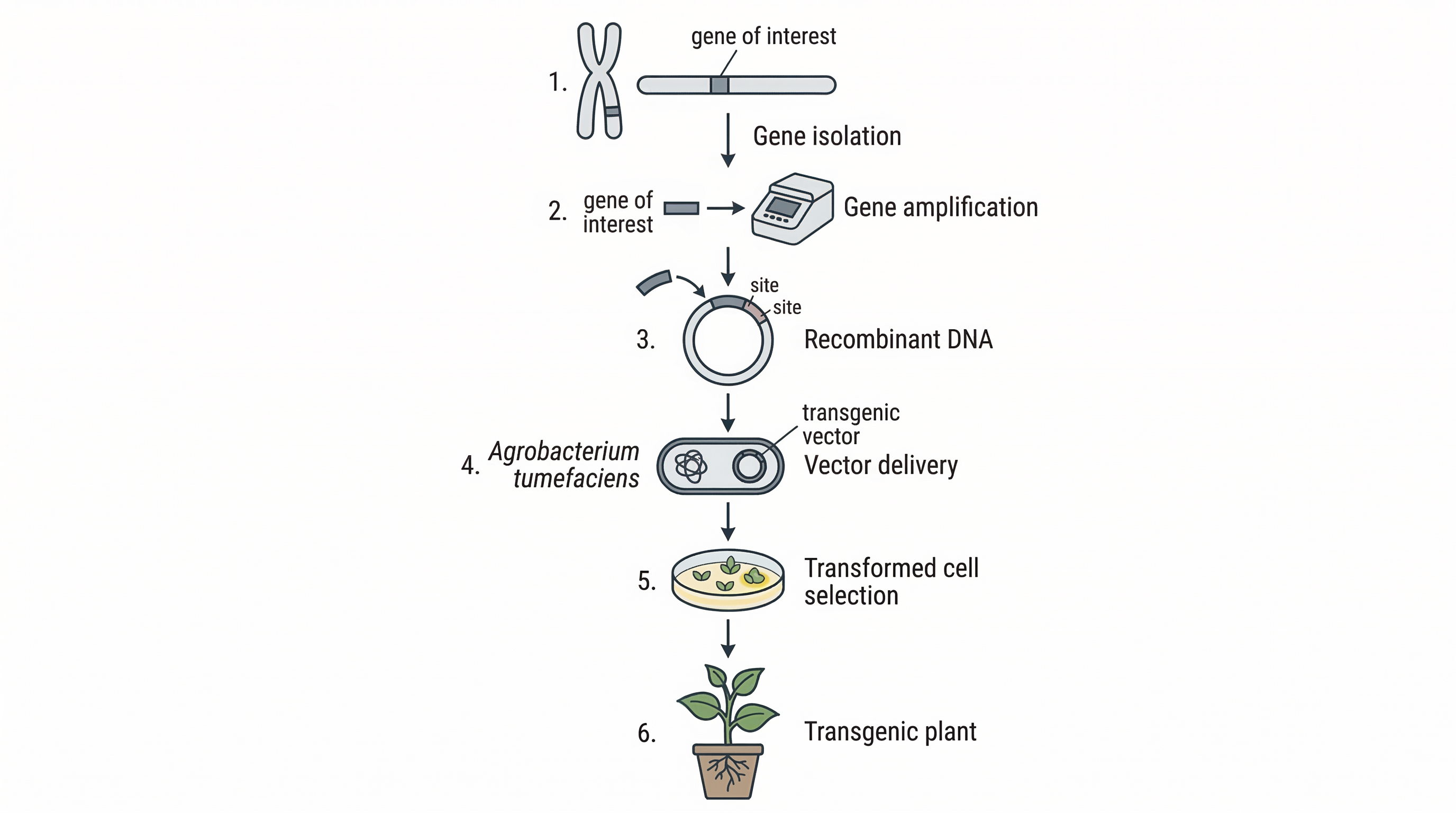
A flow diagram illustrating the essential steps for producing a genetically modified organism (GMO), including gene identification, amplification, insertion into a , delivery to cells, and cloning of transformed cells. Arrows indicate the sequence of steps.
involves altering an organism's DNA to change its characteristics.
It allows for the transfer of genes between different species.
The process typically involves identifying a desired gene, isolating it, inserting it into a , and introducing it into a host organism.
Examiner Tip
When asked to 'explain' genetic engineering, ensure you mention both altering existing base sequences and introducing genes from other organisms, and the resulting GMO.
The first successful genetic engineering experiment was performed in 1973 by Herbert Boyer and Stanley Cohen, who inserted a gene from one bacterium into another.
A flow diagram illustrating the essential steps for producing a genetically modified organism (GMO), including gene identification, amplification, insertion into a , delivery to cells, and cloning of transformed cells. Arrows indicate the sequence of steps.
involves altering an organism's DNA to change its characteristics.
It allows for the transfer of genes between different species.
The process typically involves identifying a desired gene, isolating it, inserting it into a , and introducing it into a host organism.
Examiner Tip
When asked to 'explain' genetic engineering, ensure you mention both altering existing base sequences and introducing genes from other organisms, and the resulting GMO.
The first successful genetic engineering experiment was performed in 1973 by Herbert Boyer and Stanley Cohen, who inserted a gene from one bacterium into another.