
Biology · Infectious disease
This chapter explores infectious diseases, which are caused by pathogens transmitted between individuals. It details specific diseases like cholera, malaria, HIV/AIDS, and tuberculosis, covering their pathogens, transmission, and control measures, while also examining the action of antibiotics and the critical issue of antibiotic resistance.
infectious disease — A disease caused by an organism such as a protoctist, bacterium or virus.
These diseases, also known as communicable diseases, can spread from an infected person to an uninfected person, or from animals to humans. They are distinct from non-infectious diseases, which are not caused by pathogens. Like a computer virus spreading from one computer to another, an infectious disease spreads from one host to another.
Students often think 'disease' always implies something very serious, but actually many mild conditions like the common cold are also infectious diseases.
pathogen — An organism that causes disease.
Pathogens can be viruses, bacteria, protoctists, or fungi. They invade a host organism and disrupt its normal physiological functions, leading to illness. Understanding the specific pathogen is crucial for effective treatment and control. Think of a pathogen as a saboteur that infiltrates a system (the body) and causes it to malfunction.
Students often think all microorganisms are pathogens, but actually most microorganisms are harmless or beneficial; only those that cause disease are pathogens.
When asked to define 'infectious disease', ensure you include 'caused by an organism' or 'pathogen' and 'transmitted' to gain full marks.
disease transmission — The transfer of a pathogen from a person infected with that pathogen to an uninfected person; transmission may occur by direct contact, through the air or water or by animal vectors, such as insects.
Transmission can be direct (e.g., sexual contact, airborne droplets) or indirect (e.g., contaminated food/water, vectors). Breaking the transmission cycle is a key strategy in disease control and eradication efforts. Imagine a relay race where the baton (pathogen) is passed from one runner (host) to the next, either directly or via an intermediary.
Students often think transmission always requires direct contact, but actually many pathogens can survive in the environment or be carried by vectors, leading to indirect transmission.
When describing transmission, specify the method (e.g., 'water-borne', 'insect vector', 'direct contact') and the specific agent involved (e.g., 'female Anopheles mosquito', 'faeces').
disease carrier — Person infected with a pathogen who shows no symptoms, but can be the source of infection in other people (not carrier of an inherited disease).
Carriers are particularly problematic for disease control because their lack of symptoms makes them difficult to identify and isolate. They can unknowingly spread the pathogen, contributing to wider outbreaks. A disease carrier is like a hidden messenger, delivering a harmful package (pathogen) without showing any outward signs of carrying it.
disease vector — An organism which carries a pathogen from one person to another or from an animal to a human.
Vectors are typically arthropods like mosquitoes or ticks, which transmit pathogens during feeding. They are not necessarily infected themselves but act as intermediaries. Controlling vectors is a crucial strategy for preventing vector-borne diseases. A disease vector is like a delivery service that transports a package (pathogen) from one sender (infected host) to a recipient (uninfected host).
Distinguish between a disease carrier (infectious but asymptomatic) and a vector (an organism that transmits the pathogen but is not necessarily infected itself).
transmission cycle — The passage of a pathogen from one host to another is continually repeated as the pathogen infects new hosts.
This cycle describes the continuous process of a pathogen moving between hosts, ensuring its survival and spread. Control methods aim to interrupt this cycle at various points, such as by vaccinating hosts or eliminating vectors. Think of a continuous loop or a chain reaction where each infection leads to the potential for more infections, perpetuating the pathogen's existence.
disease eradication — The complete breakage of the transmission cycle of a pathogen so that there are no more cases of the disease caused by the pathogen anywhere in the world.
Eradication is the ultimate goal for some diseases, meaning the pathogen no longer exists in nature. This is a rare achievement, requiring highly effective control measures and global coordination. Eradication is like completely deleting a harmful file from every computer system globally, ensuring it can never reappear.
endemic disease — A disease that is always in a population.
An endemic disease is consistently present at a predictable level within a specific geographical area or population. Its continued presence is maintained by ongoing transmission within that population. Malaria in tropical regions is an example. Like a background noise that is always present in a particular environment, an endemic disease is a constant presence in a population.
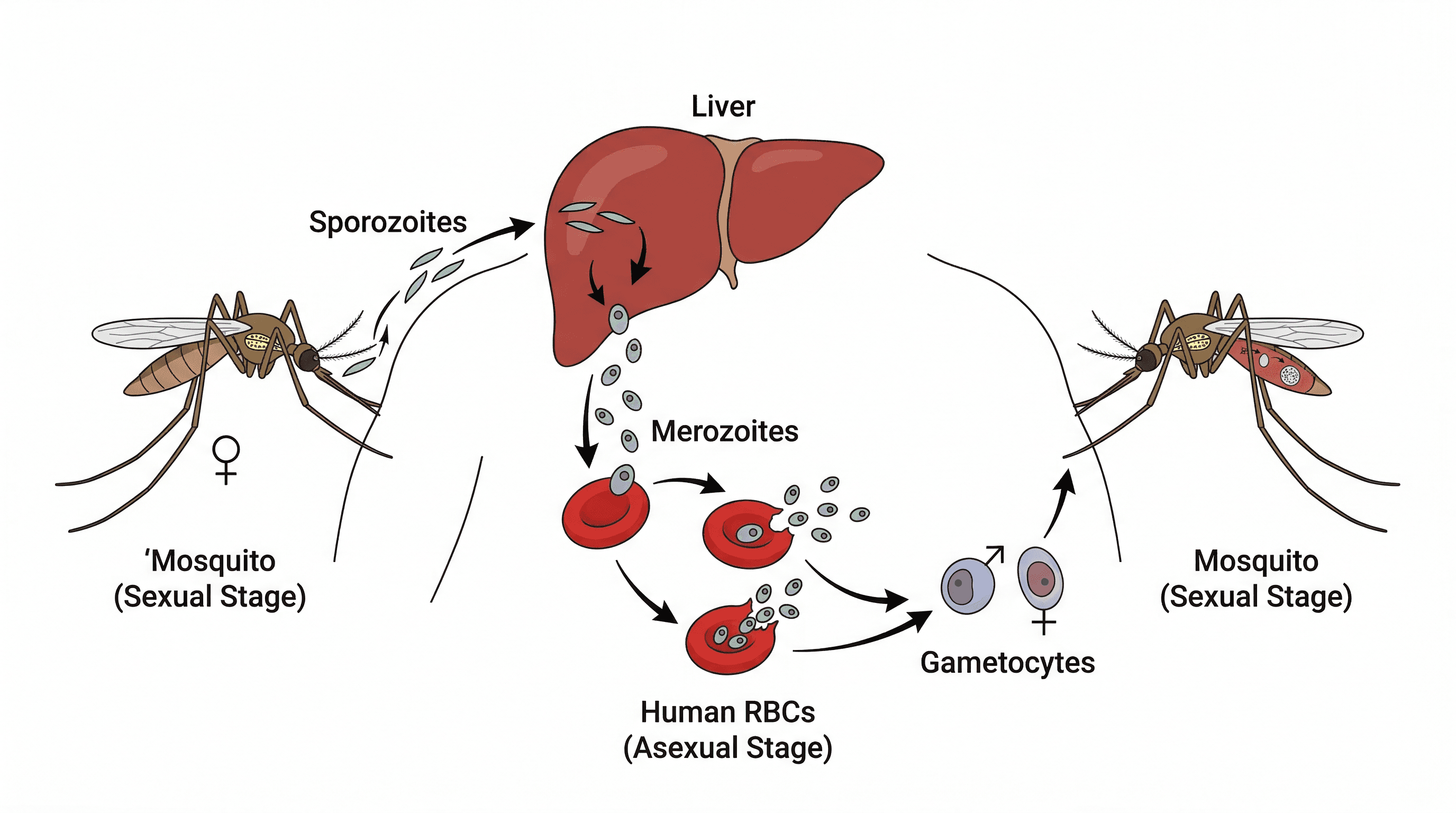
Human pathogens can be viruses, bacteria, and protoctists. Cholera, caused by the bacterium *Vibrio cholerae*, is transmitted via contaminated water. Malaria, caused by the protoctist *Plasmodium*, is transmitted by a vector, specifically the female *Anopheles* mosquito. Tuberculosis (TB), caused by the bacterium *Mycobacterium tuberculosis*, spreads through airborne droplets. HIV, a virus, is transmitted through the exchange of body fluids.
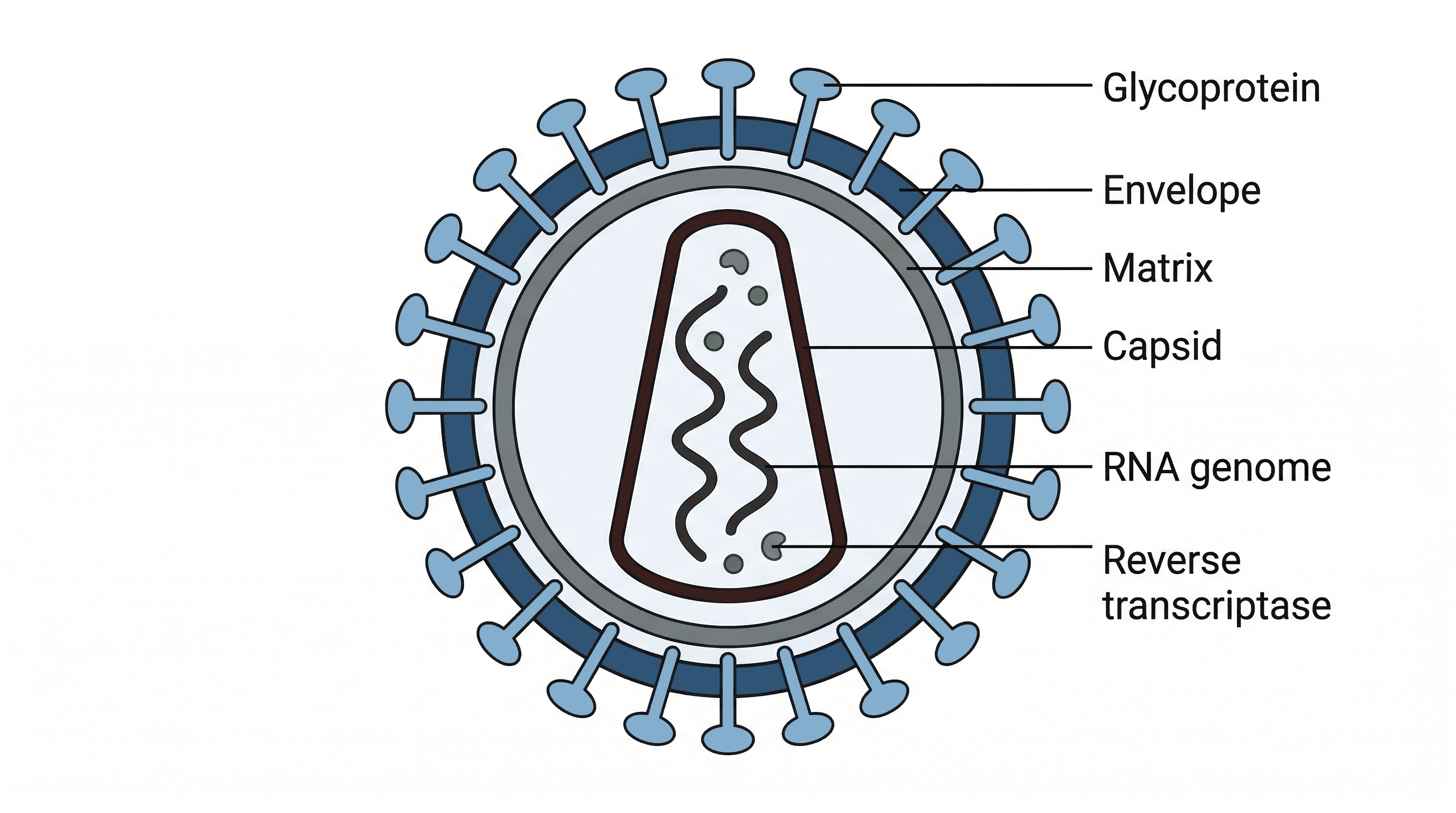
HIV — Human immunodeficiency virus.
HIV is a retrovirus that primarily infects and destroys T-helper lymphocytes, weakening the immune system. It is the causative agent of AIDS. Its genetic material is RNA, which is reverse transcribed into DNA upon infection. HIV is like a saboteur that specifically targets and dismantles the command center (T-helper lymphocytes) of the body's defense system.
AIDS — Acquired immunodeficiency syndrome.
AIDS is a collection of opportunistic diseases and conditions that occur when the immune system is severely weakened by HIV infection. It is not a single disease but a syndrome characterized by a low count of T-helper lymphocytes, making the body vulnerable to various infections and cancers. AIDS is like a castle whose walls have been so severely damaged (by HIV) that it can no longer defend itself against various invaders (opportunistic infections).
Students often think HIV and AIDS are the same thing, but actually HIV is the virus that causes the infection, and AIDS is the syndrome (collection of opportunistic infections) that develops as a result of advanced HIV infection.
Ensure you differentiate between HIV (the virus) and AIDS (the syndrome) and understand that HIV infection leads to AIDS over time as the immune system deteriorates.
opportunistic infection — An infection caused by pathogens that take advantage of a host with a weakened immune system, as may happen in someone with an HIV infection.
These infections are typically harmless in individuals with healthy immune systems but can become severe or life-threatening when the host's defenses are compromised. They are a hallmark of AIDS, as HIV destroys T-helper lymphocytes, leaving the body vulnerable. Imagine a city with strong defenses (immune system) that normally keeps petty criminals (opportunistic pathogens) in check. If the defenses collapse, these criminals can run rampant and cause serious damage.
The effectiveness of control measures for diseases like cholera, malaria, TB, and HIV is influenced by biological, social, and economic factors. Biological factors include pathogen characteristics and drug resistance. Social factors involve public health education and community engagement. Economic factors relate to the cost of treatments, preventative infrastructure, and access to healthcare. Control measures aim to interrupt the transmission cycle, for example, by providing clean water for cholera, vector control for malaria, vaccination for TB, and safe practices for HIV.
antibiotic — A substance derived from a living organism that is capable of killing or inhibiting the growth of a microorganism.
Antibiotics are drugs specifically targeting bacteria by interfering with their unique cellular processes, such as cell wall synthesis or protein synthesis. They are ineffective against viruses because viruses lack these bacterial targets. An antibiotic is like a specialized weapon that targets specific vulnerabilities in bacterial cells, leaving human cells unharmed.
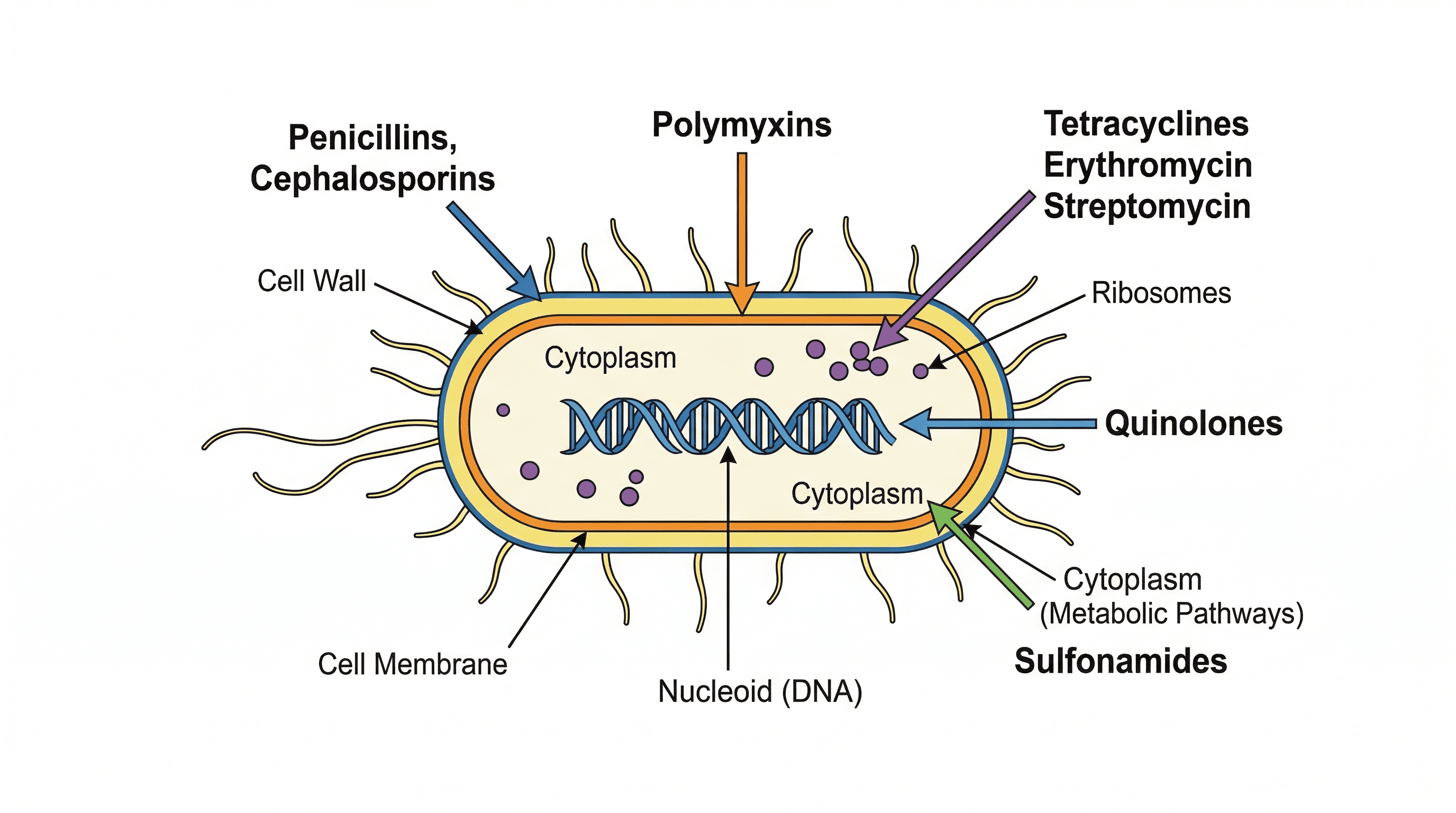
Antibiotics, such as penicillin, act on bacteria by interfering with specific bacterial structures or metabolic pathways. For instance, penicillin inhibits the synthesis of bacterial cell walls, leading to cell lysis. Viruses, however, lack cell walls and other metabolic machinery targeted by antibiotics, as they rely on host cells for replication. Therefore, antibiotics have no effect on viruses.
Students often think antibiotics kill all microorganisms, but actually they are primarily effective against bacteria and have no effect on viruses or fungi.
When explaining antibiotic action, specify the bacterial target (e.g., cell wall synthesis, protein synthesis) and explicitly state why they do not affect human cells or viruses.
antibiotic resistance — The ability of bacteria or fungi to grow in the presence of an antibiotic that would normally slow their growth or kill them; antibiotic resistance arises by mutation and becomes widespread when antibiotics are overused.
Resistance develops through genetic mutations in bacteria, allowing them to survive exposure to antibiotics. These resistant bacteria then reproduce, leading to a population dominated by resistant strains. Overuse and misuse of antibiotics accelerate this process, posing a significant public health threat. Antibiotic resistance is like a lock-picking skill that some bacteria develop, allowing them to bypass the 'lock' (antibiotic) that was designed to stop them.
Students often think individuals become resistant to antibiotics, but actually it is the bacteria that become resistant, not the human host.
The consequences of antibiotic resistance are severe, leading to infections that are harder to treat, longer hospital stays, and increased mortality. Drug-resistant TB is a significant concern. To reduce the impact of antibiotic resistance, measures include reducing the overuse and misuse of antibiotics, completing full courses of antibiotics, developing new antibiotics, and improving hygiene to prevent infections in the first place. This process is driven by natural selection, where antibiotics act as a selective pressure, favoring resistant mutants.
Explain antibiotic resistance using the principles of natural selection: variation (random mutation), selection pressure (the antibiotic), and inheritance (resistant bacteria survive and reproduce).
For any named disease, structure your answer using: Pathogen, Mode of Transmission, Treatment, and Prevention methods. When discussing prevention, always link the method directly to breaking the pathogen's transmission cycle.
infectious disease
A disease caused by an organism such as a protoctist, bacterium or virus.
pathogen
An organism that causes disease.
disease transmission
The transfer of a pathogen from a person infected with that pathogen to an uninfected person; transmission may occur by direct contact, through the air or water or by animal vectors, such as insects.
disease carrier
Person infected with a pathogen who shows no symptoms, but can be the source of infection in other people (not carrier of an inherited disease).
transmission cycle
The passage of a pathogen from one host to another is continually repeated as the pathogen infects new hosts.
disease eradication
The complete breakage of the transmission cycle of a pathogen so that there are no more cases of the disease caused by the pathogen anywhere in the world.
endemic disease
A disease that is always in a population.
disease vector
An organism which carries a pathogen from one person to another or from an animal to a human.
HIV
Human immunodeficiency virus.
AIDS
Acquired immunodeficiency syndrome.
opportunistic infection
An infection caused by pathogens that take advantage of a host with a weakened immune system, as may happen in someone with an HIV infection.
antibiotic
A substance derived from a living organism that is capable of killing or inhibiting the growth of a microorganism.
antibiotic resistance
The ability of bacteria or fungi to grow in the presence of an antibiotic that would normally slow their growth or kill them; antibiotic resistance arises by mutation and becomes widespread when antibiotics are overused.
| Command word | What examiners expect |
|---|---|
| Explain | Provide reasons or mechanisms. For example, 'Explain how antibiotics work' requires detailing their specific bacterial targets. 'Explain why antibiotics don't affect viruses' requires mentioning the absence of bacterial targets in viruses. |
| Discuss | Present a balanced argument or explore various aspects of a topic. For example, 'Discuss the biological, social, and economic factors influencing disease control' requires addressing each type of factor with relevant examples. |
| Outline | Give a brief summary of the main points. For example, 'Outline measures to reduce antibiotic resistance' requires listing key strategies without extensive detail. |
| Give the names of | State the specific scientific names of pathogens or vectors. For example, *Vibrio cholerae* for cholera, *Plasmodium* for malaria, *Anopheles* mosquito as the vector. |
Mistake
Confusing HIV and AIDS.
Correction
HIV is the virus that causes the infection, and AIDS is the syndrome (collection of opportunistic infections) that develops as a result of advanced HIV infection.
Mistake
Assuming antibiotics work on all microorganisms.
Correction
Antibiotics are primarily effective against bacteria and have no effect on viruses or fungi.
Mistake
Thinking all disease transmission requires direct contact.
Correction
Many pathogens can survive in the environment or be carried by vectors, leading to indirect transmission (e.g., water-borne cholera, insect-borne malaria).
Mistake
Believing all microorganisms are pathogens.
Correction
Most microorganisms are harmless or beneficial; only those that cause disease are pathogens.
Mistake
Using 'vector' and 'carrier' interchangeably.
Correction
A vector is an organism that transmits a pathogen (e.g., mosquito), while a carrier is an infected person who shows no symptoms but can transmit the disease.
Mistake
Thinking individuals become resistant to antibiotics.
Correction
It is the bacteria that become resistant to antibiotics, not the human host.