
Biology · Photosynthesis
Photosynthesis is a vital energy transfer process where light energy is converted into chemical potential energy stored in carbohydrates. This chapter explores the intricate structure of chloroplasts, the roles of various photosynthetic pigments, and the two main stages: the light-dependent reactions and the light-independent Calvin cycle. Finally, it examines the environmental factors that limit the rate of photosynthesis and methods for its investigation.
photosynthetic pigments — Coloured substances that absorb light of particular wavelengths, supplying energy to drive the reactions in the light-dependent stage of photosynthesis.
These pigments, including chlorophyll a, chlorophyll b, carotene, and xanthophyll, are embedded in the thylakoid membranes. They capture light energy and funnel it to reaction centres, initiating the electron transport chain. Photosynthetic pigments are like an array of different-coloured 'antennae' that can each pick up specific 'radio frequencies' (wavelengths of light) to gather as much energy as possible.
chlorophyll — A green pigment that absorbs energy from light, used in photosynthesis.
Chlorophyll is the primary photosynthetic pigment found in chloroplasts, responsible for capturing light energy. It exists in two main forms, chlorophyll a and chlorophyll b, which absorb slightly different wavelengths of light, primarily in the red and blue regions of the spectrum, reflecting green light. Think of chlorophyll like a solar panel on a house; it's designed to capture energy from sunlight and convert it into a usable form for the plant.
Students often think chlorophyll absorbs all light, but actually it reflects green light, which is why plants appear green.
When asked to describe the role of chlorophyll, ensure you mention its ability to absorb light energy and channel it to reaction centres, not just 'it's green'.
absorption spectrum — A graph showing the absorbance of different wavelengths of light by a photosynthetic pigment.
An absorption spectrum illustrates which wavelengths of light a particular pigment absorbs most effectively. For example, chlorophylls absorb strongly in the blue and red regions, while reflecting green light. An absorption spectrum is like a 'light preference chart' for a pigment, showing which colours of light it 'likes' to absorb the most.
action spectrum — A graph showing the effect of different wavelengths of light on a process, for example the rate of photosynthesis.
An action spectrum plots the rate of a biological process (like photosynthesis) against the wavelength of light. It typically mirrors the combined absorption spectra of the pigments involved, showing peaks where light is most effectively used. An action spectrum is like a 'performance report' for photosynthesis, showing how well it 'works' at different colours of light.
Students often confuse absorption spectra with action spectra, but actually absorption spectra show what light is absorbed, while action spectra show how effective different wavelengths are at driving photosynthesis.
Be able to compare and contrast absorption and action spectra, explaining why they are similar (pigments absorb light used for photosynthesis) but also why they might not be identical (e.g., energy transfer efficiency, accessory pigments).
chromatography — A technique that can separate substances in a mixture according to their solubility in a solvent.
In paper chromatography for pigments, a solvent moves up the paper by capillary action, carrying dissolved pigments with it. Pigments separate based on their differential solubility in the solvent and their adsorption to the paper, resulting in distinct spots. Chromatography is like a 'race' where different pigments run at different speeds depending on how well they dissolve in the solvent and how much they stick to the paper, causing them to separate.
Rf value — A number that indicates how far a substance travels during chromatography, calculated by dividing the distance travelled by the substance by the distance travelled by the solvent; Rf values can be used to identify the substance.
The Rf value is a ratio, always between 0 and 1. A higher Rf value indicates greater solubility in the solvent and less adsorption to the stationary phase. It is a characteristic value for a given substance under specific chromatographic conditions. The Rf value is like a 'speed score' for each pigment in the chromatography race. A higher score means it travelled further relative to the solvent.
Rf value calculation
Used in chromatography to identify substances; values are always between 0 and 1.
Remember the formula: Rf = distance travelled by pigment spot / distance travelled by solvent. Know the relative Rf values for common chloroplast pigments (carotenoids highest, then chlorophyll a, then chlorophyll b).
Students often forget to measure the solvent front, but actually it's crucial for calculating the Rf value accurately.
Photosynthesis is an essential energy transfer process that converts light energy into chemical potential energy, stored within carbohydrate molecules. The overall equation for this process is 6CO₂ + 6H₂O → C₆H₁₂O₆ + 6O₂. This equation represents the net input of carbon dioxide and water, and the output of glucose and oxygen, driven by light energy in the presence of chlorophyll.
Overall equation for photosynthesis
Represents the overall input and output of photosynthesis, not the detailed steps.
stroma — The background material in a chloroplast in which the light-independent stage of photosynthesis takes place.
The stroma is the fluid-filled space within the inner membrane of a chloroplast, analogous to the cytoplasm of a cell. It contains enzymes, ribosomes, DNA, and starch grains, providing the necessary environment for the Calvin cycle reactions. The stroma is like the 'factory floor' of the chloroplast, where all the machinery (enzymes) for building carbohydrates from carbon dioxide is located.
lamellae — Membranes found within a chloroplast.
Lamellae are internal membranes within the chloroplast that connect the grana. They are part of the thylakoid membrane system and contain photosynthetic pigments and electron transport chain components. If grana are stacks of pancakes, lamellae are the single pancakes connecting different stacks, allowing communication and transport between them.
thylakoid membranes — The membranes inside a chloroplast that enclose fluid-filled sacs; the light-dependent stage of photosynthesis takes place in these membranes.
These membranes are highly folded and form flattened sacs called thylakoids, which are often stacked into grana. They embed photosynthetic pigments, electron carriers, and ATP synthase, providing the site for light absorption, electron transport, and ATP synthesis. These membranes are like the 'solar panels' and 'power lines' of the chloroplast, where light energy is captured and converted into chemical energy (ATP and reduced NADP).
thylakoid spaces — Fluid-filled sacs enclosed by the thylakoid membranes.
The thylakoid spaces (or lumen) are the internal compartments within the thylakoids. Protons are pumped into these spaces during the light-dependent stage, creating a proton gradient that drives ATP synthesis. These spaces are like a 'reservoir' for protons. As protons build up inside, they create a pressure that drives the 'water wheel' (ATP synthase) to make energy.
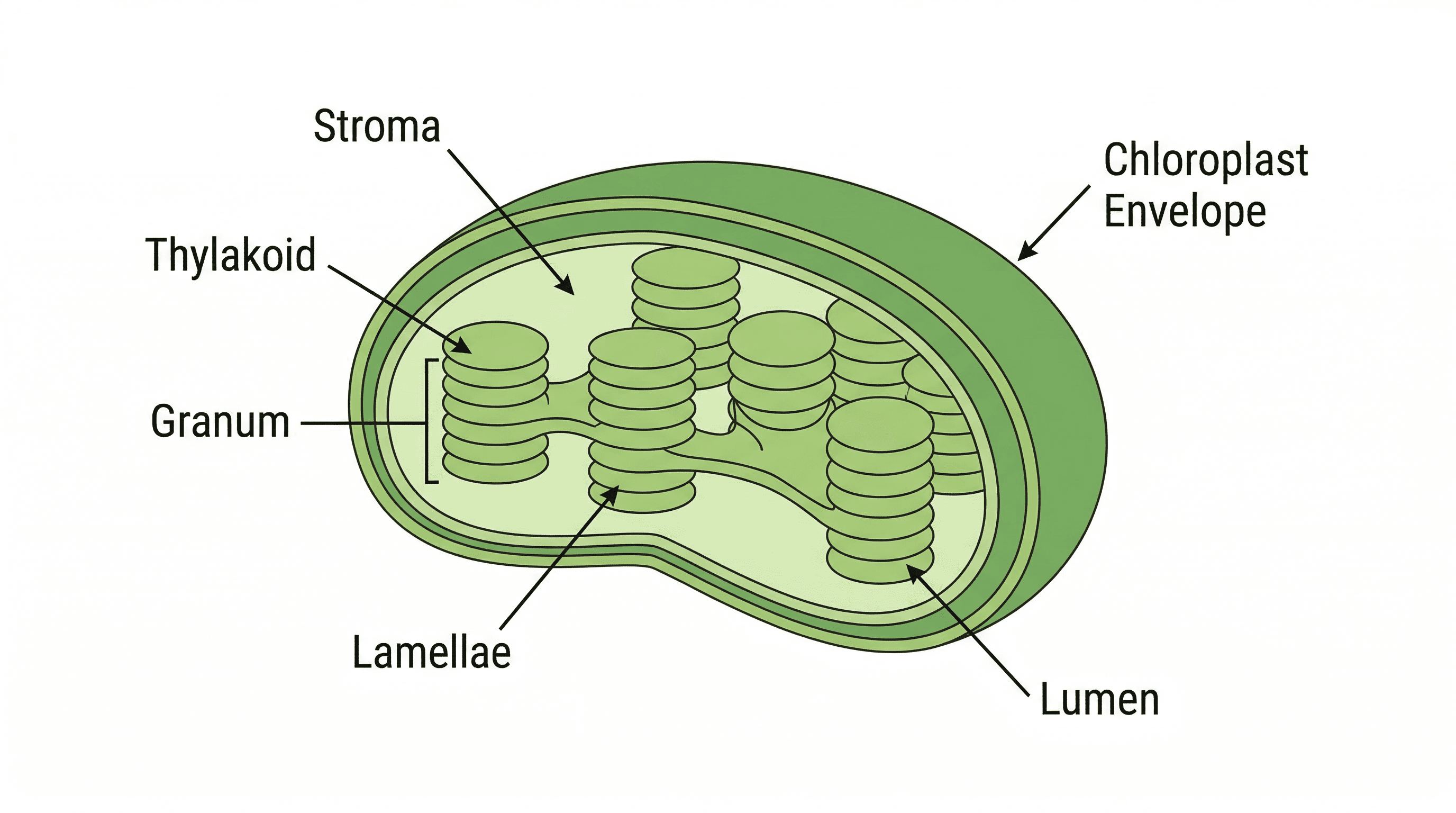
Clearly state that the light-independent stage (Calvin cycle) occurs in the stroma and mention the presence of enzymes, ribosomes, and DNA. Highlight the large surface area provided by thylakoid membranes for efficient light absorption and electron transport, linking structure to function.
light-dependent stage — The first series of reactions that take place in photosynthesis; it requires energy absorbed from light.
This stage occurs in the thylakoid membranes of chloroplasts. It involves the absorption of light energy by pigments, leading to the splitting of water (photolysis), the production of ATP (photophosphorylation), and the reduction of NADP to reduced NADP. Oxygen is released as a byproduct. The light-dependent stage is the initial power generation and raw material processing unit, creating the energy (ATP) and reducing power (reduced NADP) needed for the next steps.
Be precise about the products of the light-dependent stage: ATP, reduced NADP, and oxygen. State where it occurs (thylakoid membranes) and its energy requirement (light).
Students often think this stage directly produces glucose, but actually it produces ATP and reduced NADP, which are then used in the light-independent stage.
photosystem — A cluster of light-harvesting pigments surrounding a reaction centre.
Photosystems are functional units located in the thylakoid membranes. Each photosystem contains many pigment molecules (chlorophylls and accessory pigments) that absorb light energy and transfer it to a central reaction centre, which contains a pair of chlorophyll a molecules. A photosystem is like a 'satellite dish' with many small antennae (pigments) collecting signals (light energy) and focusing them onto a central receiver (reaction centre).
reaction centre — The part of a photosystem towards which energy from light is funnelled; it contains a pair of chlorophyll a molecules, which absorb the energy and emit electrons.
Located at the core of a photosystem, the reaction centre receives light energy from surrounding accessory pigments. This energy excites electrons in its chlorophyll a molecules, causing them to be emitted and enter the electron transport chain. The reaction centre is the 'engine' of the photosystem. All the light energy collected by the surrounding pigments is directed here to power the initial step of electron emission.
photoactivation — The emission of an electron from a molecule as a result of the absorption of energy from light.
When a chlorophyll a molecule in a reaction centre absorbs light energy, its electrons become excited to a higher energy level. If this energy is sufficiently high, the electron is emitted from the molecule and captured by an electron acceptor. Photoactivation is like a 'kick' from light energy that makes an electron jump out of its atom, ready to start a chain reaction.
photophosphorylation — Producing ATP using energy that originated as light.
This process occurs in the thylakoid membranes during the light-dependent stage. Light energy excites electrons, which then pass along an electron transport chain, releasing energy to pump protons and create a gradient. This proton gradient drives ATP synthase to produce ATP from ADP and Pi. It's like a hydroelectric dam, but instead of water, it uses the flow of electrons (energised by light) to generate a 'current' (proton gradient) that powers a turbine (ATP synthase) to make energy (ATP).
Students often confuse photophosphorylation with oxidative phosphorylation, but actually photophosphorylation uses light energy, while oxidative phosphorylation uses energy from chemical reactions (respiration).
cyclic photophosphorylation — The production of ATP using energy from light, involving only photosystem I.
In cyclic photophosphorylation, excited electrons from photosystem I are passed along an electron transport chain and then return to photosystem I. This electron flow generates a proton gradient, leading to ATP synthesis, but does not produce reduced NADP or oxygen. This is like a closed-loop power generator. Electrons are energised by light, generate ATP as they cycle through carriers, and then return to their starting point to be re-energised.
State that only Photosystem I is involved in cyclic photophosphorylation, only ATP is produced, and no water is split or oxygen released.
Students often think all photophosphorylation produces reduced NADP, but actually cyclic photophosphorylation only produces ATP.
non-cyclic photophosphorylation — The production of ATP using energy from light, involving both photosystem I and photosystem II; this process also produces reduced NADP.
This process, also known as the Z-scheme, involves both photosystem I and photosystem II. Electrons flow from photosystem II to photosystem I, generating ATP, and then from photosystem I to NADP, reducing it to reduced NADP. Water is split to replace electrons in photosystem II, releasing oxygen. This is like an open-ended power generator. Electrons move in one direction, generating ATP along the way, and then are used to create reduced NADP, requiring a constant supply of new electrons from water.
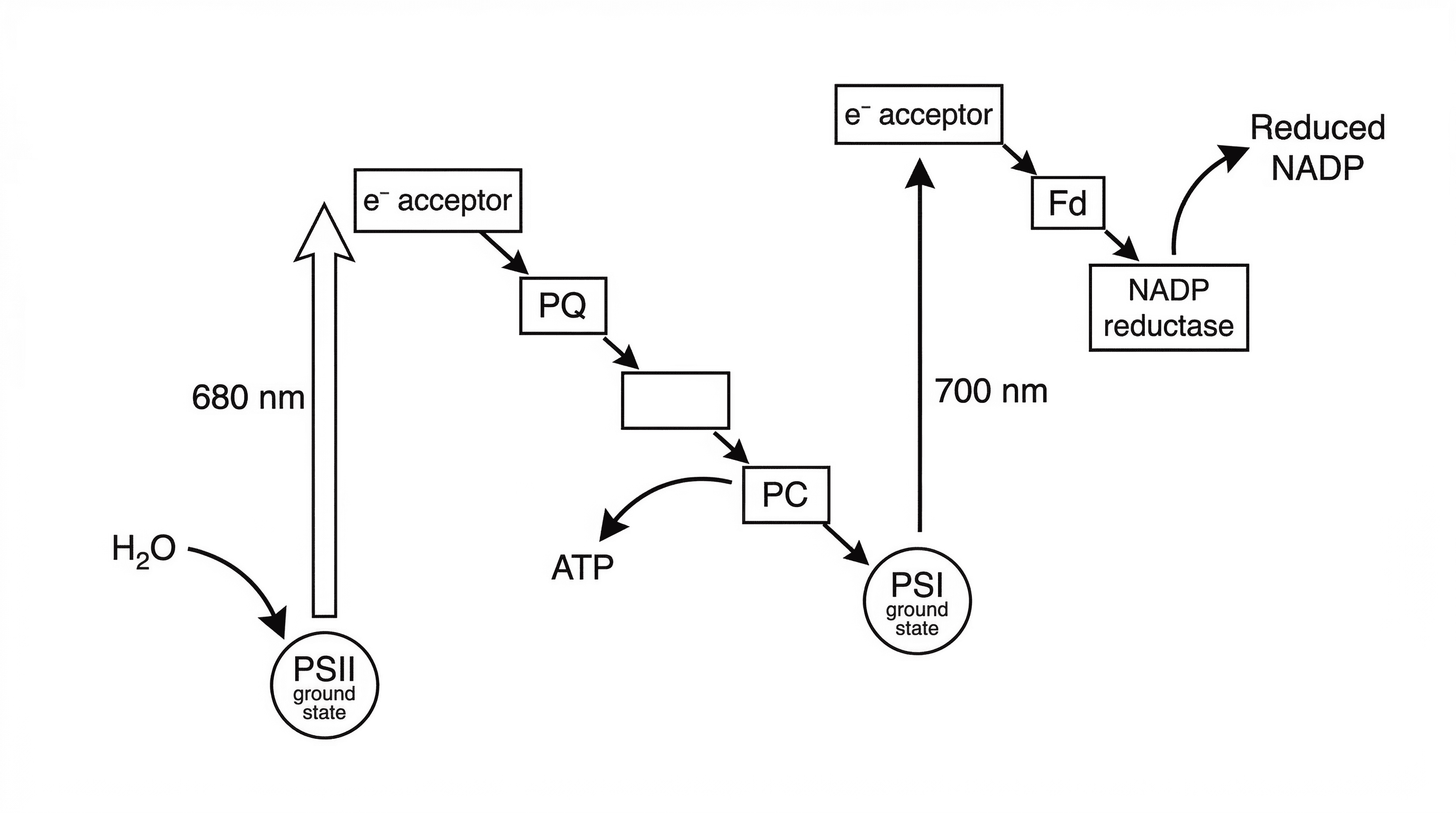
Emphasise that both ATP and reduced NADP are products of non-cyclic photophosphorylation, both photosystems are involved, and photolysis of water occurs, releasing oxygen.
photolysis — Splitting a water molecule, using energy from light.
Photolysis occurs in photosystem II during the light-dependent stage. Water molecules are split into hydrogen ions (protons), electrons, and oxygen. The electrons replace those lost from chlorophyll a, the protons contribute to the proton gradient for ATP synthesis, and oxygen is released. Think of photolysis as a water-splitting machine powered by sunlight, breaking water into its components to provide essential parts for the photosynthetic process.
Photolysis of water
Occurs in photosystem II during the light-dependent stage.
Students often think oxygen comes from carbon dioxide, but actually it comes from the splitting of water during photolysis.
Clearly state the products of water splitting (2H+, 2e-, ½O2) and its role in replacing electrons in photosystem II.
oxygen-evolving complex — An enzyme found in photosystem II that catalyses the breakdown of water, using energy from light.
This enzyme, also known as the water-splitting complex, is associated with photosystem II. It uses light energy to split water molecules (photolysis) into protons, electrons, and oxygen, providing electrons to replace those lost by chlorophyll a in photosystem II. This complex is like a 'water cracker' that breaks water molecules apart to supply the necessary electrons and protons for photosynthesis.
NADP — A coenzyme that transfers hydrogen from one substance to another, in the reactions of photosynthesis.
NADP acts as an electron and proton carrier in photosynthesis. In the light-dependent stage, it accepts electrons and hydrogen ions (protons) to become reduced NADP, which then carries this reducing power to the light-independent stage to reduce carbon dioxide. NADP is like a rechargeable battery or a shuttle bus for hydrogen and electrons. It picks them up in the light-dependent stage and delivers them where needed in the light-independent stage.
Reduction of NADP
Occurs at the end of the electron transport chain in non-cyclic photophosphorylation.
Students often confuse NADP with NAD (used in respiration), but actually NADP is specific to photosynthesis, while NAD is specific to respiration.
Always refer to it as 'reduced NADP' when it has accepted hydrogen and electrons, and 'oxidised NADP' when it has released them.
light-independent stage — The final series of reactions that take place in photosynthesis; it does not require light but does need substances that are produced in the light-dependent stage.
Also known as the Calvin cycle, this stage occurs in the stroma of the chloroplast. It uses the ATP and reduced NADP from the light-dependent stage to fix carbon dioxide and reduce it to carbohydrates like triose phosphate, which can then be converted into glucose and other organic molecules. The light-independent stage is the main manufacturing unit, taking the energy and raw materials from the first stage to build the final product (carbohydrates).
Students often think 'light-independent' means it can happen in complete darkness indefinitely, but actually it relies on the products of the light-dependent stage, which will run out in prolonged darkness.
Emphasise that while the light-independent stage doesn't directly use light, it is dependent on the products (ATP and reduced NADP) of the light-dependent stage. Mention its location (stroma) and key inputs (CO2, ATP, reduced NADP).
Calvin cycle — A cycle of reactions in the light-independent stage of photosynthesis in which carbon dioxide is reduced to form carbohydrate.
The Calvin cycle takes place in the stroma of chloroplasts. It involves three main phases: carbon fixation (CO2 combines with RuBP), reduction (GP is reduced to TP using ATP and reduced NADP), and regeneration (RuBP is regenerated from TP using ATP). The Calvin cycle is like a biochemical 'recycling plant' that takes in carbon dioxide, processes it using energy and reducing power, produces a small amount of carbohydrate, and then regenerates its starting material to keep the process going.
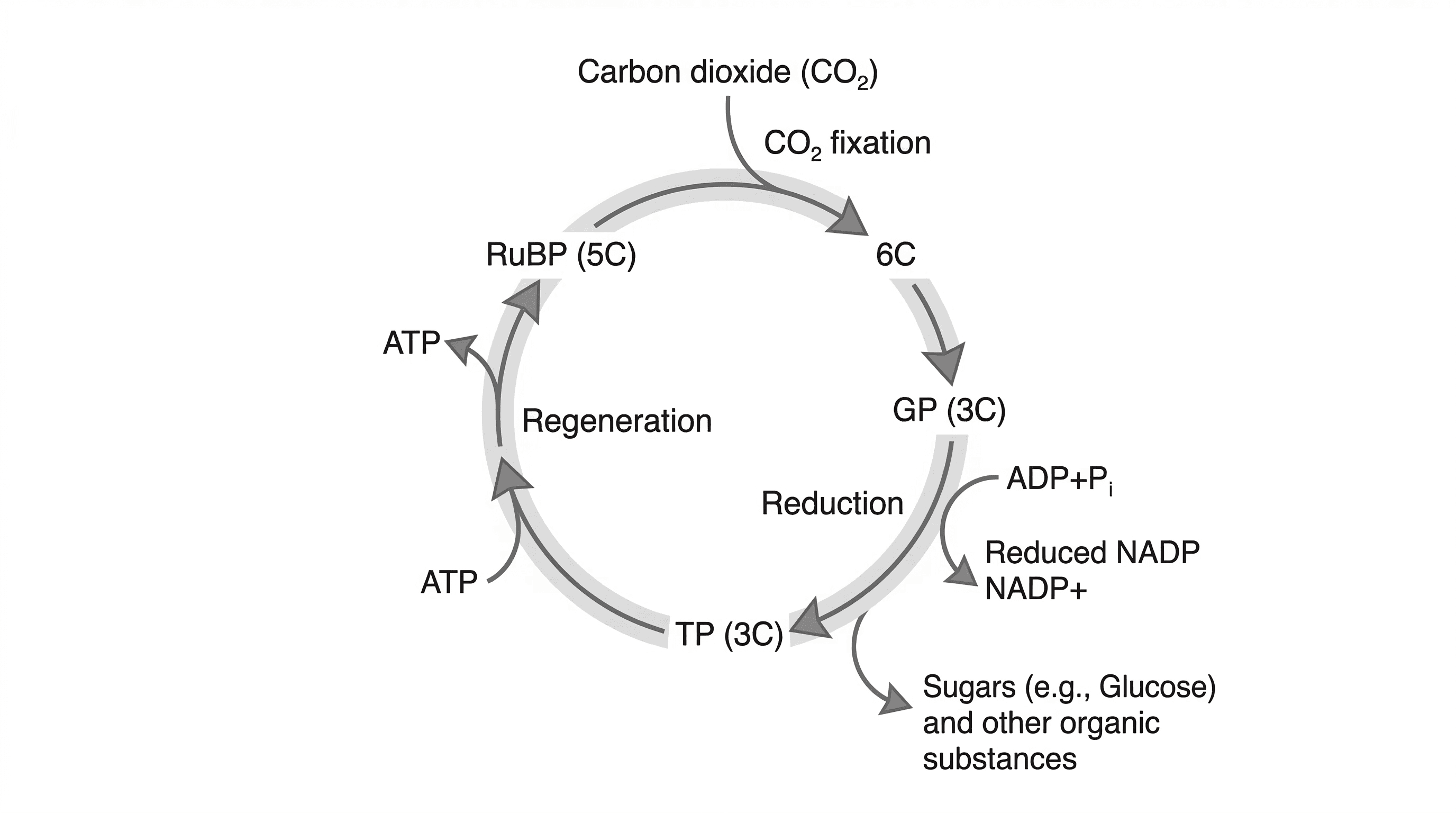
ribulose bisphosphate (RuBP) — A five-carbon phosphorylated sugar which is the first compound to combine with carbon dioxide during the light-independent stage of photosynthesis.
RuBP is a key molecule in the Calvin cycle. It acts as the carbon dioxide acceptor, combining with CO2 in a reaction catalysed by rubisco to form an unstable six-carbon intermediate, which then splits into two molecules of GP. RuBP is like the 'empty seat' waiting for carbon dioxide to join the Calvin cycle. Once CO2 sits down, the cycle can begin.
rubisco — The enzyme that catalyses the combination of RuBP with carbon dioxide.
Rubisco (ribulose bisphosphate carboxylase-oxygenase) is arguably the most abundant enzyme on Earth. It catalyses the crucial carbon fixation step in the Calvin cycle, where CO2 is incorporated into an organic molecule (RuBP). Rubisco is the 'gatekeeper' enzyme that allows carbon dioxide to enter the photosynthetic pathway and become part of organic molecules.
glycerate-3-phosphate (GP) — A three-carbon compound which is formed when RuBP combines with carbon dioxide.
After RuBP combines with CO2 and the unstable 6C intermediate splits, two molecules of GP are formed. GP is then reduced to triose phosphate (TP) using ATP and reduced NADP from the light-dependent stage. GP is like the 'intermediate product' in the carbohydrate factory. It's not the final product, but it's the next step after the raw material (CO2) has been incorporated.
triose phosphate (TP) — A three-carbon phosphorylated sugar, the first carbohydrate to be formed during the light-independent stage of photosynthesis.
TP is formed from the reduction of GP using ATP and reduced NADP. It is a crucial molecule because some TP is used to regenerate RuBP, while the rest is used to synthesise other organic molecules like glucose, starch, sucrose, lipids, and amino acids. TP is the 'versatile building block' produced by the Calvin cycle. It can either be recycled to keep the cycle going or used to build all the other essential organic compounds for the plant.
Students often think the Calvin cycle directly produces glucose, but actually it produces triose phosphate (TP), which is then used to synthesise glucose and other organic molecules.
Be able to describe the key compounds (RuBP, GP, TP) and the role of rubisco, ATP, and reduced NADP in each step of the Calvin cycle.
limiting factor — The requirement for a process to take place that is in the shortest supply; an increase in this factor will allow the process to take place more rapidly.
In photosynthesis, common limiting factors include light intensity, carbon dioxide concentration, and temperature. The rate of photosynthesis is determined by the factor that is furthest from its optimum level, even if other factors are abundant. Think of a car assembly line. If you have plenty of parts and workers but only one wrench, the wrench is the limiting factor for how fast you can build cars. Increasing the number of wrenches will speed up production until something else becomes limiting.
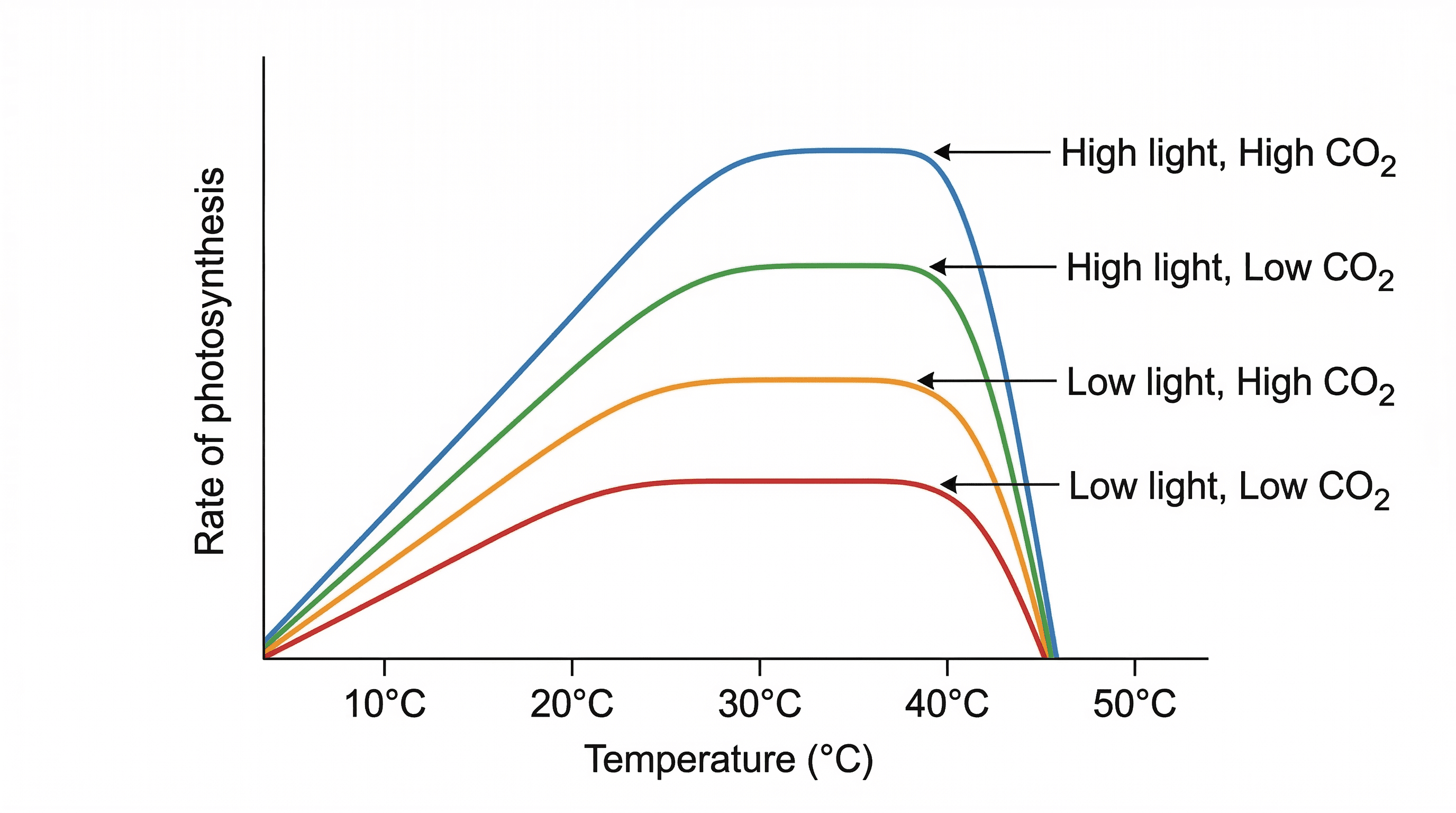
Students often think that increasing any factor will always increase the rate, but actually only increasing the *limiting* factor will increase the rate.
When interpreting graphs, identify the region where the rate is increasing in response to a change in a factor, indicating that factor is limiting. Where the rate plateaus, another factor has become limiting.
The rate of photosynthesis can be investigated by measuring the uptake of carbon dioxide or the production of oxygen. For aquatic plants, the rate of oxygen bubble production can be counted or the change in pH (due to CO2 uptake) can be monitored. Using a redox indicator with a chloroplast suspension allows for the investigation of the effect of light intensity and wavelengths on the light-dependent stage, as the indicator changes colour when reduced by electrons from the electron transport chain.
When asked to investigate photosynthesis (e.g., using an aquatic plant), state the independent and dependent variables and describe how you would control all other variables to ensure a valid result.
chlorophyll
A green pigment that absorbs energy from light, used in photosynthesis.
light-dependent stage
The first series of reactions that take place in photosynthesis; it requires energy absorbed from light.
light-independent stage
The final series of reactions that take place in photosynthesis; it does not require light but does need substances that are produced in the light-dependent stage.
photolysis
Splitting a water molecule, using energy from light.
photophosphorylation
Producing ATP using energy that originated as light.
NADP
A coenzyme that transfers hydrogen from one substance to another, in the reactions of photosynthesis.
Calvin cycle
A cycle of reactions in the light-independent stage of photosynthesis in which carbon dioxide is reduced to form carbohydrate.
stroma
The background material in a chloroplast in which the light-independent stage of photosynthesis takes place.
lamellae
Membranes found within a chloroplast.
thylakoid membranes
The membranes inside a chloroplast that enclose fluid-filled sacs; the light-dependent stage of photosynthesis takes place in these membranes.
thylakoid spaces
Fluid-filled sacs enclosed by the thylakoid membranes.
photosynthetic pigments
Coloured substances that absorb light of particular wavelengths, supplying energy to drive the reactions in the light-dependent stage of photosynthesis.
absorption spectrum
A graph showing the absorbance of different wavelengths of light by a photosynthetic pigment.
photosystem
A cluster of light-harvesting pigments surrounding a reaction centre.
reaction centre
The part of a photosystem towards which energy from light is funnelled; it contains a pair of chlorophyll a molecules, which absorb the energy and emit electrons.
chromatography
A technique that can separate substances in a mixture according to their solubility in a solvent.
Rf value
A number that indicates how far a substance travels during chromatography, calculated by dividing the distance travelled by the substance by the distance travelled by the solvent; Rf values can be used to identify the substance.
action spectrum
A graph showing the effect of different wavelengths of light on a process, for example the rate of photosynthesis.
cyclic photophosphorylation
The production of ATP using energy from light, involving only photosystem I.
photoactivation
The emission of an electron from a molecule as a result of the absorption of energy from light.
non-cyclic photophosphorylation
The production of ATP using energy from light, involving both photosystem I and photosystem II; this process also produces reduced NADP.
oxygen-evolving complex
An enzyme found in photosystem II that catalyses the breakdown of water, using energy from light.
ribulose bisphosphate (RuBP)
A five-carbon phosphorylated sugar which is the first compound to combine with carbon dioxide during the light-independent stage of photosynthesis.
rubisco
The enzyme that catalyses the combination of RuBP with carbon dioxide.
glycerate-3-phosphate (GP)
A three-carbon compound which is formed when RuBP combines with carbon dioxide.
triose phosphate (TP)
A three-carbon phosphorylated sugar, the first carbohydrate to be formed during the light-independent stage of photosynthesis.
limiting factor
The requirement for a process to take place that is in the shortest supply; an increase in this factor will allow the process to take place more rapidly.
| Command word | What examiners expect |
|---|---|
| Describe | For chloroplast structure, describe the thylakoid membranes, grana, stroma, and their relative positions. For stages, describe the sequence of events, inputs, and outputs. For chromatography, describe the practical steps. |
| Explain | For energy transfer, explain how light energy is converted to chemical energy. For structure-function, explain how specific features of the chloroplast (e.g., large surface area of thylakoids) relate to their roles. For limiting factors, explain why a factor limits the rate and how increasing it affects the process. |
| Interpret | For absorption and action spectra, interpret the peaks and troughs in relation to pigment absorption and photosynthetic efficiency. For limiting factor graphs, interpret the different regions of the curve to identify the limiting factor. |
| Calculate | For chromatography, calculate Rf values using the provided formula and measurements. |
Mistake
Thinking oxygen produced in photosynthesis comes from carbon dioxide.
Correction
Oxygen actually comes from the splitting of water (photolysis) during the light-dependent stage.
Mistake
Confusing the light-dependent and light-independent stages, or thinking the latter can occur indefinitely in darkness.
Correction
The light-independent stage relies on ATP and reduced NADP from the light-dependent stage, so it will cease when these products run out in prolonged darkness.
Mistake
Confusing absorption spectra (what light is absorbed) with action spectra (how effective different wavelengths are at driving photosynthesis).
Correction
Absorption spectra show the wavelengths a pigment absorbs, while action spectra show the rate of photosynthesis at different wavelengths.
Mistake
Thinking that increasing any factor will always increase the rate of photosynthesis.
Correction
Only increasing the *limiting* factor will increase the rate of photosynthesis. Once another factor becomes limiting, increasing the original factor will have no further effect.
Mistake
Confusing NADP (photosynthesis) with NAD (respiration) and their respective roles as hydrogen/electron carriers.
Correction
NADP is specific to photosynthesis, carrying reducing power to the Calvin cycle. NAD is specific to respiration.
Mistake
Thinking glucose is the direct product of the Calvin cycle.
Correction
Triose phosphate (TP) is the direct product of the Calvin cycle, from which glucose and other organic molecules are then synthesised.