
Nexelia Academy · Official Revision Notes
Complete A-Level revision notes · 37 chapters
This chapter introduces the core concepts of business activity, including the purpose of businesses, the factors of production, and the crucial concept of adding value. It also explores the economic problem of scarcity and opportunity cost, and highlights the vital roles of entrepreneurs and intrapreneurs in driving economic development.
Business — A business is an organisation that uses resources to meet the needs of customers by providing a product or service that they demand.
Businesses are fundamental to economic activity, transforming scarce resources into goods and services that satisfy consumer needs. Their primary aim is often to add value and make a profit, contributing to a higher standard of living. Think of a baker: they take flour, water, and yeast (resources) and turn them into bread (a product) that customers want, adding value through their skill and effort.
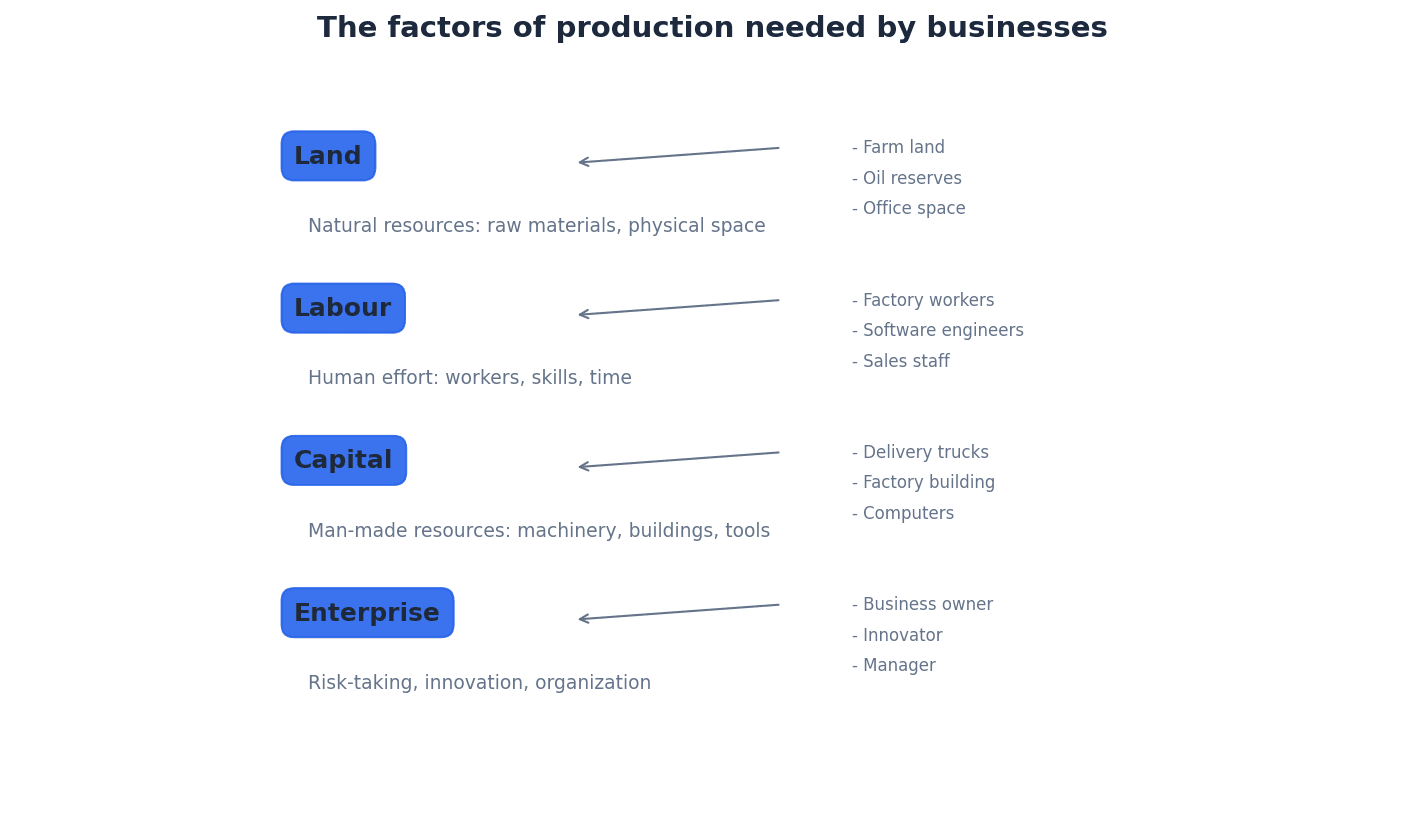
Factors of production — Factors of production are the resources needed by businesses to be able to operate and produce goods or services.
These four categories – land, labour, capital, and enterprise – are the fundamental building blocks for any economic activity. Their availability and efficient combination determine a business's capacity to produce. Imagine building a house: the land is where it stands, the builders are the labour, the tools and machinery are the capital, and the architect/project manager is the enterprise bringing it all together.
Be prepared to define and give examples for each of the four factors of production, as this is a common definitional question.
Land — Land is a general term that includes not only land itself but all the renewable and non-renewable resources of nature, such as coal, crude oil and timber.
This factor encompasses all natural resources, whether they are directly used as raw materials or provide the physical space for operations. Its scarcity is a core aspect of the economic problem. For a farmer, the land is the soil for crops, the water for irrigation, and even the sunlight that helps plants grow.
Students often think 'land' only refers to real estate, but actually it includes all natural resources, both above and below the surface.
Labour — Labour refers to the manual and skilled labour that make up the workforce of the business.
This factor represents the human effort, both physical and mental, applied in the production process. The quality and quantity of labour significantly impact a business's productivity and output. In a restaurant, the chefs, waiters, and cleaners all represent labour, each contributing their skills to the service.
Capital — Capital is not just the finance needed to set up a business and pay for its continuing operations, but also all the manufactured resources used in production, including capital goods such as computers, machines, factories, offices and vehicles.
Capital is crucial for enabling production, providing the tools and infrastructure necessary for businesses to operate efficiently. It represents accumulated wealth used to create more wealth. For a taxi company, the cars are capital goods, and the money used to buy them and pay for fuel is finance capital.
Students often think 'capital' only means money, but actually it also includes manufactured resources like machines and factories used in production.
Distinguish clearly between financial capital (money) and physical capital (capital goods) when discussing this factor of production.
Enterprise — Enterprise is the initiative and coordination provided by risk-taking individuals called entrepreneurs, who combine the other factors of production into a unit capable of producing goods and services.
Enterprise is the driving force behind business creation and innovation, involving the vision, risk-taking, and organisational skills needed to bring a business idea to fruition. It provides the managing, decision-making, and coordinating roles. The conductor of an orchestra is like enterprise, bringing together the musicians (labour), instruments (capital), and sheet music (land/resources) to create a performance.
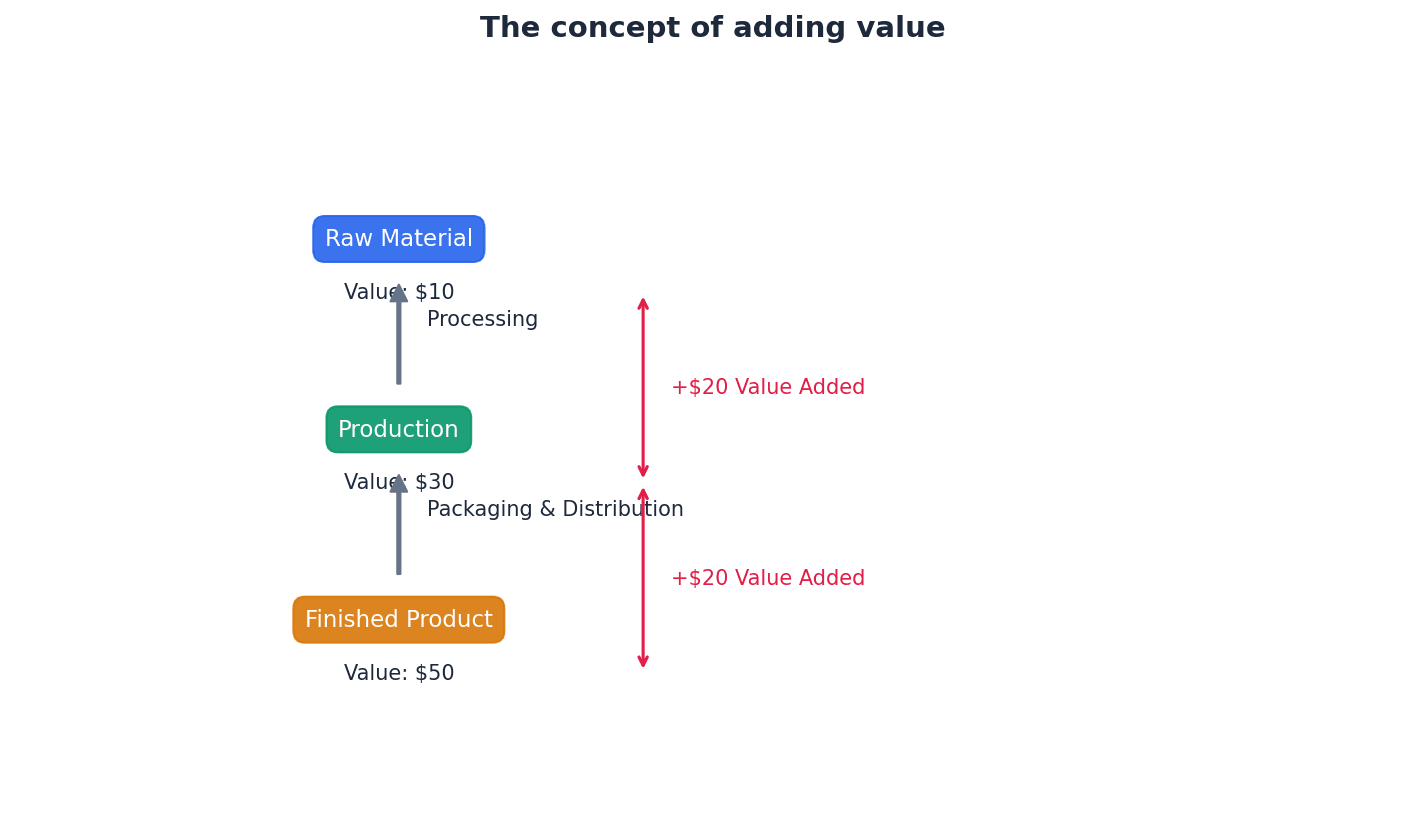
Added value — Added value is the difference between the selling price of the products sold by a business and the cost of the materials that it bought in.
Adding value is essential for a business's survival and profitability, as it allows the business to cover other costs (like labour and rent) and provide a return to investors. It reflects the perceived worth customers place on the transformed product or service. A coffee shop buys raw coffee beans for a low price, but after roasting, grinding, brewing, and serving it in a pleasant environment, the selling price of a cup of coffee is much higher, representing the added value.
Students often think added value is the same as profit, but actually profit is what remains after all costs, including labour and overheads, have been deducted from added value.
When asked to explain 'adding value', clearly state it's the difference between selling price and bought-in material costs, and explain its importance for covering other expenses and generating profit.
Economic problem — The economic problem is the situation where there are insufficient goods to satisfy all of our needs and wants at any one time.
This fundamental problem arises from the scarcity of resources relative to unlimited human wants. It forces individuals, businesses, and governments to make choices about how to allocate resources. Imagine having a limited budget for groceries but wanting to buy everything in the supermarket; you can't, so you have to choose what's most important.
Ensure your explanation of the economic problem links scarcity of resources to the inability to satisfy all needs and wants, leading to the necessity of choice.
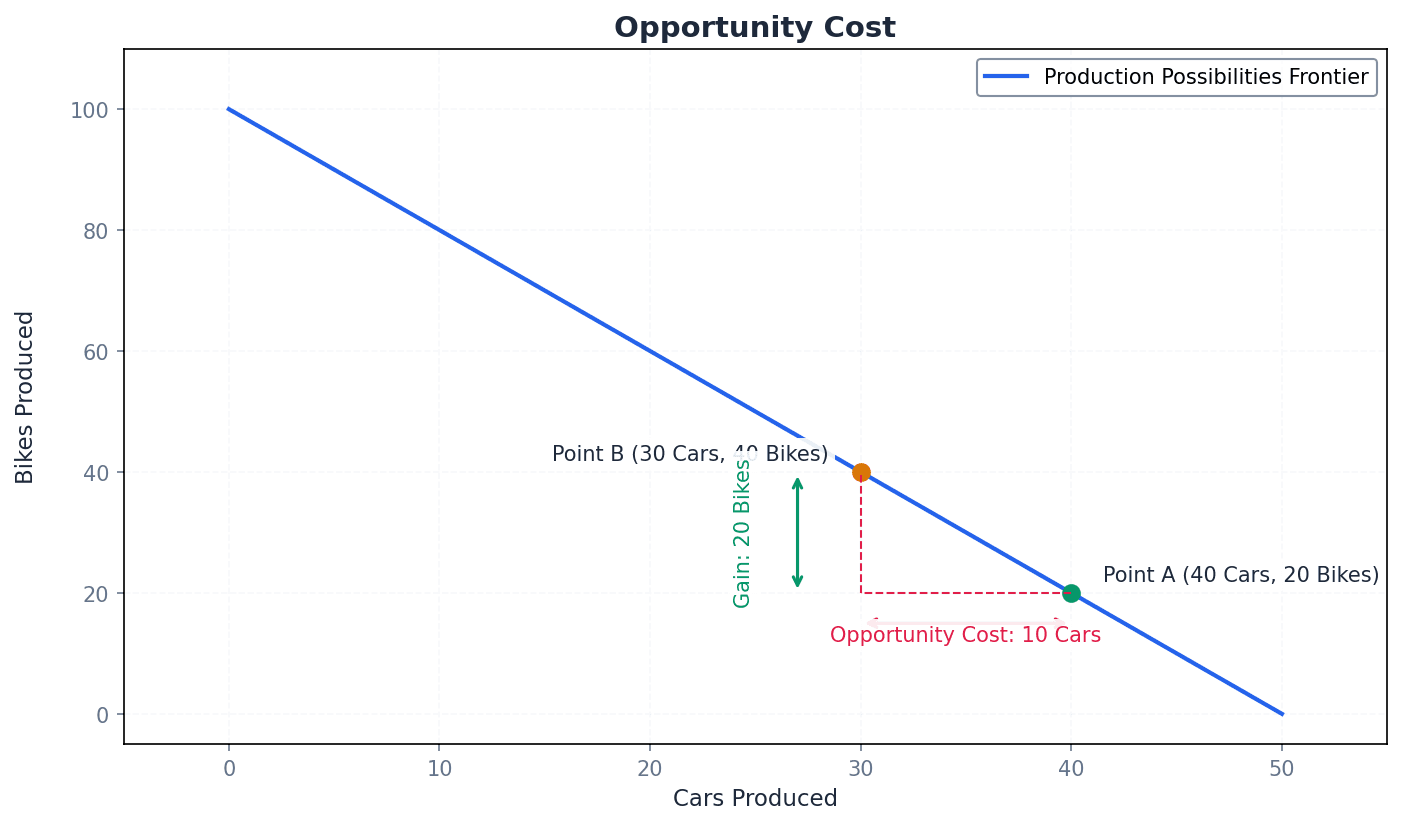
Opportunity cost — Opportunity cost is the next most desired product which is given up when deciding to purchase or obtain one item over others.
This concept highlights the trade-offs inherent in all economic decisions. Every choice made means foregoing the benefits of the next best alternative, which is the true cost of that decision. If you choose to spend your Saturday studying for an exam, the opportunity cost might be going to a concert with friends, which was your next best alternative.
Students often think opportunity cost is all the things given up, but actually it is only the single next best alternative that is foregone.
When explaining opportunity cost, clearly identify the choice made and the single best alternative that was sacrificed as a direct result of that choice.
Entrepreneur — An entrepreneur is a risk-taking individual who combines the other factors of production into a unit capable of producing goods and services, providing the managing, decision-making and coordinating roles.
Entrepreneurs are central to economic development, identifying market gaps, innovating, and taking personal and financial risks to create new businesses. Their qualities include innovation, commitment, multi-skilling, leadership, self-confidence, and risk-taking. A chef who decides to open their own restaurant, investing their savings, hiring staff, designing the menu, and managing daily operations, is an entrepreneur.
When analysing entrepreneurs, focus on their personal qualities (e.g., risk-taking, innovation) and their role in combining factors of production and managing the business.
Entrepreneurs and their enterprise are vital for a country's economic development. They drive innovation, create new businesses, generate employment opportunities, and contribute to tax revenues. This leads to increased competition, a wider variety of goods and services, and ultimately a higher standard of living for the population. However, entrepreneurs often face barriers such as obtaining sufficient capital, finding good locations, intense competition, and managing business risk and uncertainty.
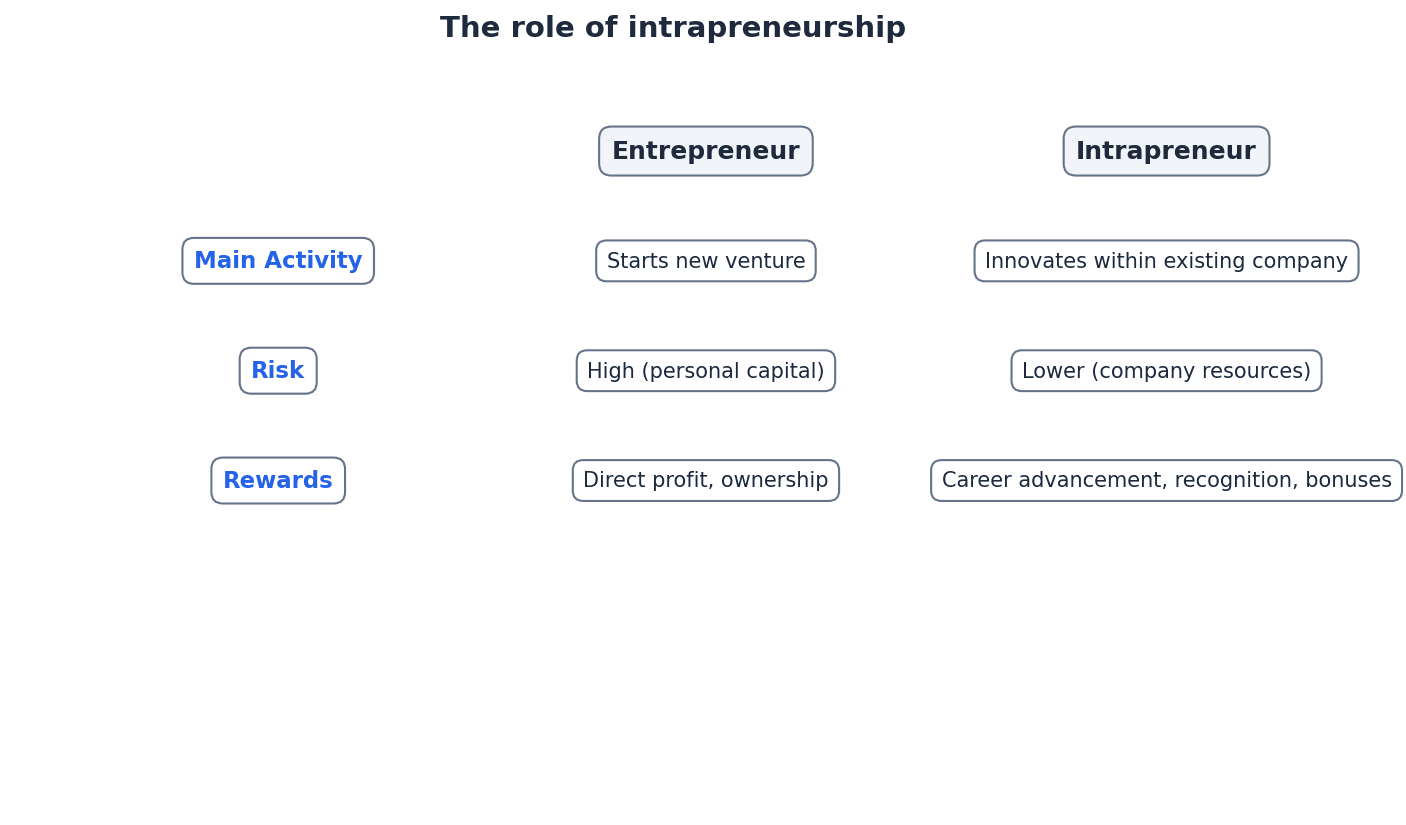
Intrapreneur — An intrapreneur is a person who has the same qualities as entrepreneurs and is encouraged to demonstrate the same skills as entrepreneurs within an existing business.
Intrapreneurs drive innovation and change from within established organisations, helping businesses adapt to dynamic environments and retain creative talent. They take risks on behalf of the company, not personally. An employee at a large tech company who develops a new product feature or service idea, champions it, and brings it to market using company resources, is an intrapreneur.
Distinguish intrapreneurs from entrepreneurs by highlighting that intrapreneurs operate within an existing business, with the business taking the risk and receiving the rewards.
Business plan — A business plan is a detailed document outlining a new business's strategies, operations, marketing, management team, and financial forecasts.
It serves as a roadmap for the business and a crucial tool for attracting finance from investors and lenders. While beneficial for planning, it can also create a false sense of certainty or lead to inflexibility if not adapted to a dynamic environment. Think of a business plan as a detailed blueprint for building a house; it shows what you intend to build, how you'll build it, who will help, and how much it will cost, to convince a bank to lend you money.
Students often think a business plan guarantees success, but actually it's a forecast and a guide, and external factors can still lead to failure if the plan isn't flexible.
When evaluating business plans, discuss both their benefits (e.g., securing finance, clear direction) and limitations (e.g., inflexibility, based on forecasts).
Always evaluate. When asked about business plans, discuss both their benefits (e.g., securing finance) and limitations (e.g., can be rigid).
Advantages & Disadvantages
Business Plans
Entrepreneurship for Economic Development
Evaluation Starters
Essay Structure Guide
Introduction
Start by defining key terms relevant to the question (e.g., entrepreneur, economic development, business plan). Briefly outline the main arguments you will present.
Conclusion
Summarise your main arguments and provide a final, reasoned judgment that directly answers the question. Avoid introducing new information. Emphasise the overall significance of enterprise and planning while acknowledging their complexities.
This chapter explores how business activities are categorised into economic sectors and the shifts between them, such as industrialisation and deindustrialisation. It then differentiates between private and public sector organisations, detailing various private sector legal structures like sole traders, partnerships, and companies, evaluating their advantages and disadvantages.
Industrialisation — The growing importance of secondary sector manufacturing industries in developing countries.
This process involves a shift in economic activity from primary to secondary sectors, leading to increased national output and job creation. For example, a country that primarily farms crops (primary sector) starting to build factories to turn those crops into processed foods (secondary sector) is undergoing industrialisation. It often results in higher standards of living but can also cause social problems due to rural-to-urban migration.
Students often think industrialisation only refers to historical events, but actually it is an ongoing process in many developing economies today.
Deindustrialisation — The decline in the importance of secondary sector activity and an increase in the tertiary sector in developed economies.
This occurs as economies mature, with rising incomes leading to increased demand for services over goods, and manufacturing facing global competition. For instance, a country that used to make a lot of cars and steel (secondary sector) now focusing more on tourism, banking, and technology services (tertiary sector) is experiencing deindustrialisation. It results in job losses in manufacturing but creates opportunities in service industries.
Students often think deindustrialisation means a country stops manufacturing entirely, but actually it means the manufacturing sector's relative importance to the economy declines.
When analysing industrialisation, ensure you discuss both benefits (e.g., GDP increase, job creation) and problems (e.g., urbanisation issues, import costs) to achieve higher marks.
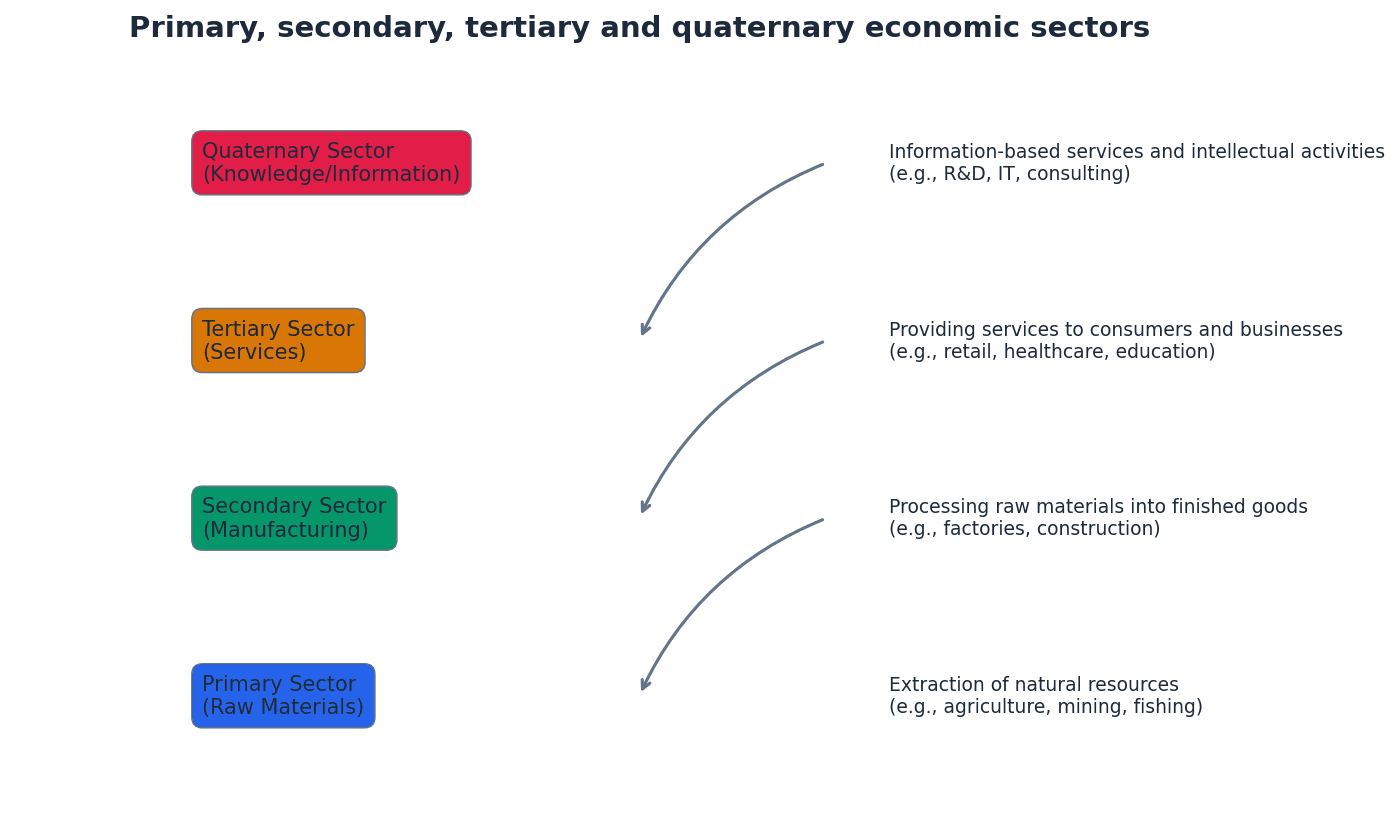
Business activity is classified into primary (extraction of raw materials), secondary (manufacturing), tertiary (services), and quaternary (knowledge-based) economic sectors. The relative importance of these sectors changes over time, particularly as economies develop. Industrialisation signifies a shift towards the secondary sector in developing nations, while deindustrialisation marks a decline in the secondary sector and a rise in the tertiary sector in developed economies. These shifts have significant consequences for national output, employment, and living standards.
Public-sector enterprises — Organisations that are government-owned or state-run, providing important goods and services.
These enterprises often operate with social objectives rather than solely profit motives, providing essential services like health, education, or strategic industries. A national healthcare system or a state-owned railway company are examples, aiming to serve the public rather than maximise shareholder profit. They are financed mainly by the government and can be prone to inefficiency or political interference.
Public goods — Goods and services that cannot be charged for, making it impossible for a private-sector business to make a profit from producing them.
These goods are non-excludable and non-rivalrous, meaning individuals cannot be prevented from using them, and one person's use does not diminish another's. Street lighting is a classic example: once installed, everyone benefits, and you can't charge individuals for their specific use, so the government provides it. They are typically provided by the public sector and funded through taxes.
Students often think public-sector enterprises are the same as public limited companies, but actually public-sector enterprises are government-owned, while public limited companies are private sector businesses whose shares are traded publicly.
Distinguish clearly between public-sector enterprises and public limited companies in your answers, as confusing them is a common error. Focus on ownership and primary objectives.
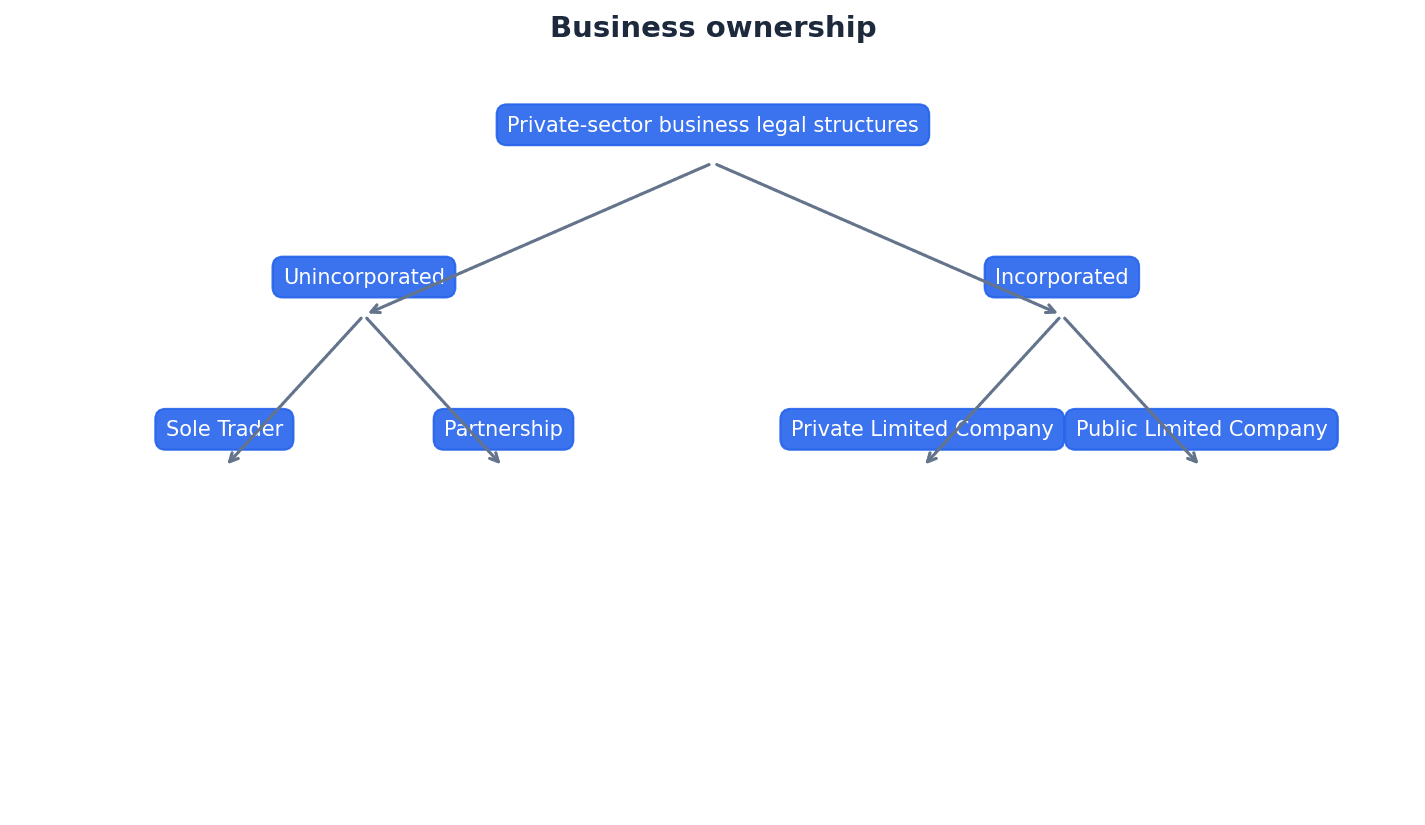
The economy is broadly divided into the private sector and the public sector. The private sector comprises businesses owned and controlled by individuals or groups, aiming to generate profit. In contrast, the public sector consists of organisations that are government-owned or state-run, known as public-sector enterprises. These entities typically provide essential goods and services, often with social objectives rather than purely profit motives, and are funded primarily by the government.
Sole trader — A business organisation with a single owner, who may employ others but retains complete control.
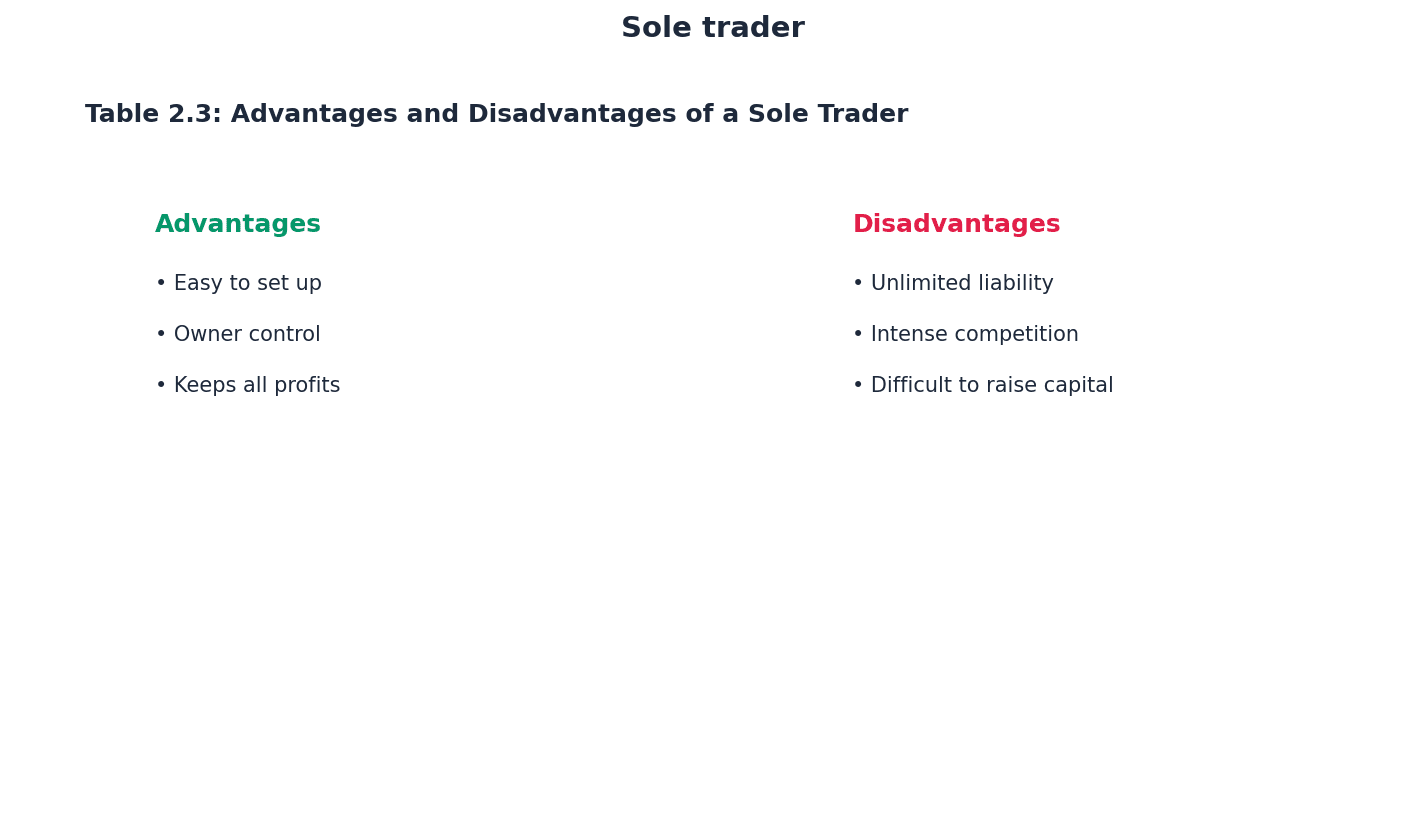
This is the most common form of business ownership, easy to set up, and the owner keeps all profits. A freelance graphic designer working from home, managing all aspects of their business and keeping all profits, is a sole trader. However, the owner faces unlimited liability, making personal assets vulnerable to business debts, and often struggles to raise additional capital for expansion.
Students often think a sole trader cannot employ anyone, but actually they can employ others; the key is that there is only one owner.
Unlimited liability — A legal status where the owner’s personal possessions and property can be taken to pay off the debts of the business, should it fail.
This applies to sole traders and most partnerships, meaning there is no legal distinction between the owner's personal assets and the business's assets. If a business goes bankrupt and has unlimited liability, it's like the business's debts are also the owner's personal debts, and creditors can claim their house or car. It increases the financial risk for the owner and can deter entrepreneurship.
When evaluating sole traders, always discuss unlimited liability as a significant drawback and its implications for the owner's personal finances.
Partnerships — Businesses formed by two or more people to overcome some drawbacks of being a sole trader, often with a formal Deed of Partnership.
Partners share decision-making, inject additional capital, and share business losses. Two lawyers deciding to open a law firm together, sharing clients, responsibilities, and profits, would typically form a partnership. While offering greater privacy than companies, most partners still face unlimited liability, and the partnership lacks continuity if a partner dies.
Students often think all partnerships have limited liability, but actually most partnerships have unlimited liability for all partners, unless it's a specific 'limited partnership' type.
Highlight the shared decision-making and additional capital as advantages of partnerships, but always balance this with the significant disadvantage of unlimited liability for partners.
Limited liability — A legal status where shareholders are only liable for the amount they have invested in the company, protecting their personal assets.
This is a key feature of companies, encouraging investment as individuals are prepared to provide finance without risking their entire personal wealth. If you buy shares in a company with limited liability, the most you can lose is the money you paid for those shares, even if the company goes bankrupt. It transfers the risk of business failure from investors to creditors.
Emphasise that limited liability is a major reason why companies can raise substantial capital, as it reduces the risk for investors.
Shareholders — Part-owners of a company who buy small units of ownership called shares.
Shareholders provide finance to the company and benefit from limited liability. If a company is like a pie, shareholders are people who buy slices of that pie, becoming part-owners. They can influence the company through voting rights, especially those with large blocks of shares who may become directors.
Legal personality — A company is recognised in law as having a legal identity separate from that of its owners.
This means the company itself can enter into contracts, own assets, sue, and be sued, rather than the individual owners. Think of a company as having its own 'birth certificate' and 'identity' in the eyes of the law, separate from the people who own or run it. It provides a layer of protection for owners and allows the business to operate as a distinct entity.
Continuity — In a company, the death of an owner or director does not lead to its break-up or dissolution.
Ownership continues through the inheritance or transfer of shares, ensuring the business can operate indefinitely regardless of changes in personnel. A company is like a river that keeps flowing even if some water molecules (owners) leave or new ones join; the river itself continues. This provides stability and long-term planning capability.
Limited companies offer significant advantages over sole traders and partnerships, primarily limited liability for their owners (shareholders). They also possess a separate legal personality, meaning the company is a distinct legal entity from its owners, and continuity, ensuring the business's existence is not tied to the lifespan of its owners. These features make them attractive for growth and investment, though they involve more legal formalities.
Private limited company — A small firm where owner(s) create a company with limited liability, and shares are sold to family, friends, and employees, not the general public.
This structure offers limited liability, legal personality, and continuity, while often allowing original owners to retain control. It's like a family business that has grown and wants the protection of limited liability, but still wants to keep ownership within a close circle. However, there are legal formalities, and raising capital from the general public is not possible.
Students often think 'private' in private limited company means no one knows about the company, but actually their end-of-year accounts must be sent to a government office and are publicly available.
Public limited company (plc) — A legal organisation, usually for very large businesses, that has access to substantial funds for expansion by advertising and selling shares to the general public on a stock exchange.
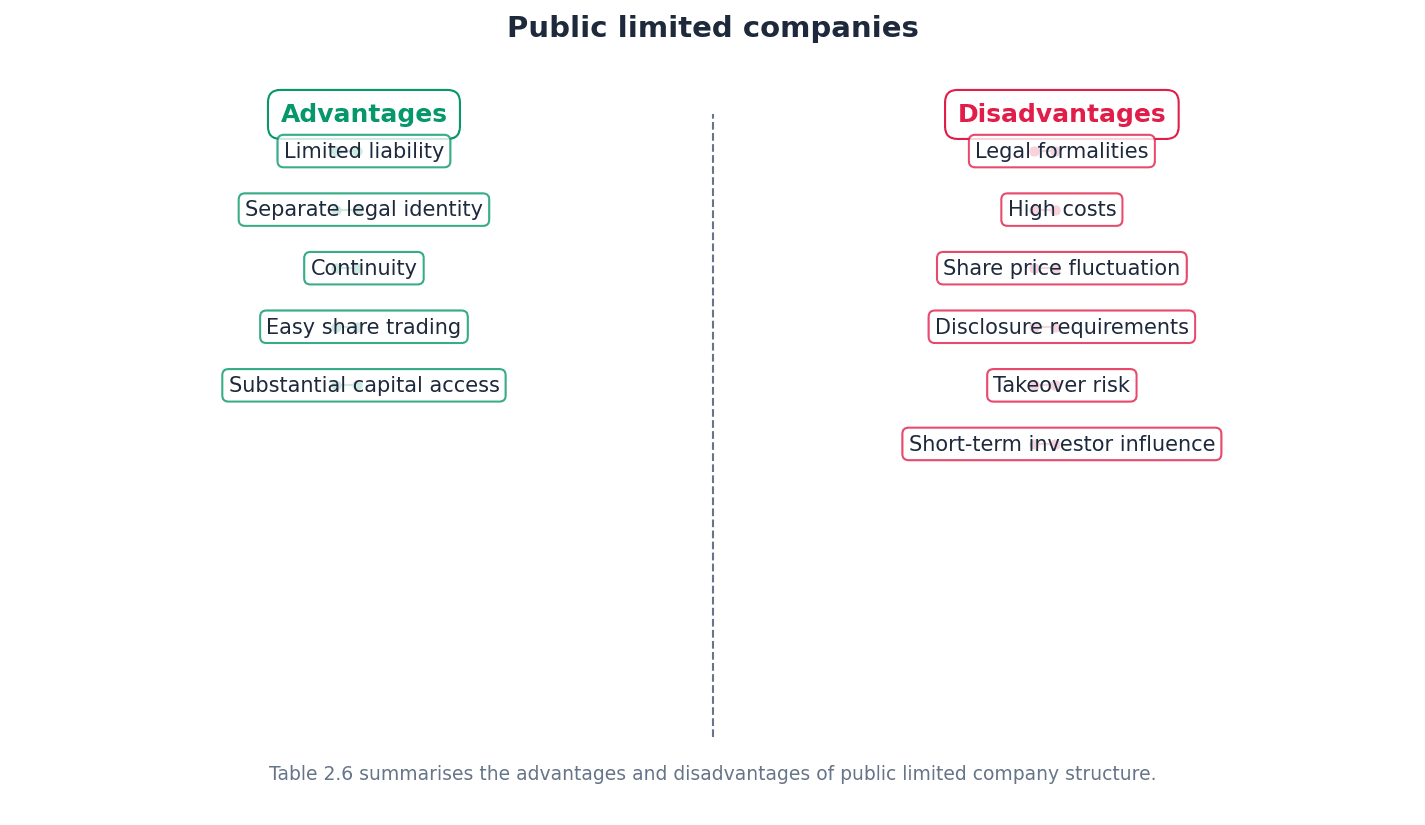
Plcs benefit from all private company advantages, plus the ability to raise vast capital and allow easy share trading. Think of a very large company like Apple or Coca-Cola; their shares are bought and sold by millions of people on the stock market, allowing them to raise huge amounts of money. However, they face extensive legal formalities, high costs, public scrutiny, and a separation of ownership and control that can lead to conflicts.
Students often think public limited companies are in the public sector, but actually they are private sector businesses; 'public' refers to their ability to sell shares to the general public.
Initial public offering (IPO) — The first sale of shares by a private company to the general public, converting it into a public limited company.
An IPO allows a company to raise significant capital from a wide range of investors. It's like a private club opening its doors for the first time to anyone who wants to join, by buying a membership (shares). It also provides liquidity for existing shareholders, enabling them to sell their shares easily.
When explaining IPOs, link it directly to the conversion of a private limited company to a public limited company and the primary purpose of raising substantial capital.
Cooperatives — A form of business organisation where all members contribute to running the business, share workload, responsibilities, decision-making, and profits equally.
Cooperatives can be producer/worker or consumer/retail focused. Imagine a group of farmers who pool their resources to buy seeds and equipment together, and then collectively sell their produce to get better prices; this is an agricultural cooperative. They benefit from bulk buying and shared motivation but can suffer from poor management skills, capital shortages, and slow decision-making due to member consultation.
Franchise — A legal contract allowing a franchisee to use the name, logo, and marketing methods of a franchiser.
The franchisee operates a business under the established brand of the franchiser, benefiting from brand recognition, advice, and national advertising, which reduces the risk of failure. Buying a McDonald's franchise means you get to open a McDonald's restaurant, use their famous name and recipes, and get their support, but you have to follow their rules and pay them a fee. In return, the franchisee pays an initial fee and a share of profits/revenue, and must adhere to strict rules.
Students often think a franchise is a type of legal structure, but actually it's a business agreement; the franchisee still chooses a legal structure (e.g., sole trader, private limited company) for their own operation.
Joint venture — When two or more businesses work closely together on a project, sharing costs, risks, and potentially different strengths and experiences.
Joint ventures allow companies to combine resources for new ventures, exploit new markets, and reduce individual risk. Two different construction companies partnering to build a very large bridge, combining their expertise and sharing the massive costs and risks, is a joint venture. However, they can face challenges due to differing management styles, blame for errors, and the risk of one partner's failure jeopardising the whole project.
Social enterprises — Businesses that aim to make profit in socially responsible ways, using much of any profit to benefit society.
Social enterprises directly produce goods or provide services with social aims, using ethical methods. A coffee shop that uses its profits to fund education programs for disadvantaged youth, rather than just paying dividends to shareholders, is a social enterprise. Unlike charities, they rely on making a profit to survive and do not depend on donations, competing with other businesses in the market.
When discussing social enterprises, highlight the dual objective of making a profit AND achieving social aims, and how this differentiates them from purely profit-focused businesses and charities.
When asked to recommend a change in ownership (e.g., sole trader to Ltd), always discuss the pros and cons of BOTH structures before giving a justified conclusion.
When comparing structures, focus on key differences: liability (limited/unlimited), sources of finance, control, and legal formalities.
Advantages & Disadvantages
Sole Trader
Partnerships
Evaluation Starters
Essay Structure Guide
Introduction
Start by defining the key terms in the question (e.g., sole trader, private limited company, industrialisation). Briefly outline the scope of your essay, stating what aspects of business structure or sectoral change you will discuss.
Conclusion
Summarise your main arguments without introducing new information. Provide a justified conclusion that directly answers the question, weighing the pros and cons discussed and making a clear recommendation or judgment based on your evaluation.
This chapter explores various methods for measuring business size, including employees, revenue, and market share, and discusses their respective strengths and limitations. It also examines the crucial role of small and family businesses within economies and industries, alongside their unique advantages and disadvantages. Finally, the chapter differentiates between organic and external growth strategies, detailing various forms of integration and evaluating their impact on stakeholders, while also considering reasons for the failure of mergers and takeovers.
Revenue — Revenue (or sales turnover) is the total value of sales made by a business over a given period.
Revenue represents the total money a business collects from selling its goods or services, similar to the total cash a lemonade stand takes in before deducting costs. It is often used to compare business size, especially within the same industry, but can be misleading across different sectors due to varying production values.
Students often think revenue is the same as profit, but actually revenue is the total income from sales before any costs are deducted, while profit is what remains after all costs are paid. Profit assesses business performance, not size.
When asked to compare business size using revenue, ensure you state that it is more effective for businesses in the same industry. Do not confuse it with profit.
Capital employed — Capital employed is the total value of long-term investment in a business.
This measure reflects the value of assets a business uses to generate revenue, such as machinery and buildings. For example, an optician requires expensive diagnostic machines, leading to higher capital employed than a hairdresser, even with the same number of employees. While larger businesses generally require more capital, comparisons between different industries can be misleading due to varying capital intensity.
Students often think capital employed only refers to money, but actually it includes all long-term assets like machinery, buildings, and equipment, not just cash.
When using capital employed as a measure, acknowledge its limitations, especially when comparing businesses in different sectors, as capital intensity varies greatly.
Market capitalisation — Market capitalisation is the total value of a company's issued shares.
This is calculated by multiplying the current share price by the total number of shares issued, representing the total 'price tag' of a company on the stock market. For instance, a company with 100 shares at 500. This measure is only applicable to public limited companies and can fluctuate daily with share prices, making it less stable for long-term comparisons.
Students often think market capitalisation reflects the company's internal value, but actually it's a market-driven valuation that can be influenced by investor sentiment and external factors, not just the company's assets or profits.
Remember that market capitalisation is only for public limited companies and is highly volatile. Explain how changes in share price can significantly alter this measure without affecting other aspects of the business.
Market Capitalisation
Used only for public limited companies; value fluctuates daily with share prices.
Market share — Market share is the proportion of total market sales held by one business.
This is a relative measure indicating a firm's dominance within its industry. For example, if your pizza shop sells 20 out of 100 pizzas in a town, your market share is 20%. A high market share suggests a large firm, but this is relative to the total market size; a high share in a small market does not necessarily mean a very large firm.
Students often think a high market share always means a large business, but actually it depends on the overall size of the market. A high share in a niche market might still represent a small absolute business size.
When discussing market share, always consider the total market size. A high market share is a good indicator of leadership within an industry, but not necessarily of absolute business size.
Market Share
Calculated for a given time period; a relative measure of business size within an industry.
Beyond revenue, capital employed, market capitalisation, and market share, the number of employees is another common way to measure business size. However, no single measure is universally 'best'; the most appropriate measure depends on the purpose of the comparison and the industry context. For instance, comparing a capital-intensive manufacturing firm with a labour-intensive service provider requires careful consideration of the chosen metric.
Students often think there is one 'best' measure of business size, but actually the most appropriate measure depends on the purpose of the comparison.
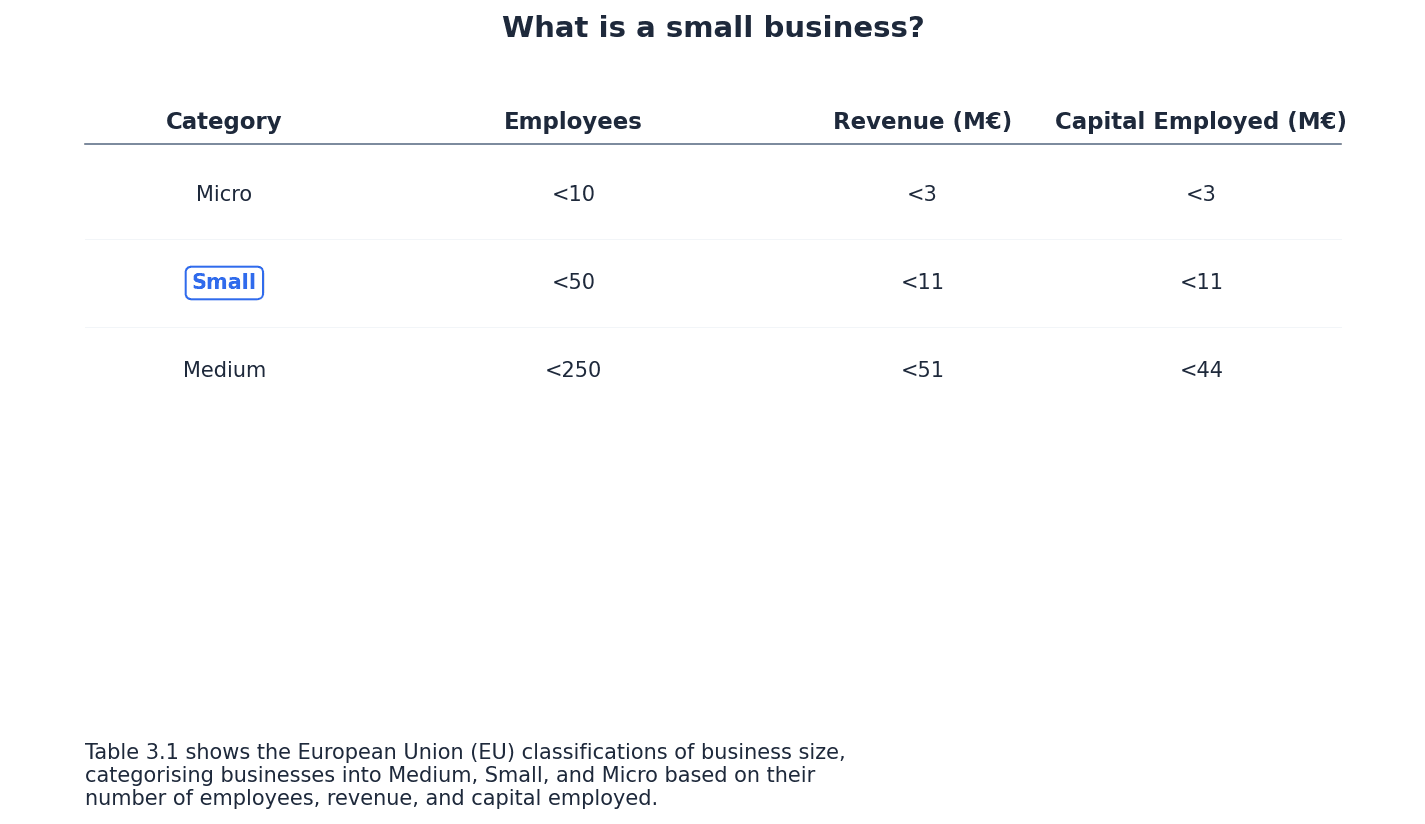
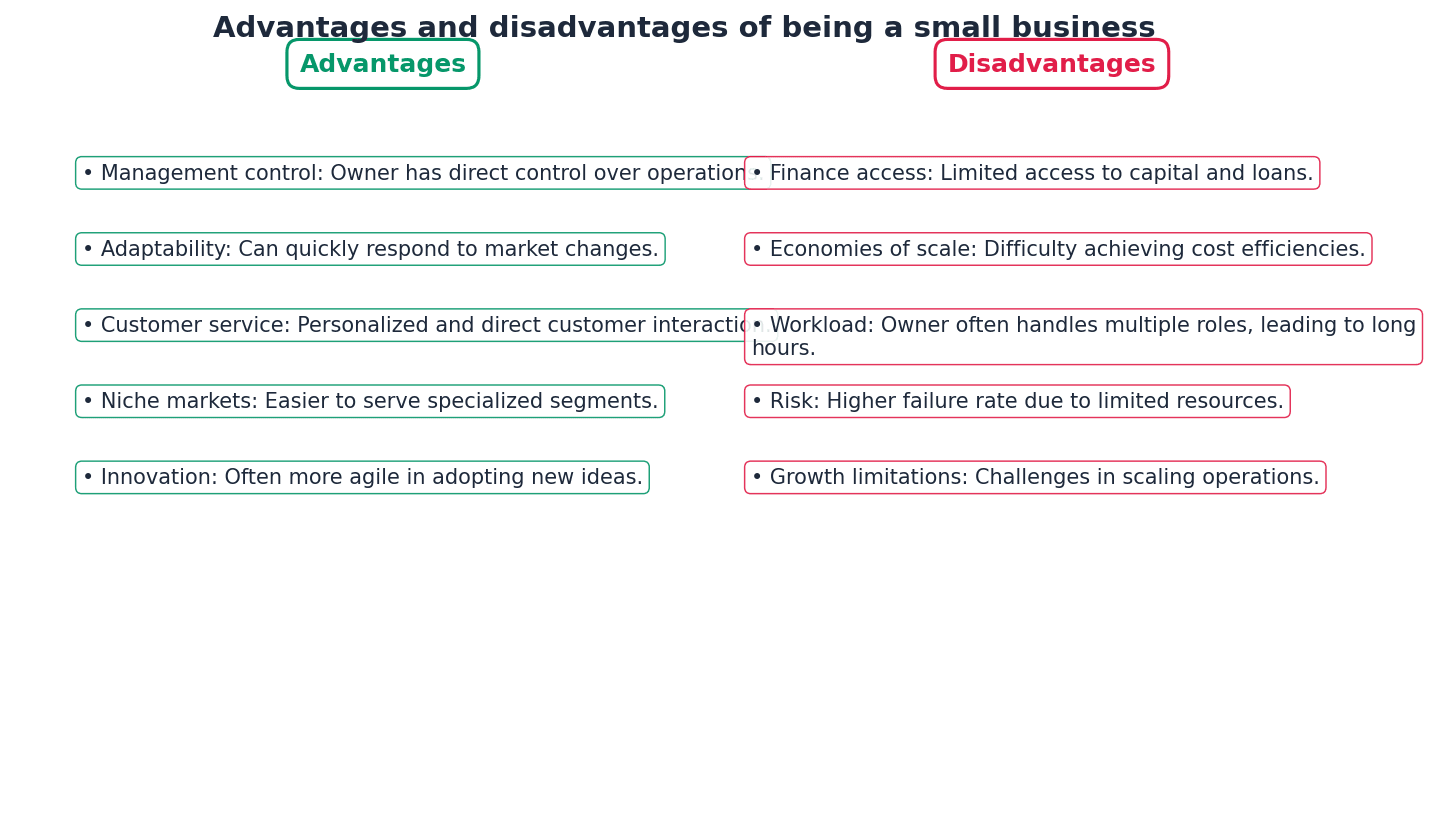
Small businesses play a crucial role in economies and industries. They are vital for employment, innovation, and competition, often acting as suppliers to larger firms. Family businesses, which can range from small enterprises to large public limited companies with controlling family interests, also contribute significantly, bringing unique strengths and weaknesses.
Students often think small businesses are insignificant, but actually they are crucial for employment, innovation, competition, and as suppliers to larger firms.
Students often think family businesses are always small, but actually many large public limited companies are family-owned with controlling interests.
Organic (internal) growth — Organic (internal) growth occurs when a business expands its operations by increasing its own output, sales, or opening new branches.
This form of growth involves expanding from within, such as a bakery opening new shops or increasing cake sales, using its own resources and reinvesting profits. It is typically slower but helps avoid problems associated with rapid expansion, like inadequate capital or management issues from integrating different business cultures.
Students often think organic growth is only about increasing sales, but actually it also includes expanding production capacity, developing new products, or entering new markets using existing resources.
When evaluating organic growth, discuss its slower pace but highlight benefits like maintaining control, avoiding culture clashes, and using retained earnings. Contrast it with the speed and risks of external growth.
External growth — External growth, also known as integration, involves bringing together two or more businesses through mergers or takeovers.
This method allows for rapid expansion, like two puzzle pieces fitting together to form a larger picture. However, it can lead to significant management problems due to the need to combine different systems, resolve conflicts between management teams, and address cultural differences.
Students often think external growth is always successful, but actually it frequently fails to achieve its objectives due to integration challenges, culture clashes, and diseconomies of scale.
When analysing external growth, always consider the potential for management problems, culture clashes, and diseconomies of scale, as these are common reasons for failure. Evaluate its impact on various stakeholders.
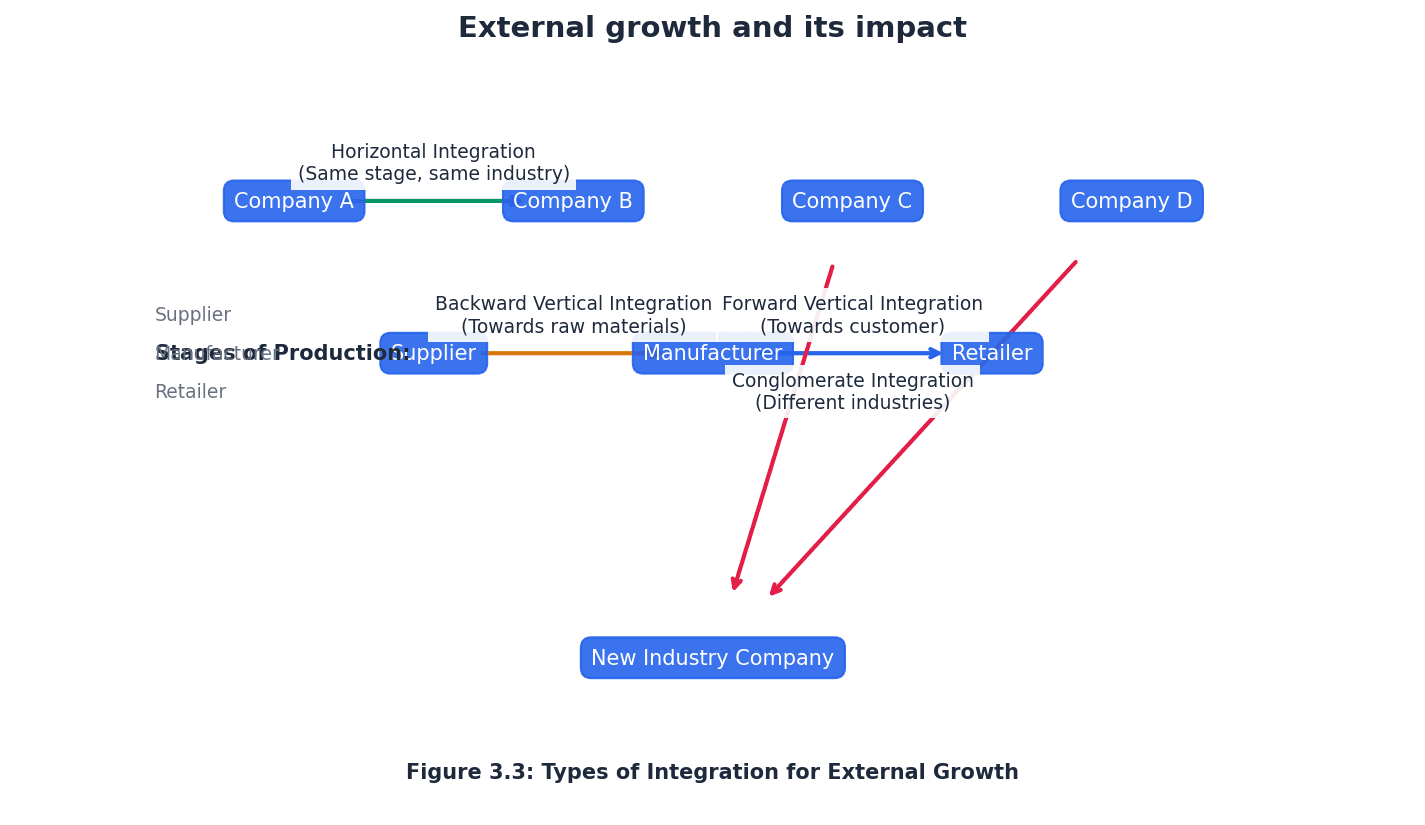
Horizontal integration — Horizontal integration is the merger or takeover of a business at the same stage of production in the same industry.
This strategy eliminates a competitor and increases market share, such as McDonald's buying Burger King. It can lead to economies of scale but may also result in redundancies, reduced customer choice, and potential monopoly investigations.
Students often think horizontal integration only benefits the acquiring company, but actually it can also lead to negative impacts like job losses for workers and reduced choice for consumers.
When discussing horizontal integration, focus on market power, economies of scale, and the impact on competition. Remember to analyse both advantages and disadvantages for stakeholders like consumers and workers.
Forward vertical integration — Forward vertical integration is the merger or takeover of a business at a later stage of production in the same industry.
This allows a business to control the promotion and pricing of its products and secures an outlet, like a car manufacturer buying dealerships to move closer to the final customer. However, the business may lack experience in the new sector, and consumers might react negatively to reduced competition.
Students often think forward vertical integration guarantees success in the new stage, but actually the business may lack the specific expertise needed to manage operations effectively in that sector.
For forward vertical integration, emphasise control over distribution and marketing. Evaluate the risks of lacking experience in the new stage and the potential for consumer backlash due to reduced competition.
Backward vertical integration — Backward vertical integration is the merger or takeover of a business at an earlier stage of production in the same industry.
This strategy provides control over the quality, price, and delivery times of supplies, such as a bakery buying a wheat farm to acquire a raw material supplier. It encourages joint research and development and can limit competitors' access to materials. Risks include lack of experience in managing a supplying company and potential complacency of the acquired business.
Students often think backward vertical integration always improves supply quality, but actually the acquired supplier might become complacent due to having a guaranteed customer, potentially reducing innovation.
When analysing backward vertical integration, highlight benefits like supply chain control and quality assurance. Also, consider the potential for the acquiring firm to lack expertise in the supplying sector and the impact on competition.
Conglomerate integration — Conglomerate integration is the merger or takeover of a business in a completely different industry.
This diversifies the business, spreading risk across different markets and potentially moving into faster-growing sectors, like a shoe company buying a hotel chain. However, it can lead to a lack of management experience in the acquired sector and a lack of clear focus for the overall business.
Students often think conglomerate integration always reduces risk, but actually it can introduce new risks due to a lack of management expertise in unfamiliar industries.
For conglomerate integration, focus on diversification and risk spreading. Be sure to discuss the significant challenge of managing businesses in unrelated sectors and the potential for loss of strategic focus.
Strategic alliance — A strategic alliance is a form of external growth that involves an agreement between businesses or organisations to cooperate on a specific project or objective without complete integration or changes in ownership.
In a strategic alliance, parties remain independent, sharing resources and expertise to achieve mutual benefits, such as developing new products or entering new markets. It's like two sports teams practicing together for a tournament without merging. Alliances are often temporary and end once objectives are met.
Students often think strategic alliances involve a change of ownership, but actually the parties remain independent, cooperating on specific objectives.
Distinguish strategic alliances from mergers/takeovers by emphasising independence and the specific, often temporary, nature of the cooperation. Focus on shared resources and mutual benefits for the partners.
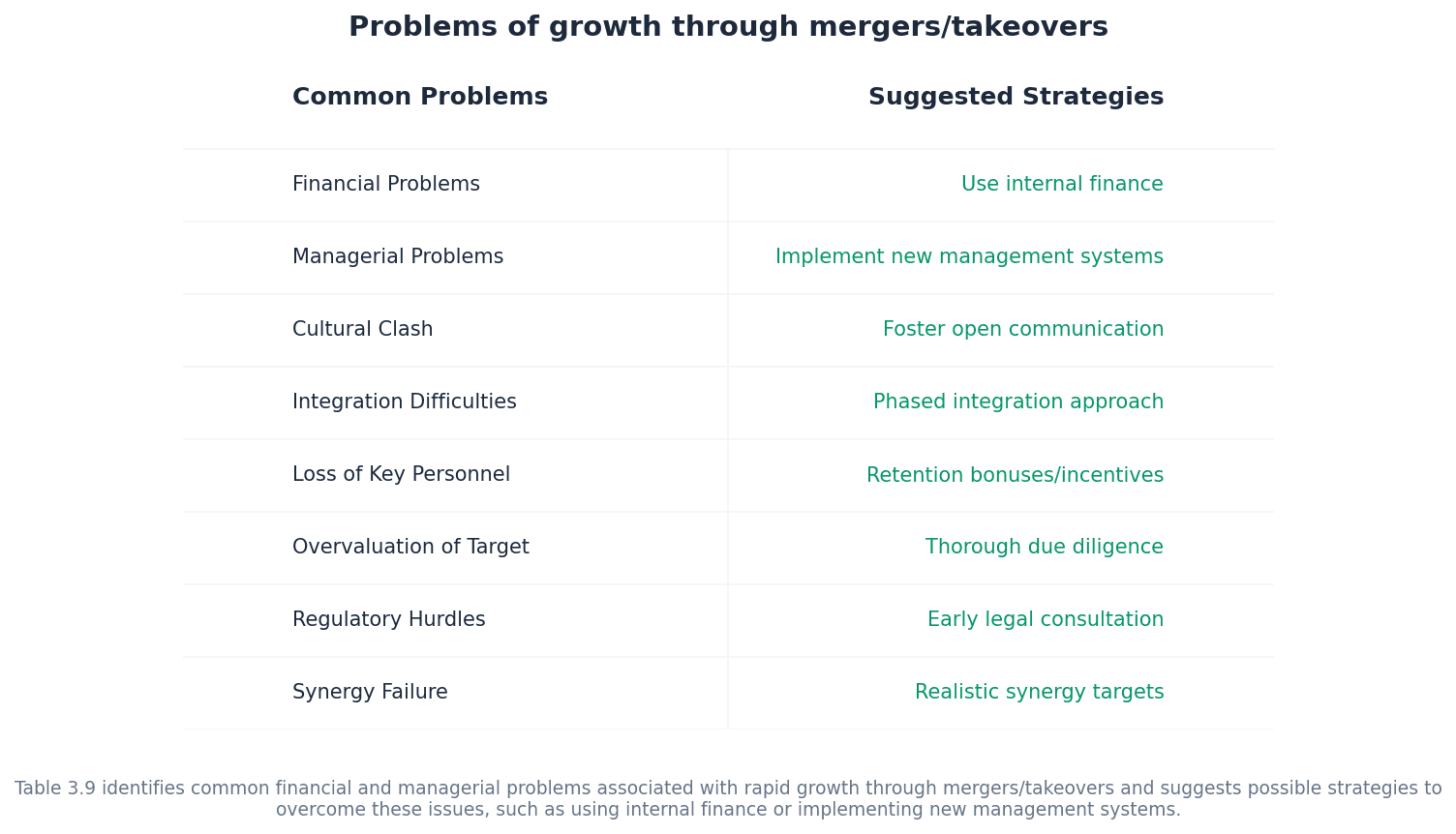
Despite the potential benefits of external growth, many mergers and takeovers fail to achieve their objectives. Common problems include significant management challenges, culture clashes between the integrating businesses, and the emergence of diseconomies of scale. These issues can lead to reduced efficiency, demotivated staff, and ultimately, a failure to realise the anticipated synergies or profitability.
Students often think external growth (mergers/takeovers) always leads to increased efficiency and profitability, but actually many fail due to management problems, culture clashes, and diseconomies of scale.
For questions on growth, evaluate the pros and cons. Don't just list the types of integration; analyse the potential for synergy vs. the risk of failure.
Provide a balanced argument. When discussing small businesses, analyse both their advantages (e.g., flexibility) and disadvantages (e.g., limited finance).
Be precise with terminology. Clearly distinguish between 'organic' and 'external' growth, and between 'horizontal', 'vertical', and 'conglomerate' integration.
Advantages & Disadvantages
Small Businesses
Organic (Internal) Growth
Evaluation Starters
Essay Structure Guide
Introduction
Begin by defining the key terms from the question (e.g., 'external growth' and 'stakeholders'). Briefly outline the scope of your essay, stating that you will evaluate the impact of different forms of external growth on various stakeholders and consider reasons for potential failure.
Conclusion
Summarise your main arguments, reiterating the varied impacts of external growth on stakeholders and the significant challenges that can lead to failure. Provide a final, reasoned judgment on whether external growth is generally beneficial or detrimental, acknowledging the complexities and conditional nature of its success.
This chapter explores the crucial role of setting clear business objectives for private, public, and social enterprises, emphasizing the importance of SMART criteria. It analyzes the links between mission statements, aims, objectives, strategies, and tactics, and their role in effective decision-making. The chapter also discusses the growing significance of corporate social responsibility, the triple bottom line, and how ethical considerations can influence business objectives and activities over time.
Business aims — The core central purpose of a business’s activity, expressed as broad indications of what a business hopes to achieve in future.
Aims are general, long-term statements of intent that are not expressed in SMART terms. They provide the overall direction for the business and must be converted into specific objectives to be actionable. For example, a country's aim might be 'to improve the quality of life for its citizens', which is broad and aspirational.
Mission statements — An attempt to condense the central purpose of a business’s existence into one statement, summing up the business aim in a motivating and appealing way.
Mission statements are not concerned with specific, quantifiable goals but provide a vision and overall sense of purpose. They inform external groups, motivate employees, and guide behaviour, though they can be vague. A school's mission statement might be 'To foster a love of learning and prepare students for global citizenship', which is an overarching philosophy.
Students often confuse aims with objectives, but actually aims are broad, qualitative statements of purpose, while objectives are specific, measurable, and time-bound targets derived from those aims.
Students often think mission statements are the same as objectives, but actually mission statements are broad, qualitative declarations of purpose, whereas objectives are specific, measurable targets.
Distinguish clearly between aims and objectives in your answers. Aims provide the overall vision, while objectives are the concrete steps to achieve that vision.
SMART objectives — Business objectives that are Specific, Measurable, Achievable, Realistic and relevant, and Time-limited.
This acronym provides a framework for setting effective objectives that are clear, quantifiable, attainable, pertinent to the business's resources, and have a defined deadline. General objectives are often meaningless without these criteria. For instance, instead of saying 'I want to get fit', a SMART objective would be 'I will run 5km in under 30 minutes by the end of three months'.
Students often think 'Achievable' and 'Realistic' are the same, but actually 'Achievable' refers to the possibility of reaching the target, while 'Realistic' considers the company's resources and current market conditions.
When asked to analyse SMART objectives, break down an example objective and explain how it meets each of the five criteria. Also, discuss the benefits of using SMART objectives for decision-making and motivation.
Setting clear business objectives is critical for private, public, and social enterprises. Objectives provide direction, enable effective decision-making, and allow for the measurement of progress. They help to translate broad aims into actionable targets, ensuring that all activities within the business contribute towards a common purpose.
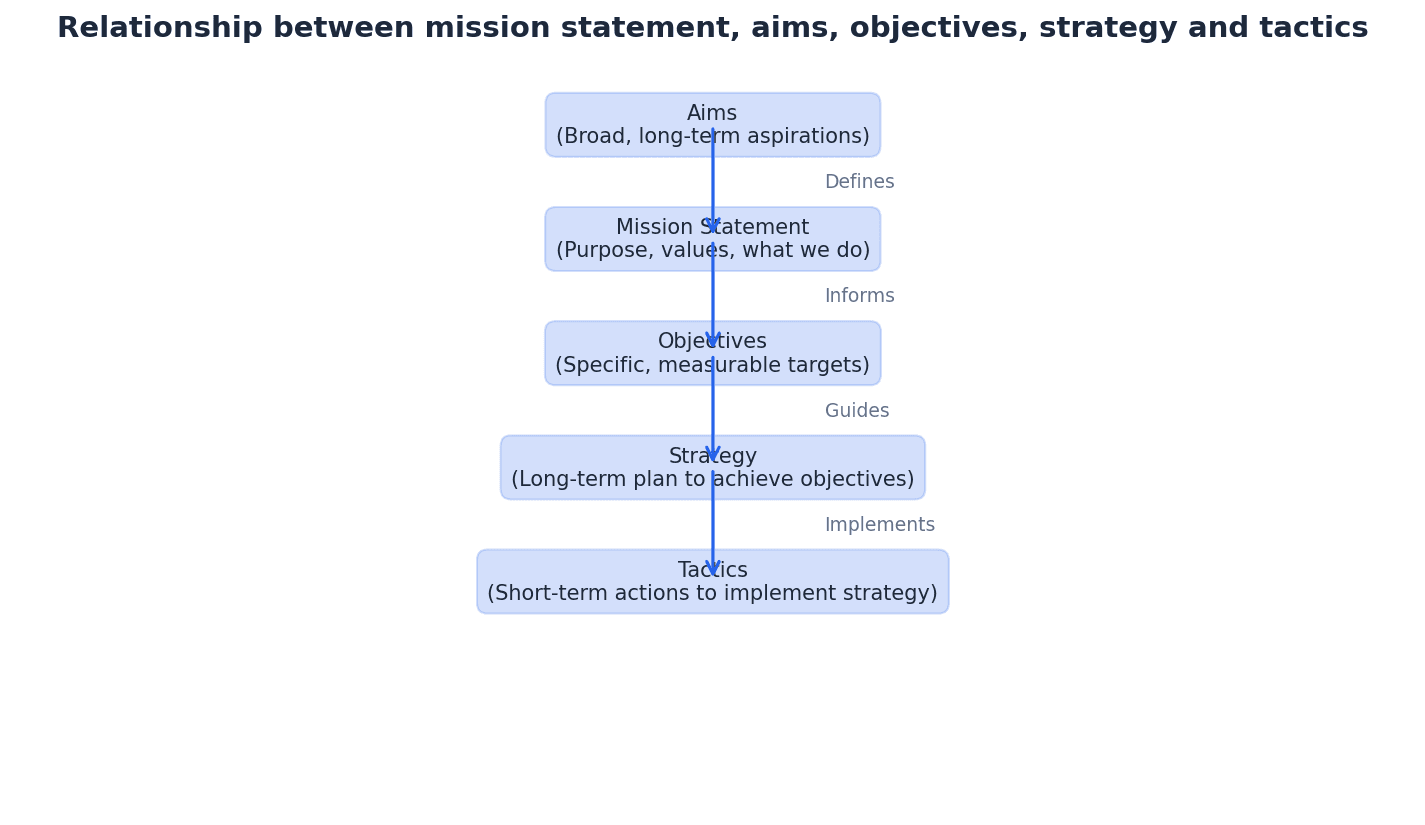
Business strategies — The long-term plans of action of a business, providing the focus for how aims and objectives will be achieved.
Strategies are developed based on clear objectives and guide important decisions for the business as a whole or for individual departments. They address how a business will compete, grow, and achieve its goals over an extended period. For example, if an objective is to 'increase market share by 20%', a strategy might be 'to enter new international markets'.
Tactical decisions — Small-scale, short-term decisions taken to implement a broader business strategy.
Once a strategy has been decided, tactical decisions are the operational choices made to execute that strategy. They are more detailed and immediate than strategic decisions. If the strategy is 'to enter new international markets', a tactical decision might be 'to launch a specific advertising campaign in India next month'.
Students often confuse strategies with tactics, but actually strategies are the overarching long-term plans, while tactics are the specific, short-term actions taken to implement those strategies.
When analysing strategies, ensure you link them directly to the business's objectives. Explain how a particular strategy helps achieve a specific objective, rather than just describing the strategy itself.
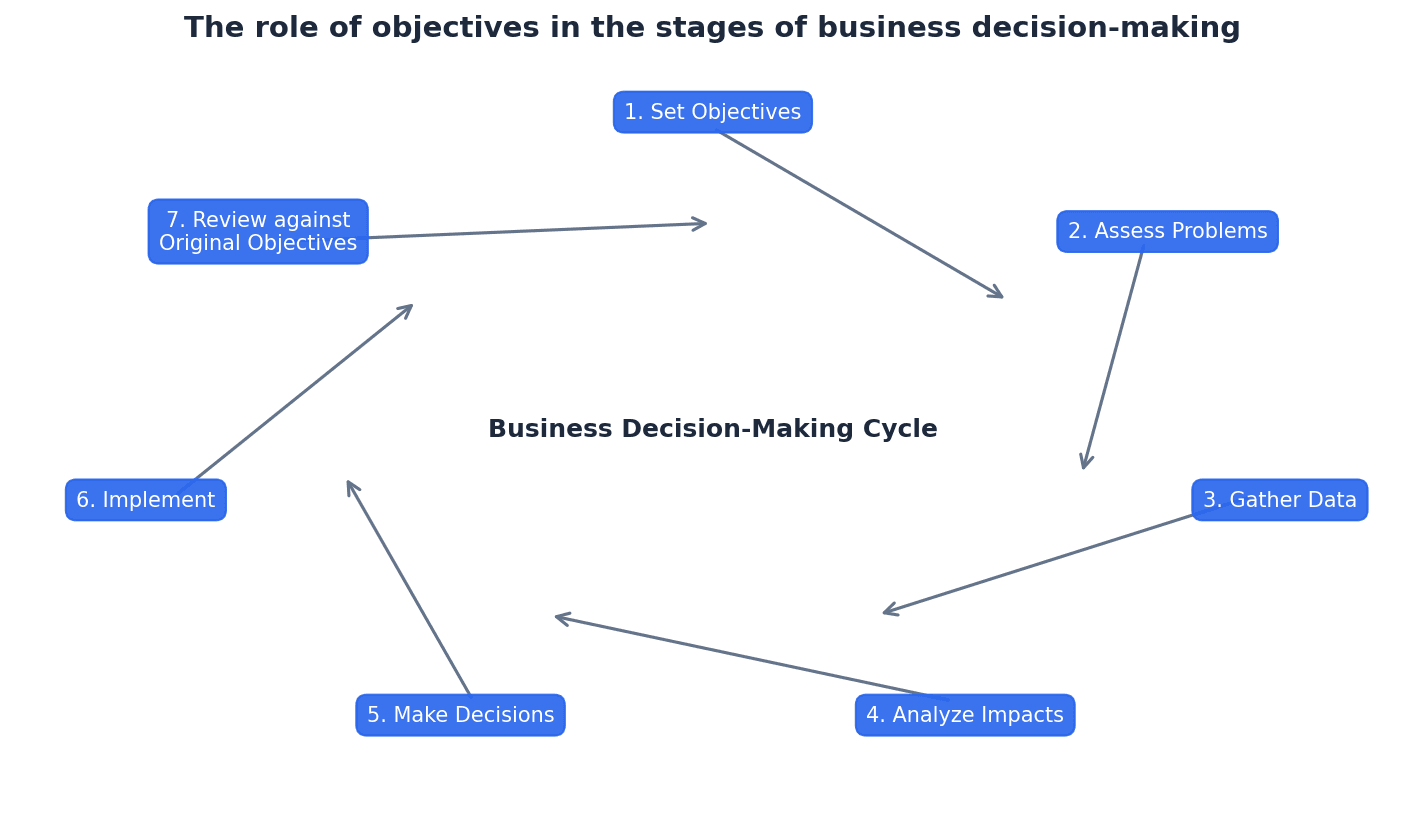
Objectives play a crucial role in business decision-making by providing a clear framework for choices. They guide the allocation of resources, the development of strategies, and the evaluation of outcomes. Without clear objectives, decisions can become arbitrary and lack coherence, potentially leading to inefficient operations and missed opportunities.
Private sector businesses typically focus on financial objectives. Common objectives include profit maximisation, growth, increasing market share, survival, maximising short-term revenue, and increasing shareholder value. These objectives are driven by the need to generate returns for owners and investors, and to ensure the long-term viability of the business in a competitive environment.
Profit maximisation — Producing at the level of output where the greatest positive difference between total revenue and total costs is achieved.
This objective aims to achieve the highest possible profit. While it rewards investors and finances growth, it can attract competitors, lead to short-term focus, and may conflict with other stakeholder interests like job security or environmental protection. Imagine a lemonade stand owner who constantly adjusts the price and number of cups sold to find the exact combination that brings in the most money after all costs are paid.
Students often think profit maximisation means selling as much as possible, but actually it means finding the optimal balance between revenue and costs to achieve the highest absolute profit.
When asked to evaluate profit maximisation, consider both its benefits (e.g., shareholder returns, reinvestment) and its limitations (e.g., short-term focus, stakeholder conflicts, difficulty in measurement).
Profit satisficing — Aiming to achieve enough profit to keep the owners satisfied, rather than earning as much profit as possible.
This is a common aim for small business owners who prioritise a comfortable lifestyle, leisure time, or work-life balance over working longer hours to maximise profits. Once a satisfactory profit level is reached, other aims take priority. A freelance graphic designer might aim to earn enough to cover their living expenses and save a bit, then decline extra work to enjoy their weekends.
Students often think profit satisficing means making minimal profit, but actually it means achieving a 'sufficient' or 'acceptable' level of profit that meets the owners' needs and allows for other non-financial objectives.
When discussing profit satisficing, link it to the objectives of small business owners and their desire for work-life balance or independence, contrasting it with the pure financial drive of larger corporations.
Social enterprises have a distinct set of objectives, often balancing financial viability with social and environmental impact. Public sector businesses, on the other hand, typically focus on providing essential services, improving public welfare, and operating within budgetary constraints, rather than profit generation. Their objectives are often driven by government policy and public need.
Triple bottom line — The three main aims of social enterprises: economic (financial), social, and environmental.
This concept suggests that businesses, especially social enterprises, should measure their success not just by profit, but also by their positive impact on people (social) and the planet (environmental). It signifies that profit is not the sole objective. Imagine a coffee shop that not only makes a profit, but also employs homeless individuals and uses compostable cups while sourcing fair-trade beans.
Students often think the triple bottom line only applies to charities, but actually it's a framework for social enterprises and increasingly for other businesses committed to CSR, to measure performance across profit, people, and planet.
When discussing the triple bottom line, ensure you explicitly mention and explain each of the three components (profit, people, planet) and how they contribute to a holistic view of business success, especially for social enterprises.
Corporate social responsibility (CSR) — The concept that businesses should consider the interests of society by taking responsibility for the impact of their decisions and activities on customers, employees, communities and the environment.
CSR involves businesses adopting a wider perspective than just profit, incorporating social, environmental, and ethical issues into their objectives. This can be driven by public pressure, legal changes, or a genuine concern for 'public responsibility'. A clothing company that ensures its factories pay fair wages, use sustainable materials, and avoid child labor, even if it costs more, is demonstrating CSR.
Students often think CSR is just about donating to charity, but actually it encompasses a broader commitment to ethical practices, environmental sustainability, and positive social impact throughout all business operations.
When analysing CSR, evaluate both the potential benefits (e.g., improved reputation, increased sales, employee motivation) and the potential drawbacks (e.g., increased costs, reduced short-term profits) and consider whether it's a genuine commitment or a PR exercise.
Ethical code of conduct — A document detailing a company's rules and guidelines on how employees should behave and make decisions in situations with an ethical or moral dimension.
This code helps guide employees through ethical dilemmas, ensuring consistency in behaviour and decision-making that aligns with the company's values. It covers issues beyond legal requirements. Think of a school's student handbook that outlines rules on academic honesty, respect for others, and appropriate online behaviour.
Students often think an ethical code is just about following the law, but actually it goes beyond legal requirements to define what the company considers morally right or wrong, even if not legally mandated.
When analysing ethical codes, discuss how they can influence both business objectives (e.g., setting CSR goals) and activities (e.g., supplier choice, advertising practices), and evaluate the short-term costs versus long-term benefits.
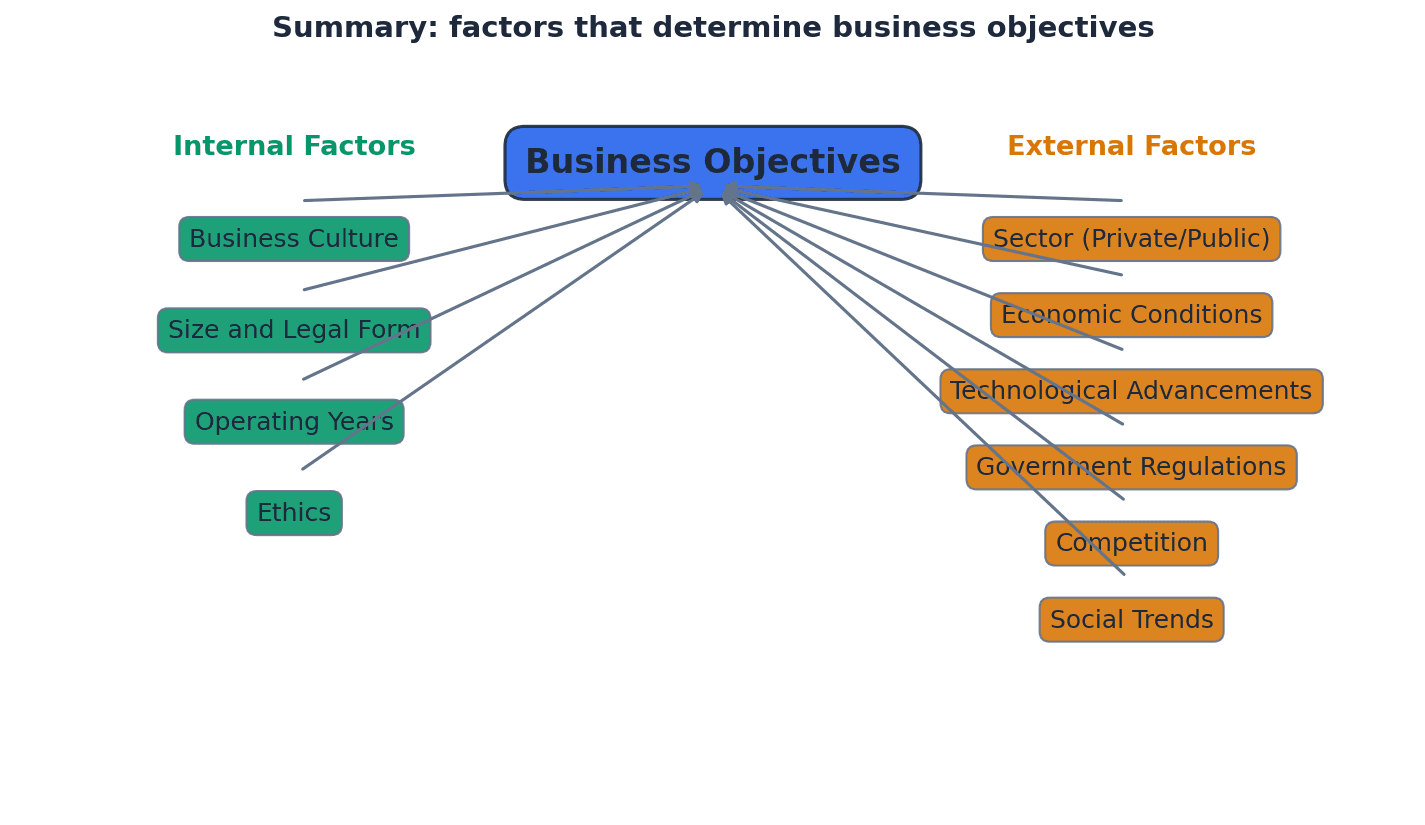
Business objectives are not static; they evolve over time due to various internal and external factors. These include the business's age, size, legal form, and whether it operates in the private or public sector. The competitive environment, economic conditions, and changes in business culture or ethical considerations can also significantly influence a business's priorities and objectives.
Demonstrate higher-level understanding by explaining how a business's objectives might need to change over time in response to internal or external factors.
In case studies, always link a business's objectives to its type (e.g., private, public, social enterprise) to explain its priorities.
Advantages & Disadvantages
Profit maximisation
Corporate Social Responsibility (CSR)
Evaluation Starters
Essay Structure Guide
Introduction
Begin by defining key terms such as 'business objectives' and 'CSR' (if relevant to the question). Briefly state the importance of objectives and outline the main arguments you will present regarding their influence or evolution.
Conclusion
Summarise your main arguments, reiterating the dynamic nature and critical role of objectives in business success. Provide a final, balanced judgement on the extent to which objectives are influenced by various factors or the overall effectiveness of specific objective-setting approaches.
This chapter explores the concept of stakeholders, defining them as any group or individual with an interest in a business, and distinguishes between internal and external types. It examines their roles, rights, and responsibilities, and assesses how business decisions impact them, highlighting the importance of accountability. The chapter also addresses how stakeholder aims influence business decisions, identifies potential conflicts, and evaluates strategies for resolution.
Stakeholder — A stakeholder is any individual or group with an interest in the activities of a business.
This broad term includes both internal groups, such as employees and owners, and external groups like customers, suppliers, and the government. Their interests can be directly or indirectly affected by business decisions, much like how actors, directors, parents, and the audience all have an interest in a school play's success.
Students often confuse 'stakeholder' with 'shareholder'. Remember that a stakeholder is a much broader term covering anyone affected by or affecting the business, while a shareholder is just one type of stakeholder.
Shareholder concept — The traditional view that the primary duty of a company is to its shareholders, focusing on increasing shareholder value.
This concept implies that directors and managers are legally bound to prioritise the financial interests of the owners, making decisions with the goal of maximising profits and returns for shareholders. This is similar to a sports team focusing solely on winning the championship for its owner, potentially neglecting fan experience.
When evaluating business decisions, consider how they align with or diverge from the shareholder concept. Use terms like 'legally binding duty' to demonstrate understanding of its significance.
Stakeholder concept — The view that businesses should consider the interests of all parties involved in and affected by business activity, not just the owners.
This broader perspective acknowledges that various groups, including local communities, the public, government, and environmental groups, have legitimate interests that should influence business decision-making. Ignoring these can lead to negative reactions, much like a community garden project considering local residents and environmental groups, not just the gardeners.
Students often think the shareholder concept is outdated and no longer relevant. However, it remains a legally binding duty for companies in many jurisdictions, though often balanced with stakeholder considerations.
Students often think the stakeholder concept means ignoring shareholder interests. In reality, it means balancing shareholder interests with those of other groups, which can often lead to long-term benefits for shareholders too.
Accountability — The responsibility of a business to justify its actions and decisions to its stakeholders.
This involves being transparent about operations and demonstrating how decisions consider the aims and impacts on various stakeholder groups. Increased corporate social responsibility often leads to greater accountability, much like a student being accountable to their teacher for homework.
Students often think accountability is just about legal compliance. However, it extends to ethical and social responsibilities beyond what is legally mandated.
Stakeholders are individuals or groups with an interest in a business's activities. They can be categorised as either internal, such as employees and managers, or external, including customers, suppliers, the local community, and the government. Understanding this distinction is crucial for analysing their varying interests and influence.
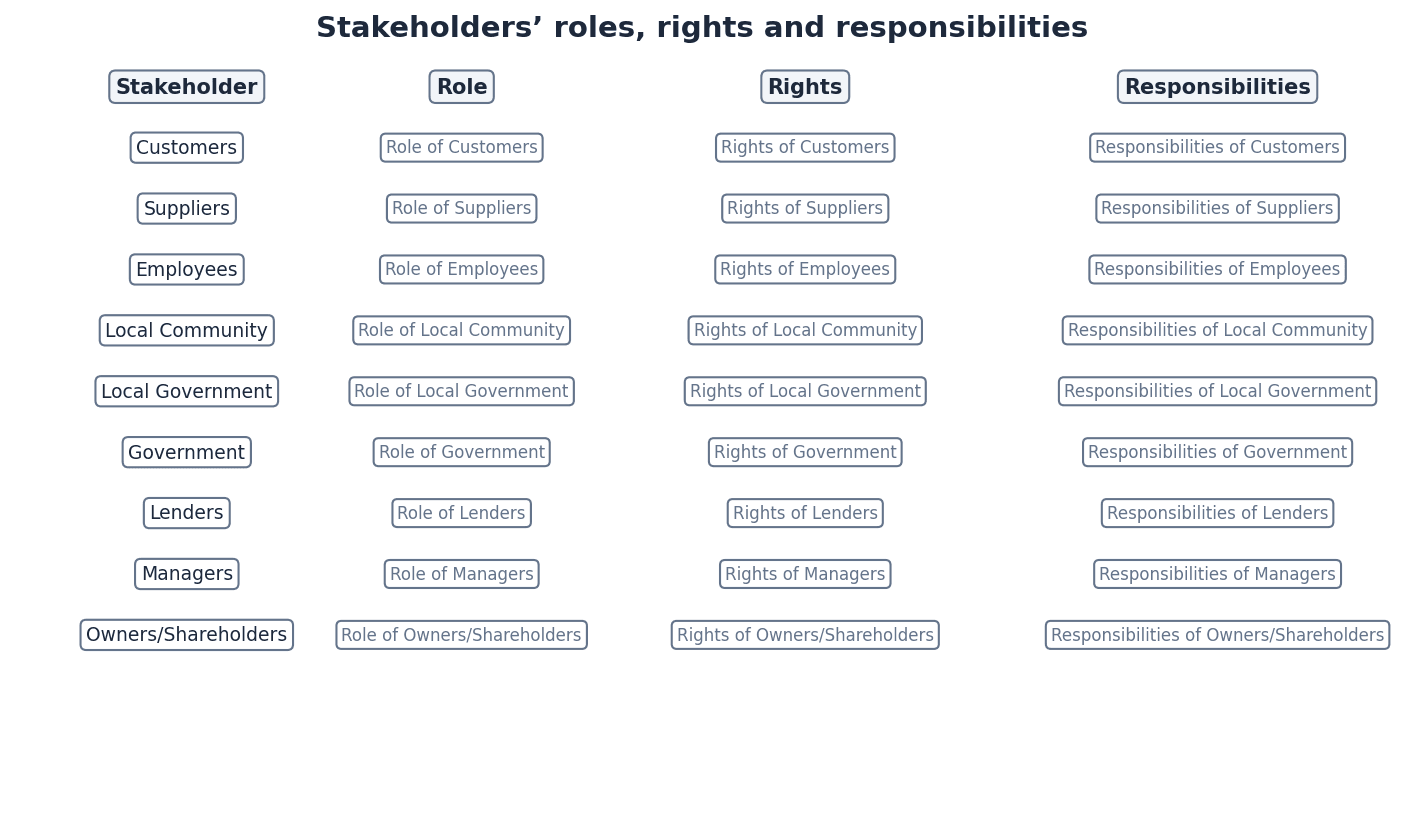
Key business stakeholders have distinct roles, rights, and responsibilities. For instance, employees have a right to fair pay and safe working conditions, while customers have a right to safe products. Businesses, in turn, have responsibilities to these groups, such as providing fair pay for employees and prompt payment to suppliers. These responsibilities extend beyond legal obligations to include ethical and social considerations.
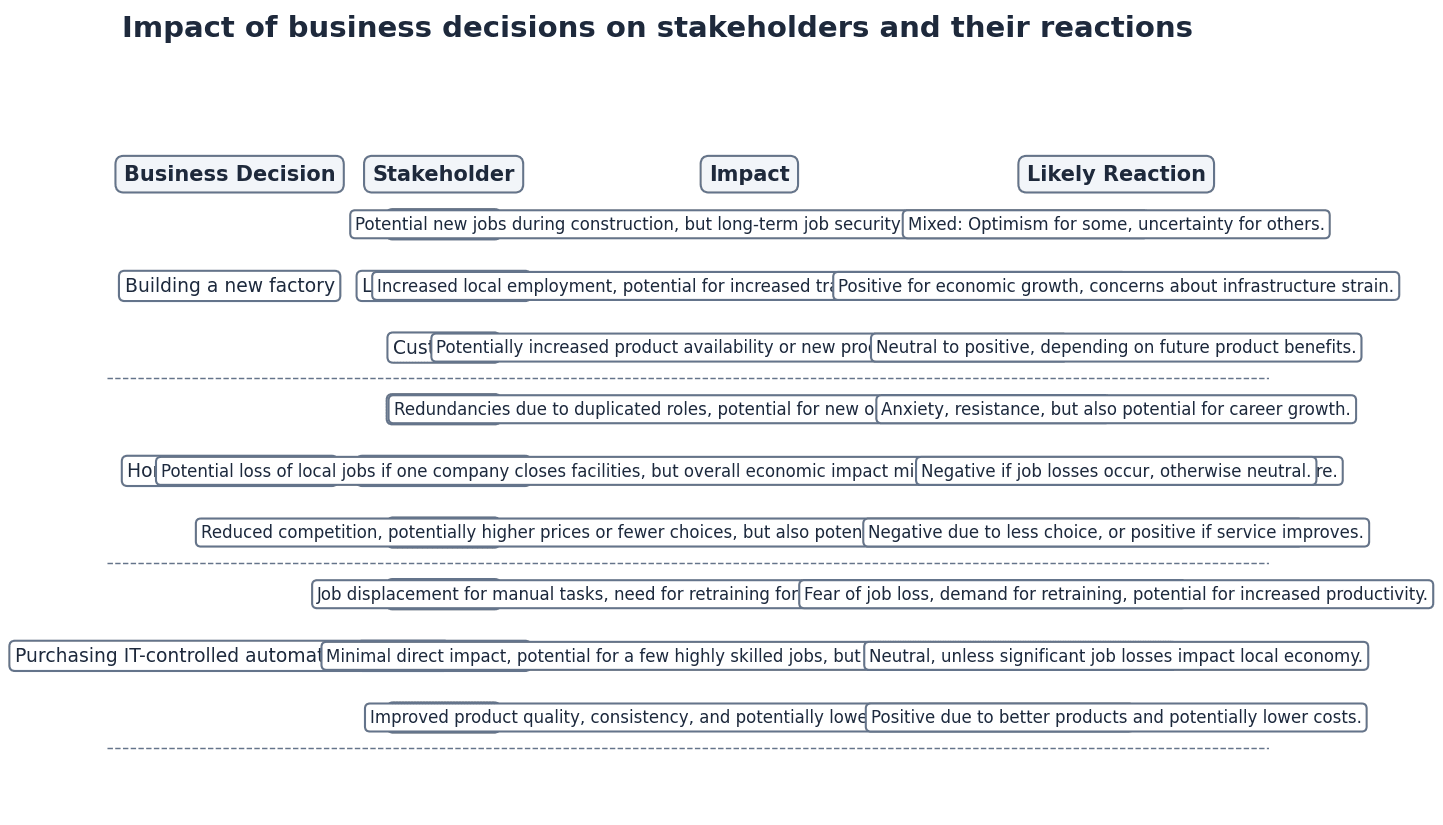
Business decisions inevitably impact various stakeholder groups, often leading to different reactions. For example, a decision to cut costs might lead to job losses, negatively affecting employees and the local community. Conversely, investing in new technology could benefit shareholders through increased profits and customers through improved products. Businesses must be accountable for these impacts, justifying their actions and demonstrating transparency.
When analysing accountability, link it to specific business actions or policies, such as publishing Corporate Social Responsibility (CSR) reports or engaging in community consultations. Explain how this can build trust and reputation.
Stakeholder aims and objectives often conflict. For example, shareholders may desire higher profits, which could clash with employees wanting higher wages or customers demanding lower prices. Businesses must assess these conflicting aims and evaluate strategies to respond, which might involve compromise, prioritisation, or seeking long-term benefits that satisfy multiple groups. Changing business objectives will also impact different stakeholder groups in varying ways, often creating new conflicts.
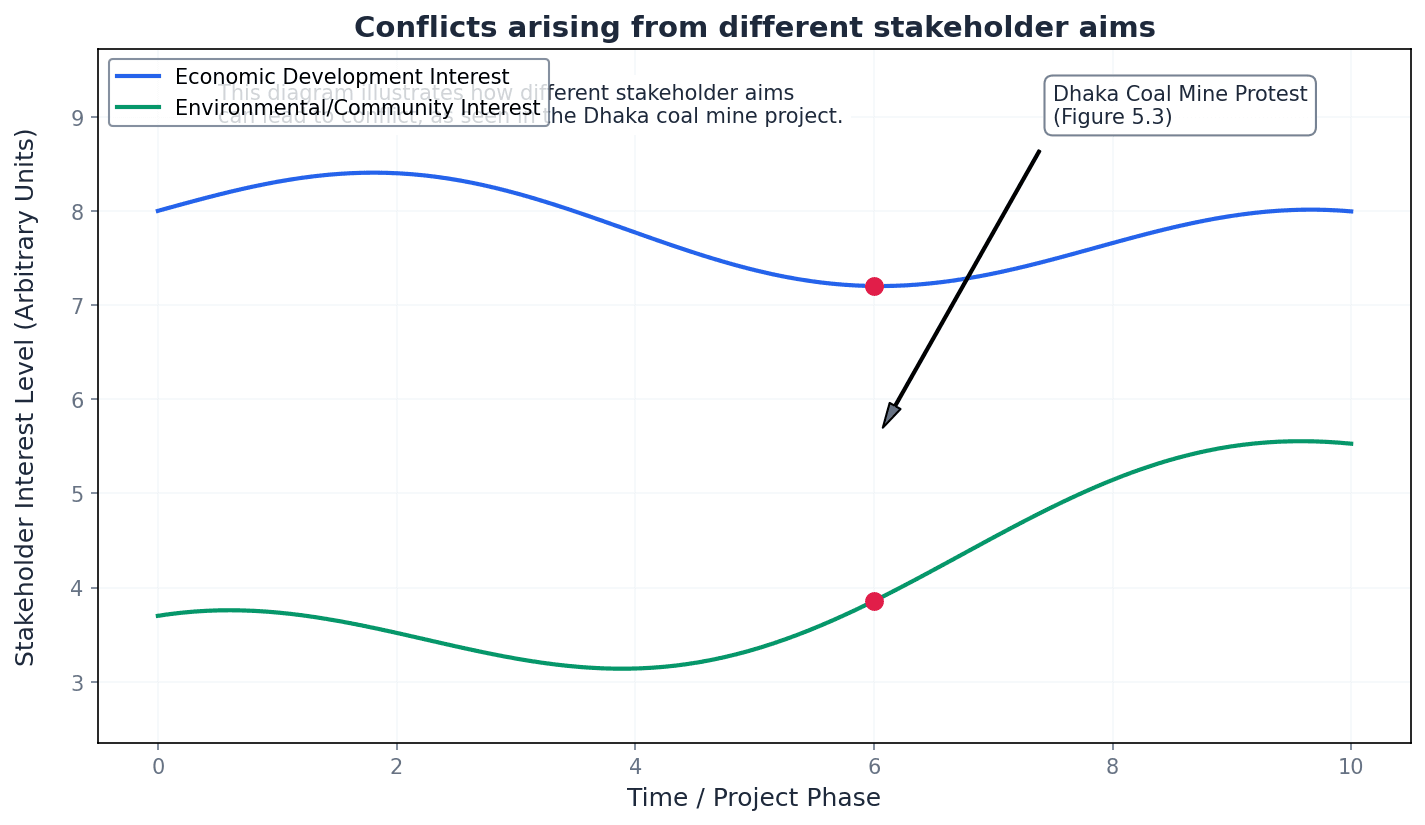
Students often believe that all stakeholder aims can be met simultaneously. However, conflicts are common and require compromise or prioritisation by the business.
Students may think that meeting stakeholder aims always reduces profits. In reality, it can lead to long-term benefits, such as improved reputation, increased customer loyalty, and higher profits.
When asked to 'analyse' stakeholders, ensure you discuss both their interest in the business and how business decisions impact them, and vice versa. Distinguish between internal and external stakeholders.
When discussing the stakeholder concept, provide specific examples of how different stakeholder groups' interests might be considered. Use command words like 'assess' or 'evaluate' to discuss the implications of adopting this approach.
In evaluation questions, justify which stakeholder group a business might prioritise and why, linking your reasoning to the business's objectives or its adoption of the stakeholder/shareholder concept.
When analysing a business decision, always consider the impact on at least two different stakeholder groups to show balance and identify potential conflict.
Advantages & Disadvantages
Adopting the Shareholder Concept
Adopting the Stakeholder Concept
Evaluation Starters
Essay Structure Guide
Introduction
Begin by defining 'stakeholder' and briefly outlining the distinction between internal and external stakeholders. State the main argument or approach your essay will take regarding the impact of stakeholders or the resolution of conflicts.
Conclusion
Summarise your main arguments, reiterating the complexity of managing stakeholder relationships. Provide a final, justified judgment on how businesses should approach stakeholder management, perhaps linking it to the concept of accountability and long-term sustainability.
This chapter explores the diverse external influences on business activity, encompassing political, legal, social, demographic, technological, competitive, international, and environmental factors. It examines how government interventions, legal controls, societal shifts, and technological advancements impact business decisions, alongside the growing importance of sustainability and corporate social responsibility.
Privatisation — The transfer of ownership of state-owned industries into the private sector by creating public limited companies.
Shares in these newly formed public limited companies are sold through the stock exchange. This is like selling a public library system to a private company, which would then run it for profit, potentially charging for services that were once free.
Students often think privatisation always leads to better services, but actually it can lead to higher prices or reduced access for some consumers if profit becomes the sole driver.
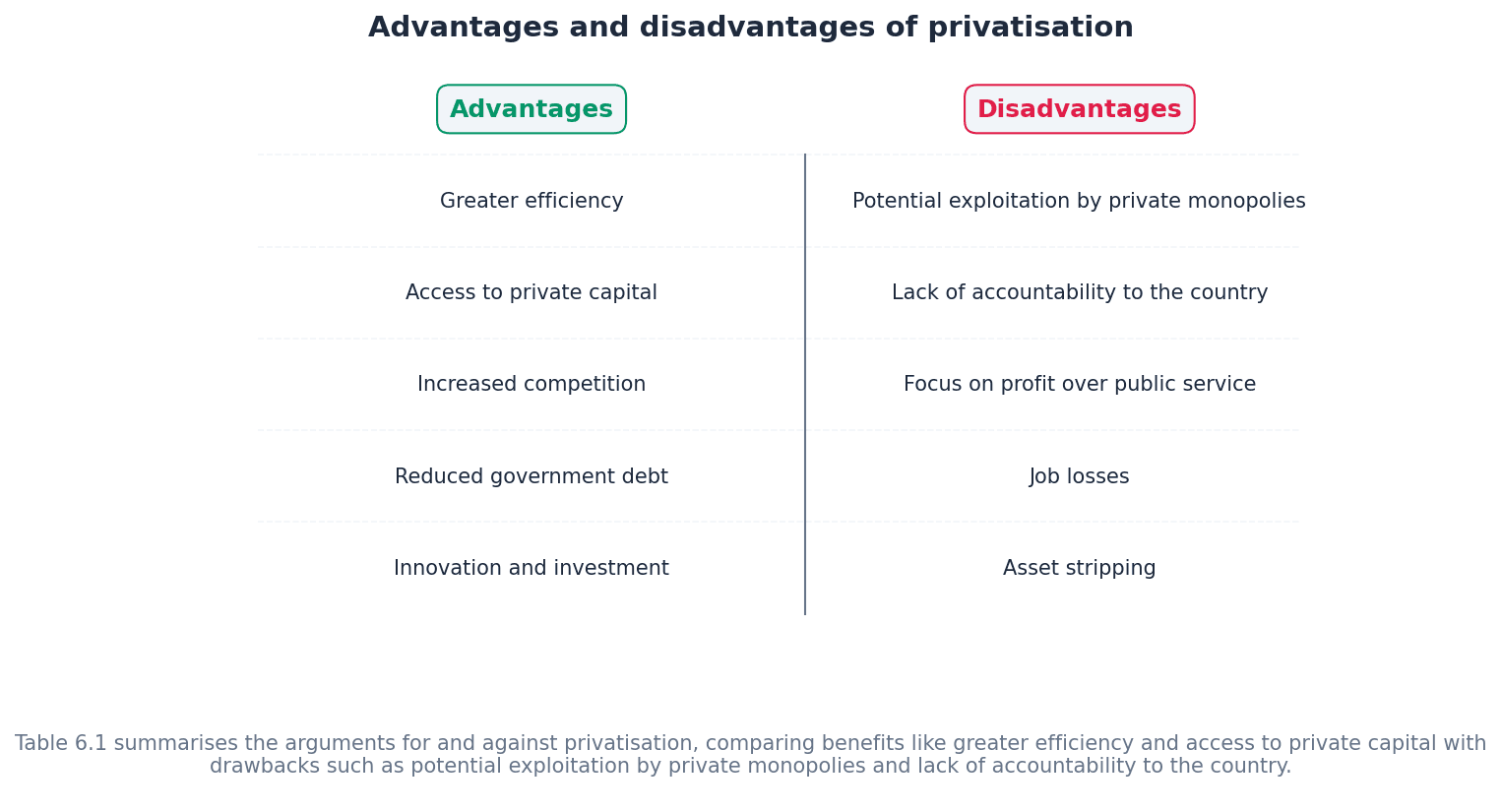
When evaluating privatisation, ensure you discuss both the claimed advantages (e.g., efficiency, investment) and disadvantages (e.g., public interest, monopolies) and justify your conclusion with specific examples.
Nationalisation — The process of the state buying privately owned businesses to bring them under government control.
This is often done to ensure essential services are provided based on societal needs rather than just profit, or to save struggling industries. If a country's main railway system is privately owned and facing bankruptcy, nationalisation would be the government buying it to keep it running, potentially prioritising public service over profit.
Students often think nationalisation means the business will always be inefficient, but actually it can allow for integrated policy and economies of scale, though it may lack profit incentives.
When analysing nationalisation, consider the trade-offs between social objectives (e.g., public service, preventing exploitation) and economic efficiency, using examples to illustrate the impact on stakeholders.
Governments intervene in business ownership through privatisation and nationalisation, impacting market structure and service provision. Beyond ownership, legal controls are used to regulate business activity, influencing decisions related to employment, consumer rights, and competition. These interventions aim to balance economic efficiency with social welfare.
Minimum wage — A legally binding lowest hourly rate that employers can pay their workers.
The two main aims are to prevent exploitation of poorly organised workers and reduce income inequalities. This is like a price floor for labour, ensuring workers earn at least a certain amount per hour.
Students often think a minimum wage always benefits all low-paid workers, but actually some businesses might respond by reducing staff numbers or slowing hiring, leading to job losses for some.
When discussing minimum wage, evaluate both the positive impacts (e.g., increased living standards, work incentive) and negative impacts (e.g., uncompetitiveness, job losses, inflation) on businesses and the economy.
Governments use legal controls to regulate employment practices, including recruitment, contracts, termination, and health and safety at work. Consumer protection laws ensure product safety and fair marketing, while competition laws prevent monopolies and anti-competitive practices. Businesses must adapt their strategies to comply with these evolving legal frameworks.
Corporate social responsibility (CSR) — When a business accepts its legal and moral obligations to all stakeholders, not just investors.
This involves considering the impact of business decisions on society and the environment, going beyond just making a profit. It's like a company that not only makes good products but also ensures its factories are safe, its workers are paid fairly, and it doesn't pollute the local river.
Students often think CSR is just about charity, but actually it encompasses a much broader range of ethical and environmental practices integrated into core business operations.
When evaluating CSR, consider the benefits (e.g., improved public image, attracting talent) and costs (e.g., higher expenses, potential for greenwashing) and how it impacts different stakeholder groups.
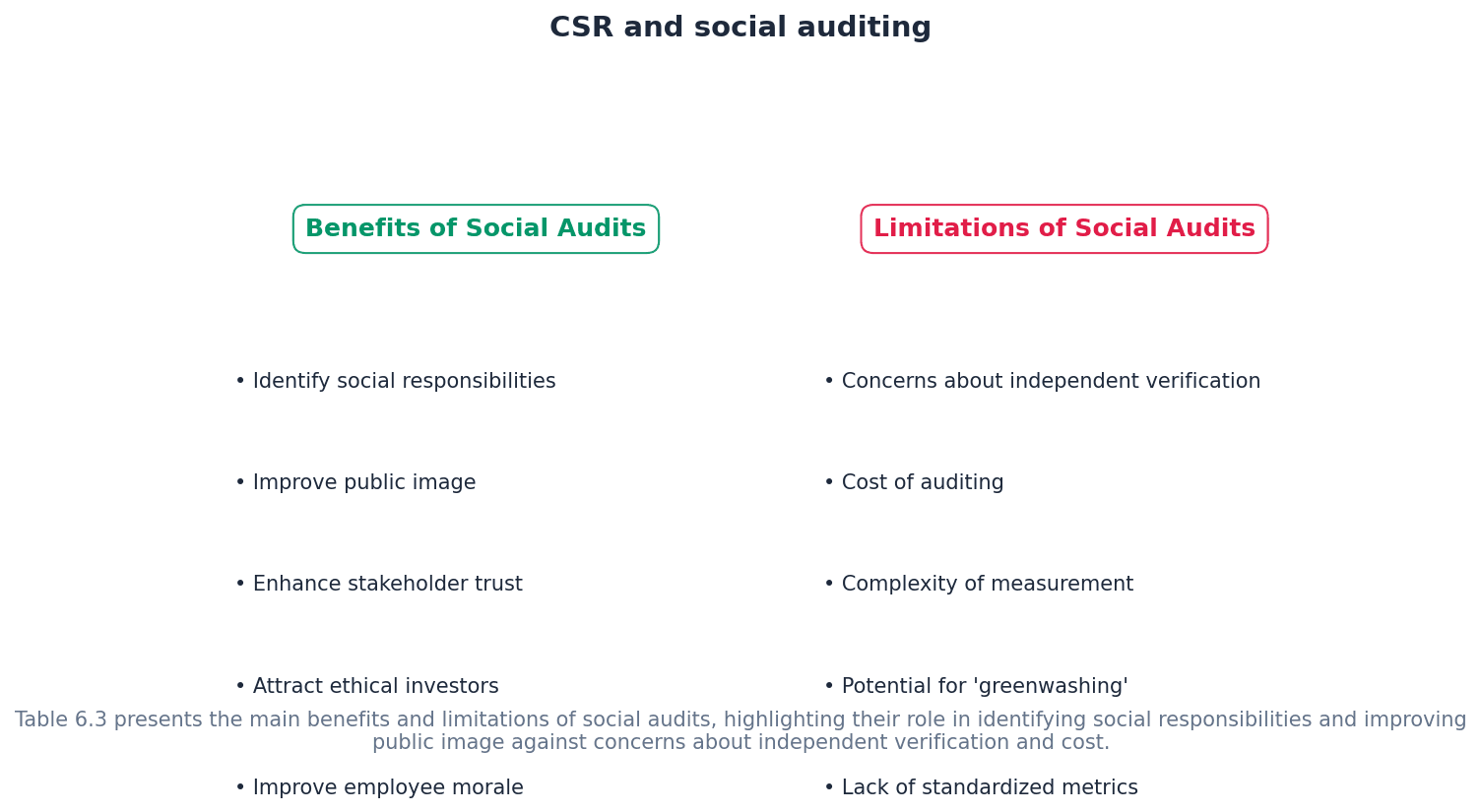
Social audits — Annual reports that indicate the social impact of a business over a period, showing efforts to meet social responsibilities.
These audits typically include health and safety records, pollution levels, community contributions, and ethical sourcing. Just as a financial audit checks a company's money, a social audit checks a company's 'goodness' – how it treats its employees, the environment, and the community.
Students often think social audits are legally binding and always accurate, but actually they are often voluntary and may not be independently checked, leading to concerns about their credibility.
When assessing social audits, discuss their benefits (e.g., identifying areas for improvement, marketing tool) and limitations (e.g., lack of independent verification, cost, potential for 'smokescreen') to provide a balanced evaluation.
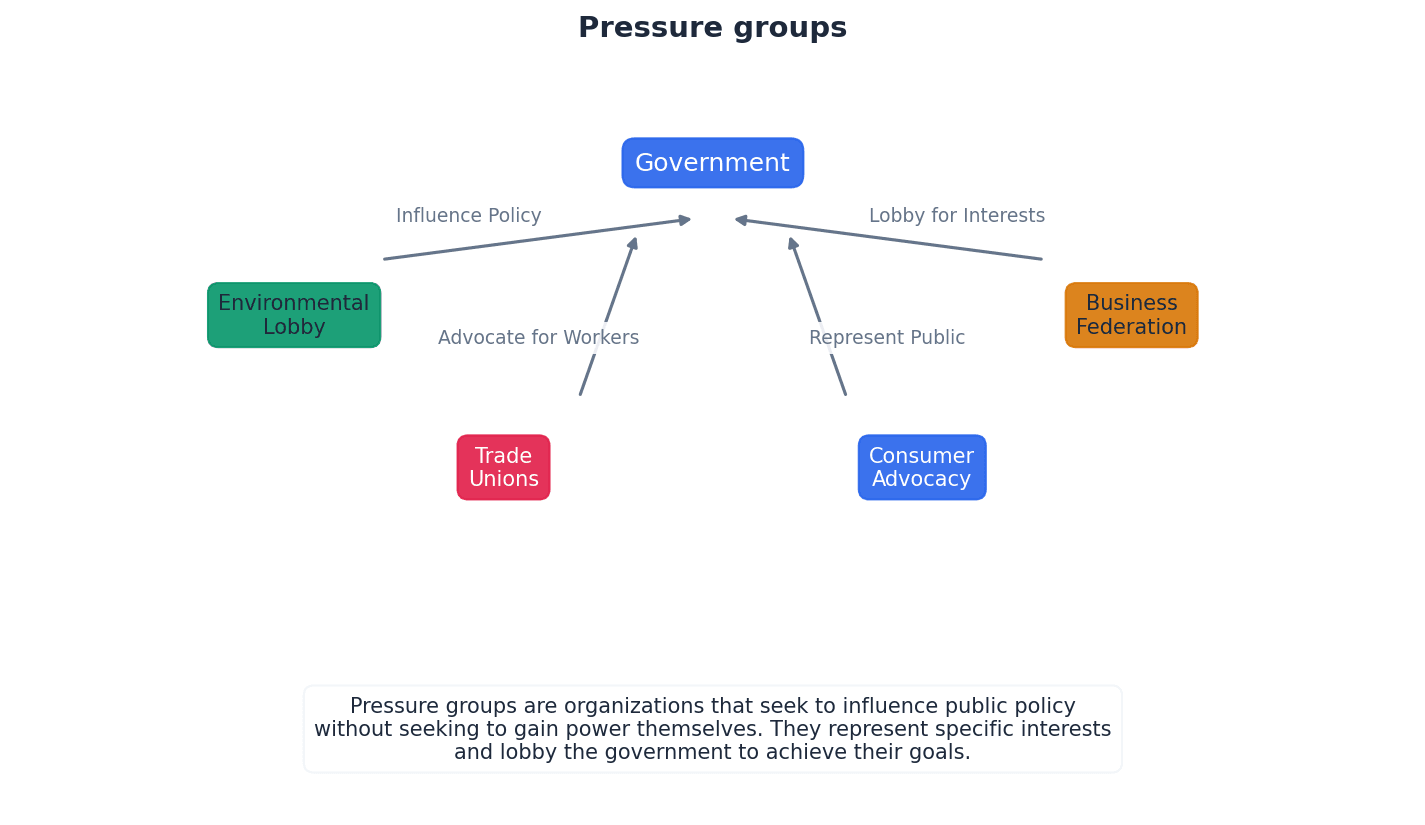
Pressure groups — Organisations that seek to influence business and government decisions to achieve specific aims, often related to social or environmental issues.
They achieve their goals through publicity, influencing consumer behaviour (e.g., boycotts), and lobbying governments to change laws. They act as a collective voice for a cause, mobilising people to force change.
Students often think pressure groups only target businesses, but actually they also lobby governments to introduce new laws or change existing policies.
When evaluating the impact of pressure groups, analyse their methods (e.g., media, boycotts, lobbying) and how these can create both threats (e.g., bad publicity, reduced sales) and opportunities (e.g., improved reputation by responding) for businesses.
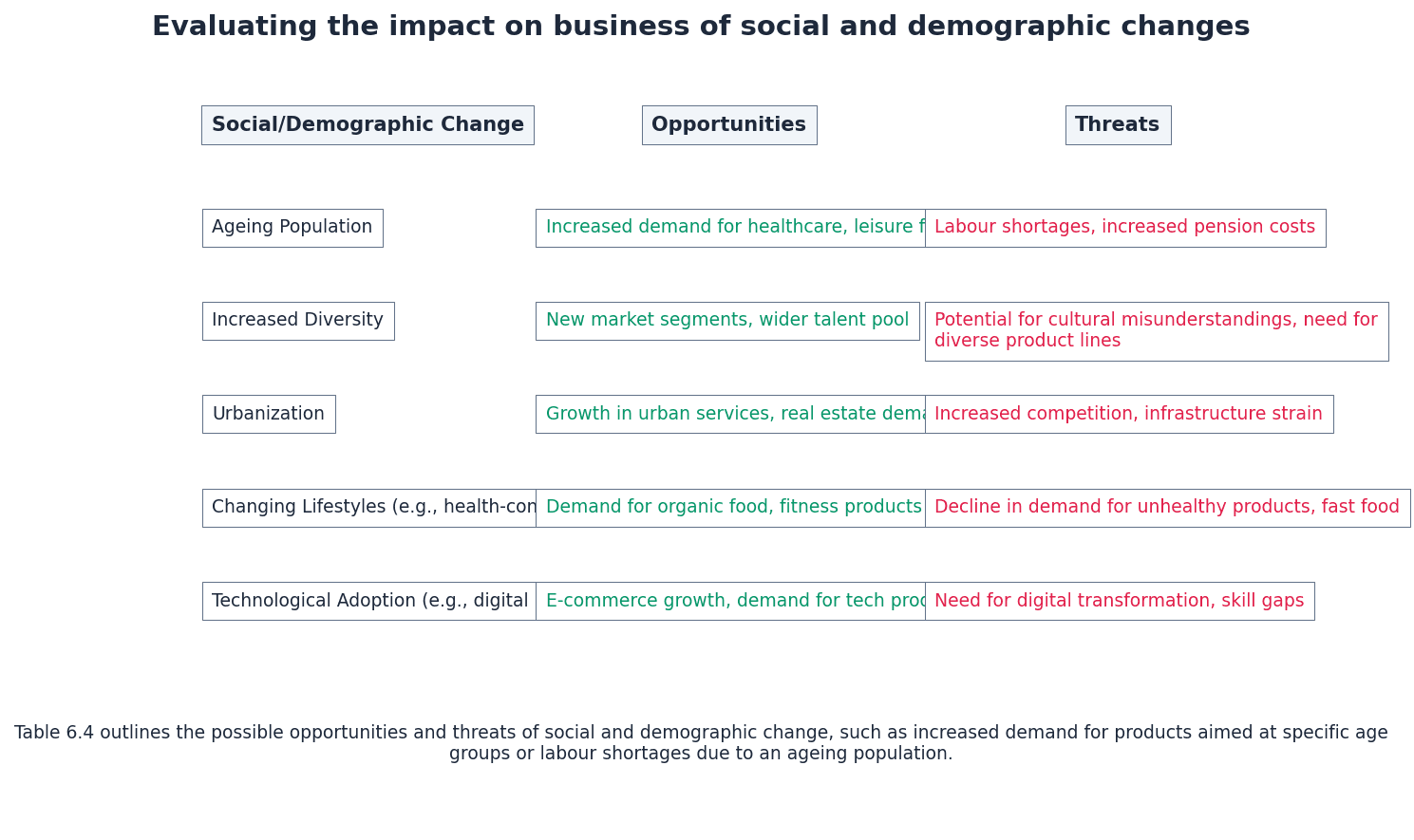
Changes in society, such as an ageing population or evolving employment patterns, significantly impact business strategy. Businesses must adapt to new consumer needs, workforce demographics, and societal expectations regarding ethical conduct and community engagement. Understanding these shifts is crucial for identifying new market opportunities and managing human resources effectively.
Technological advancements present both opportunities and threats to businesses. They can disrupt existing markets, but also provide valuable data for decision-making, enhance efficiency, and foster innovation. Businesses must effectively introduce and manage new technologies to remain competitive and meet evolving customer demands.
Multinational business — A business that has its headquarters in one country but owns operations that produce goods and services in more than one country.
Multinationals expand globally to be closer to markets, access lower production costs, avoid import restrictions, and gain access to natural resources. An example is a fast-food chain with headquarters in one country but owning and operating restaurants in many others.
Students often think a multinational is just a company that sells products in more than one country, but actually it must also own and operate production facilities in multiple countries.
When discussing multinationals, ensure you distinguish between simply exporting/importing and owning operations abroad. Evaluate both the benefits (e.g., jobs, investment) and drawbacks (e.g., exploitation, profit repatriation) for host countries.
International trade and multinational corporations play a significant role in shaping the business environment. International trade agreements can open new markets or impose restrictions, while technology facilitates global operations. Multinationals bring benefits like employment and foreign currency to host countries but also pose risks such as exploitation and cultural imposition.
Sustainability — The ability of our global community to continue to enjoy current standards of living by making business decisions that help protect the environment for future generations.
Sustainable business decisions involve practices like replanting forests, avoiding over-exploitation of resources, and responsible waste disposal. It's like not picking all the fruit from a tree at once, but leaving enough for it to continue producing year after year.
Students often think sustainability is only about environmental protection, but actually it also encompasses social and economic aspects to ensure long-term well-being for all.
When discussing sustainability, link business decisions to their long-term impact on resources and future generations, considering both environmental and economic implications.
Greenwashing — Making misleading or untrue claims about a business's environmental practices or benefits.
This practice aims to create a false impression of environmental responsibility but can backfire badly if discovered, leading to bad publicity and damage to brand image. It's like painting a rusty, polluting car green and calling it 'eco-friendly' without actually changing its engine or emissions.
When evaluating environmental claims, consider the potential for greenwashing and its long-term negative impact on brand image and consumer loyalty, contrasting it with genuine sustainability efforts.
Environmental audits — Independent checks that evaluate a business's environmental performance, reporting on factors like pollution, waste, energy use, and recycling rates.
These audits compare current performance with previous years and targets, and are used by stakeholders to assess a company's environmental impact. Similar to how a doctor checks your health, an environmental audit checks the 'health' of a company's impact on the planet.
Students often think environmental audits are legally required and always objective, but actually they are often voluntary and can be used as a publicity stunt if not independently verified.
When assessing environmental audits, discuss their purpose (e.g., setting targets, influencing consumers) and limitations (e.g., voluntary nature, cost, potential for bias) and how their effectiveness depends on independent verification.
The growing importance of sustainability means businesses must consider their environmental impact. This includes managing pollution, waste, energy use, and resource depletion. Environmental audits provide a way to assess performance, though their voluntary nature can limit credibility. Stakeholders increasingly demand corporate social responsibility and genuine efforts towards protecting the environment for future generations.
When asked to 'evaluate' an external influence, always present a balanced argument. Discuss both the opportunities AND the threats it creates for the business.
Use a framework like PESTLE-C (Political, Economic, Social, Technological, Legal, Environmental, Competitive) to structure your analysis of the external environment, ensuring you don't miss key factors.
Always apply the influence to the specific business in the case study. For example, how does a new consumer protection law affect a car manufacturer differently from a software company?
For questions on multinationals, analyse the impact on the 'host country' by considering different stakeholders: local businesses, employees, the government, and the community.
When discussing CSR or environmental issues, move beyond simple descriptions. Analyse the potential conflict between ethical behaviour and the pursuit of profit for shareholders.
In your conclusion, make a justified judgement. For example, which external factor is the *most* significant threat and why? This demonstrates higher-level evaluation skills.
Advantages & Disadvantages
Privatisation
Nationalisation
Evaluation Starters
Essay Structure Guide
Introduction
Begin by defining the key external influence in question and briefly outlining its relevance to business activity. State your overall argument or the main areas you will explore.
Conclusion
Summarise your main arguments without introducing new information. Make a clear, justified judgement about the overall impact or significance of the external influence, directly answering the question posed. Reinforce your evaluation by explaining *why* certain factors are more important than others.
This chapter examines how external economic factors and government policies influence business operations. It covers government support, market failure, macroeconomic objectives like growth and inflation, and the impact of monetary, fiscal, supply-side, and exchange rate policies on business decisions.
market failure — Failure to allocate resources effectively is referred to as market failure.
Market failure occurs when the free market mechanism does not consider all costs, leading to an inefficient allocation of resources. For example, a shared kitchen where no one pays for cleaning supplies leads to a messy kitchen because the 'market' (cooking) fails to account for the 'external cost' (cleaning).
Students often confuse market failure with a business failing, but actually it refers to the market's inability to efficiently allocate resources, often due to external costs, public goods, or monopolies.
private costs — When a business makes a product, it must pay for the costs of the land, capital, labour and materials; these are called private costs.
Private costs are the direct costs incurred by a business in the production of goods or services, such as the ingredients for a cake, the oven, and the electricity bill for baking. These costs are typically reflected in a firm's accounting records and influence its pricing and output decisions.
Distinguish clearly between private costs and external costs when discussing market failure. An 'analysis' question might require you to explain how ignoring external costs leads to market failure.
monopoly — When a market is dominated by one supplier, a monopoly is said to exist.
A monopoly producer can restrict output and raise prices to maximise profits, leading to under-provision of products compared with demand. This is a form of market failure as it results in an inefficient allocation of resources and harms consumer welfare, much like being the only ice cream seller on a hot beach allows for very high prices.
macroeconomic objectives — All governments set targets for the whole economy and these are referred to as macroeconomic objectives.
These objectives typically include economic growth, low price inflation, low unemployment, a long-term balance of payments, and exchange rate stability. Governments use various policies to try and achieve these targets, guiding the entire economy towards desired outcomes like prosperity and stability.
Students often think all macroeconomic objectives can be achieved simultaneously, but actually there are often conflicts, such as between economic growth and low inflation.
economic growth — Economic growth is the annual percentage increase in a country’s total level of output – known as gross domestic product (GDP) – usually measured by changes in real GDP.
Economic growth signifies that a country is becoming richer, leading to higher living standards, increased employment, and more resources for public services. It is like a pie getting bigger each year, meaning the country's 'pie' of goods and services is expanding, so there's potentially more for everyone.
Students often think economic growth is always beneficial, but actually rapid growth can lead to negative externalities like increased pollution or job losses due to technological change.
gross domestic product (GDP) — Gross domestic product (GDP) is a country’s total level of output.
GDP is the total monetary value of all finished goods and services produced within a country's borders in a specific time period. Real GDP adjusts for inflation, providing a more accurate measure of economic growth, much like a total score a country gets for all the goods and services it produces in a year.
When discussing economic growth, specify 'real GDP' to indicate that inflation has been accounted for. Evaluate both the benefits and potential drawbacks, especially in relation to other macroeconomic objectives.
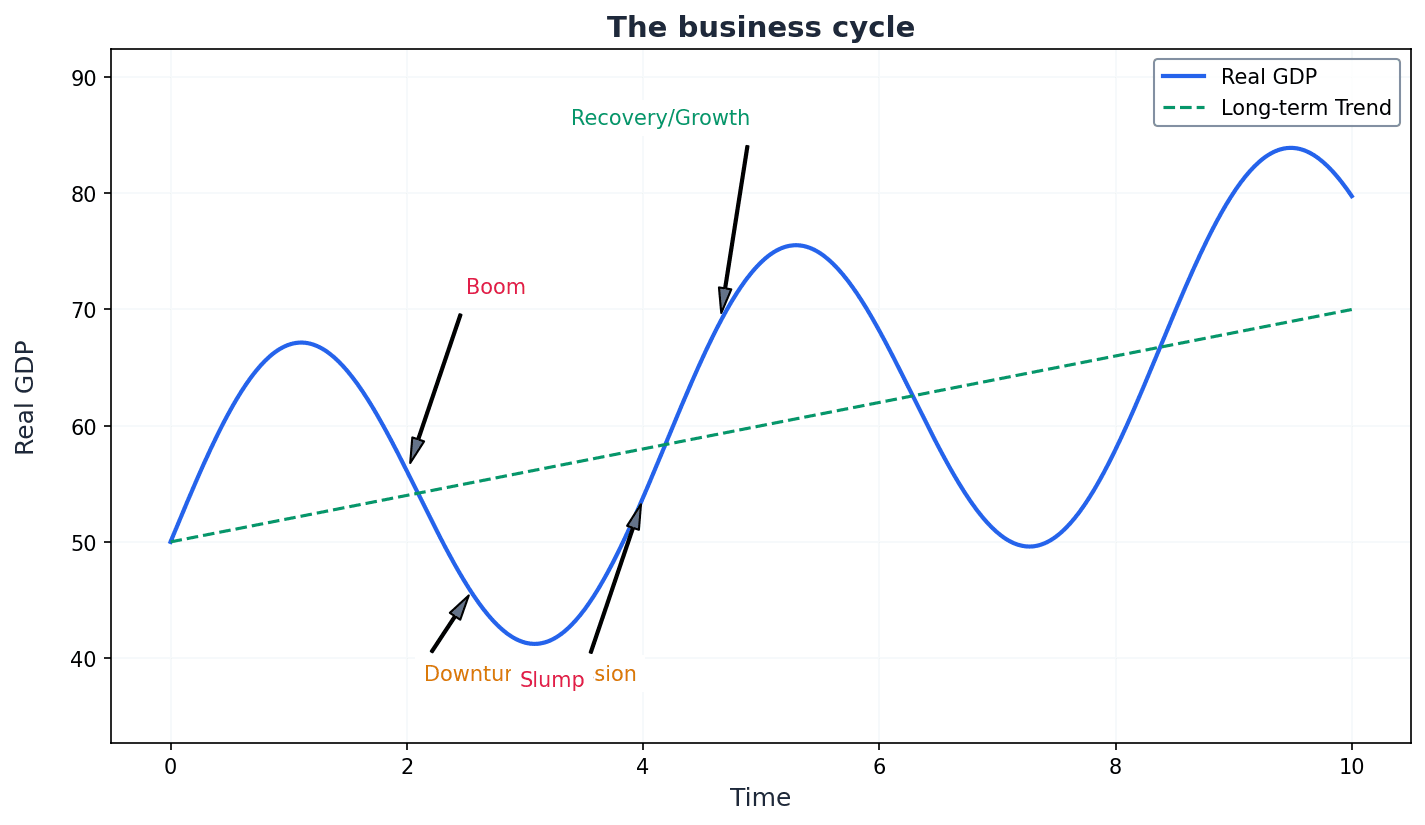
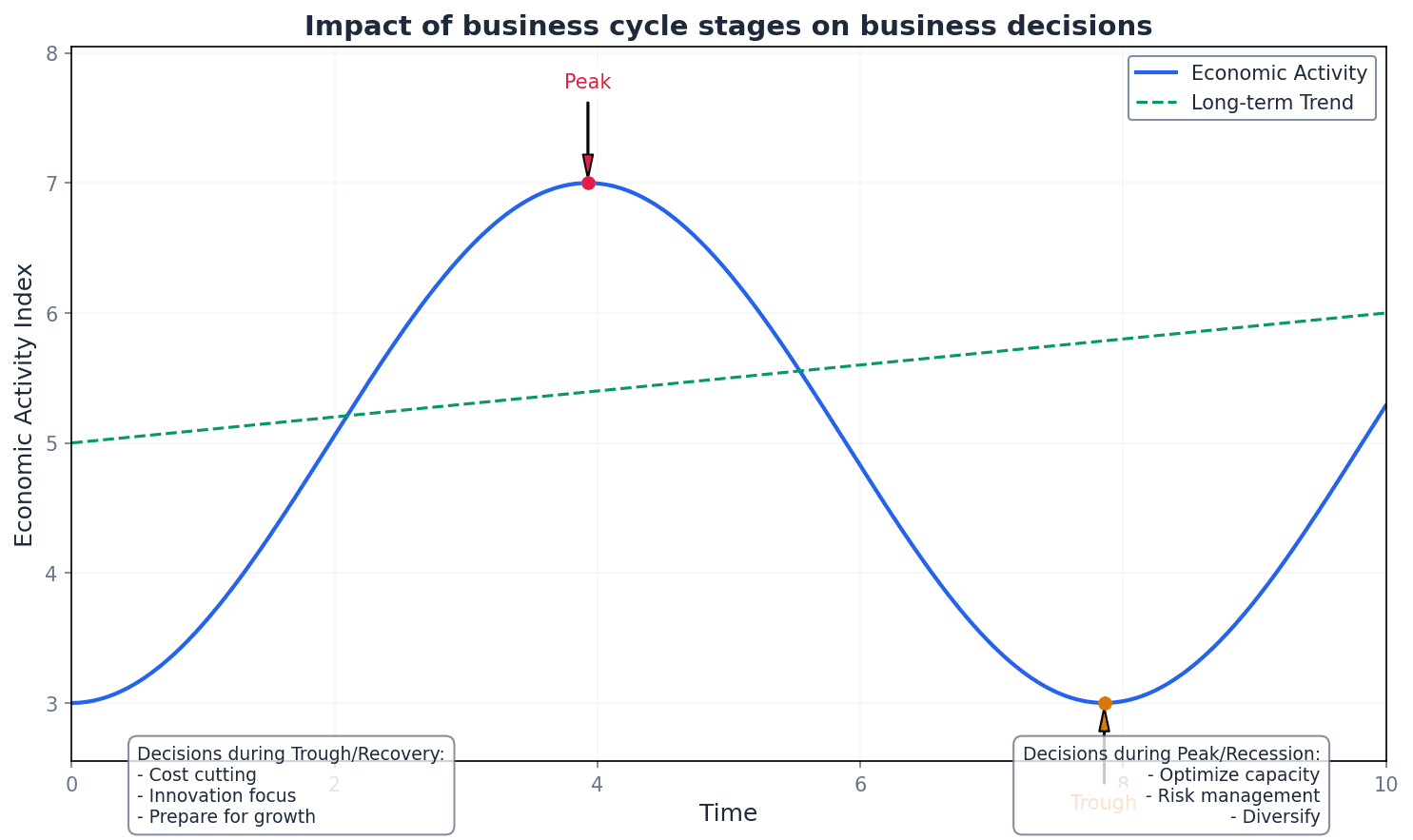
The business cycle describes the natural fluctuations in economic activity, moving through stages of boom, recession, slump, and recovery. Each stage has a distinct impact on business decisions regarding investment, employment, and pricing strategies. Businesses must adapt their strategies to these cyclical changes to remain competitive and profitable.
inflation — Inflation is the rate at which consumer prices, on average, increase each year.
Inflation means the spending power of money falls over time as goods and services become more expensive, like a balloon slowly expanding where the value of your money shrinks. It can be caused by cost-push factors (rising production costs) or demand-pull factors (excess consumer demand).
deflation — If one dollar buys more goods this year than it did last year, then the value of money has increased. This must have been caused by deflation.
Deflation is a sustained decrease in the general price level, meaning the spending power of money increases. While seemingly beneficial, it can lead to reduced demand as consumers delay purchases, lower profitability for businesses, and increased real value of debts, much like a shrinking balloon where your money buys more, but people might wait for prices to fall even further.
Students often think deflation is always good because prices are falling, but actually it can be very damaging to an economy by discouraging spending and investment, potentially leading to a recession.
When analysing inflation, distinguish between cost-push and demand-pull causes. Evaluate both the benefits of low inflation and the serious drawbacks of high inflation for businesses, including uncertainty and competitiveness.
cyclical unemployment — Cyclical unemployment is caused by falling demand for products during the recession stage of the business cycle.
During a recession, businesses produce fewer goods and services, leading to a reduced need for workers. This type of unemployment is directly linked to the overall economic downturn, similar to a restaurant needing fewer staff during a city-wide festival due to a temporary drop in customers.
Students often think all unemployment is due to a lack of skills, but actually cyclical unemployment is due to a lack of overall demand in the economy, not individual worker deficiencies.
structural unemployment — Structural unemployment results in certain types of workers being unable to find work, even though jobs could exist in expanding industries.
This occurs due to structural changes in the economy, such as shifts in consumer tastes or technological advancements replacing workers. Workers' skills may no longer match the available jobs, much like a blacksmith whose skills are obsolete in a world of mass-produced metal goods.
frictional unemployment — While workers are looking for other work, they are said to be frictionally unemployed.
This type of unemployment is short-term and occurs when workers are transitioning between jobs or entering the workforce for the first time. It is a natural feature of a dynamic labour market, like the brief period between finishing one TV series and finding a new one to watch.
When analysing unemployment, specify the type (cyclical, structural, frictional) as the impact and appropriate government response will differ.
monetary policy — Monetary policy is mainly concerned with changes in interest rates.
Monetary policy is controlled by the central bank, which sets the base interest rate to influence inflation and economic activity. Higher rates reduce borrowing and demand, while lower rates encourage spending and investment, acting like a 'thermostat' for the economy.
Students often think monetary policy directly controls government spending, but actually it primarily influences the cost and availability of money and credit in the economy.
fiscal policy — Governments are responsible for fiscal policy, which involves decisions about government spending and tax rates.
Fiscal policy is used to influence aggregate demand, economic growth, and unemployment. Expansionary fiscal policy stimulates the economy, while contractionary policy slows it down, much like the government's 'wallet' and 'income' influencing money circulation.
expansionary — Using fiscal policy in this way is described as expansionary and will lead to a budget deficit.
Expansionary fiscal policy involves increasing government expenditure or reducing taxes to boost aggregate demand, stimulate economic growth, and reduce unemployment. It is like giving the economy a 'shot in the arm' with more money to spend.
contractionary — Both of these policies would be termed contractionary or deflationary policies.
Contractionary fiscal policy involves reducing government expenditure or increasing taxes to decrease aggregate demand, slow down an overheating economy, and combat inflation. It is like putting the brakes on a car that's going too fast to prevent it from 'overheating'.
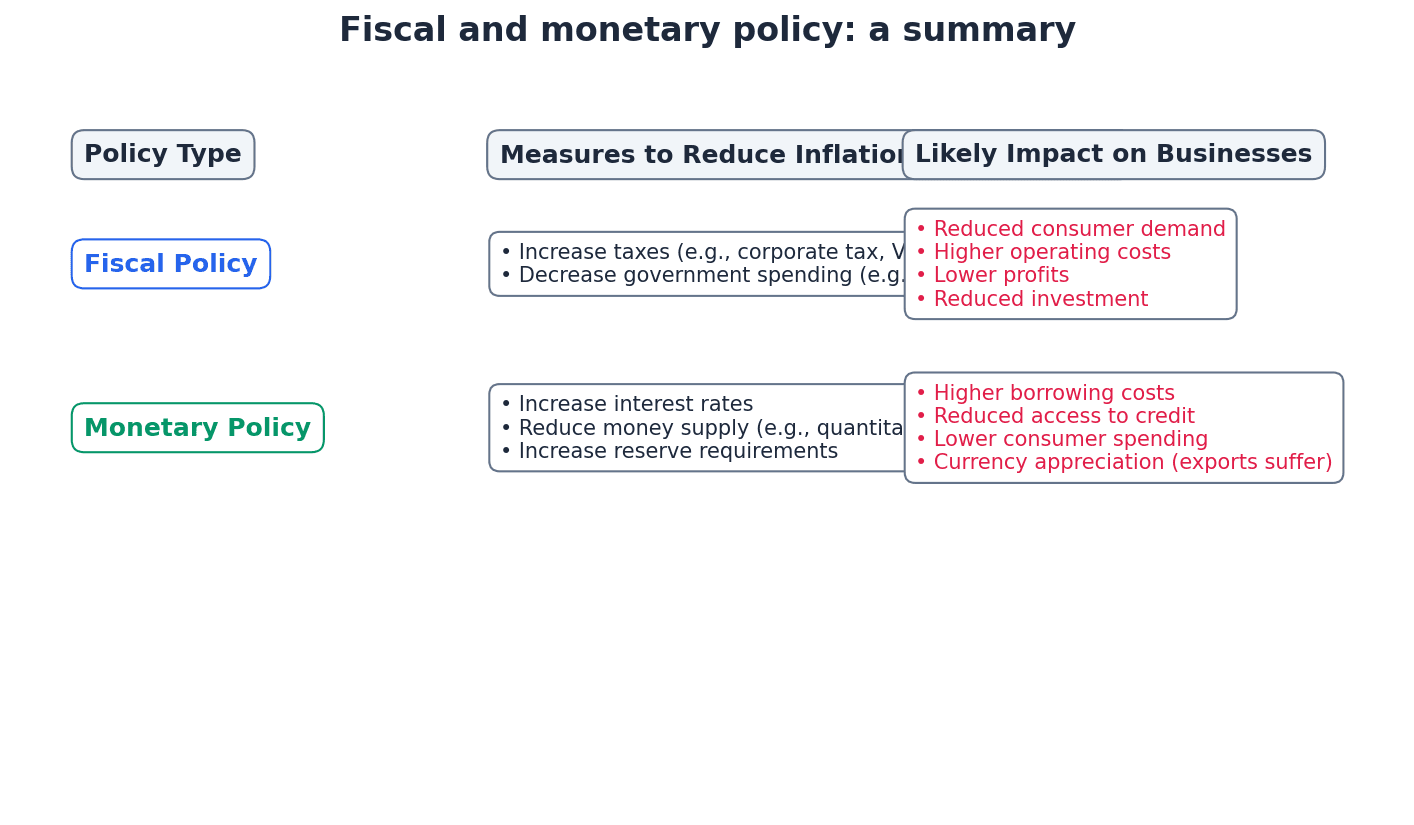
Always link a government policy to a specific business decision. E.g., 'Higher interest rates (monetary policy) increase loan costs, which may cause a business to postpone expansion plans.'
supply-side policies — Government policies that aim to increase industrial competitiveness are often referred to as supply-side policies.
These policies focus on improving the supply efficiency of the economy by enhancing productivity, encouraging innovation, and increasing market flexibility. Examples include tax cuts, training subsidies, and infrastructure spending, aiming to make factories more efficient and productive.
When evaluating supply-side policies, focus on their long-term impact on productivity, competitiveness, and potential for non-inflationary growth. Link specific policies to their intended effects on businesses and the workforce.
exchange rate depreciation — If the supply of a currency is greater than demand, the price of the currency falls. This is called an exchange rate depreciation.
A depreciation means the domestic currency buys less foreign currency. This makes exports cheaper for foreign buyers and imports more expensive for domestic consumers, potentially boosting exports and reducing imports. It's like your local currency suddenly buying fewer foreign sweets.
exchange rate appreciation — If the demand for a currency is greater than its supply, the price of it rises. This is called an exchange rate appreciation.
An appreciation means the domestic currency buys more foreign currency. This makes imports cheaper for domestic consumers and exports more expensive for foreign buyers, potentially reducing exports and increasing imports. It's like your local currency suddenly buying more foreign sweets.
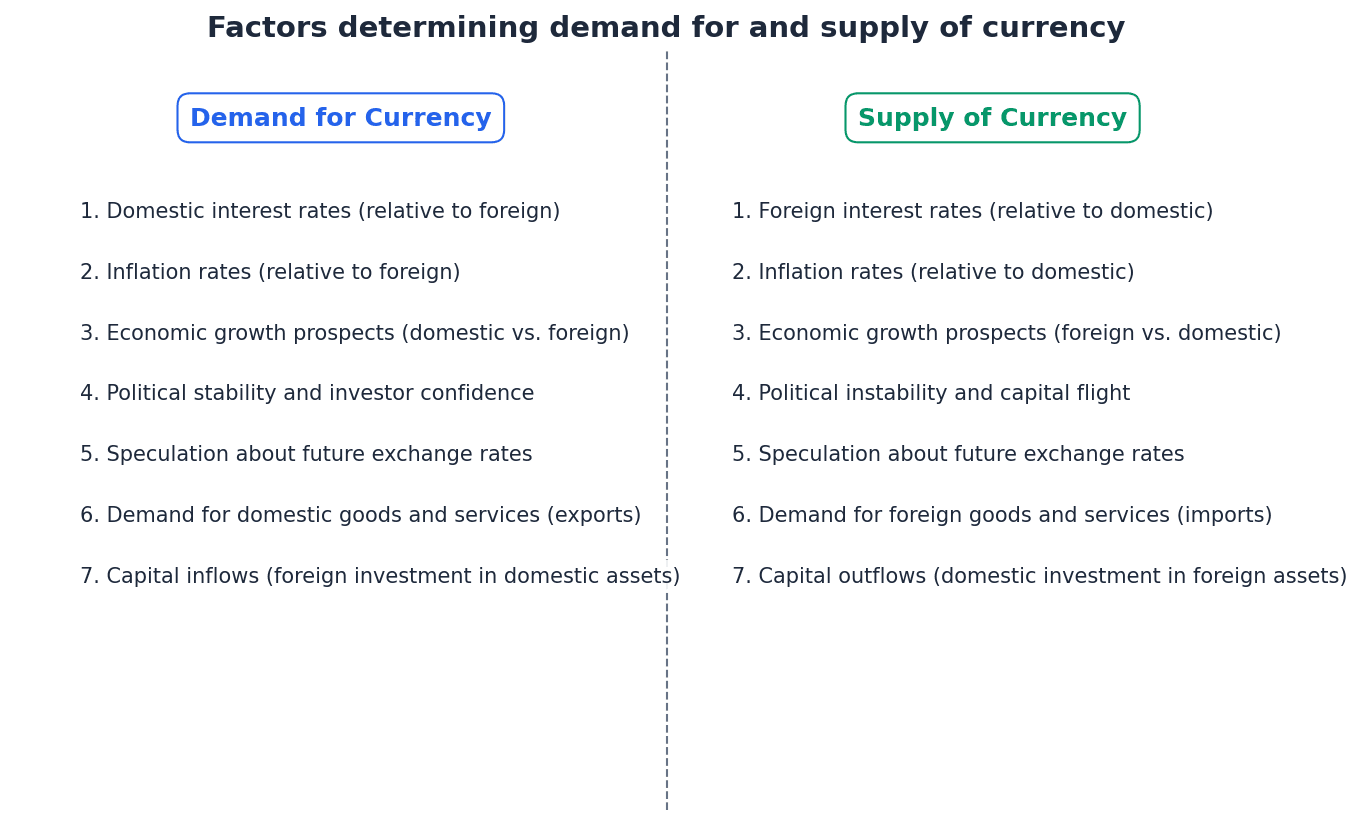
For exchange rate questions, clearly state if the currency is appreciating or depreciating and analyse the impact on BOTH importers and exporters.
In evaluation, discuss the conflicts between government objectives. E.g., 'Policies to boost growth might lead to demand-pull inflation.'
Advantages & Disadvantages
Economic Growth
Inflation
Evaluation Starters
Essay Structure Guide
Introduction
Begin by defining the key terms from the question (e.g., 'macroeconomic objectives' or 'fiscal policy') and briefly outlining the scope of your essay, stating the main arguments you will present regarding the impact on business activity.
Conclusion
Summarise your main arguments, reiterating the complex and often conflicting nature of external economic influences and government policies on business activity. Provide a final, balanced judgement on the overall impact, perhaps suggesting that adaptability and strategic planning are crucial for businesses in a dynamic economic environment.
This chapter explores business strategy as a plan to achieve SMART objectives and introduces strategic management, a process encompassing strategic analysis, choice, and implementation. It then evaluates various approaches for developing strategies, including tools for market creation, future planning, environmental assessment, competitive analysis, growth options, change management, and quantitative decision-making.
Business strategy — A clear plan and set of policies that help a business focus on achieving its SMART objectives.
Think of a business strategy like a detailed roadmap for a long road trip: it outlines the destination (objectives), the main routes to take (plans), and the rules for driving (policies) to ensure you get there efficiently. Strategy answers big questions like 'Which markets and products do we want to be in?' and involves major decisions to provide integration, direction, and focus for the business's future success.
Students often think strategy is just about setting goals, but actually it's about the detailed plan and policies for how to achieve those goals, considering resources and the competitive environment.
When asked to 'analyse the purpose of business strategy', ensure you link it to achieving SMART objectives, providing direction, and focusing resources, rather than just defining it.
Strategic management — The process of setting SMART objectives and then undertaking strategic analysis, strategic choice, and strategic implementation.
Strategic management is like a football team's season-long plan: it involves scouting opponents (strategic analysis), deciding on formations and player acquisitions (strategic choice), and then executing training and game plans (strategic implementation) to win the championship (objectives). This is the highest level of managerial activity, involving long-term decisions that are difficult to reverse and impact all major departments of the business, ensuring the organisation plans for the future and responds logically to change.
Students often think strategic management is only about making decisions, but actually it's a continuous process that includes analysis, choice, and implementation, with evaluation feeding back into future analysis.
For 'evaluate the importance of strategic management', discuss how it helps businesses plan for the future, respond to change, and make effective long-term decisions, contrasting this with the consequences of not having it.
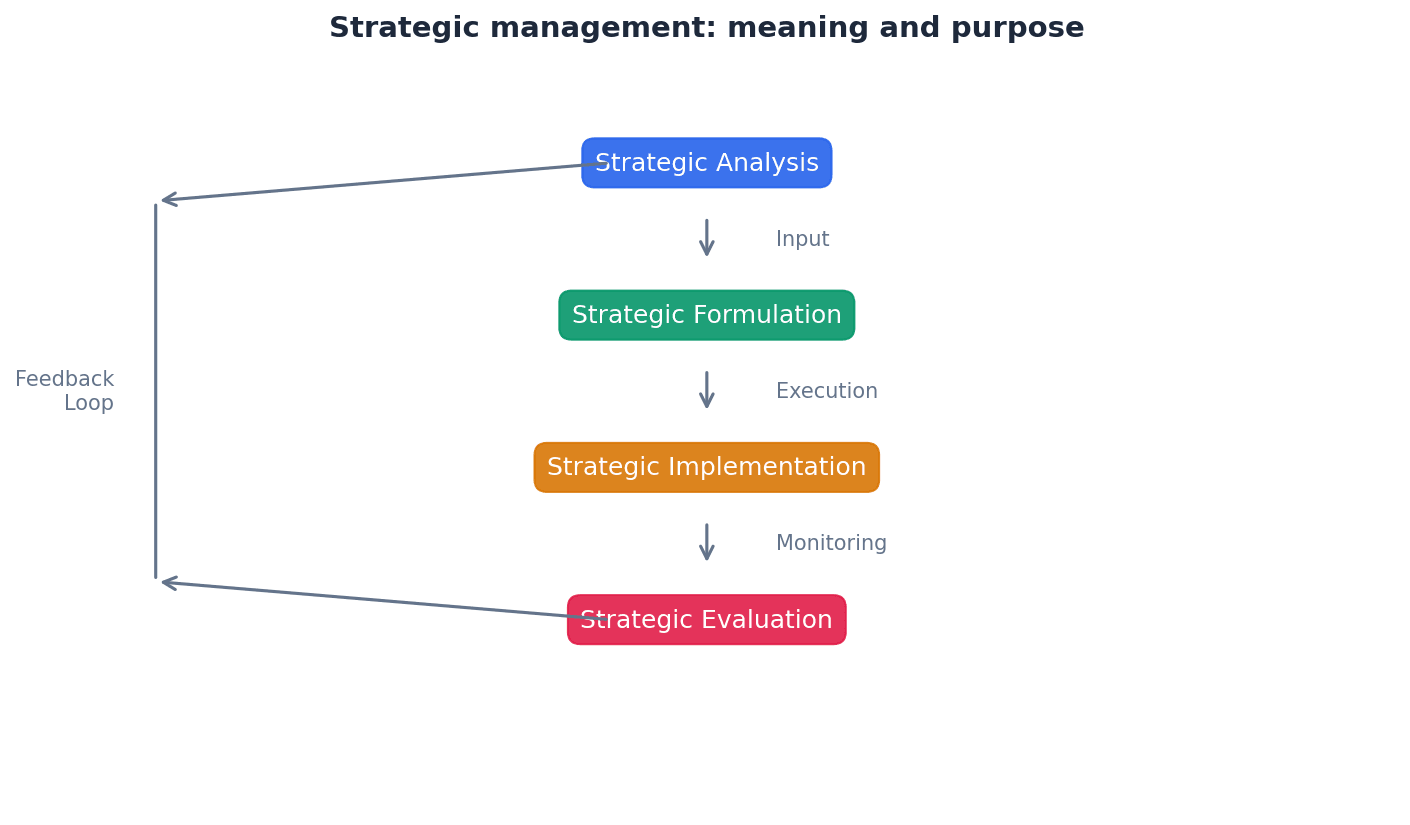
Strategic analysis — The process of assessing the current position of the company in relation to its market, competitors, and the external environment.
Before embarking on a journey, strategic analysis is like checking your current location on a map, assessing traffic conditions, and looking at weather forecasts to understand your starting point and potential challenges. This stage involves looking in detail at where the business is now, what is happening to it, and what might happen in the future, to ensure long-term plans fit with this external analysis.
Students often confuse strategic analysis with strategic choice, but analysis is about understanding the current situation, while choice is about making decisions based on that understanding.
When discussing 'strategic analysis', ensure you mention both internal (e.g., resources, strengths) and external factors (e.g., market, competitors, PEST factors) to show a comprehensive understanding.
Strategic choice — The stage of strategic management that involves taking important long-term decisions to push the business towards its objectives.
After gathering all the information about your journey (strategic analysis), strategic choice is like deciding which specific route to take, weighing up the pros and cons of a scenic route versus a faster highway. This stage analyses the benefits and limitations of different strategic options identified during strategic analysis, deciding between them based on challenging goals, achievability, and affordability within available resources.
When evaluating 'strategic choice', remember to link it to achieving competitive advantage and ensuring the chosen strategy is both challenging and feasible given the business's resources.
Strategic implementation — The stage of strategic management that involves allocating sufficient resources to put decisions into effect and evaluating their success.
Strategic implementation is like actually driving the car on your chosen route: you need a well-maintained vehicle (resources), a skilled driver (leadership), clear directions (organisational structure), and passengers who want to reach the destination (motivated staff). This is a crucial cross-functional task that requires an appropriate organisational structure, adequate resources, motivated staff, supportive leadership, and control systems to monitor progress towards objectives.
For 'analyse the challenges of strategic implementation', focus on factors like resource allocation, organisational structure, staff motivation, leadership, and control systems, rather than just stating it's difficult.
Businesses employ various approaches to develop effective strategies, ranging from creating new market spaces to analysing internal and external environments, assessing industry competition, and planning for growth. These tools aid managers in making informed decisions and navigating uncertainties to achieve their SMART objectives.
Blue ocean strategy — An approach to developing business strategy that focuses on creating uncontested market spaces rather than competing in existing, highly contested markets.
Instead of trying to catch fish in a crowded 'red ocean' where everyone else is fishing, a blue ocean strategy is like discovering a completely new, untouched part of the ocean where you are the only one fishing. This strategy aims to make competition irrelevant by combining high product differentiation with low cost, creating new demand and exploiting new market segments that have no close rivals.
Students often think blue ocean strategy means just being innovative, but actually it specifically means creating new market space where competition is irrelevant, often by simultaneously pursuing differentiation and low cost.
Scenario planning — A strategic planning technique where managers identify a limited number of possible future outcomes or situations (scenarios) and discuss what strategy the business could adopt if each scenario occurred.
Scenario planning is like a chess player thinking several moves ahead, considering different possible responses from their opponent and planning their own counter-moves for each eventuality. This approach helps businesses prepare for an uncertain future by forcing managers to consider main risks and uncertainties, develop flexible strategies, and look far into the future for creative solutions.
SWOT analysis — A strategic analysis technique that identifies a business's internal Strengths and Weaknesses, and external Opportunities and Threats.
SWOT analysis is like a personal self-assessment before a job interview: you list your skills (strengths), areas for improvement (weaknesses), potential career paths (opportunities), and challenges in the job market (threats). SWOT helps managers assess the most likely successful future strategies by matching the firm’s resources and strengths to the competitive environment, often serving as a starting point for corporate strategy development.
Students often think SWOT analysis provides specific actions, but actually it's a framework for understanding a business's position; further analysis is needed to formulate detailed strategies.
When undertaking a 'SWOT analysis', ensure you clearly distinguish between internal factors (S, W) and external factors (O, T), and remember it's a qualitative tool, not quantitative.
Strengths — Internal factors about a business that are its current real advantages and could be used as a basis for developing a competitive advantage.
In a race, a runner's strength might be their exceptional endurance or a unique training regimen that gives them an edge. These are positive attributes identified through an internal audit, such as experienced management, product patents, a loyal workforce, or a good product range.
Weaknesses — Internal business factors that are viewed as disadvantages and can hinder a business's performance.
In a race, a runner's weakness might be a recurring injury or a lack of speed in short bursts. These are negative attributes identified through an internal audit, such as a poorly trained workforce, limited production capacity, or ageing equipment.
Opportunities — Potential areas for expansion of the business and future profits, identified by an external audit of the market and competitors.
For a runner, an opportunity might be a new, less competitive race opening up, or a sponsorship deal that provides better equipment. These are positive external factors that a business can exploit, such as new technologies, expanding export markets, or lower interest rates increasing consumer demand.
Threats — External factors that could negatively impact a business, gained from an external audit of the business and economic environment, market conditions, and competitors.
For a runner, a threat might be a new, highly skilled competitor entering the race, or a sudden change in weather conditions making the track difficult. These are negative external factors that a business needs to mitigate, such as new competitors, globalisation driving down prices, changes in law, or shifts in government economic policy.
PEST analysis — A form of strategic analysis that focuses on analysing the macro environment in which a business operates, covering Political, Economic, Social, and Technological factors.
Before launching a new product, PEST analysis is like a meteorologist studying the broader climate (political stability, economic trends, social attitudes, technological advancements) to see if the conditions are favourable for a successful launch. PEST analysis assesses wide-ranging and major external factors that could influence future business strategies, identifying them as either opportunities or threats, and is complementary to SWOT analysis.
Students often think PEST analysis is about internal business factors, but actually it exclusively focuses on external, macro-environmental factors that are beyond the business's control.
When conducting a 'PEST analysis', ensure each factor identified is clearly external and macro-level, and explain how it could create an opportunity or a threat for the business.
Porter’s five forces — A framework that models an industry as being influenced by five competitive forces: threat of new entrants, bargaining power of buyers, bargaining power of suppliers, threat of substitute products, and competitive rivalry.
Porter's five forces is like a general surveying a battlefield: they assess the strength of enemy forces (competitive rivalry), potential new enemies (new entrants), the loyalty of their own troops (supplier power), the demands of their allies (buyer power), and alternative weapons the enemy might use (substitutes). This model helps managers understand the competitive structure of an industry and establish a competitive advantage by analysing the intensity of competition and potential profitability.
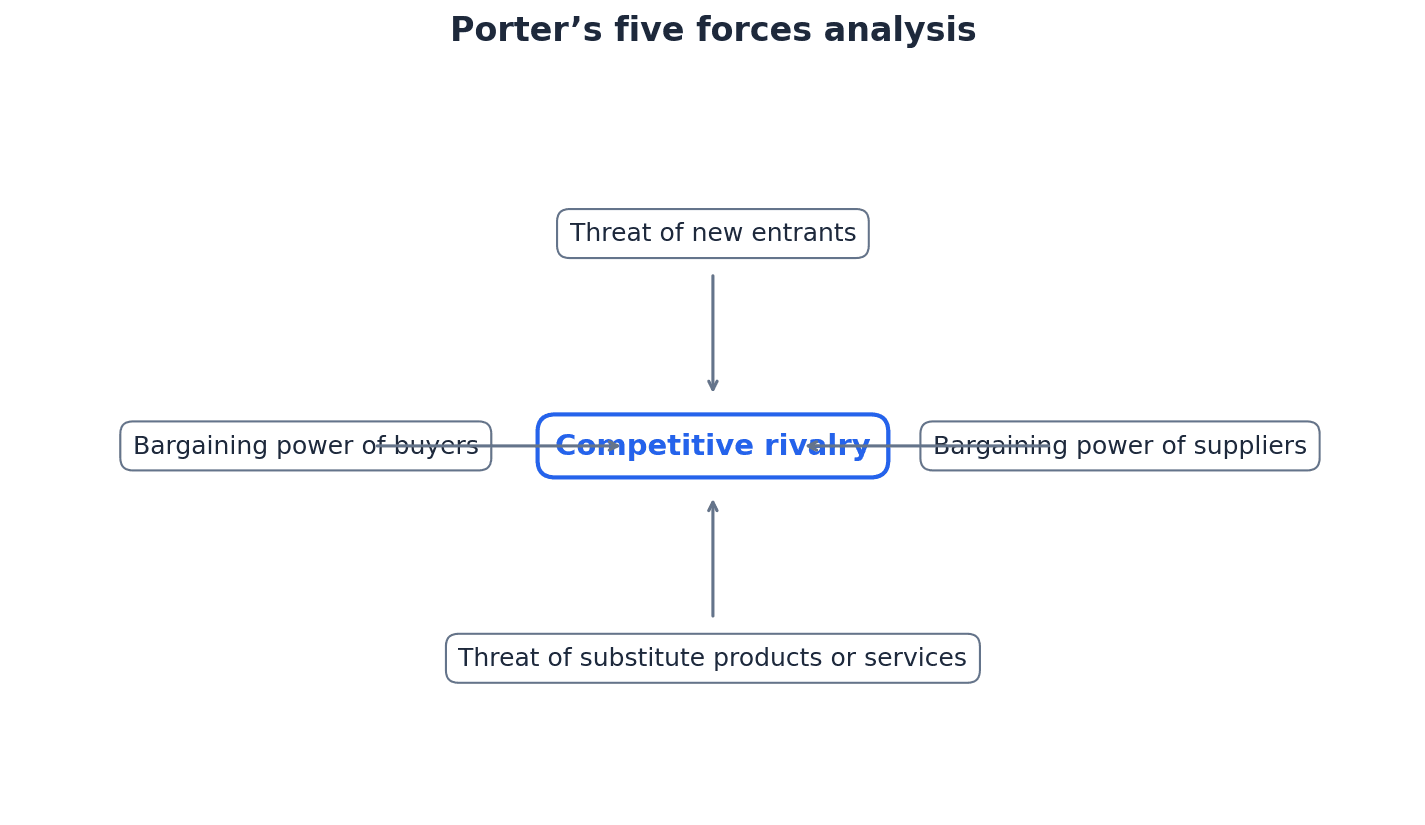
Students often confuse substitute products in Porter's model with rival products in the same industry, but actually substitutes refer to products from *other* industries that can satisfy the same customer need.
When applying 'Porter's five forces', clearly explain how each force impacts the industry's attractiveness and profitability, and how a business can develop strategies to mitigate negative impacts or leverage positive ones.
Core competencies — Unique capabilities or skills that a business possesses, which provide clear benefits to consumers, are difficult for competitors to copy, and are applicable to a range of different products and markets.
A chef's core competence might be their unique ability to blend spices to create a distinctive flavour profile that no other chef can replicate, which they can then apply to many different dishes. Developing core competencies can lead to a sustainable competitive advantage, as they are the integrated multiple technologies and product skills that underpin a business's core products and strategic opportunities.
When discussing 'core competencies', ensure you link them to competitive advantage, difficulty of imitation, and applicability across multiple products/markets, rather than just general skills.
Core products — Products developed from a business's core competencies, which are not necessarily sold to final consumers but are used to produce a large number of end-user products.
If a company's core competence is making small, efficient electric motors, then the motors themselves are the core products, which can then be used in drills, lawnmowers, and food processors (end-user products). These products leverage the unique capabilities of the business, allowing for economies of scale in their manufacture and opening up strategic opportunities for new markets and end products.
Ansoff matrix — An analytical tool that assesses alternative corporate business strategies based on two main variables: the market (existing or new) and the product (existing or new).
The Ansoff matrix is like a restaurant owner deciding how to grow: they can sell more of their current dishes to existing customers (market penetration), create new dishes for existing customers (product development), sell their current dishes to new customers (market development), or open a completely new type of business in a new location (diversification). This matrix presents four distinct strategies for increasing sales: market penetration, product development, market development, and diversification, each with varying degrees of risk.
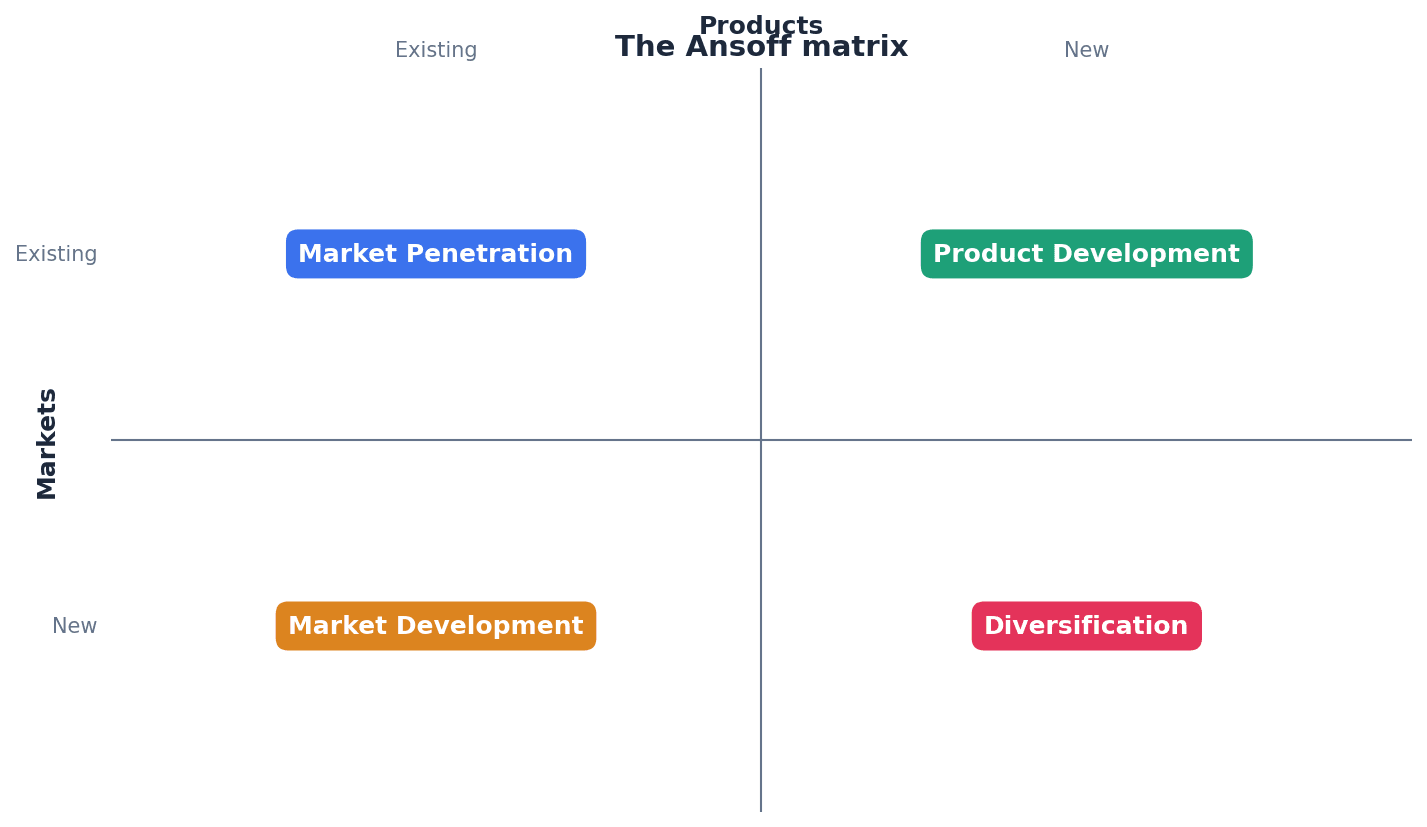
Students often think the Ansoff matrix provides a complete strategic plan, but actually it's a framework for identifying strategic options; further analysis (like SWOT/PEST) is needed for detailed planning.
When using the 'Ansoff matrix', clearly identify which quadrant a strategy falls into and explain the associated level of risk, linking it to the familiarity with the product and market.
Market penetration — A strategy in the Ansoff matrix that involves selling existing products in existing markets.
A coffee shop trying to sell more of its existing coffee to its regular customers by offering loyalty cards or special promotions is pursuing market penetration. This is generally the least risky strategy, aiming to increase market share through methods like price reductions, increased promotion, or improved distribution within the current market.
Product development — A strategy in the Ansoff matrix that involves developing new products for existing markets.
A smartphone company releasing a new model with advanced features to its existing customer base is engaging in product development. This strategy often involves innovation, offering distinctive new products to current customers, such as launching a new version of an existing product or an entirely new product line.
Market development — A strategy in the Ansoff matrix that involves selling existing products in new markets.
A company that sells bottled water in its home country deciding to start exporting that same bottled water to a new country is pursuing market development. This can include exporting goods to overseas markets, selling to a new market segment, or repositioning a product to appeal to a different group of consumers.
Diversification — A strategy in the Ansoff matrix that involves developing new products for new markets.
A clothing company deciding to open a chain of hotels in a foreign country is an example of diversification, as both the product (hotels) and the market (foreign country) are new. This is the riskiest of the four strategies as it involves new challenges in both products and markets, potentially moving outside the firm's core competencies, but can offer high profits or a foothold in expanding industries.
Force-field analysis — A technique developed by Kurt Lewin that involves looking at all of the forces for and against a decision, weighing up potential advantages and disadvantages before a choice is made.
Imagine trying to push a heavy box across a room: force-field analysis is like identifying all the people pushing the box forward (driving forces) and all the people pushing against it (restraining forces) to see if you can move it, and then strategising how to get more people to push forward or fewer to push against. The main purpose is to give managers insight to strengthen forces supporting a decision and reduce forces opposing it, often used for major internal changes or new product introductions.
When applying 'force-field analysis', ensure you clearly list both driving and restraining forces, assign realistic scores, and then propose strategies to increase driving forces and decrease restraining forces.
Decision trees — A diagrammatic technique that represents all options open to a manager, the different possible outcomes, their chances of occurring, and the economic returns from these outcomes.
A decision tree is like a 'choose your own adventure' book for business: each choice leads to different paths with various probabilities of success or failure, and you map them all out to find the best overall outcome. Decision trees aid logical decision-making by allowing managers to compare the likely financial results from each option, minimise risks, and choose the option with the highest expected value.
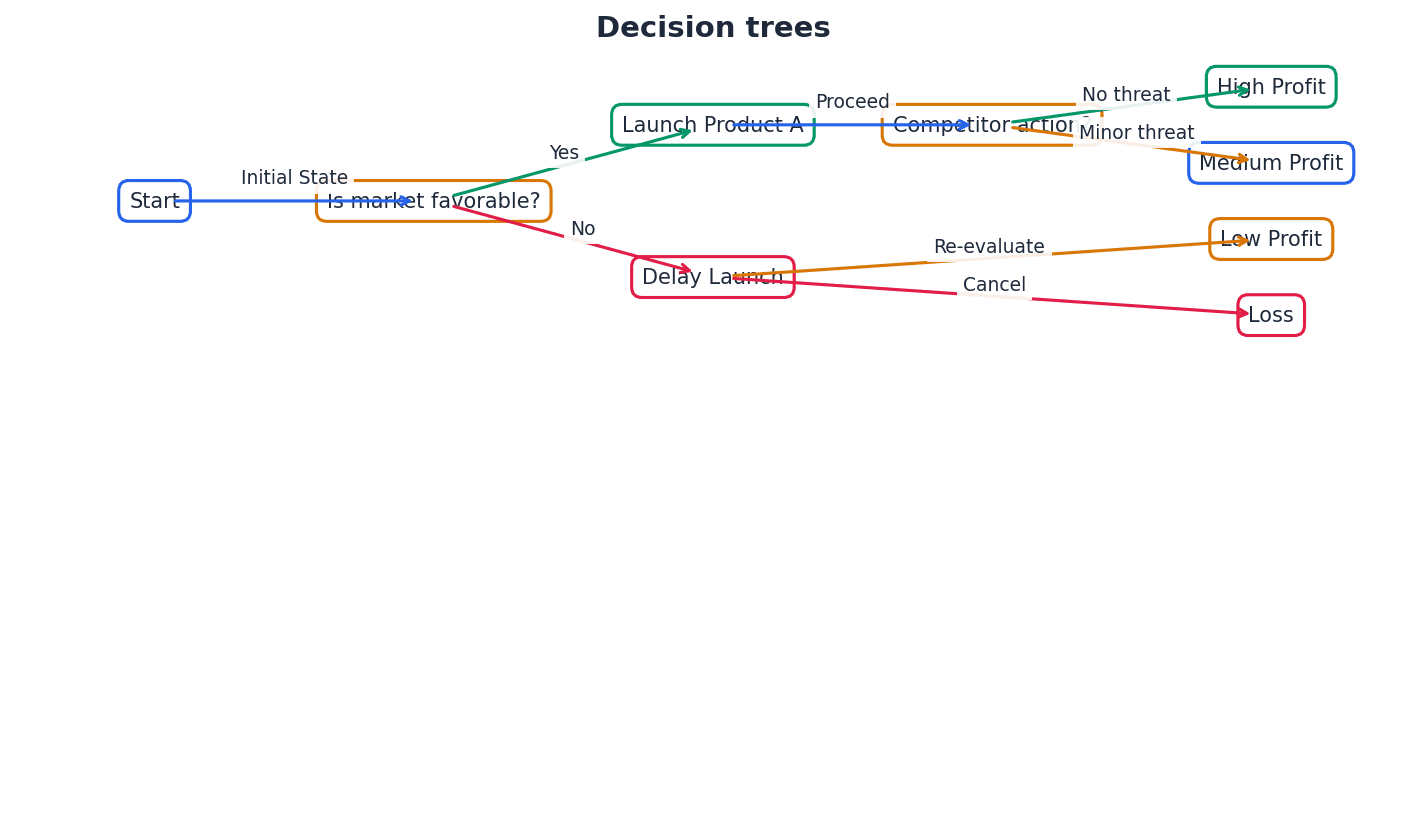
Students often think decision trees eliminate risk, but actually they only allow for a quantitative consideration of future risks; they do not remove the inherent uncertainty or the impact of non-numerical factors.
When constructing 'decision trees', remember to work from right to left to calculate expected values, clearly label decision nodes (squares) and chance nodes (circles), and include probabilities and economic returns.
Decision points (decision nodes) — Points in a decision tree, denoted by a square, where a manager has to make a choice between different options.
In a game of chess, a decision point is when you choose which piece to move, knowing each move opens up different possibilities. These represent moments where a conscious decision is made, leading to different branches in the tree, each representing a chosen course of action.
Chance node — Points in a decision tree, denoted by a circle, that show a range of outcomes may result from a decision, each with an associated probability.
In a game of dice, a chance node is when you roll the dice, and the outcome (the number rolled) is uncertain, but you know the probability of each number appearing. These represent uncertain events or external factors that are beyond the direct control of the manager, such as market demand or weather conditions.
Probabilities — Numerical values shown alongside each possible outcome in a decision tree, measuring the chance of that outcome occurring.
When flipping a coin, the probability of getting heads is 0.5 (or 50%), meaning there's an equal chance of that outcome occurring. These values, typically between 0 and 1 (or 0% and 100%), are used to calculate the expected value of each branch, often based on past data or forecasts.
Economic returns — The expected financial gains or losses of a particular outcome in a decision tree.
If you invest in a stock, the economic return is the profit or loss you make from that investment. These values represent the net financial benefit or cost associated with each possible outcome, used in conjunction with probabilities to calculate expected values.
Expected value — The average return, calculated by multiplying the probability of each outcome by its economic return and summing the results, for a particular decision path in a decision tree.
If you play a game where you win 2 with a 50% chance, the expected value is (0.5 * 2) = 4 per game. This calculation helps managers compare different options quantitatively, indicating which choice is likely to yield the highest average financial benefit over time, assuming the decision is repeated.
For Decision Trees, show all your calculations for Expected Value (EV) and Net Gain. Always conclude with a justified recommendation based on the highest financial outcome.
Advantages & Disadvantages
Blue Ocean Strategy
Scenario Planning
Evaluation Starters
Essay Structure Guide
Introduction
Start by defining business strategy and strategic management, outlining the three key stages (analysis, choice, implementation). Briefly state the purpose of strategic management in achieving SMART objectives and responding to change.
Conclusion
Summarise the importance of a structured approach to strategic management. Reiterate that no single tool is perfect and that a combination of qualitative and quantitative analysis, alongside strong leadership, is crucial for long-term success. Make a final justified recommendation if the question requires a decision.
This chapter explores corporate planning, outlining its components, benefits, and limitations, alongside internal and external influences. It delves into corporate culture, examining different types, their impact on decision-making, and the challenges of cultural change. The chapter also highlights the importance of transformational leadership in managing strategic change, detailing the process of leading and controlling change, including overcoming resistance, and covers contingency planning and crisis management.
Corporate plan — A document stating the overall objectives of an organisation and the strategies to be used to achieve them.
This plan provides a clear focus and sense of purpose for senior managers and helps communicate these objectives to all stakeholders. It also includes a control and review process to compare actual outcomes with original aims, much like a detailed travel itinerary for a long journey.
Students often think corporate plans are rigid and unchangeable, but actually effective plans should be adaptable and flexible to remain relevant during periods of change.
When asked to analyse the benefits of a corporate plan, ensure you link specific components (e.g., clear objectives, control process) to their positive impacts on the business, such as improved decision-making or stakeholder communication.
Corporate planning involves outlining overall objectives and the strategies to achieve them, alongside a control and review process. This process is influenced by both internal factors, such as the organisation's resources and existing culture, and external forces, including market conditions and technological advancements. Understanding these influences is crucial for developing a robust and adaptable plan.
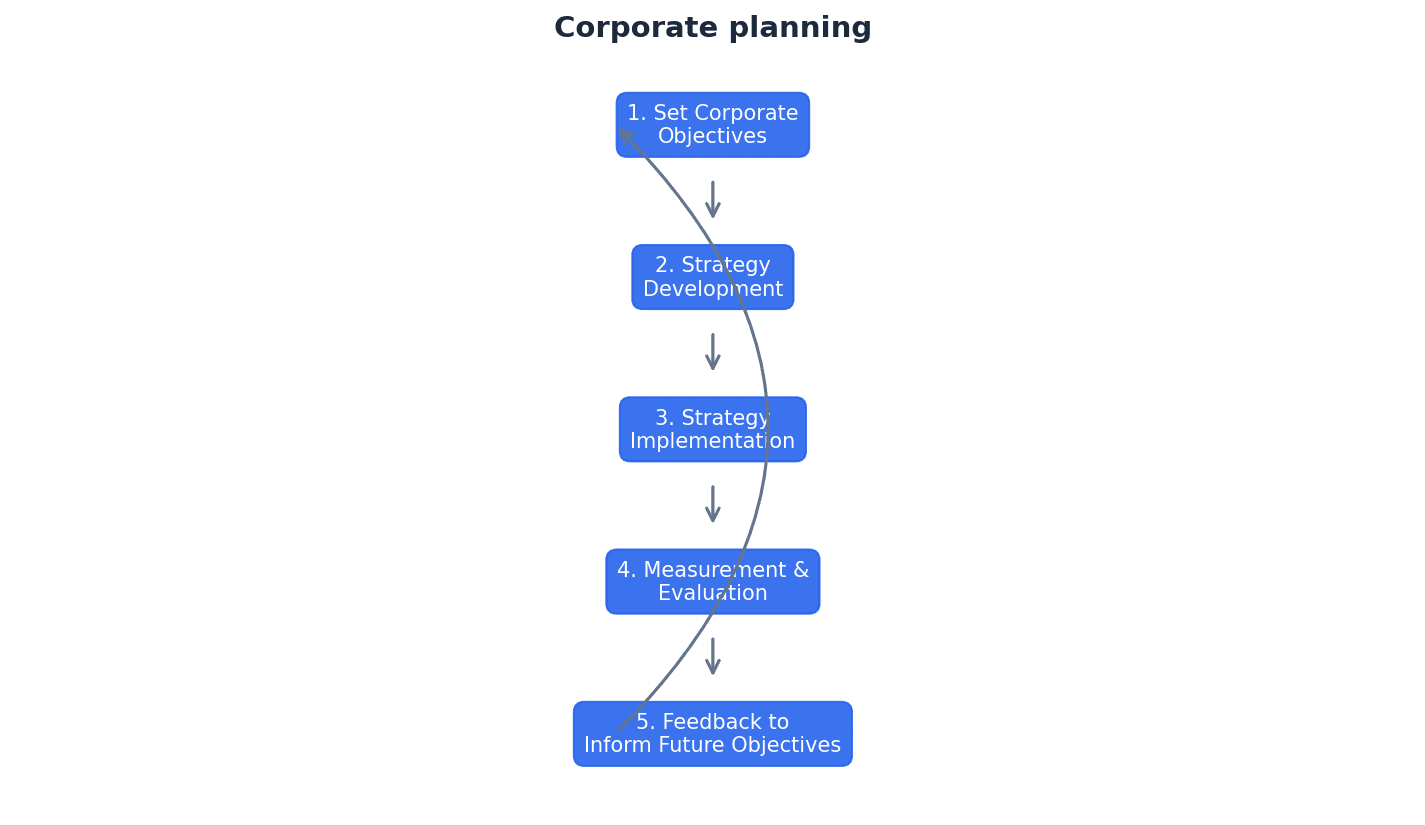
Corporate culture — The values, attitudes and beliefs of the people working in an organisation that control the way they interact with each other and with external stakeholders.
Culture defines what is considered normal behaviour and decision-making within a business, giving it a sense of identity. It is a powerful force that influences employee actions and relationships, much like the personality of a business dictates how it reacts to situations.
Students often think corporate culture is just about employee morale, but actually it profoundly impacts strategic decision-making, implementation of change, and long-term business performance.
When evaluating the impact of corporate culture, refer to specific culture types (e.g., power, task, entrepreneurial) and explain how they influence decision-making processes and employee acceptance of change.
Power culture — A culture where power is concentrated at the centre of the organisation, often associated with autocratic leadership.
In a power culture, decisions can be made swiftly due to the limited number of people involved. However, this approach may lead to resistance to change as employees are not consulted, similar to a small, tightly-knit family business where the owner makes all major decisions quickly.
Students often think swift decision-making is always good, but actually in a power culture, it can lead to lack of employee buy-in and future resistance to change.
Role culture — A culture most associated with bureaucratic organisations, where individuals operate within well-defined rules and delegated authority.
In a role culture, power and influence derive from a person's position within the organisational structure. This often leads to a lack of creativity as employees adhere strictly to procedures, much like a large government department where everyone has a specific job description and follows strict protocols.
Students often think clear rules are always efficient, but actually in a role culture, they can stifle creativity and make adaptation to change very slow.
Task culture — A culture where groups are formed to solve particular problems, encouraging creativity and empowering teams to make decisions.
This culture often develops distinctive team dynamics, similar to a matrix structure, where members are encouraged to be creative and take initiative. It is effective for problem-solving and innovation, much like a special project team assembled to develop a new product.
Person culture — A culture where there may be conflict between individual goals and those of the whole organisation, but it is often the most creative type of culture.
This culture prioritises individual autonomy and creativity, which can lead to high levels of innovation. However, managing the alignment of individual aspirations with broader organisational objectives can be challenging, similar to a collective of highly skilled artists who value their individual craft.
Students often think 'person culture' means a lack of structure, but actually it means the organisation is built around the talents and goals of individuals, which can still be highly productive.
Entrepreneurial culture — A culture where success is rewarded, and failure is not necessarily criticised as it is considered an inevitable consequence of showing initiative and risk-taking.
This culture fosters innovation and encourages employees to take calculated risks. It promotes a learning environment where mistakes are seen as opportunities for growth rather than reasons for punishment, much like a start-up company where employees are encouraged to experiment with new ideas.
Different types of corporate culture significantly impact how decisions are made and how readily a business can adapt to change. For instance, a power culture allows for swift decisions but may face resistance, while a role culture, with its emphasis on rules, can hinder innovation. Conversely, task and entrepreneurial cultures foster creativity and risk-taking, making them more adaptable to new challenges and opportunities.
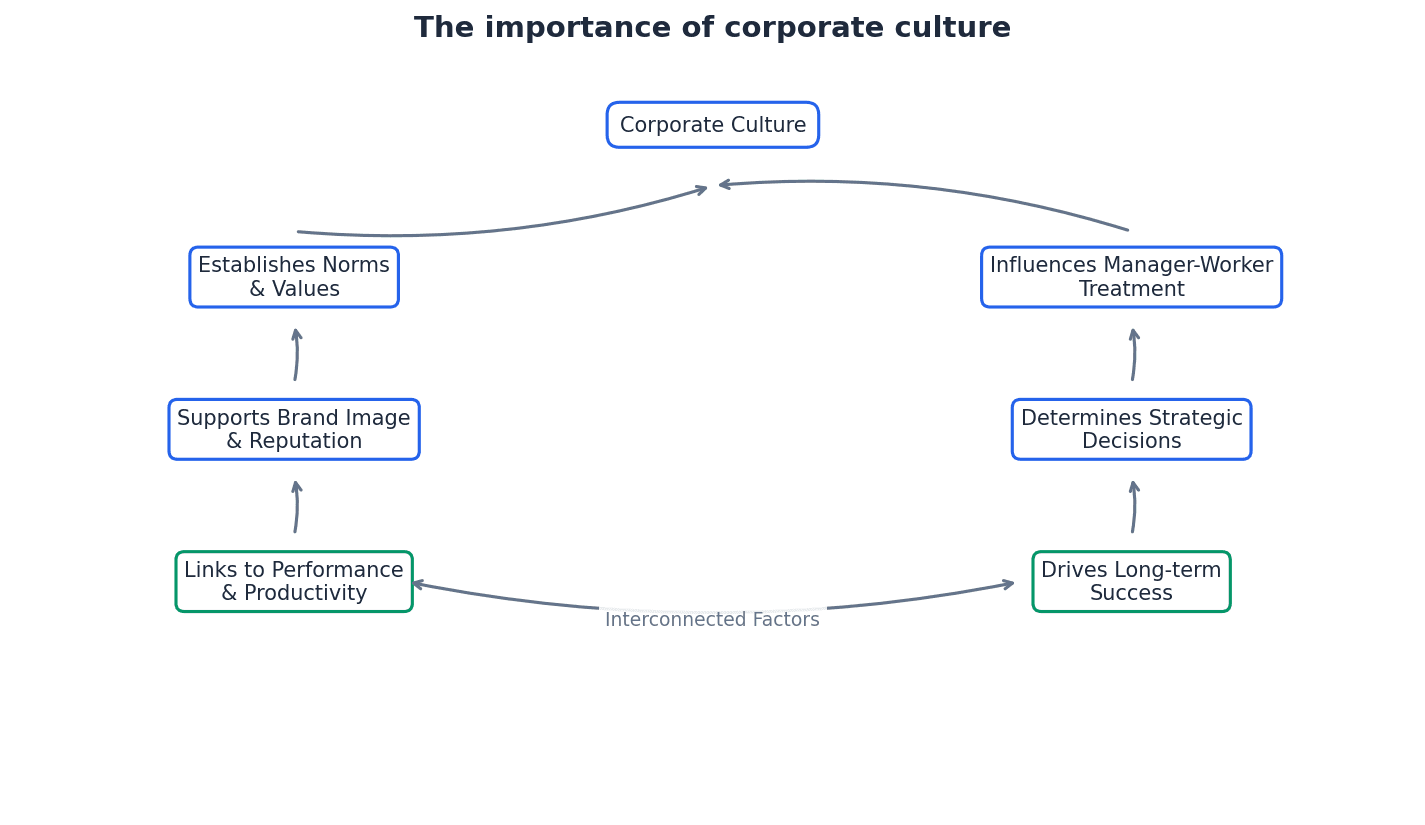
Transformational leadership — A leadership style of most importance during periods of significant corporate change, where leaders influence and inspire employees to accept and work towards a new vision.
Transformational leaders set examples, communicate a compelling vision, show genuine concern for employees, and provide stimulating challenges. This increases the chances of successful change by gaining employee support and improving motivation, much like a coach who inspires their team with a shared vision and challenges them to achieve beyond their perceived limits.
Students often think transformational leadership is just about charisma, but actually it involves specific behaviours like inspiring a shared vision, intellectual stimulation, and individualised consideration for employees.
When evaluating transformational leadership, focus on its impact on employee motivation, acceptance of change, and the business's flexibility, using action verbs like 'inspire', 'influence', and 'challenge'.
Strategic change — The continuous adoption of business strategies in response to changing internal pressures or external forces.
Strategic change is an ongoing process that businesses must manage to ensure it is positive. It can be incremental (slow and gradual) or dramatic (revolutionary and sudden), and anticipated or unanticipated, much like a ship adjusting its course in response to changing weather conditions or engine issues.
Students often think change is a one-off event, but actually strategic change is a continuous and accelerating process that businesses must constantly adapt to.
When analysing strategic change, differentiate between incremental and dramatic changes, and discuss how anticipation (or lack thereof) affects the ease of management and control.
Business process re-engineering — Totally rethinking the operation of an organisation, often in response to dramatic or revolutionary changes.
This involves a fundamental redesign of business processes to achieve dramatic improvements in critical contemporary measures of performance, such as cost, quality, service, and speed. It is a radical approach to change, like tearing out an old plumbing system and installing a completely new, more efficient one.
Project champion — An individual, often from middle or senior management, appointed to help drive a programme of change through a business.
The champion acts as a 'cheerleader' for the project, using their influence to remove obstacles, ensure resources are available, and communicate the project's goals to gain acceptance across the organisation, similar to a dedicated teacher securing funding and rallying support for a school play.
Students often think a project champion is the project manager, but actually they are typically not involved in day-to-day running but rather in advocating for and smoothing the path of the project team.
Managing strategic change effectively requires understanding its causes, which can be internal pressures or external forces. The process involves leading, not just managing, change, often through the use of project champions and project groups to promote new initiatives. Overcoming resistance to change, which can stem from fear or self-interest, is crucial for successful implementation.
Contingency planning — Planning for unforeseen events, also known as disaster recovery planning, to minimise the potential impact of a disaster and ideally prevent it from happening.
This involves identifying potential disasters, assessing their likelihood, minimising their impact, and planning for continued operations. It reassures stakeholders and helps a business recover quickly, much like having an emergency kit and an evacuation plan for your home.
Students often think contingency planning guarantees disasters won't occur, but actually it aims to reduce the chance of them occurring and, more importantly, prepares the business to lessen their damaging impact if they do.
When evaluating contingency planning, discuss both its benefits (e.g., reassurance, minimised impact) and limitations (e.g., cost, need for updates), and use specific examples of potential disasters.
Crisis management — The effective handling of unexpected emergencies when they occur, often following contingency planning.
Crisis management involves the immediate actions taken to respond to a disaster, such as communicating with the public, compensating affected parties, and implementing recovery plans to restore normal operations. It is the 'doing' when the 'planning' is put to the test, like calling the fire department and ensuring everyone is safe during a house fire.
Students often think crisis management is just about reacting, but actually effective crisis management is often built upon prior contingency planning, allowing for a more organised and effective response.
Contingency planning is vital for preparing for unforeseen events, allowing businesses to identify potential disasters, assess their likelihood, and minimise their impact. This proactive approach ensures continued operations and reassures stakeholders. When a crisis does occur, effective crisis management, often guided by these plans, enables swift and appropriate responses to mitigate damage and facilitate recovery.
When evaluating a corporate plan, always provide a balanced argument by discussing both its potential benefits (e.g., clear direction) and its limitations (e.g., can become outdated).
In questions about strategic change, always analyse the potential causes of resistance (e.g., fear, self-interest) and suggest specific methods to overcome it (e.g., communication, project champions).
For contingency planning questions, structure your answer around the four key stages: identify potential disasters, assess likelihood, minimise potential impact, and plan for continued operations.
Advantages & Disadvantages
Corporate Planning
Power Culture
Evaluation Starters
Essay Structure Guide
Introduction
Begin by defining the key terms in the question, such as 'corporate planning' or 'strategic change', and briefly outline the scope of your argument. State your overall stance or thesis.
Conclusion
Summarise your main arguments without introducing new information. Reiterate your overall judgment or conclusion, providing a final, balanced perspective on the importance or effectiveness of the concept discussed in the question.
This chapter delves into Human Resource Management (HRM), exploring its strategic purpose in recruiting, developing, and motivating employees to achieve organisational objectives. It covers essential functions like workforce planning, recruitment, selection, training, and managing employee relations, including the impact of trade unions.
Human resource management (HRM) — HRM aims to recruit capable, flexible and committed people, manages and rewards their performance, and develops their key skills to the benefit of the organisation.
Effective HRM is crucial for a business to achieve its overall objectives and maintain competitiveness. It encompasses a broad range of functions from workforce planning to employee development and welfare, much like a sports team manager who not only recruits the best players but also trains them, motivates them, ensures their well-being, and manages team dynamics to win games.
When asked to 'analyse the role and purpose of HRM', ensure you cover a range of functions beyond just recruitment, such as workforce planning, training, performance management, and employee welfare, linking them to overall business objectives.
Students often think HRM is just about hiring and firing, but actually it's a strategic function that manages the entire employee lifecycle, focusing on development, motivation, and welfare to achieve business objectives.
Workforce planning — Workforce planning means thinking ahead to establish the number of employees and the skills required in the future to meet the business’s planned objectives.
This is the essential starting point for effective HRM, preventing shortages or surpluses of workers with the right skills. It involves forecasting demand, considering productivity, business objectives, legal changes, and labour turnover, much like a chef planning ingredients for a week's menu; they need to know how many meals to prepare, what skills are needed for each dish, and account for any staff absences to ensure smooth operation.
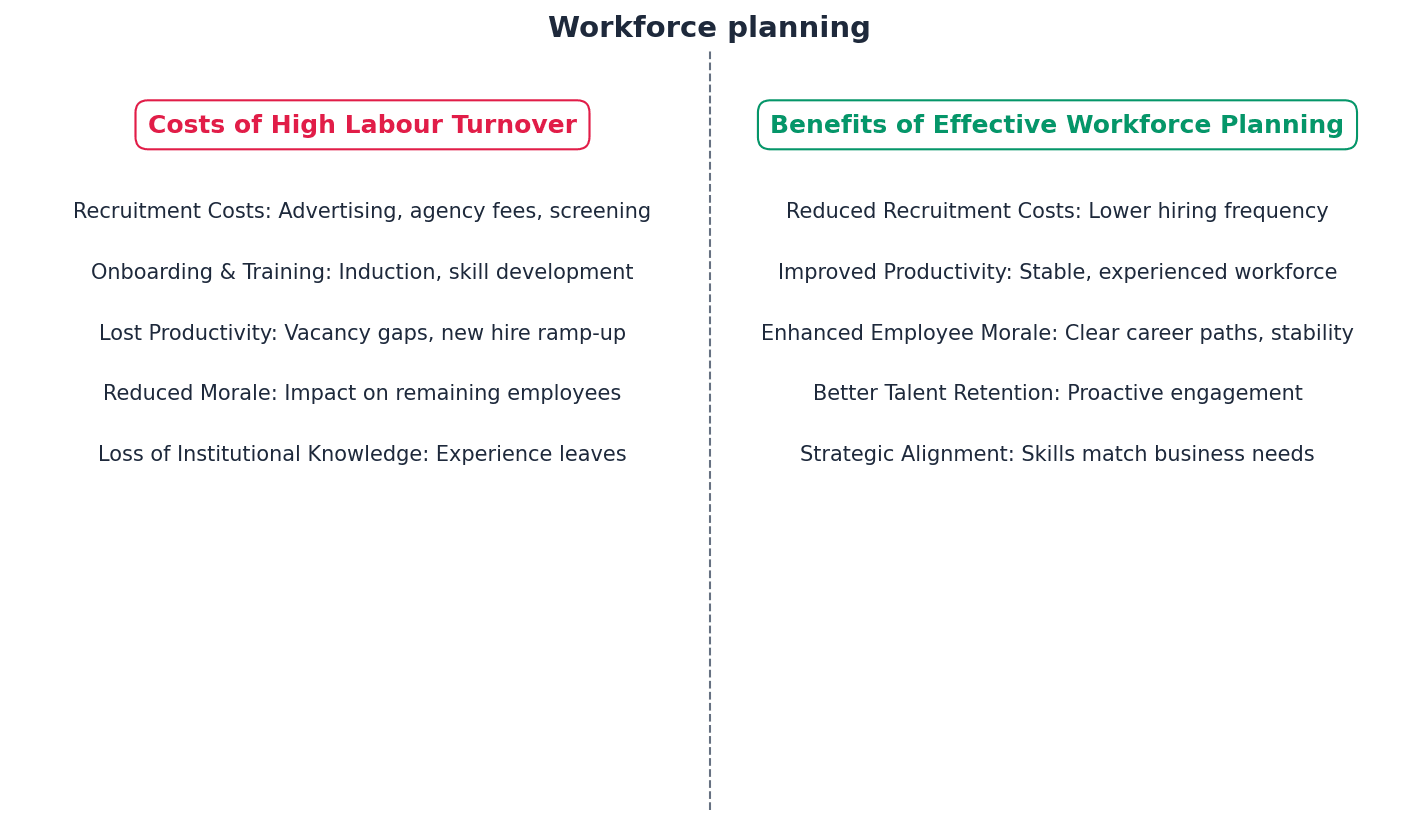
When evaluating the importance of workforce planning, consider both the costs of not planning (e.g., skill gaps, overstaffing) and the benefits of effective planning (e.g., meeting demand, increased efficiency), linking to long-term business objectives.
Students often think workforce planning is only about hiring more people, but actually it also involves assessing current staff skills, anticipating future needs, and potentially reducing staff through natural wastage or redundancy if demand falls.
Labour turnover — Labour turnover is measured by the formula: (Number of employees leaving in 1 year / Average number of employees in 1 year) × 100.
A high and increasing labour turnover rate can indicate employee discontent, low morale, or ineffective recruitment. While costly, it can also offer benefits like replacing less productive staff with new talent, but it's like a leaky bucket; you keep pouring water in (recruiting), but it keeps draining out (employees leaving), making it hard to keep the bucket full and achieve your goals.
Labour turnover rate
Used to measure the rate at which employees leave a business. Does not typically include redundancies.
When analysing labour turnover, remember to discuss both the costs (recruitment, training, poor output) and potential benefits (new ideas, replacing poor performers) and consider the context of the industry and economic conditions.
Students often think high labour turnover is always bad, but actually it can sometimes be beneficial if low-skilled or less-productive staff are leaving and being replaced by more carefully selected, higher-skilled workers, or if a business needs to reduce employee numbers.
The process of recruiting and selecting employees is crucial for an organisation's success. It begins with establishing the exact nature of the job and drawing up a job description, followed by a person specification. This leads to preparing a job advertisement, making a shortlist of applicants, and finally selecting between the applicants.
Job description — A job description provides a complete picture of the job that is vacant and will include job title, details of the tasks to be performed, responsibilities involved, place in the hierarchical structure, working conditions, and how the job will be assessed.
This document is crucial for attracting the right type of applicants as it clearly outlines what the job entails. It forms the basis for the person specification, much like an instruction manual for a specific role; it tells you exactly what the machine (employee) is supposed to do, its functions, and how its performance will be measured.
Person specification — A person specification is an analysis of the qualities, skills and qualifications that will be looked for in suitable applicants.
It is based on the job description and helps in the selection process by eliminating applicants who do not match the necessary requirements, ensuring a more targeted recruitment. It is like a shopping list for a specific item; it details all the characteristics (skills, qualifications, qualities) you are looking for in the ideal purchase (applicant).
Students often confuse a job description with a person specification, but actually the job description describes the job itself (tasks, responsibilities), while the person specification describes the ideal candidate (qualities, skills, qualifications).
When asked to 'explain the difference between a job description and a person specification', clearly state that the job description focuses on the role's duties and responsibilities, while the person specification focuses on the attributes of the individual needed for the role.
Internal recruitment — Internal recruitment is when the selected candidate already works for the organisation.
This method offers advantages such as applicants already knowing the organisation's culture and methods, providing career progression for existing staff, and often being quicker and cheaper than external recruitment. It is like promoting a junior player from within your own sports team to a senior position; they already know the team's plays and culture.
External recruitment — External recruitment is when the successful applicant does not currently work for the business.
This method brings new ideas and practices to the business, offers a wider choice of potential applicants, and can avoid resentment sometimes felt by existing staff if a colleague is promoted above them. It is like signing a new player from another team; they bring fresh perspectives, different skills, and a wider talent pool to choose from.
Students often think internal recruitment is always better due to cost savings, but actually it can limit new ideas, create resentment among colleagues, and may not bring in the highest standard of applicants if the internal pool is limited.
When evaluating recruitment methods, ensure you discuss both the advantages (e.g., cost, knowledge of culture, motivation) and disadvantages (e.g., limited new ideas, potential resentment) of internal recruitment, linking them to business objectives.
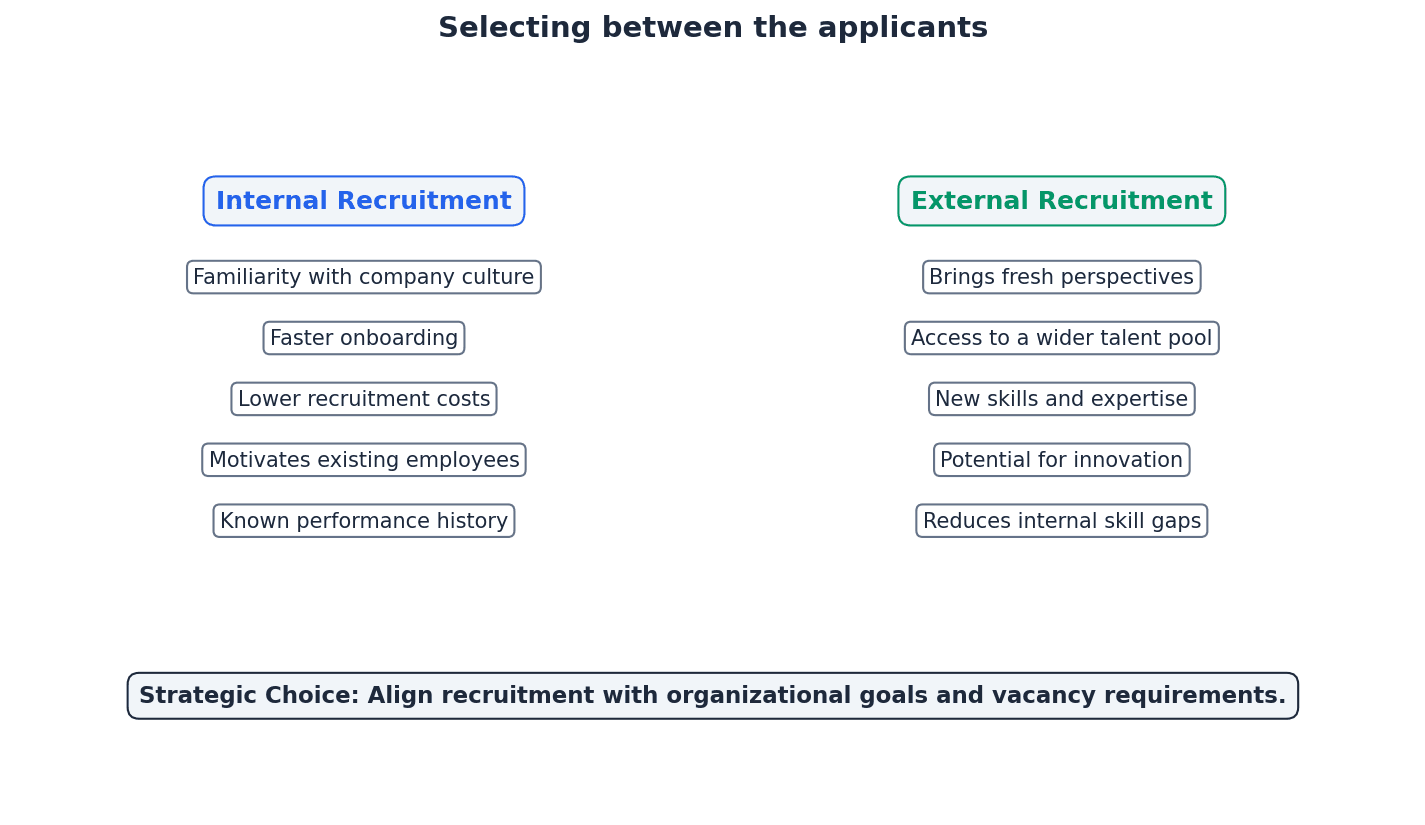
Employment contracts — Employment contracts are legally binding documents that outline the responsibilities of both the employer and the employee, including work responsibilities, working hours, pay, holiday entitlement, and notice periods.
These contracts ensure fairness and compliance with employment laws, providing protection and clarity for both parties. They can be permanent or temporary, full-time or part-time, much like a rulebook for a game; it sets out what each player (employer and employee) must do, the conditions of play, and what happens if someone wants to leave the game.
When assessing the main features of employment contracts, list specific elements like responsibilities, hours, pay, holidays, and notice periods, and explain their importance in providing legal protection and clarity for both employer and employee.
Redundancy — Redundancy occurs when workers’ jobs are no longer required, perhaps because of a fall in demand, a change in technology or the need to cut costs.
This is distinct from dismissal as it is not due to employee misconduct. Businesses often try to manage redundancies through natural wastage or voluntary redundancy before compulsory measures. It is like a specific tool in a workshop becoming obsolete because a new, more efficient machine can do its job; the tool itself isn't broken, but it's no longer needed.
Dismissal — Dismissal is when an HR manager disciplines an employee for continued failure to meet the obligations set out in the contract of employment or for gross misconduct.
This is a serious action that requires following agreed disciplinary procedures and legal requirements to avoid allegations of unfair dismissal. Reasons can include inability to do the job, negative attitude, or disregard of safety procedures. It is like a player being sent off the field for repeatedly breaking the rules or failing to perform, even after warnings.
Students often confuse redundancy with dismissal, but actually redundancy is about the job no longer existing, while dismissal is about an employee's failure to meet contract obligations or misconduct.
When explaining the difference between dismissal and redundancy, clearly state that redundancy is due to the job no longer being needed, whereas dismissal is due to the employee's performance or behaviour.
Maintaining high employee morale and welfare is crucial for productivity and retention. This includes fostering a positive work-life balance and ensuring diversity and equality in the workplace. Businesses must recognise the impact of these factors on employee motivation and overall organisational performance.
Training and development are vital for increasing efficiency and motivation within a business. They equip employees with new skills, improve existing ones, and prepare them for future roles. This investment can lead to higher productivity, better quality output, and improved employee morale.
Induction training — Induction training should be given to all new recruits and aims to introduce them to colleagues, explain organisational structure, outline premises layout, and clarify health and safety issues.
This initial training helps new employees integrate into the company, understand their environment, and become productive quickly, reducing anxiety and improving retention. It is like a guided tour and welcome packet for a new student on their first day at a new school; it helps them find their way around, understand the rules, and meet key people.
On-the-job training — On-the-job training involves instruction at the place of work, often conducted by HR managers or departmental training officers, or by working closely with experienced staff.
This method is typically cheaper than external courses, and the training content is directly relevant to the business's specific needs, allowing for immediate application of learned skills. It is like learning to cook by working directly with an experienced chef in a busy kitchen; you learn practical skills by doing them in a real work environment.
Off-the-job training — Off-the-job training covers any course of instruction away from the place of work, such as in a specialist training centre, college, or university.
This type of training can be expensive but offers the benefit of new ideas and specialist knowledge that may not be available within the company, often leading to formal qualifications. It is like attending a specialized workshop or university course to learn a new skill; you're away from your usual environment, focusing solely on learning from experts.
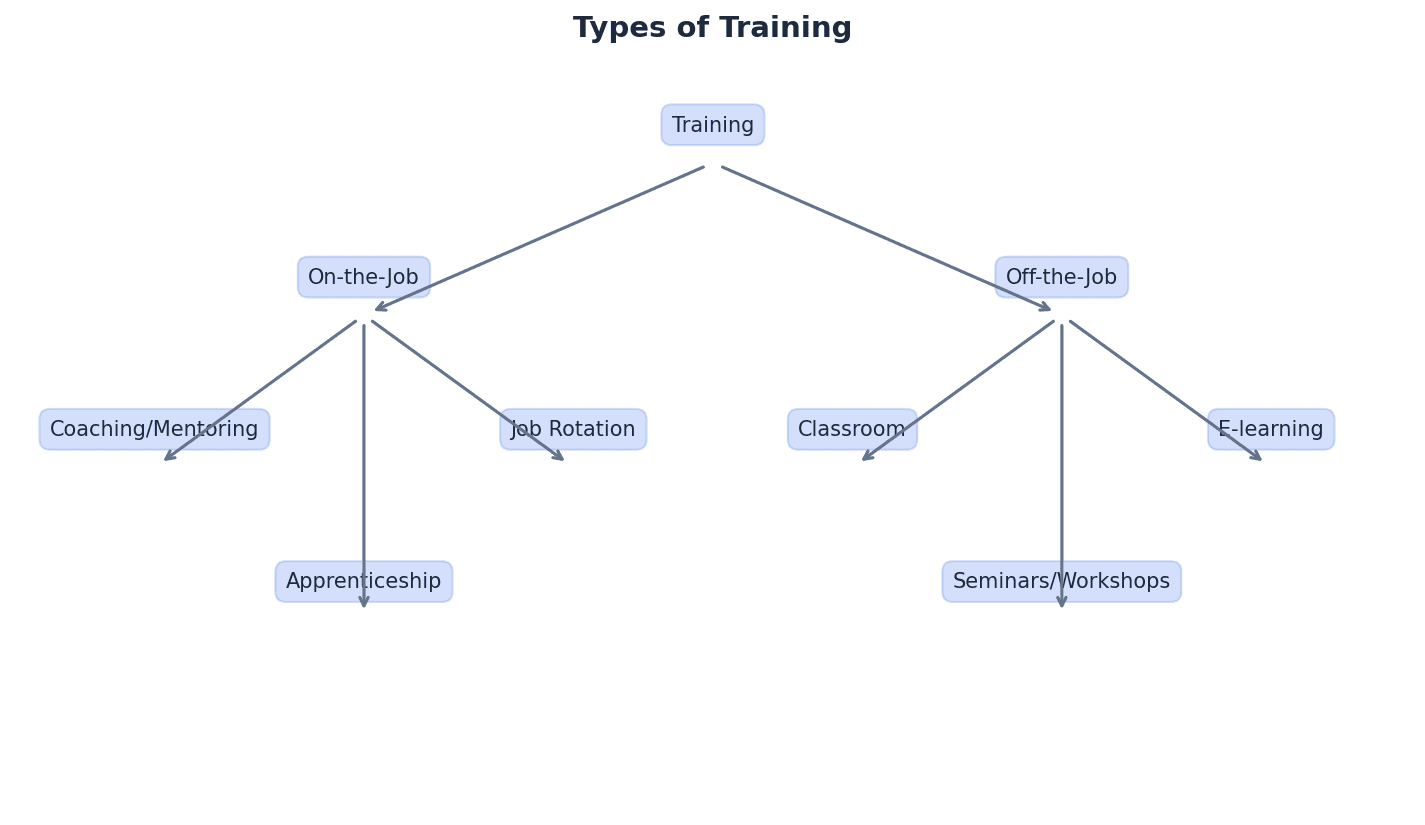
Students often think training is only a cost, but the costs of not training (e.g., low productivity, accidents, poor customer service) can be substantial.
For questions on training, provide a balanced argument by evaluating both the costs (e.g., financial outlay, lost output) and the benefits (e.g., higher productivity, improved morale).
Employee appraisal — Employee appraisal is often undertaken annually and is an essential component of a staff-development programme, involving the analysis of performance against pre-set targets and the setting of new targets.
This process links individual worker performance to business objectives, provides feedback, identifies training needs, and contributes to employee development and motivation. It is like a coach reviewing a player's performance after a season; they assess how well targets were met, provide feedback, and set new goals for improvement in the next season.
Students often think employee appraisal is just about judging past performance, but actually it's also forward-looking, focusing on setting new targets and identifying development opportunities to improve future performance and motivation.
Intrapreneurship — Intrapreneurship is encouraged through training and development programmes with the specific aim of fostering independent thinking, creativity, and innovation within an organisation.
It involves empowering employees with authority and resources to introduce innovations, accepting some failure as part of the risk-taking process, and encouraging small-scale ideas before larger ones. It is like a large ship allowing some of its crew members to design and build a small, innovative new boat on board, giving them resources and freedom, even if it might not always float perfectly on the first try.
Effective management-workforce relations are critical for business success, fostering cooperation and preventing disputes. The involvement of trade unions and the process of collective bargaining play a significant role in shaping these relations, ensuring fair treatment and working conditions for employees.
Collective bargaining — Collective bargaining is the basis of trade union influence, negotiating on behalf of all of their members within a business to gain higher pay deals and better working conditions.
This process gives workers a stronger position than if they negotiated individually, leading to more equitable outcomes and a formal channel for communication between management and workforce. It is like a group of neighbours negotiating with a landlord for better living conditions and lower rent, rather than each person trying to negotiate alone; their combined voice has more power.
Go slow — Go slow is a form of industrial action in which workers keep working but at the minimum pace demanded by their contract of employment.
This action aims to reduce output and disrupt operations without a full strike, putting pressure on employers during a dispute over pay or conditions. It is like a car driving at the absolute minimum legal speed on a highway; it's still moving, but it's intentionally slowing down traffic and causing frustration.
Work-to-rule — Work-to-rule is a form of industrial action in which employees refuse to do any work outside the precise terms of the employment contract.
This means no overtime, no non-contractual cooperation, and strict adherence to rules, which can significantly disrupt a business that relies on employee flexibility and goodwill. It is like a computer program strictly following only the code it's given, refusing to perform any unprogrammed shortcuts or helpful extra functions, even if they would make things more efficient.
Overtime bans — Overtime bans are industrial action in which workers refuse to work more than the contracted number of hours each week.
This can lead to lost output for the employer, especially during busy periods, and is used to exert pressure during industrial disputes. It is like a factory closing down its second shift; production capacity is immediately reduced, impacting total output, especially when demand is high.
Strike action — Strike action is the most extreme form of industrial action in which employees totally withdraw their labour for a period of time.
This leads to production stopping and the business shutting down, causing significant financial losses and disruption, and is typically a last resort in industrial disputes. It is like a complete shutdown of a factory; no work is done, no products are made, and the entire operation comes to a halt.
Lock-outs — Lock-outs are short-term closure of the business or factory to prevent employees from working and being paid.
This is an employer's tactic during an industrial dispute to put pressure on employees and unions to agree to terms, by denying them the opportunity to earn wages. It is like a landlord changing the locks on a tenant who is refusing to pay rent; the tenant is prevented from accessing the property until the dispute is resolved.
When discussing management-workforce relations, always link your points back to the impact on the business's objectives, such as profitability, efficiency, or reputation.
In scenario questions, use the context to justify your choice of recruitment method (internal vs. external) or training type (on-the-job vs. off-the-job).
Advantages & Disadvantages
Internal Recruitment
External Recruitment
Evaluation Starters
Essay Structure Guide
Introduction
Start by defining Human Resource Management (HRM) and briefly outlining its strategic importance to an organisation. State the key areas you will cover in your essay, such as recruitment, training, and employee relations, and briefly mention the overall objective of HRM.
Conclusion
Summarise your main arguments, reiterating the strategic importance of effective HRM in achieving overall business objectives. Provide a final, well-reasoned judgement on the most critical aspects of HRM for long-term business success, considering the balance between employee welfare and organisational efficiency.
This chapter explores motivation, its importance for business success, and various theories explaining human needs and motivational factors. It details practical financial and non-financial methods businesses use to motivate employees, evaluating their appropriateness and impact in different contexts.
Motivation — Motivation gives workers the desire to complete a job quickly and well.
Motivation encompasses the internal and external factors that stimulate people to take action and achieve a goal. Well-motivated workers are crucial for a business to achieve its objectives efficiently, leading to higher productivity and lower labour turnover, much like a car needing fuel to run efficiently.
Students often think motivation is solely about money, but actually it encompasses a wide range of financial and non-financial factors that satisfy various human needs.
Motivated workers are vital for business success as they contribute to higher productivity, better quality output, and lower labour turnover. Their desire to complete tasks quickly and well directly impacts a business's ability to achieve its objectives efficiently and effectively, ensuring sustained performance and growth.
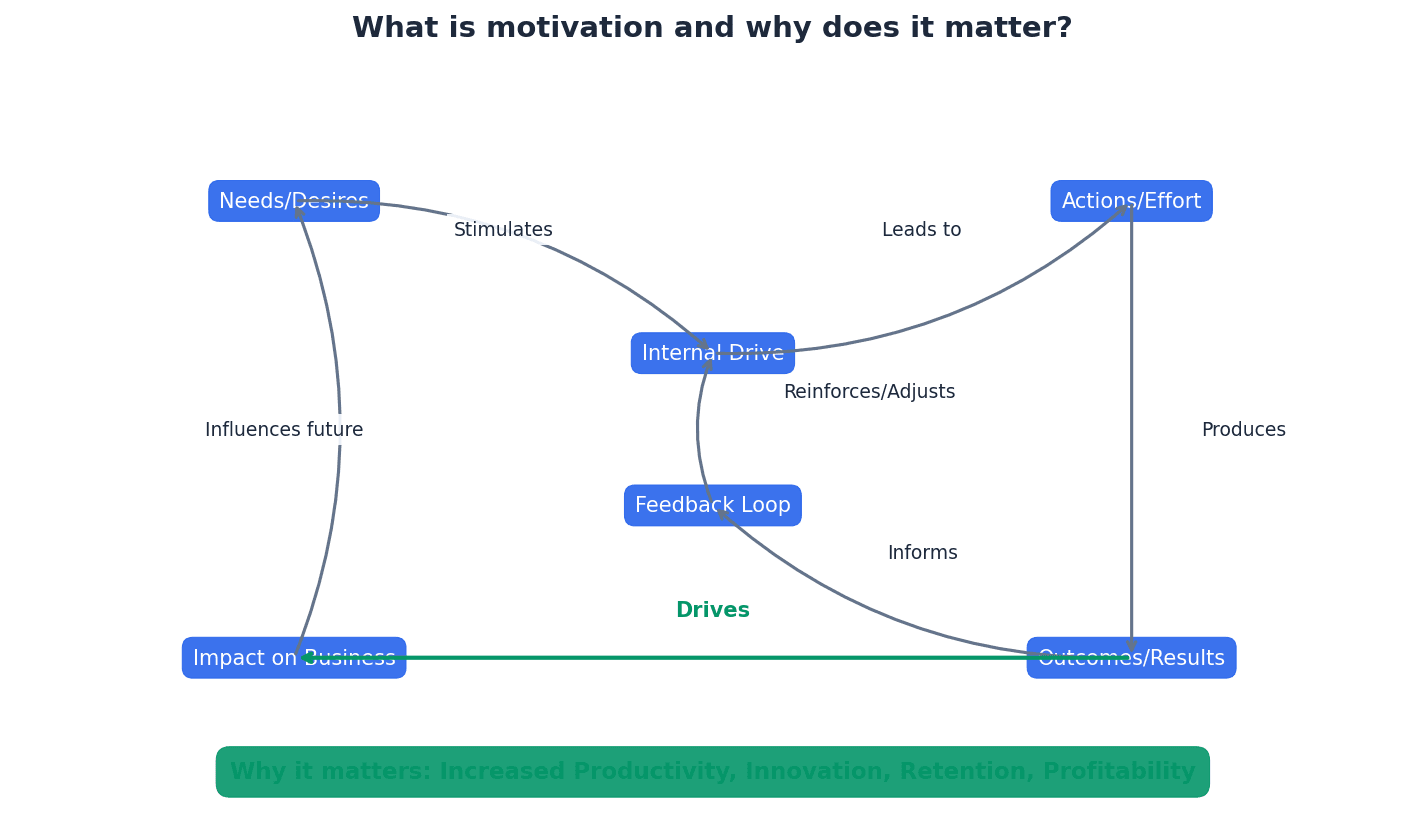
Scientific management — Scientific management is an approach to improving worker output or productivity by systematically observing, recording, and optimising work methods.
Pioneered by Frederick Taylor, this approach involves selecting workers, observing their tasks, recording times, identifying the quickest method, training all workers in this method, supervising them, and paying based on results. Its aim was to reduce inefficiency in manufacturing, much like a chef meticulously timing each step of a recipe to produce dishes consistently and quickly.
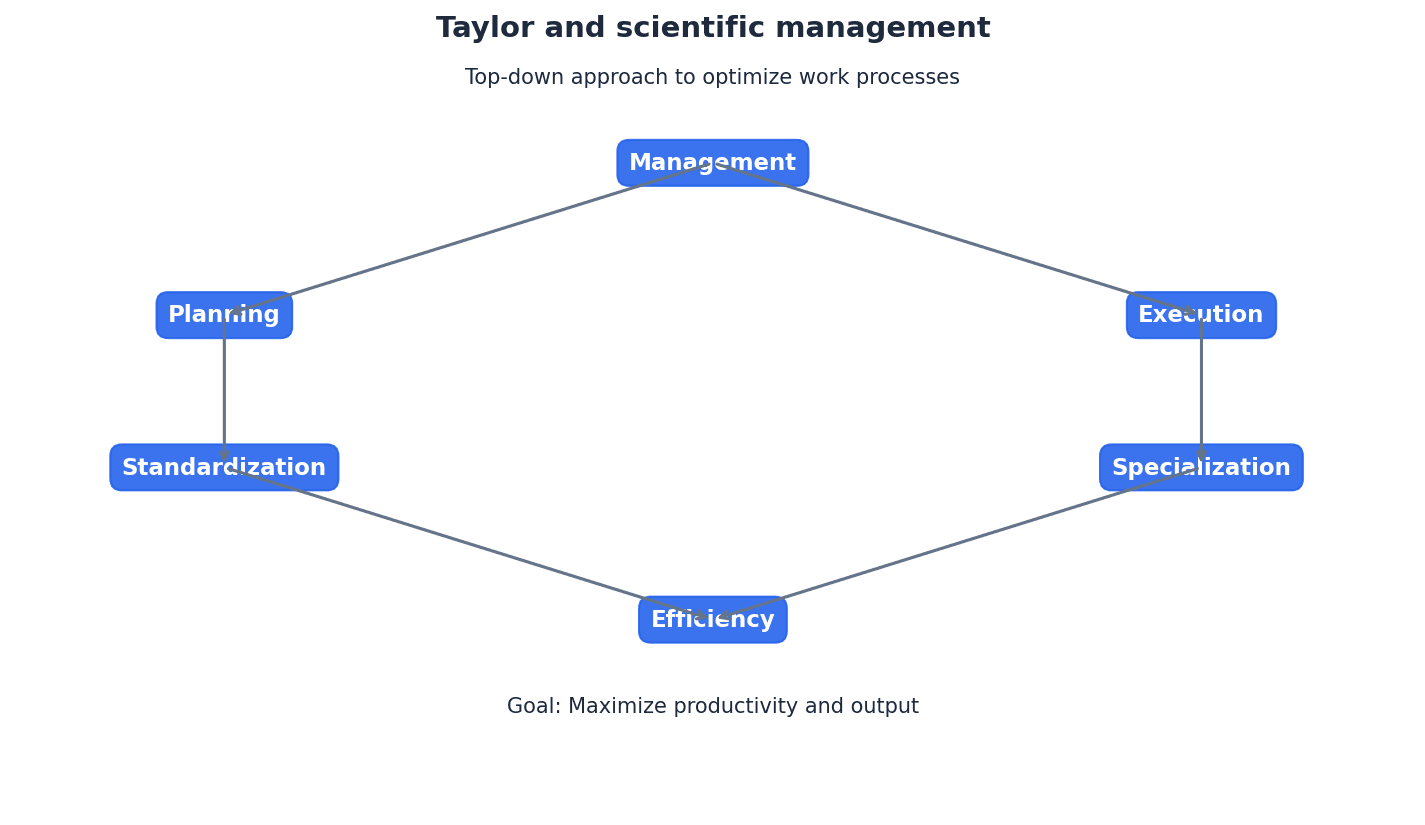
Economic man theory — The economic man theory suggests that people are motivated by money alone and the only factor that could stimulate further effort is the chance of earning more money.
This theory formed the basis of Taylor's motivational suggestions, particularly wage levels based on output (piece rate). It assumes that workers are rational and will always choose the option that maximises their financial gain, similar to a vending machine that only accepts coins for a snack.
When discussing Taylor, link his scientific approach directly to its impact on efficiency and productivity, and mention the 'economic man' theory as its underlying assumption. Evaluate its relevance to modern industry.
Piece rate — Piece rate means paying workers a certain amount for each unit produced.
This payment system directly links wages to output, incentivising workers to increase production. It can be combined with a low basic wage, with higher rates paid if output targets are exceeded (partial piece rate), much like a fruit picker getting paid per basket of fruit picked.
Students often think piece rate always leads to higher quality, but actually it can incentivise quantity over quality, as workers rush to produce more units.
Hawthorne effect — The Hawthorne effect refers to the conclusions of Elton Mayo's work, which showed that consultation with workers, team spirit, and giving workers some control over their working lives improve motivation and productivity, rather than just working conditions or pay levels.
Mayo's experiments revealed that workers' productivity increased not due to changes in physical conditions, but because they felt observed, valued, and involved. This highlighted the importance of social and psychological factors in the workplace, similar to a sports team winning because the coach fosters team bond, not just new equipment.
When discussing Mayo, clearly state the Hawthorne effect and explain its key conclusions, emphasising the shift from purely physical conditions to human relations factors. Link it to worker participation and team working.
Worker participation — Worker participation is a trend towards giving workers more of a role in business decision-making.
This can range from involvement in team-level decisions to electing worker representatives to the board of directors. It aims to improve motivation, job enrichment, and decision quality by leveraging workers' insights, much like a family deciding together on holiday plans for greater buy-in.
Self-actualisation — Self-actualisation is the highest level in Maslow's hierarchy of needs, representing the fulfilment of one's potential.
It involves challenging work that stretches the individual, opportunities to develop new skills, and a sense of achievement. Maslow believed not everyone reaches this level, but everyone is capable of it, similar to a musician composing original music and inspiring others.
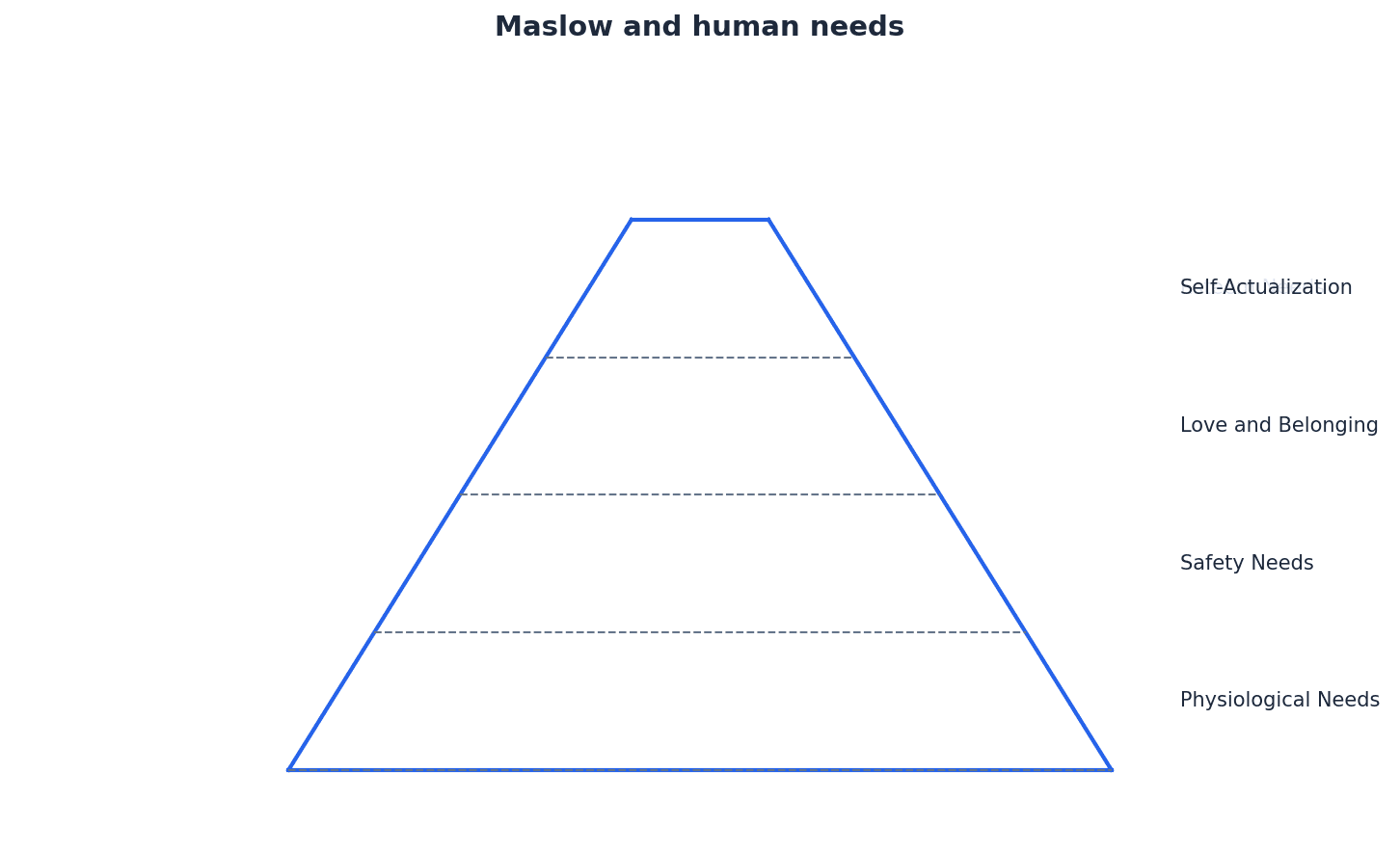
Students often think Maslow's hierarchy is rigid and universally applicable; individual needs can vary, and reversion to lower levels is possible.
When applying Maslow, explain how specific job roles or opportunities (e.g., challenging projects, training) can help satisfy self-actualisation needs, and note its impermanent nature.
Motivators — Motivators are factors identified by Herzberg that lead to job satisfaction, including achievement, recognition for achievement, the work itself, responsibility, and advancement.
Herzberg argued that these intrinsic factors are essential for true motivation and job satisfaction. Even if hygiene factors are met, motivators must be present for workers to willingly give their best, like challenging levels and rewards in a video game.
Hygiene factors — Hygiene factors are factors identified by Herzberg that lead to job dissatisfaction if absent, including company policy and administration, supervision, salary, relationships with others, and working conditions.
These extrinsic factors surround the job and must be addressed by management to prevent dissatisfaction. However, even if they are in place, they do not, by themselves, create a well-motivated workforce; they only remove dissatisfaction, much like clean tables in a restaurant prevent unhappiness but don't make the food delicious.
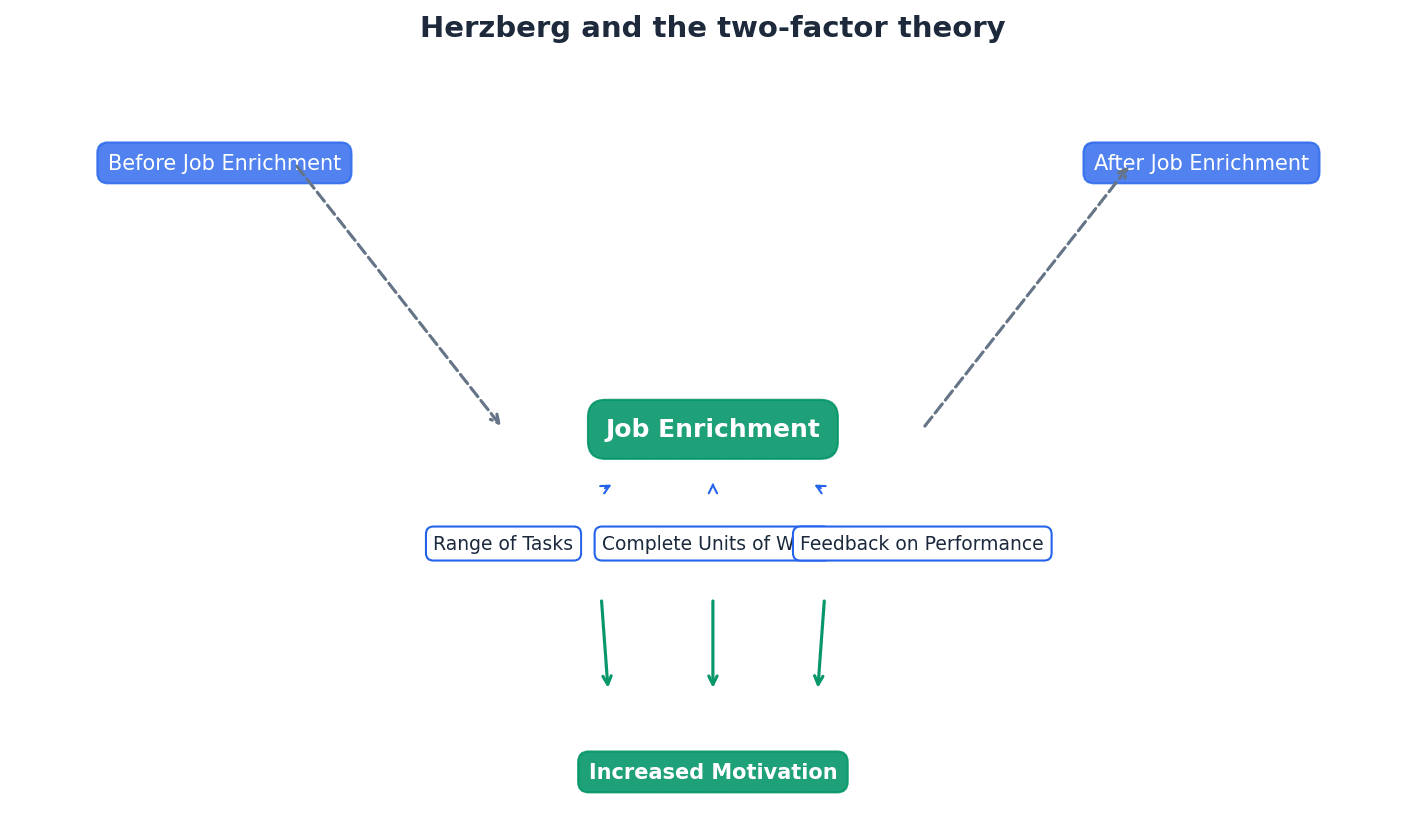
Students often think Herzberg's hygiene factors motivate workers; they only prevent dissatisfaction, while motivators actively create satisfaction.
Clearly distinguish between Herzberg's motivators and hygiene factors. When asked to apply Herzberg, focus on how job enrichment provides motivators.
Job enrichment — Job enrichment is a method of motivation that involves giving workers more challenging and rewarding tasks, increased responsibility, and greater control over their work.
Based on Herzberg's theory, it aims to provide motivators by assigning complete units of work, offering feedback on performance, and providing a range of tasks. This leads to increased job satisfaction and motivation, similar to a worker assembling an entire toy and testing it, gaining a sense of ownership.
Valence — Valence is the depth of the desire of an employee for an extrinsic reward, such as money, or an intrinsic reward, such as satisfaction, according to Vroom's expectancy theory.
It represents the value an individual places on a particular outcome or reward. If an employee does not value the potential reward, their motivation will be low, regardless of expectancy or instrumentality, much like how much you actually want a specific prize for winning a race.
Expectancy — Expectancy is the degree to which people believe that putting effort into work will lead to a given level of performance, according to Vroom's expectancy theory.
It is the perceived probability that effort will result in successful performance. If an employee believes that no matter how hard they try, they cannot achieve the desired performance, their motivation will be low, similar to how confident you are that studying hard will lead to a good grade.
Instrumentality — Instrumentality is the confidence of employees that they will actually get what they desire, even if it has been promised by the manager, according to Vroom's expectancy theory.
It is the perceived probability that successful performance will lead to a desired reward. If an employee performs well but does not trust that the promised reward will materialise, their motivation will be low, like being confident that race organisers will give you the promised prize.
When applying Vroom's theory, ensure you explain all three components (valence, expectancy, instrumentality) and how the absence of any one can reduce motivation. Use specific examples for valence.
Businesses employ various financial methods to motivate workers, aiming to link rewards directly to performance or provide income security. These methods range from direct payments for output to more complex schemes involving company profits or shares, each with distinct impacts on employee behaviour and motivation.
Time-based wage rate — A time-based wage rate is a payment system where a payment per hour is set, and the total wage is determined by multiplying this by the number of hours worked.
This is a common way of paying manual, clerical, and non-management workers, often paid weekly. It offers security over pay levels but provides no direct incentive to increase output, much like a babysitter paid a fixed amount per hour regardless of tasks completed.
Salary — A salary is a fixed annual payment, usually paid monthly, that is not dependent on the number of hours worked or the number of units produced.
It is common for professional, supervisory, and management staff, offering security of income and status. Salary levels are often fixed for a year and may be part of salary bands based on experience and performance, similar to a subscription service with a fixed monthly payment.
Commission — Commission payments are usually paid to salespeople, either as a percentage of sales or a fixed amount per sale, and can make up all or part of their total income.
It provides a strong financial incentive to increase sales but can reduce income security and may encourage high-pressure selling tactics that could damage customer relationships, much like a real estate agent earning a percentage of each house sale.
Bonus payment — A bonus payment is an additional payment made to employees beyond their contracted wage or salary, often based on agreed criteria such as increased output, productivity, or sales.
Bonuses can be paid to individuals or teams for outstanding performance or reaching targets. They incentivise good performance but can cause resentment if not received or if perceived as unfair, similar to a football player receiving an extra payment for scoring a hat-trick.
Performance-related pay (PRP) — Performance-related pay is usually a bonus payable in addition to the basic salary, awarded based on an individual's performance against pre-set targets.
It is widely used for roles where output is not quantitatively measurable, such as management. It involves regular target setting, annual appraisals, and bonuses for exceeding targets, aiming to encourage target achievement, much like a student receiving an extra scholarship for specific academic grades.
Students often think Performance-related pay is purely objective, but actually it relies heavily on subjective appraisal, which can lead to perceived favouritism or unfairness if not managed transparently.
Profit sharing — Profit sharing is a financial incentive arrangement where employees receive a proportion of the company's profits.
The aim is to increase employee commitment to the business's success, encouraging them to strive for higher performance and cost savings. However, the share might be too small to be highly motivating, and shareholders might object, similar to friends dividing a portion of lemonade stand earnings.
Share-ownership schemes — Share-ownership schemes are financial incentives that give workers shares, or the chance to buy discounted shares, in the company they work for.
These schemes aim to reduce the division between owners and workers, increasing employees' sense of belonging and commitment to the organisation's success. As shareholders, employees can participate in company meetings, much like being given a small piece of a cake you helped bake.
Fringe benefits — Fringe benefits, also known as perks of the job, are non-cash forms of reward offered to employees in addition to normal payment systems.
These can include company cars, health insurance, pension schemes, and discounts. They are used to give status to higher-level employees and to recruit and retain the best staff, despite having a financial value, like getting free popcorn and a drink with a movie ticket.
Students often classify fringe benefits as non-financial motivators, but actually while they are non-cash, they do have a financial value and are often considered part of the total compensation package.
Beyond monetary rewards, businesses utilise various non-financial methods to enhance employee motivation, focusing on job design, development, and involvement. These strategies aim to satisfy higher-level needs, fostering job satisfaction, skill development, and a sense of belonging.
Job rotation — Job rotation allows workers to do several different jobs, increasing their skills and the range of work they can do.
It can relieve boredom and make the workforce more flexible, as workers can cover for colleagues' absences. However, it is more limited than job enrichment as it doesn't necessarily increase empowerment or responsibility, much like a chef working on different stations in a kitchen.
Job enlargement — Job enlargement refers to increasing the loading of tasks on existing workers.
This might occur due to employee shortages or redundancies. It is unlikely to lead to long-term job satisfaction unless the additional tasks are made more interesting or challenging, otherwise it can just feel like more work, such as a cashier also stocking shelves without increased pay or responsibility.
Job redesign — Job redesign involves adding, and sometimes removing, certain tasks and functions to create more rewarding work for employees.
It is closely linked to job enrichment and often involves employee input. Examples include training bank employees to sell financial products or hairdressers to offer beauty therapies, leading to wider skills and increased recognition, similar to adding new apps and features to a basic smartphone.
Students often confuse job enrichment with job enlargement or job rotation, but actually enrichment specifically adds depth and responsibility, not just more tasks or different tasks of similar difficulty.
Quality circle (QC) — A quality circle (QC) is a group of five to ten employees with experience in a particular work area who meet regularly to identify, analyse, and solve problems arising in their operation.
These informal meetings aim to improve product quality and productivity by leveraging workers' hands-on experience. They promote employee participation and fit well with Herzberg's ideas of responsibility and challenging tasks, much like a neighbourhood watch group discussing local crime issues.
Always apply theory to the case study. Don't just describe Maslow's theory; explain which level of the hierarchy the employees in the scenario are at.
For 'evaluate' questions, weigh up the pros and cons of a motivational method in the context of the specific business (e.g., 'Piece rate may suit a factory but would demotivate a team of software developers').
When recommending a strategy, justify why it is the most appropriate for that specific business, considering its industry, workforce, and objectives.
Advantages & Disadvantages
Piece Rate Payment System
Job Enrichment
Evaluation Starters
Essay Structure Guide
Introduction
Start by defining motivation and briefly outlining its importance for businesses. State the main theories or methods you will discuss in relation to the question.
Conclusion
Summarise your main arguments, providing a balanced judgement on the most appropriate motivational strategies. Make a justified recommendation, considering the specific circumstances of the business or scenario.
This chapter explores the diverse responsibilities of management, from traditional functions to modern roles, and examines how different management styles impact business success. It also delves into McGregor's theories, highlighting how managerial perceptions of workers influence leadership approaches and employee behaviour.
Manager — Any individual responsible for people, resources or decision-making can be termed a manager.
Managers hold authority over employees below them in the organisational hierarchy. Their role involves directing, motivating, and disciplining staff within their specific section or department to achieve pre-defined goals. A manager is like a coach of a sports team, guiding players, making tactical decisions, motivating them, and ensuring they perform well to win the game.
Supervisors — Supervisors are appointed by management to watch over the work of others.
This role primarily involves leading and controlling a team to work towards pre-set goals, ensuring tasks are completed correctly and efficiently, rather than strategic decision-making. A supervisor is like a team leader in a group project, ensuring everyone is on task, following instructions, and contributing to the overall objective, without necessarily making the big project decisions.
Director — An appointed or elected member of the board of directors of a company who, with other directors, has the responsibility for determining and implementing the company’s policy.
Directors report to the CEO and are crucial in shaping the company's strategic direction and ensuring policies are effectively put into practice, overseeing specific areas or functions. Directors are like the heads of different departments in a school, each responsible for their area (e.g., academics, finance) but working together under the principal (CEO) to achieve the school's overall goals.
Students often think directors are just managers, but actually directors are part of the board, responsible for governance and policy, while managers implement those policies.
Chief executive officer (CEO) — A CEO is the highest-ranking executive in a company, responsible for major corporate decisions, overall operations, and managing company resources.
CEOs are at the top of the organisational hierarchy, setting the strategic direction and ensuring the business meets its objectives. Their role involves significant time in meetings, directing senior managers, and strategic decision-making. A CEO is like the captain of a ship, making the big decisions about where the ship is going, how it will get there, and ensuring all crew members are working together effectively to reach the destination.
Students often think CEOs do all the work themselves, but actually they primarily delegate tasks and direct other managers, focusing on strategic oversight.
When asked to analyse the role of a CEO, refer to Mintzberg's roles (e.g., figurehead, leader, entrepreneur) and Fayol's functions (e.g., planning, directing) to demonstrate a comprehensive understanding.
Henri Fayol identified five traditional functions of management: Planning, Organising, Commanding, Coordinating, and Controlling (POCCC). Planning involves setting objectives and strategies. Organising resources means structuring the business to meet these objectives. Commanding, directing, and motivating employees ensures tasks are carried out. Coordinating activities brings different parts of the business together, and controlling involves measuring performance against targets.
In contrast to Fayol's structured functions, Henry Mintzberg viewed management as less systematic and more reactive, involving various roles. He categorised these into three main groups: interpersonal roles (e.g., figurehead, leader), informational roles (e.g., monitor, disseminator), and decisional roles (e.g., entrepreneur, disturbance handler). This perspective highlights the dynamic and often fragmented nature of a manager's day-to-day activities.
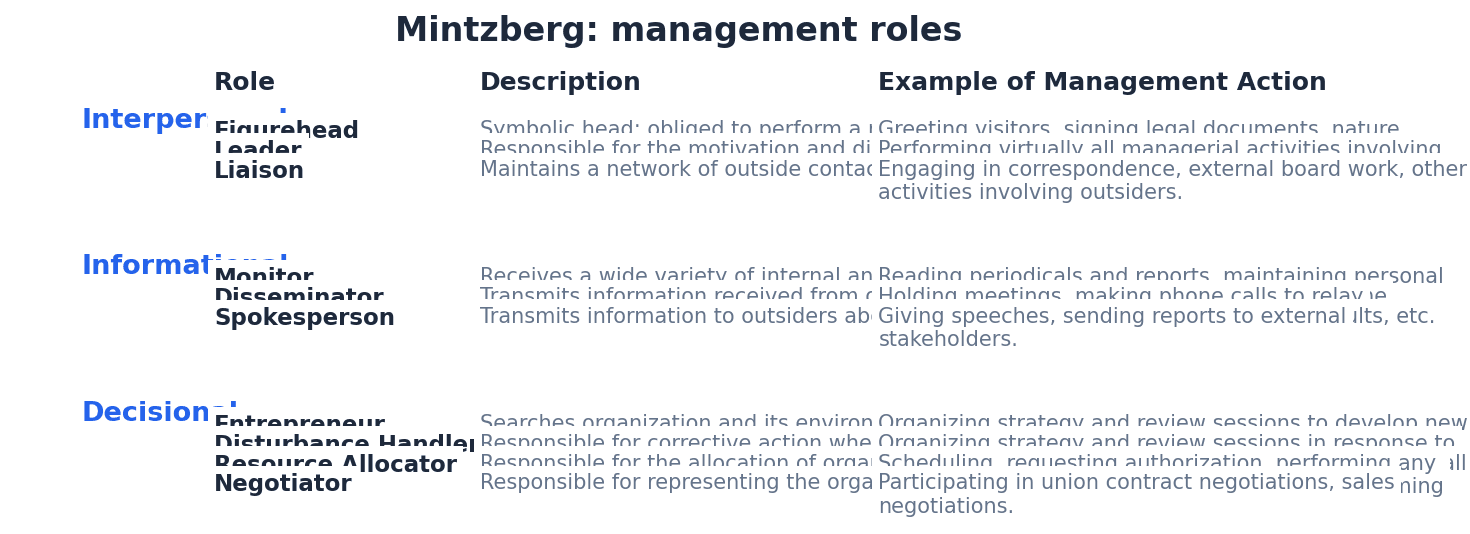
For higher marks, directly compare and contrast different approaches, such as Fayol’s structured functions vs. Mintzberg’s reactive roles.
Management style — Management style refers to the way in which managers take decisions and communicate with employees.
Different management styles, such as autocratic, democratic, paternalistic, and laissez-faire, have varying impacts on employee motivation, decision-making speed, and overall business performance. The most appropriate style depends on the specific situation. Management style is like a chef's cooking style; some chefs are very strict and follow recipes exactly (autocratic), while others encourage creativity and experimentation from their team (democratic).
Students often think there is one 'best' management style, but actually the most effective style is contingent on the specific business situation, workforce, and task.
When evaluating management styles, always justify your recommendation by linking it to the specific context of the business, workforce characteristics, and the nature of the task or crisis.
Autocratic management — Autocratic managers take decisions on their own, with no discussion.
This style involves managers setting objectives, issuing instructions, and closely supervising workers, using one-way communication. While it can lead to low motivation, it is effective in crises or situations requiring quick, decisive action. An autocratic manager is like a military general, issuing clear orders that must be followed immediately without question, especially during a battle.
Students often think autocratic management is always bad, but actually it can be highly effective in specific situations like emergencies or when dealing with inexperienced staff.
Democratic management — Democratic managers encourage discussion with workers before taking decisions, or may allow workers to take decisions themselves.
This style promotes two-way communication, fostering participation and potentially leading to better decisions and higher employee motivation due to increased responsibility and commitment. However, it can be a slow process. A democratic manager is like a team captain who discusses strategies with the players before a game, valuing their input and allowing them to make some decisions on the field.
Students often think democratic management is always the best, but actually it can be time-consuming and unsuitable for urgent situations or highly sensitive issues.
Paternalistic management — Paternalistic managers listen, explain issues and consult with workers, but do not allow them to take decisions.
These managers decide what is best for the business and workforce, focusing on employee welfare but retaining ultimate decision-making authority. It is less democratic and can demotivate experienced workers. A paternalistic manager is like a parent who listens to their children's opinions but ultimately makes the final decisions they believe are in the children's best interest.
Students often think paternalistic management is democratic because it involves consultation, but actually the final decision-making power remains solely with the manager.
Laissez-faire management — Laissez-faire management allows workers to carry out tasks and take decisions themselves within very broad limits.
This is an extreme version of democratic management with very little input from management, effective for expert teams. However, it may lead to a lack of direction and demotivation in other contexts. A laissez-faire manager is like a university professor who gives students a broad research topic and lets them explore it independently, offering minimal direct supervision.
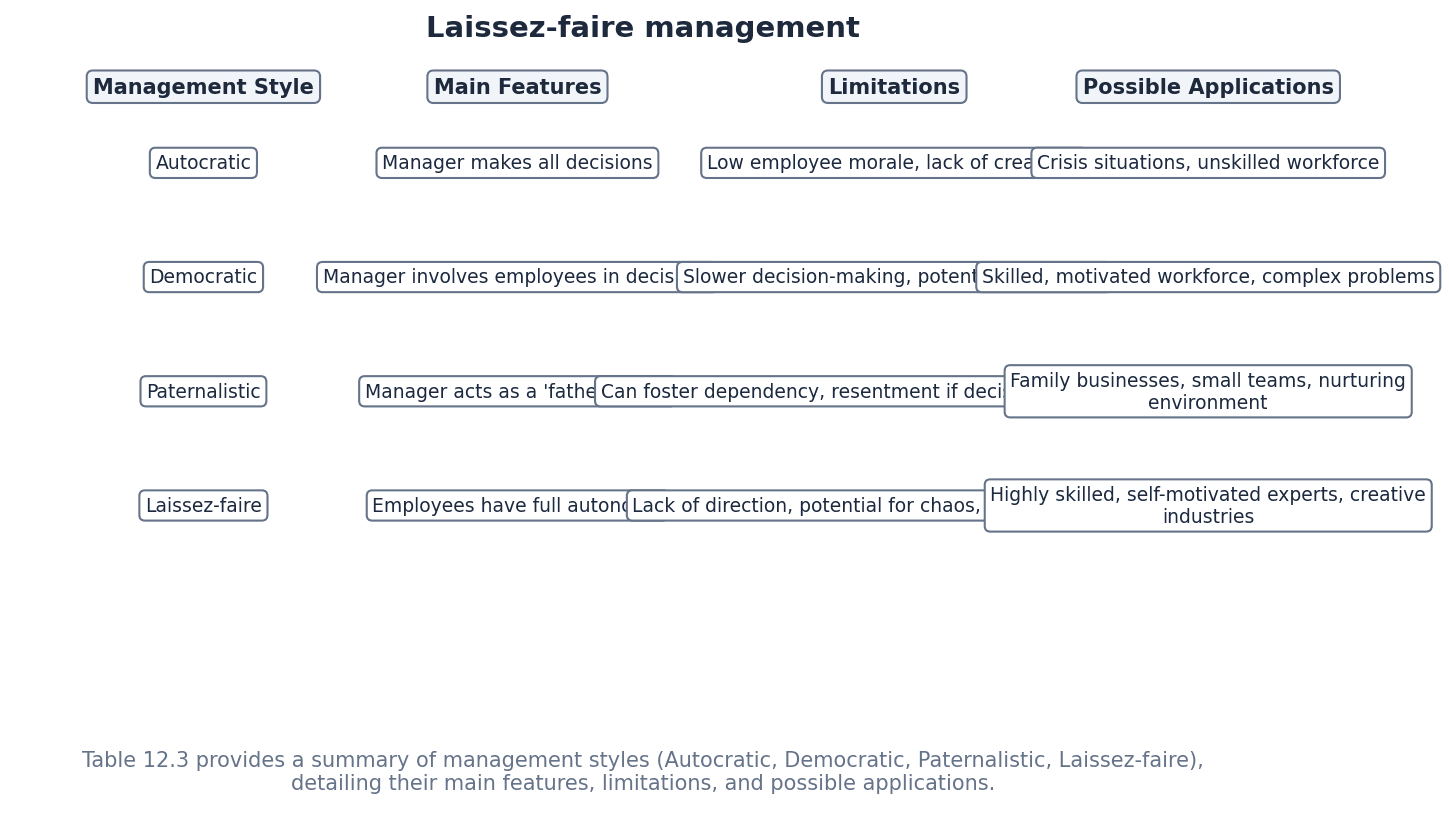
Emphasise that laissez-faire is only appropriate for highly skilled, self-motivated, and experienced teams, and can be disastrous if applied to inexperienced or unmotivated workforces.
Douglas McGregor proposed two contrasting theories about managerial attitudes towards workers, which significantly influence leadership styles and employee behaviour. These theories, Theory X and Theory Y, describe a manager's perception of their workforce, rather than inherent worker characteristics. Understanding these theories helps explain why different management styles are adopted.
Theory X — Theory X managers view their workers as lazy and disliking work, unprepared to accept responsibility, and needing to be controlled and made to work.
This managerial attitude often leads to an autocratic management style, characterised by close supervision and a lack of delegation. McGregor suggested that workers treated this way may indeed become demotivated and avoid work, creating a self-fulfilling prophecy. A Theory X manager is like a strict teacher who believes students will only work if constantly monitored and threatened with punishment, assuming they inherently dislike learning.
Students often think Theory X describes a type of worker, but actually it describes a manager's attitude towards workers, which can then influence worker behaviour.
When discussing Theory X, link it directly to autocratic leadership and explain how this managerial perception can create a self-fulfilling prophecy of low employee motivation and productivity.
Theory Y — Theory Y managers believe that workers enjoy work, find it as natural as rest or play, are prepared to accept responsibility, be creative, and contribute ideas and solutions.
This positive managerial attitude encourages a more democratic or participative management style, fostering delegation, creativity, and higher employee engagement. Workers treated this way are likely to be more motivated and take initiative. A Theory Y manager is like a supportive coach who believes players are naturally enthusiastic and capable, giving them autonomy and encouraging their creative input to improve performance.
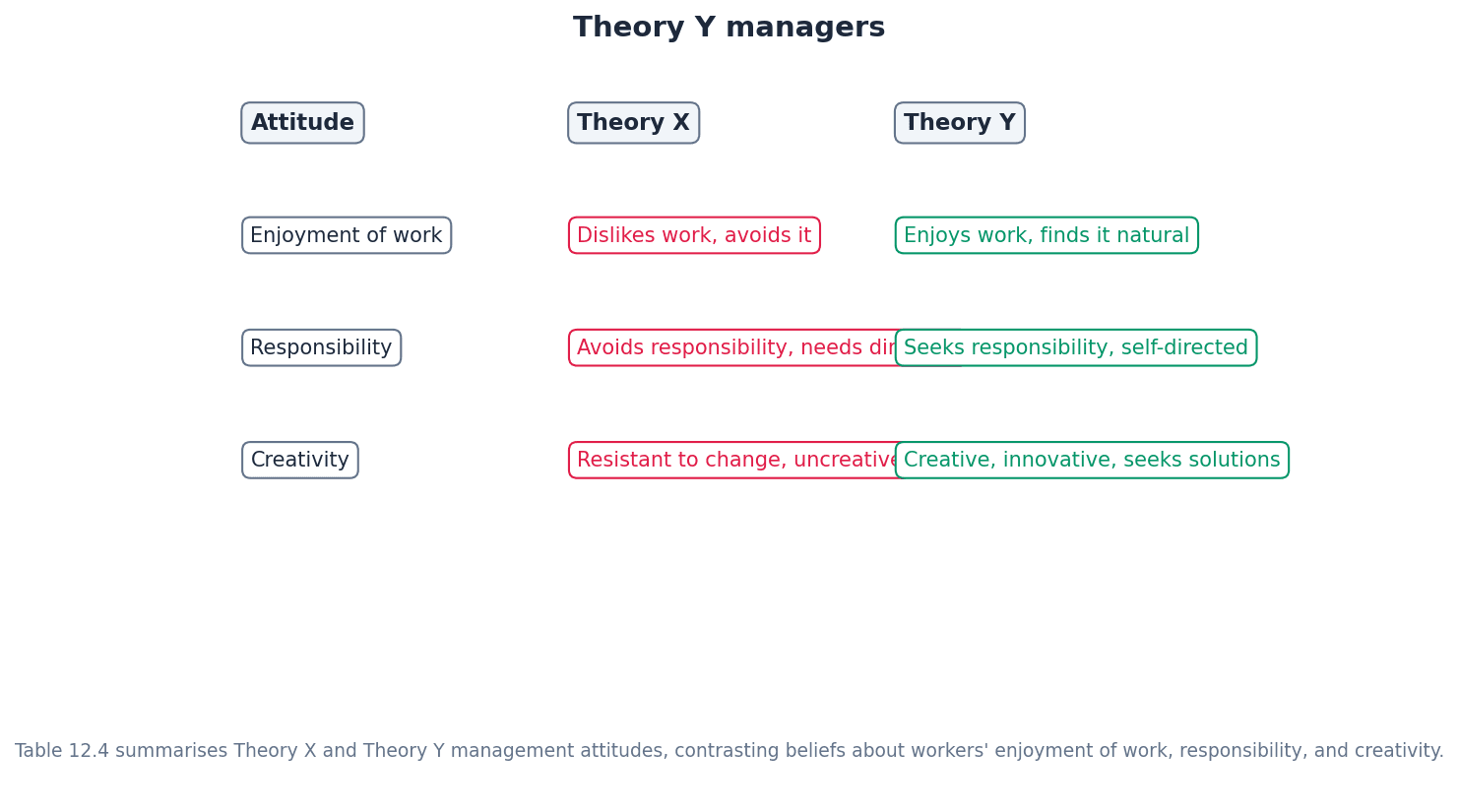
Students often think Theory Y describes ideal workers, but actually it describes a manager's positive attitude towards workers, which can lead to positive worker outcomes.
When analysing Theory Y, connect it to democratic or laissez-faire leadership styles and explain how it can lead to increased employee motivation, initiative, and problem-solving.
Always connect theory to practice. For example, explicitly state that a Theory X manager is likely to adopt an autocratic style.
Don't just describe a style. Analyse its potential advantages and disadvantages for the specific business in the question to show evaluation.
Advantages & Disadvantages
Autocratic Management Style
Democratic Management Style
Evaluation Starters
Essay Structure Guide
Introduction
Begin by defining key terms like 'manager' and 'management style'. Briefly state the purpose of management and outline the different perspectives (Fayol, Mintzberg) and styles you will discuss, setting the stage for an evaluative argument about their appropriateness.
Conclusion
Summarise the main arguments, reiterating that effective management is multifaceted and requires adaptability. Conclude by stressing the importance of good management to business success, highlighting that choosing the right style for the right situation is crucial for employee motivation and achieving objectives.
This chapter explores how businesses are organised, detailing various structures and their impact on communication, motivation, and efficiency. It covers key concepts like delegation, authority, and centralisation, explaining their necessity for achieving business objectives.
Organisational structure — The way in which a business is organised, showing how authority and responsibility are divided and coordinated.
As a business expands, a formal structure becomes necessary to clarify roles, responsibilities, and reporting lines. This allows for the division of tasks and helps workers understand who their manager is, ensuring efficient operation and communication, much like a sports team where everyone knows their role and who to report to.
Students often think organisational structure is only about drawing a chart, but actually it's about the underlying relationships, communication flows, and decision-making processes that enable a business to achieve its objectives.
Organisations require a structure to effectively manage operations, coordinate tasks, and achieve their objectives. This necessity becomes more pronounced as businesses grow, new competitors enter the industry, or business objectives change, requiring adaptations to the organisational framework.
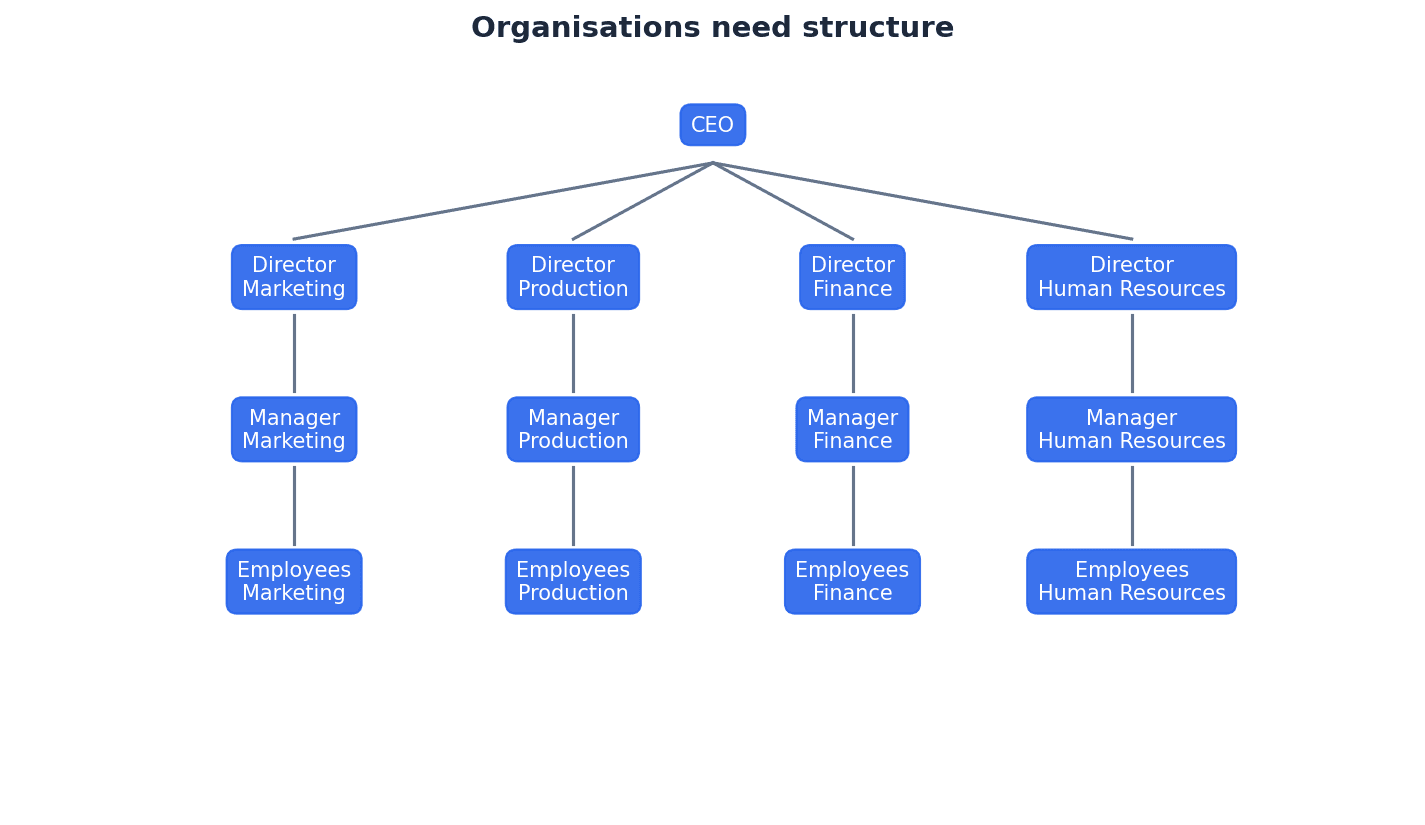
Functional structure — An organisational structure that splits an organisation into departments based on their major area of responsibility, such as marketing, production, finance, and human resources.
In a functional structure, each department is led by a specialist functional manager, and employees are grouped according to their role within that function. This encourages specialisation and departmental loyalty, similar to a school with separate departments for Maths, English, and Science, each with its own head.
Students often think functional structures are always efficient, but actually they can lead to 'silo mentality' where departments focus only on their own goals, making cross-functional projects difficult.
When evaluating functional structures, discuss both the benefits (specialisation, efficiency within departments) and drawbacks (poor inter-departmental communication, potential for conflict, slow response to change).
Hierarchical structure — An organisational structure with different layers of the organisation, with fewer and fewer people at each higher level, often presented as a pyramid.
This structure defines clear levels of authority, a chain of command, and spans of control. It provides clear roles and career paths but can lead to slow communication and a feeling of remoteness for lower-level employees, much like a military organisation with distinct ranks from generals down to soldiers.
Students often think all hierarchies are rigid and inefficient, but actually they can provide clarity, control, and a clear career ladder, especially in stable environments or for role cultures.
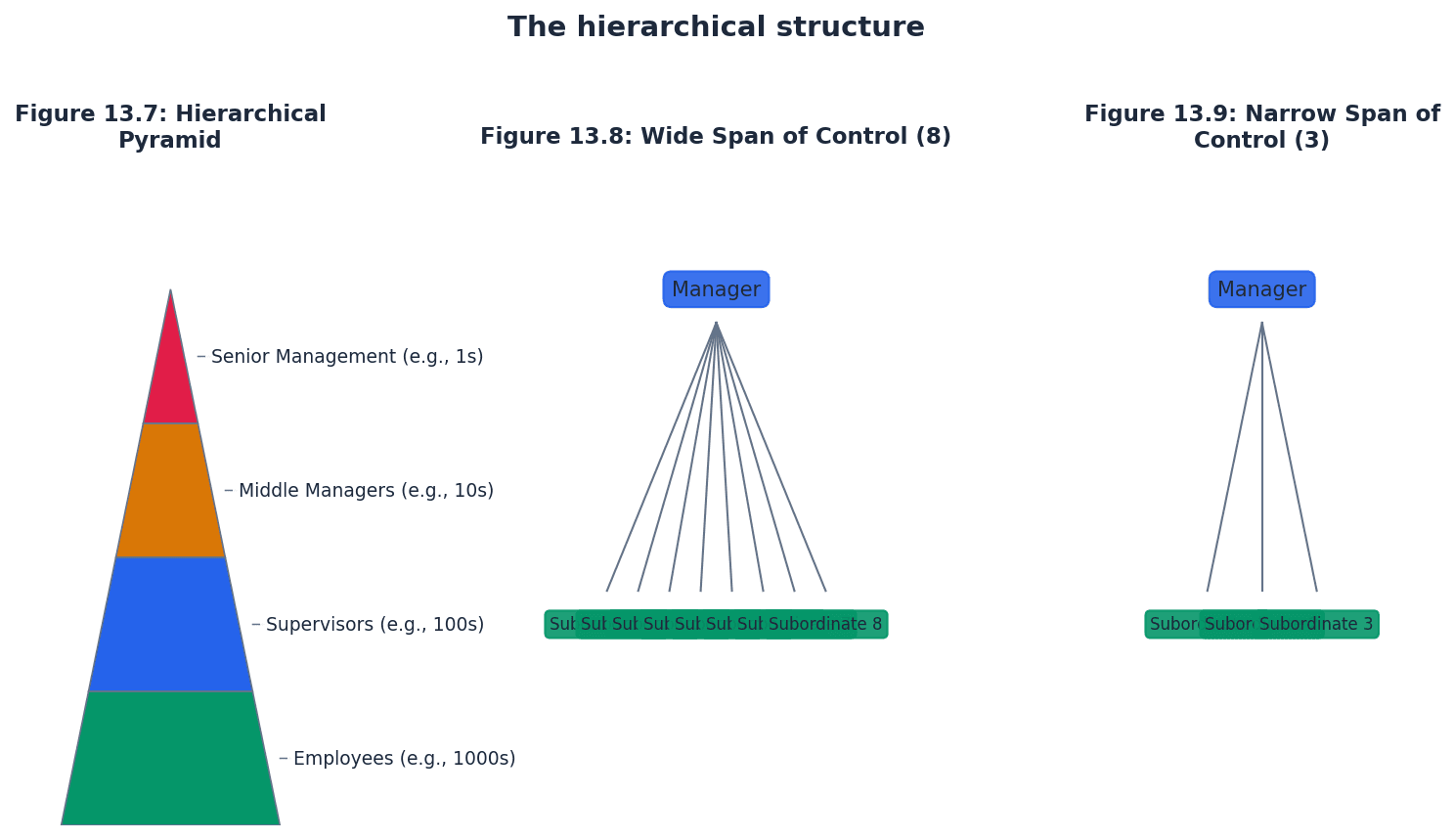
Levels of hierarchy — Each level in a hierarchical structure representing a grade or rank of staff, with lower levels subordinate to superiors on a higher level.
The number of levels determines whether a structure is 'tall' (many levels) or 'flat' (few levels). More levels can slow communication and make lower-level employees feel remote, similar to a multi-storey building where more floors affect how quickly messages travel.
When discussing levels of hierarchy, link them directly to impacts on communication speed, employee motivation (remoteness), and the average span of control.
Chain of command — The formal line of authority through which instructions are passed down the hierarchy and information is sent upwards.
A longer chain of command, typical of tall organisational structures, can slow down communication and decision-making. A shorter chain of command, found in flatter structures, generally results in better communication, much like a bucket brigade where a longer line takes more time for water to reach its destination.
Students often think a long chain of command guarantees accuracy, but actually messages can become distorted or filtered as they pass through many levels.
Span of control — The number of subordinates reporting directly to a manager.
Spans of control can be wide (many subordinates) or narrow (few subordinates). Wide spans often encourage delegation and empowerment, while narrow spans allow for closer control, similar to a teacher managing many students (wide span) versus only a few (narrow span).
When analysing spans of control, link them to delegation, employee empowerment, communication efficiency, and the number of levels in the hierarchy. A wide span often correlates with a flat structure.
Delayering — The process of removing whole layers of management to create shorter organisational structures.
Delayering aims to reduce business costs, shorten the chain of command, and improve communication. This typically increases spans of control and opportunities for delegation, potentially boosting workforce motivation but also increasing workloads for remaining managers, much like removing floors from a tall building to make it shorter.
When evaluating delayering, discuss both the cost savings and improved communication, but also consider the potential negative impacts on employee morale, workload, and the need for increased delegation and trust.
Matrix structure — An organisational structure that cuts across the departmental lines of a hierarchical chart, creating project teams made up of people from different departments or divisions.
This structure is task- or project-focused, bringing together specialists to achieve specific objectives. It encourages cross-functional communication and innovation but can lead to employees reporting to two managers, potentially causing conflict, much like teachers from different departments forming a temporary team for a special event.
Students often think matrix structures eliminate hierarchy, but actually they often overlay project teams onto an existing functional hierarchy, leading to dual reporting lines.
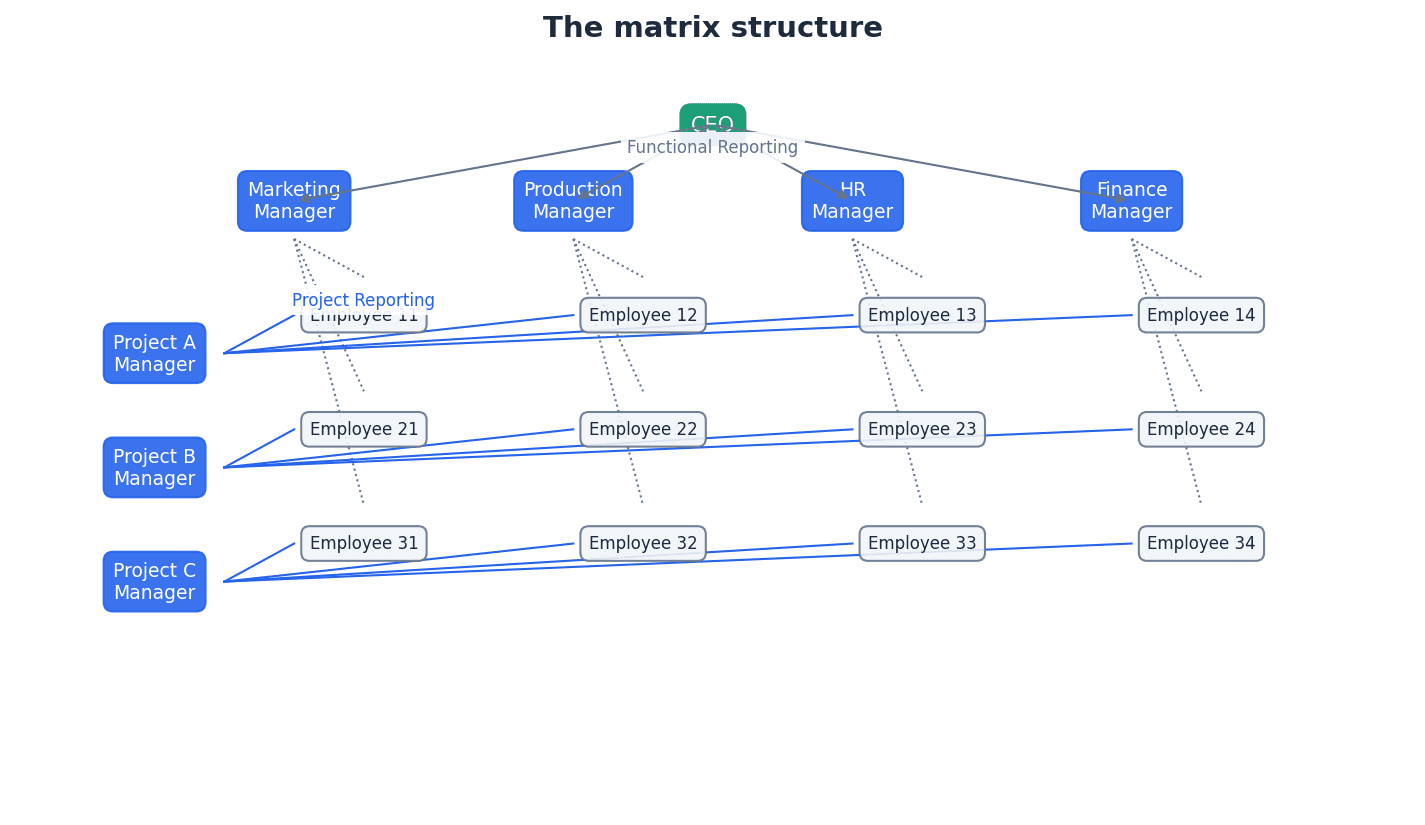
Intrapreneurship — Acting as an entrepreneur but as an employee within a large organisation.
Intrapreneurship involves employees taking initiative and developing new ideas or projects within the company, often with a high degree of autonomy. It aims to foster innovation and competitive advantage by leveraging employee creativity, often requiring structural changes like task forces and delegation, similar to a startup operating inside a big company.
Delegation — The passing down of authority from higher to lower levels in the organisation, in order for subordinate employees to perform tasks and take decisions.
Delegation is crucial for motivation, as it shows trust in subordinates and provides opportunities for skill development. It frees up senior managers for strategic roles but requires clear guidelines, appropriate training, and sufficient authority for the subordinate, much like a parent asking an older child to prepare dinner.
Students often think delegation means giving away responsibility, but actually the manager delegates authority to perform tasks, while retaining ultimate responsibility for the outcome.
When evaluating delegation, link it to motivation theories (e.g., Herzberg's motivators, Maslow's self-actualisation), efficiency (freeing up senior managers), and employee development, while also considering potential pitfalls like inadequate training or insufficient authority.
Authority — The power to undertake jobs and make decisions necessary for these jobs to be completed.
Authority is passed down through delegation, giving subordinates the power to act and make choices within their assigned tasks. Without sufficient authority, delegation is unlikely to succeed, as employees cannot effectively perform their duties, much like needing a driver's license to legally drive a car.
Responsibility — The duty to perform a task or achieve an objective.
While authority can be delegated, the overall responsibility for the work of an employee or department typically remains with the manager. The manager takes ultimate blame for underperformance or mistakes, as they selected the employee, allocated resources, and arranged training, similar to a ship captain having ultimate responsibility for the ship's safety.
Accountability — The obligation of an individual to account for their activities, accept responsibility for them, and disclose the results in a transparent manner.
When authority is delegated, the subordinate becomes accountable for the tasks performed. This means they can be held to account and disciplined for inadequate performance, requiring clear expectations and performance measurements, much like a student being accountable for submitting a project on time.
Distinguish clearly between authority, responsibility, and accountability. Explain that while authority can be delegated, ultimate responsibility often remains with the manager, but the subordinate is accountable for their delegated tasks.
Empowerment — An approach that not only delegates tasks and authority to individuals and groups but also allows them to decide on the best method to complete the job.
Empowerment gives employees even more chance to show initiative and creativity, acting as a strong motivator. It requires an even greater level of trust from managers, as there is less direct control over the work being carried out, similar to giving a chef a budget and theme to design a menu, rather than just a recipe.
Centralisation — An organisational structure where all, or most, major decisions are taken by a few senior managers at the centre of the organisation.
Centralisation involves minimum delegation to managers in other areas, departments, or divisions, ensuring consistent policies and strong central control. It can lead to rapid decision-making due to lack of discussion but may be slow to respond to local conditions, much like a single conductor leading a large orchestra.
Students often think centralisation is always inefficient, but actually it can be very effective for maintaining consistency, achieving economies of scale in purchasing, and leveraging experienced senior decision-makers.
Decentralisation — An organisational structure that passes decision-making authority to managers down the hierarchy, allowing them to take decisions that would otherwise be taken at head office.
Decentralisation involves significant delegation, empowering employees and demonstrating trust. Decisions are made closer to the action, reflecting local factors and consumer preferences, leading to quicker and more flexible responses to change, similar to local restaurant managers deciding on special menu items.
Students often think decentralisation means a complete loss of control, but actually strategic decisions and key functions like finance often remain centralised, balancing local autonomy with overall business direction.
Line managers — Managers who have direct authority over others in a hierarchical structure and carry out line functions that directly impact on the core activities of the business.
Line managers are directly involved in the primary operations of the business, such as production or sales, and have the power to make decisions and give instructions to their subordinates. They are responsible for achieving specific operational objectives, like a production manager overseeing workers on an assembly line.
Staff managers — Specialists who do not have line authority over others but are employed to give advice to senior line managers.
Staff managers carry out staff functions, supporting line managers by offering specialised advice, analysis, and expertise in areas like IT strategy or market research. They do not have direct command over operational employees, similar to a legal advisor providing expert legal advice to a CEO.
Students often confuse line managers with staff managers, but actually line managers have direct command authority over subordinates and are responsible for core business operations, unlike staff managers who provide advice.
Link structure to objectives: Always explain WHY a particular structure (e.g., matrix for innovation, functional for efficiency) is suitable for achieving the business's specific objectives mentioned in the case study.
Evaluate with balance: When assessing a change like delayering, always discuss both the advantages (e.g., faster communication, lower wage costs) and disadvantages (e.g., loss of expertise, wider spans of control causing stress).
Advantages & Disadvantages
Functional Structure
Hierarchical Structure (Tall vs. Flat)
Evaluation Starters
Essay Structure Guide
Introduction
Begin by defining organisational structure and briefly outlining its importance in achieving business objectives. State the main types of structures and the key concepts you will discuss in relation to the question.
Conclusion
Summarise your main arguments, reiterating the dynamic nature of organisational structure and its critical role in business success. Provide a final, balanced judgment on the most effective approaches, considering the various factors discussed.
This chapter explores the critical role of effective business communication, both internal and external, and evaluates various methods including spoken, written, electronic, and visual. It distinguishes between one-way and two-way, as well as vertical and horizontal communication channels, highlighting their impact on motivation and efficiency. The chapter also analyses common barriers to communication and provides strategies for managers to overcome them, emphasising their role in facilitating clear and effective information flow within an organisation.
Feedback — Feedback is the response to a message by the receiver.
Feedback is crucial for effective communication as it confirms whether the message has been received and understood by the receiver. Without feedback, the sender cannot be sure if their message was successful. It is like asking a friend if they understood your instructions for a game; their 'yes' or 'no' (and follow-up questions) is the feedback.
Students often think feedback is only positive reinforcement, but actually it is any response that confirms receipt and understanding, whether positive, negative, or neutral.
Non-verbal communication — Non-verbal communication refers to messages sent without words, through body language, facial expressions, or general appearance.
This form of communication allows people to form impressions about another person's role, personality, intentions, or emotional state, even without explicit verbal interaction. It can reinforce or contradict spoken messages, much like a dog wagging its tail to show happiness, even without barking; its body language communicates its emotional state.
Students often think non-verbal communication is only about body language, but actually it also includes appearance, gestures, and even silence.
One-way communication — One-way communication is a method where messages are sent without allowing for or encouraging feedback from the receiver.
This approach means the receiver cannot question the message or ask for clarification, and the sender is unsure if the message was understood or acted upon. It is often associated with authoritarian management styles, similar to a public announcement over a loudspeaker where information is broadcast, but there's no immediate way for the audience to respond or ask questions.
Students often think one-way communication is always bad, but actually it can be appropriate for simple, non-negotiable information like safety notices or emergency instructions.
Two-way communication — Two-way communication is any form of communication that encourages feedback from the receiver.
This method allows for discussion, clarification, and participation, which can be highly motivating for employees and is essential for democratic leadership. It helps ensure the message is understood and acted upon correctly, much like a conversation between two people, where both can speak, listen, and respond to each other's points.
Students often think two-way communication is always face-to-face, but actually it can also occur remotely via telephone or video conferencing.
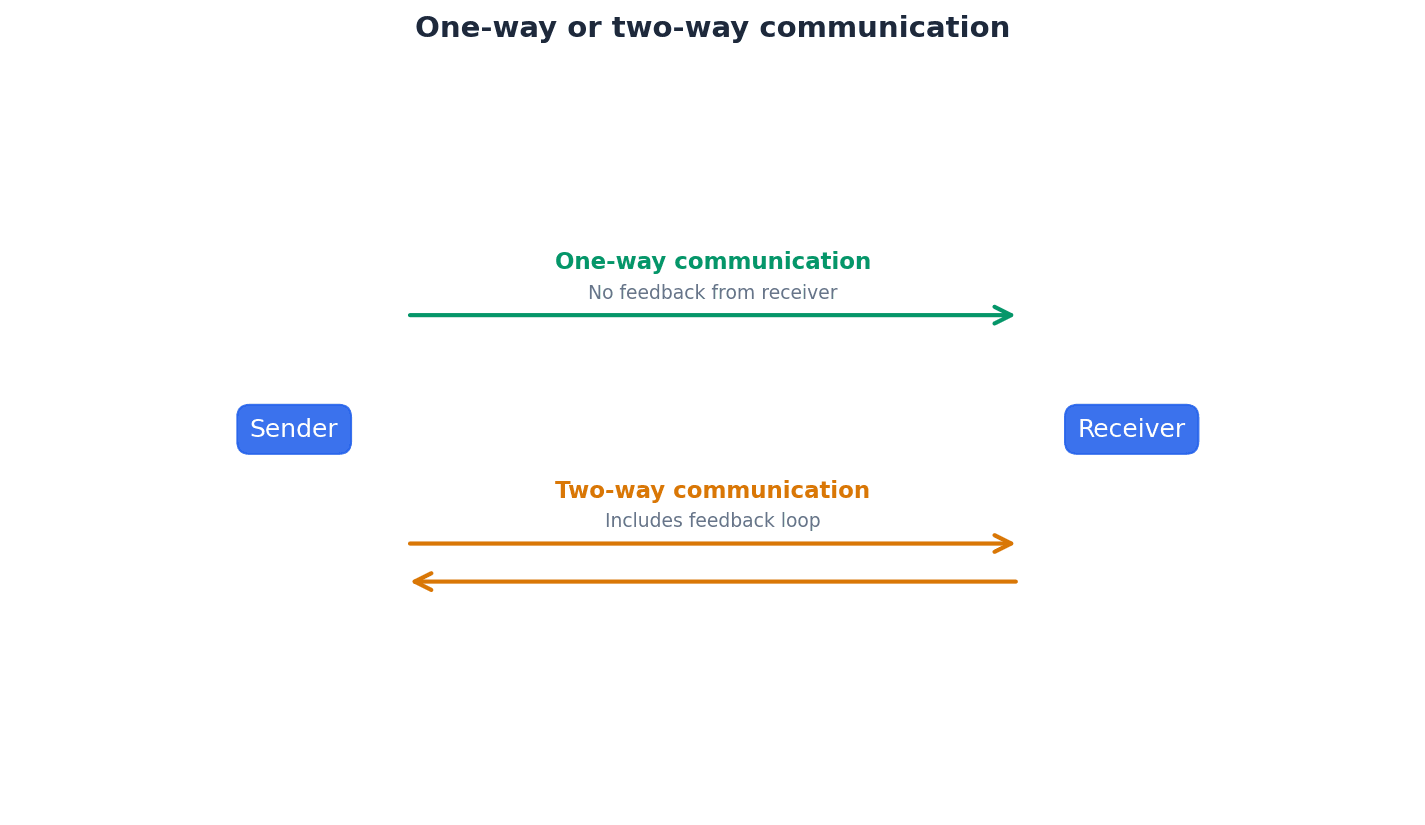
Effective communication is vital for both internal functions, such as motivating employees and improving efficiency, and external relations, including building brand image and driving sales. It is essential in various situations, from daily operations to crisis management, ensuring that information flows clearly and effectively throughout the business and with its stakeholders.
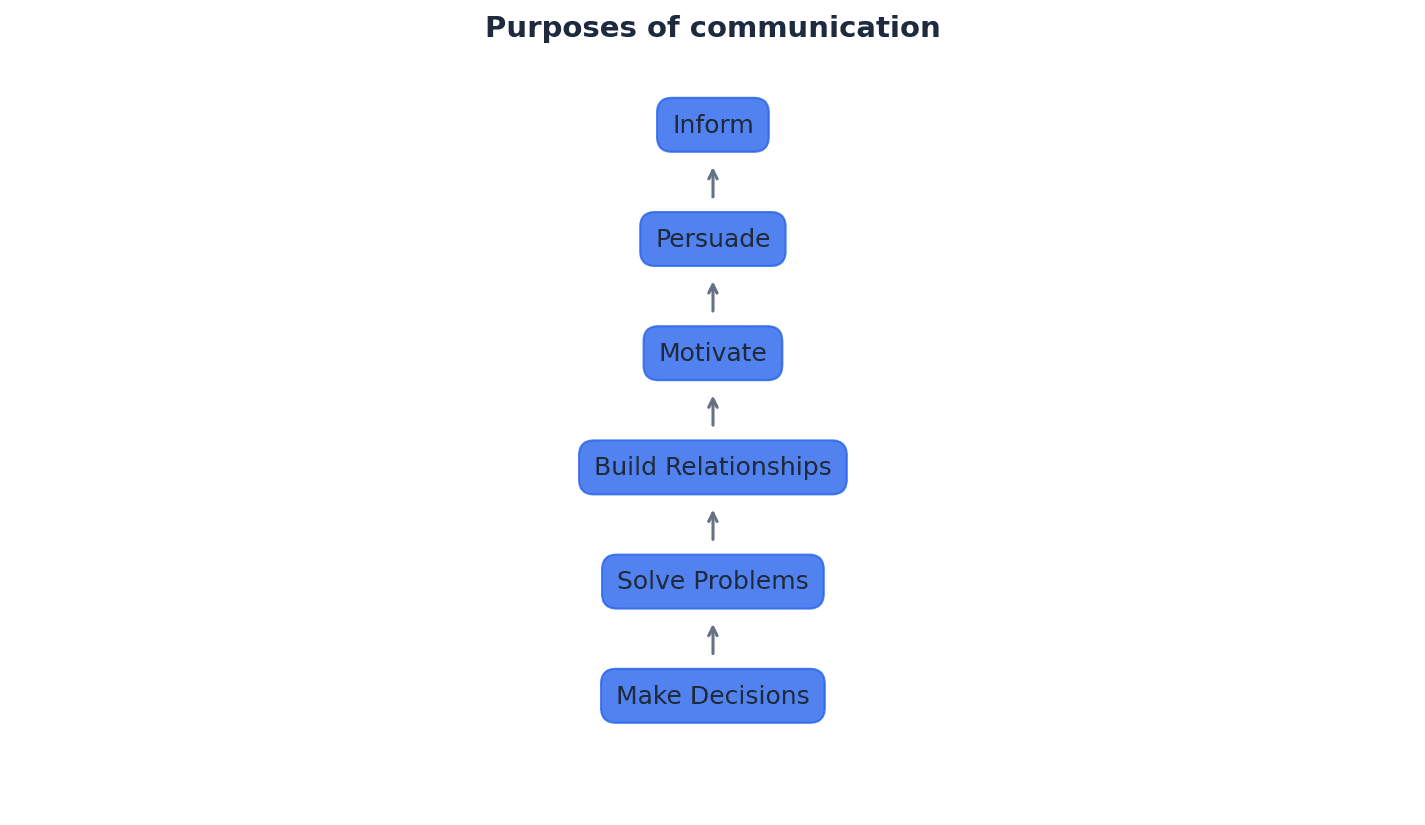
Businesses utilise various methods for communication, including spoken, written, electronic, and visual forms. Spoken communication, such as meetings, allows for immediate feedback and non-verbal cues. Written communication, like reports, provides a formal record. Electronic communication, such as email, offers speed and reach. Visual communication, through charts and diagrams, can simplify complex information. Non-verbal communication, encompassing body language and appearance, also plays a significant role in conveying messages, often reinforcing or contradicting spoken words.
When analysing communication methods, consider how non-verbal cues can support or hinder spoken messages, especially in face-to-face interactions. Discuss its absence in written or electronic communication.
Vertical communication — Vertical communication is the main direction of communication in formal hierarchies, flowing from a senior manager down to lower levels.
Messages are passed down the organisational hierarchy, often through intermediaries, until they reach the intended recipient. It is typically used by authoritarian managers and can lead to distortion or delays, much like water flowing down a waterfall, from the top to the bottom, following a clear, established path.
Students often think vertical communication only flows downwards, but actually it can also refer to upward communication (e.g., reports from subordinates to managers), though the chapter focuses on downward flow.
Horizontal communication — Horizontal communication occurs across an organisation, between people who have the same status but different areas of responsibility.
This type of communication facilitates coordination and idea sharing between departments at the same level, but it can be less common due to managers focusing on subordinates or departmental conflicts over resources and objectives. It is like different lanes of traffic moving side-by-side on a highway, where cars in adjacent lanes can interact without changing their hierarchical position.
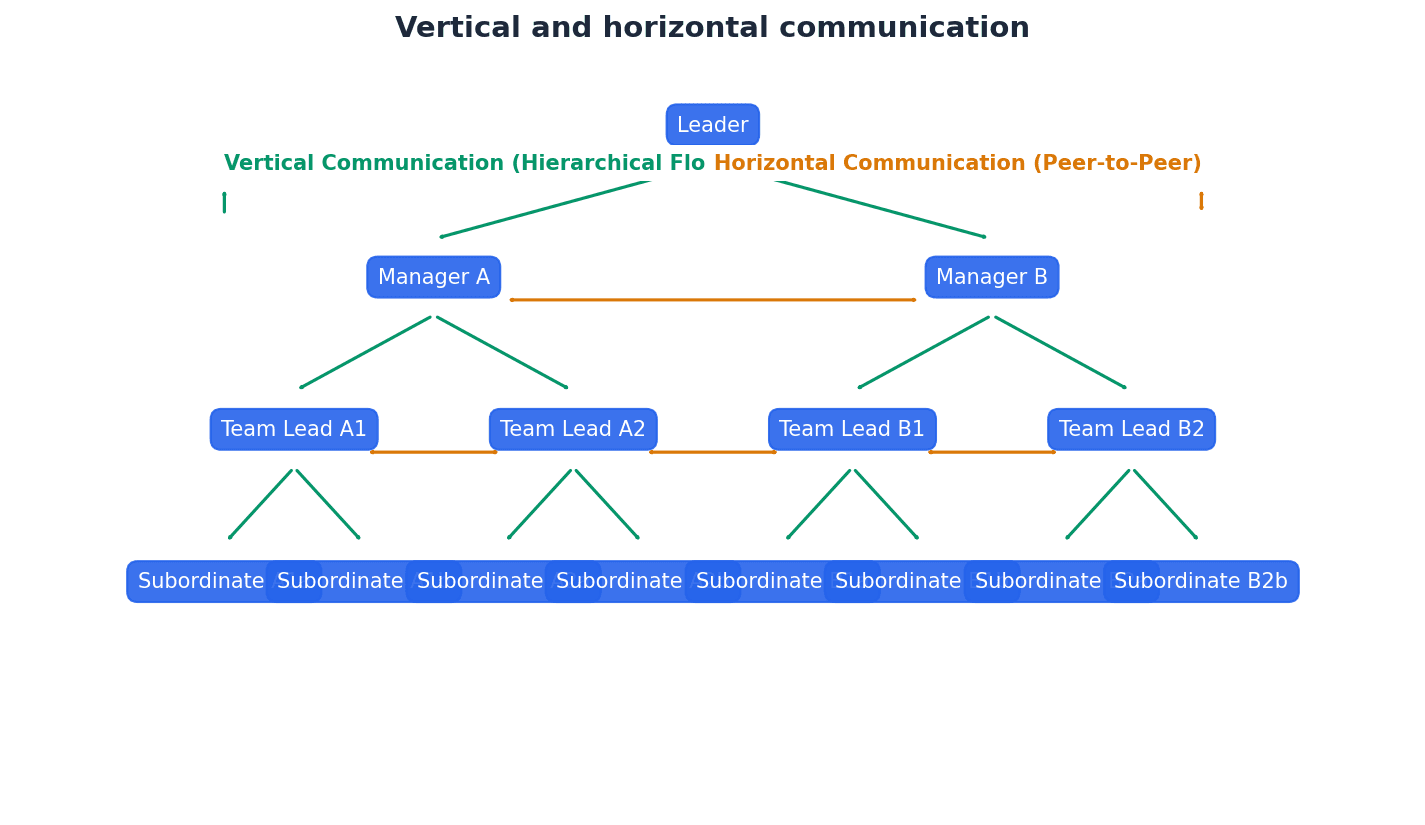
When analysing organisational structures, link vertical communication to traditional, hierarchical structures and discuss its potential for message distortion and slow transmission due to multiple intermediaries.
Informal communication — Informal communication is unofficial communication that takes place in every organisation, often through social interactions and gossip.
While it can take up working time and spread rumours, it also helps create feelings of belonging, allows management to test new ideas, and can reduce barriers between departments, fostering new ideas. It is like the 'grapevine' in a community, where news and information spread through unofficial channels among friends and acquaintances.
Students often think informal communication is always detrimental, but actually it can have significant benefits for social cohesion and idea generation if managed appropriately.
Barrier to communication — Any factor that prevents a message being received, or correctly understood, is termed a barrier to communication.
These barriers can arise from failures in the communication process (e.g., inappropriate method, jargon, information overload), poor attitudes of senders or receivers (e.g., lack of trust, demotivation), or physical reasons (e.g., noise, geographical distance). It is like a wall or an obstacle course that prevents a ball from reaching its target directly and clearly.
Barriers to effective communication can stem from various sources. These include failures in the communication process itself, such as using an inappropriate method for the message, employing jargon that the receiver doesn't understand, or information overload. Poor attitudes of senders or receivers, like a lack of trust or demotivation, can also impede understanding. Furthermore, physical reasons such as excessive noise or geographical distance can prevent a message from being received or correctly understood.
When asked to analyse communication problems, categorise barriers into process failures, attitudinal issues, and physical factors. Recommend specific strategies to overcome each type of barrier.
Managers play a crucial role in facilitating clear and effective information flow by actively working to overcome communication barriers. This involves choosing appropriate communication methods for different situations, ensuring messages are clear and concise, and fostering an environment of trust and open dialogue. By addressing process failures, attitudinal issues, and physical obstacles, management can significantly improve communication within an organisation, thereby enhancing efficiency and motivation.
When recommending a communication method, always justify your choice in the context of the business scenario (e.g., urgency, complexity, confidentiality, need for a record).
In questions about improving communication, first identify the specific barrier in the case study, then explain precisely how your suggestion would overcome it.
Always link communication to business performance. Explain how effective communication improves efficiency, motivation, decision-making, or customer service.
Advantages & Disadvantages
One-way communication
Two-way communication
Evaluation Starters
Essay Structure Guide
Introduction
Begin by defining effective business communication and briefly outlining its importance for both internal and external operations. State your main argument or the key areas you will evaluate in relation to the question.
Conclusion
Summarise your main arguments, reiterating the critical role of effective communication in business success. Conclude with a final evaluative statement on the challenges and opportunities for businesses in achieving optimal communication.
This chapter delves into the essence of leadership, exploring its purpose, the qualities of effective leaders, and various leadership roles within a business. It critically evaluates different leadership theories, from traditional trait-based approaches to modern transformational and contingency models, and highlights the crucial role of emotional intelligence in fostering successful leadership.
Leadership is fundamental to guiding an organisation towards its objectives by providing vision and inspiration. While often confused with management, leadership focuses on setting direction and motivating people, whereas management is more concerned with control, planning, and resource allocation. Effective leadership is crucial for navigating change, fostering a positive organisational culture, and ultimately driving business success.
Directors — Senior managers elected into office by shareholders in a limited company, usually heading a major functional department.
Directors are like the captains of different sections of a sports team, each responsible for their specific area but all working under the head coach (CEO) to achieve the team's overall goal. They are responsible for delegating tasks, assisting in senior employee recruitment, meeting departmental objectives set by the board, and communicating these objectives to their department. Their role is crucial for strategic direction and operational oversight.
Students often think directors are only involved in high-level strategy, but actually they also have significant operational responsibilities within their departments.
When asked to analyse the role of directors, ensure you cover both their strategic (setting objectives) and operational (delegating, recruitment) responsibilities, linking them to business success.
Managers — Individuals responsible for people, resources, or decision-making, with authority over employees below them in the hierarchy.
A manager is like a conductor of an orchestra, ensuring each musician (employee) plays their part correctly and in harmony to produce the desired performance (business objectives). Managers direct, motivate, praise, and discipline workers in their section or department. They are key to implementing the vision set by leaders and ensuring day-to-day operations run smoothly.
Students often think managers are the same as leaders, but actually managers focus more on control and resource allocation, while leaders provide vision and inspiration.
Distinguish between management and leadership when evaluating roles; managers ensure tasks are done, while leaders inspire and set direction. Use command words like 'analyse' to break down their specific functions.
Supervisors — Employees appointed by management to watch over the work of others, leading a team towards pre-set goals.
A supervisor is like a team leader in a group project, ensuring everyone is on track, helping with problems, and facilitating cooperation to meet the project's deadline. Supervisors are typically not in a decision-making role but are responsible for guiding and supporting their team to achieve objectives in a cooperative spirit. Their modern role is more collaborative than inspectorial.
Students often think supervisors are just 'inspectors', but actually their role has evolved to be more about supporting and facilitating team members to achieve goals.
When discussing supervisors, highlight their role in team leadership and goal achievement, emphasising the shift from control to cooperation. Avoid simply stating they 'watch over' workers.
Workers’ representatives — Individuals elected by workers, either as trade union officials or on works councils, to discuss employee concerns with managers.
Think of workers' representatives as the elected student council members who bring student issues and suggestions to the school administration. These representatives act as a voice for the workforce, ensuring that employee interests and concerns are communicated to management. They play a crucial role in industrial relations and fostering a positive working environment.
Students often think workers' representatives only deal with disputes, but actually they also engage in proactive discussions about working conditions, pay, and other areas of concern.
When analysing the role of workers' representatives, focus on their communication and negotiation functions, and how they contribute to employee welfare and potentially business harmony.
Informal leaders — People who have the ability to lead without formal power, often due to their experience, personality, or special knowledge.
In a group of friends, the person everyone naturally looks to for advice or to organise activities, even without an official title, is an informal leader. Informal leaders can have significant influence over workers, sometimes more than formal leaders, especially if they are seen as true motivators rather than just supervisors. Management should aim to work with them to achieve business aims.
Students often think informal leaders are always disruptive, but actually they can be a valuable asset if management aligns their influence with business objectives.
When evaluating informal leadership, discuss both the potential benefits (motivation, support) and challenges (disruption if ignored), and suggest strategies for management to engage with them effectively.
Various theories attempt to explain what makes a leader effective, ranging from the idea that leaders are born with innate qualities to the belief that leadership skills can be learned and adapted to different situations. Understanding these theories helps in evaluating leadership effectiveness and developing future leaders.
Great man (Great person) theory — A leadership theory suggesting that the ability to lead is inherent and cannot be taught, with leaders born with specific traits and destined for leadership.
This theory is like believing that some people are born with a natural talent for music or art, and no amount of training can make someone a 'great' musician or artist if they don't have that innate gift. It views leaders as heroic, intelligent, and possessing innate qualities like charisma, intellect, and confidence, implying leadership is a natural gift rather than a learned skill.
Students often think this theory applies to all successful leaders, but actually it's a traditional view that contrasts with modern theories suggesting leadership can be developed.
When discussing this theory, highlight its focus on innate traits and destiny, and contrast it with behavioural or contingency theories that emphasise learned skills and adaptability.
Trait theory — A leadership theory similar to great person theory, believing that people are either born with or can develop specific personality characteristics required for leadership.
This is like saying a successful athlete either has natural speed and strength (innate traits) or can develop them through rigorous training (learned traits) to become a champion. Traditionally, it focused on innate traits like initiative, determination, and charisma. A more modern approach suggests some traits can be learned and developed, leading to behavioural theory.
Students often think trait theory only considers inborn qualities, but actually modern interpretations acknowledge that some traits can be developed through training.
When applying trait theory, list specific traits and explain how they contribute to leadership effectiveness. Differentiate between the traditional and modern views of trait acquisition.
Behavioural theory — A leadership theory that assumes capable leaders can learn the necessary skills and focuses on what leaders actually do by studying their behaviour in different situations.
Instead of asking 'What kind of person is a good chef?', behavioural theory asks 'What does a good chef actually do in the kitchen to make delicious food?' – focusing on their actions and techniques. This theory assesses leadership effectiveness by analysing a leader's actions and whether that behaviour leads to success. It suggests leaders use technical, human, and conceptual skills and can adapt their style.
Students often think behavioural theory ignores personality, but actually it focuses on observable actions and learned skills, which can be influenced by personality but are not solely determined by it.
When evaluating behavioural theory, provide examples of specific leadership behaviours (e.g., motivating, communicating) and explain how adapting these behaviours to situations improves performance.
Contingency theory — A leadership theory suggesting that the most successful leaders adapt their leadership style to different situations, as no single style is universally effective.
A contingency leader is like a versatile chef who can cook different cuisines (leadership styles) depending on the ingredients available, the occasion, and the diners' preferences (different situations). This theory highlights that factors like subordinate experience, leader-follower relationships, time constraints, and the leader's power level dictate the most appropriate leadership approach. Leaders must be flexible.
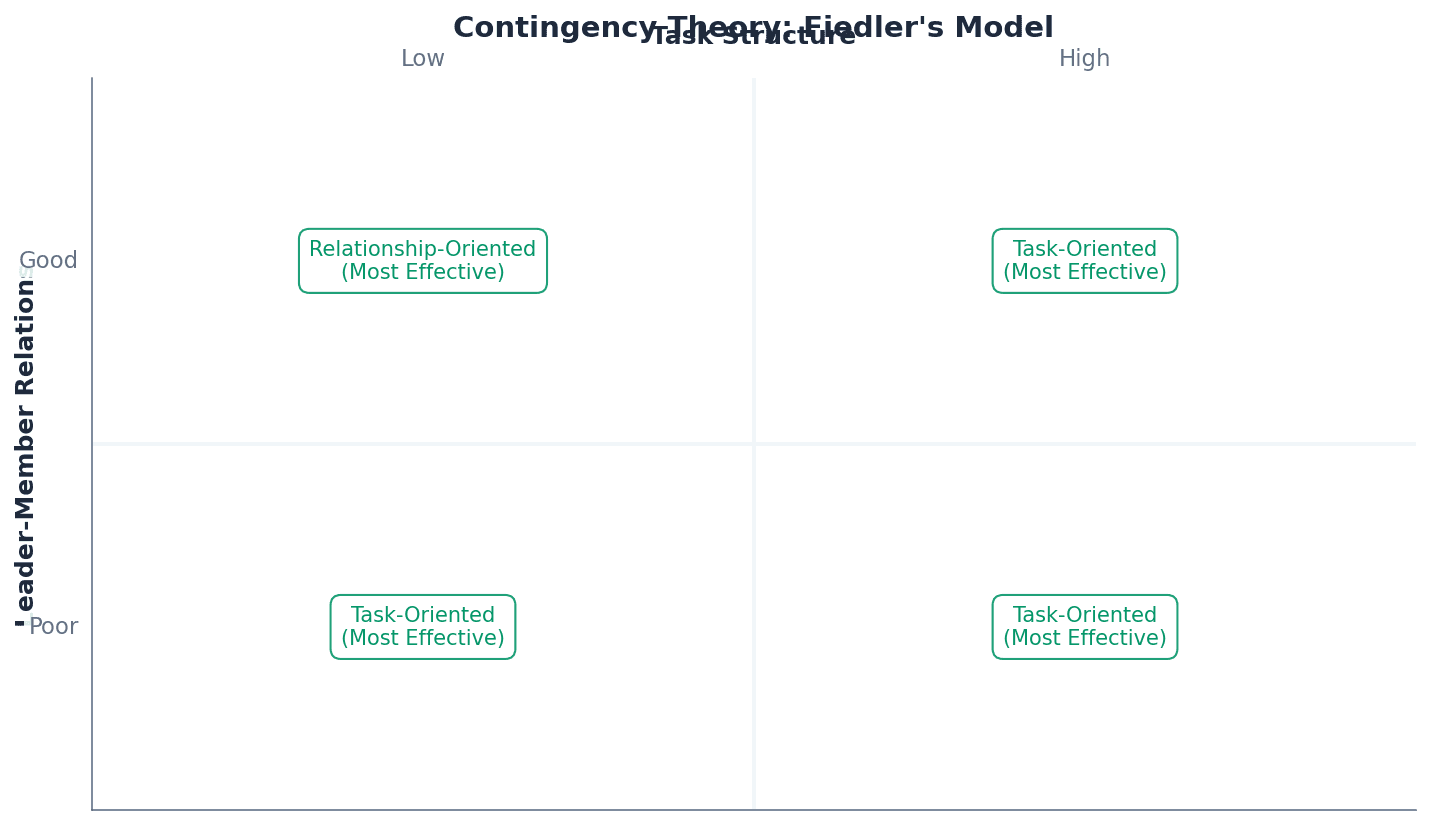
Students often think contingency theory means leaders have no consistent style, but actually it means they have a repertoire of styles and choose the most suitable one for each context.
When applying contingency theory, always link the chosen leadership style directly to specific situational factors mentioned in the case study, explaining why that style is appropriate.
Transactional leadership — A leadership approach based on the assumption that employees undertake tasks in exchange for reward, using a system of rewards and punishments.
Transactional leadership is like a contract: 'If you complete this job (task), you will get paid (reward).' It's a clear exchange of effort for compensation. This style involves giving clear direction, setting targets, and providing rewards for satisfactory task completion or punishments for underperformance. It is often used when time is limited and objectives are critical.
Students often think transactional leadership is always negative, but actually it can be very effective for achieving short-term goals and ensuring compliance, especially in critical situations.
When discussing transactional leadership, focus on the 'exchange' aspect (rewards/punishments for performance) and its suitability for specific contexts like meeting deadlines, rather than just labelling it as 'bad'.
Transformational leadership — A leadership style focused on leading and inspiring workers to change or transform the organisation's culture to achieve improved performance.
A transformational leader is like a motivational coach who inspires a team to believe in a grand vision, challenging them to grow and work together to achieve something extraordinary, not just win the next game. Transformational leaders use charisma, inspiration, intellectual stimulation, and individualised consideration to motivate employees towards a shared vision, focusing on employee satisfaction and productivity.
Students often think transformational leadership is only about being charismatic, but actually it also involves intellectual stimulation, individualised consideration, and inspiring a shared vision.
When evaluating transformational leadership, explain how it changes organisational culture, motivates employees beyond self-interest, and is particularly effective during periods of significant change.
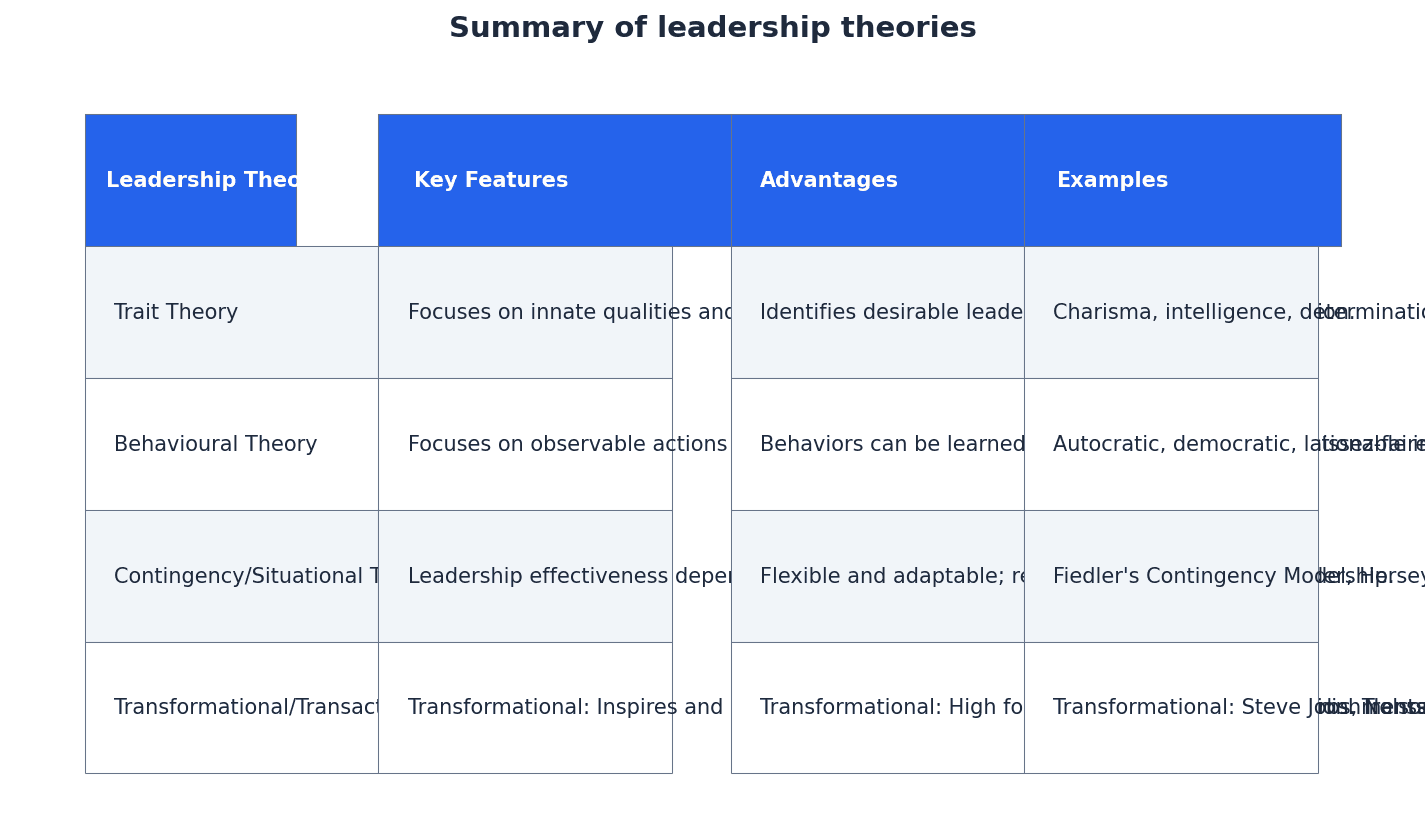
Beyond traditional leadership theories, emotional intelligence (EI) has emerged as a critical factor for effective leadership. It is argued that managers with high EI are more effective leaders, even if they are not traditionally 'super-intelligent'. High EI allows leaders to better understand and manage themselves and others, leading to improved decision-making and stronger team dynamics.
Emotional intelligence (EI) — The ability to understand oneself (goals, behaviour, responses) and others (feelings), leading to more effective leadership and decision-making.
Emotional intelligence is like having a 'people radar' – you can sense what's going on with yourself and others, allowing you to navigate social situations and motivate people more effectively. High EI involves self-awareness, self-management, social awareness, and social skills. It is argued that managers with high EI are more effective leaders, even if not traditionally 'super-intelligent'.
Students often think high intelligence (IQ) automatically makes a good leader, but actually emotional intelligence (EQ) is often more critical for managing people and fostering collaboration.
When discussing EI, link its competencies (self-awareness, social skills) directly to improved leadership outcomes like better decision-making, higher motivation, and stronger team building.
Emotional quotient (EQ) — A measurable indicator of a person's level of emotional intelligence.
Just as IQ measures intellectual ability, EQ measures emotional ability. It's a score that reflects how well you 'read' and respond to emotions. A higher EQ suggests a greater ability to understand and manage one's own emotions and those of others. Studies suggest high EQ can improve business performance by enhancing leadership effectiveness.
Students often think EQ is less important than IQ for business success, but actually many studies suggest high EQ is a stronger predictor of leadership effectiveness and team performance.
When referring to EQ, ensure you explain its relevance to leadership and business performance, rather than just defining it as a 'score'. Connect it to the practical benefits of emotional intelligence.
Daniel Goleman identified four key competencies that comprise emotional intelligence, each contributing to a leader's ability to understand and manage emotions effectively. These competencies are self-awareness, self-management, social awareness, and social skills, and they are interconnected, forming a holistic approach to emotionally intelligent leadership.
Self-awareness — Knowing what one feels, using that to guide decision-making, having a realistic view of one's abilities, and self-confidence.
Self-awareness is like having a clear internal compass; you know your own direction, strengths, and limitations, which helps you navigate challenges and make decisions confidently. This competency involves understanding one's own emotions, strengths, weaknesses, values, and goals. It's foundational for effective leadership as it allows leaders to act authentically and make informed choices.
Students often think self-awareness is just about knowing your feelings, but actually it also includes a realistic assessment of one's capabilities and self-confidence.
When analysing self-awareness, explain how it contributes to a leader's credibility and decision-making, for example, by preventing them from taking on projects beyond their competence.
Self-management — Being able to recover quickly from stress, being trustworthy and conscientious, and showing initiative and self-control.
Self-management is like being the disciplined captain of your own ship; you can steer through storms (stress), keep the crew's trust (trustworthy), and stay on course (conscientious and self-controlled). This competency involves managing one's internal states, impulses, and resources. Leaders with strong self-management can maintain composure under pressure, act with integrity, and drive themselves and others forward.
Students often think self-management is just about controlling anger, but actually it encompasses a broader range of behaviours like trustworthiness, conscientiousness, and initiative.
When discussing self-management, link specific behaviours (e.g., stress recovery, trustworthiness) to positive impacts on team morale and productivity, and how their absence can demotivate staff.
Social awareness — Sensing what others are feeling, being able to take their views into account, and getting on with a wide range of people.
Social awareness is like having an emotional radar for others; you can pick up on their feelings and perspectives, allowing you to connect with them and understand their needs. This competency involves understanding the emotions, needs, and concerns of other people. Leaders with high social awareness can build rapport, empathise, and make decisions that consider diverse perspectives.
Students often think social awareness is just about being friendly, but actually it's a deeper ability to understand and empathise with others' emotional states and perspectives.
When evaluating social awareness, explain how it enables a leader to build stronger relationships, foster collaboration, and make more inclusive and effective decisions by considering others' views.
Social skills — Handling emotions in relationships well, accurately understanding different social situations, and using social skills to persuade, negotiate, and lead.
Social skills are like being a master diplomat; you know how to navigate complex social interactions, influence others, and build strong alliances to achieve common goals. This competency involves effectively managing relationships and building networks. Leaders with strong social skills can communicate persuasively, resolve conflicts, inspire teams, and facilitate change.
Students often think social skills are just about being talkative, but actually they involve a sophisticated understanding of social dynamics and the ability to use that understanding for influence and leadership.
When analysing social skills, focus on their application in leadership contexts such as negotiation, persuasion, and team building, and how these contribute to achieving organisational objectives.
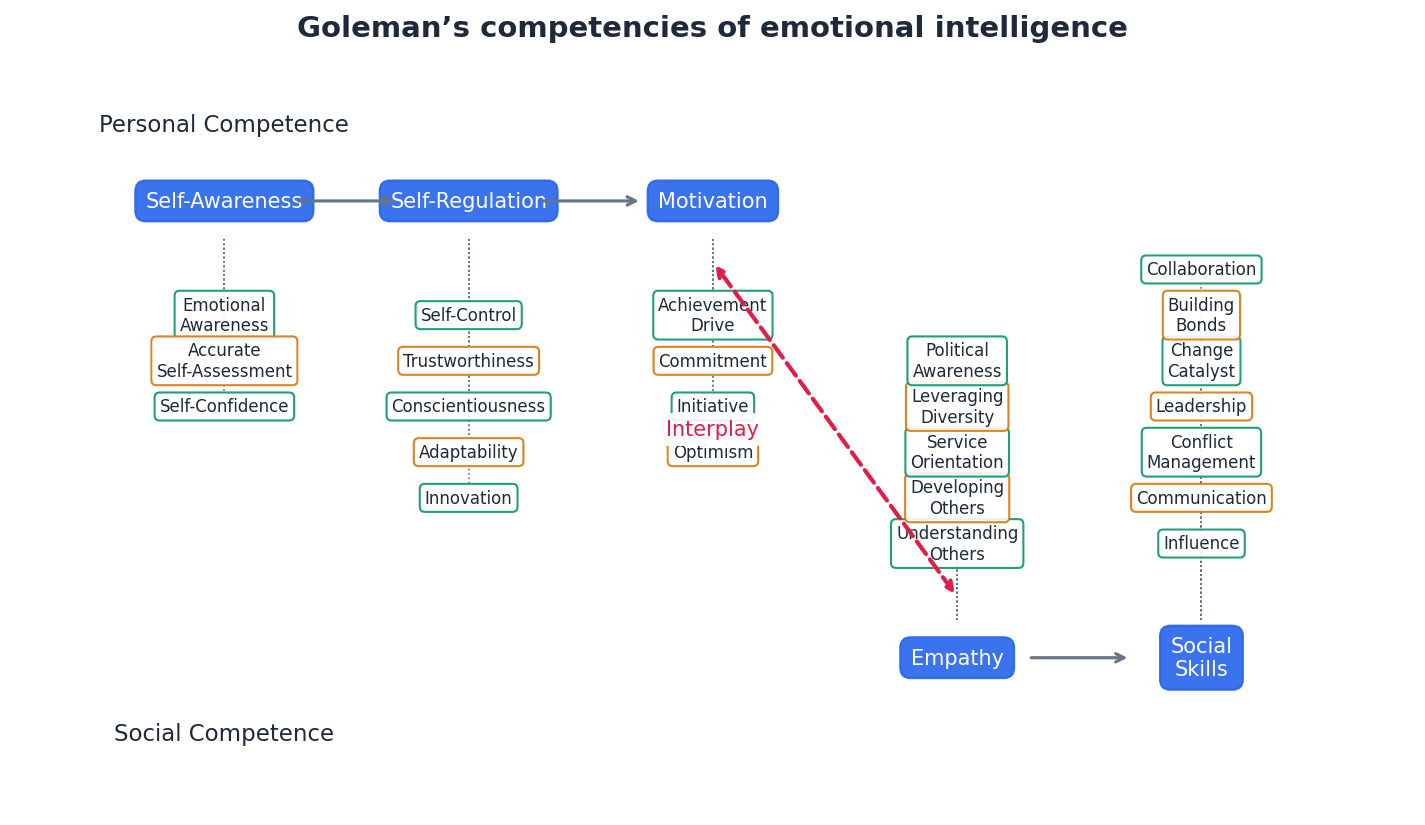
For 'evaluate' questions on leadership styles, always use a contingency approach. Argue that the 'best' style depends on the context provided in the case study.
Always link leadership to business outcomes. Explain *how* a particular style or quality impacts key metrics like motivation, productivity, labour turnover, or the success of organisational change.
Advantages & Disadvantages
Transactional Leadership
Transformational Leadership
Evaluation Starters
Essay Structure Guide
Introduction
Begin by defining leadership and briefly outlining its purpose in a business context. State the different leadership theories or roles you will be evaluating, and briefly mention the importance of emotional intelligence. Your introduction should set the stage for a balanced discussion.
Conclusion
Summarise the key arguments, reiterating that effective leadership is multifaceted and often requires adaptability. Conclude with a final judgment on the most crucial aspects of leadership, perhaps emphasising the growing importance of emotional intelligence and the ability to choose the right style for the right situation to achieve sustainable business success.
This chapter explores human resource management strategies, contrasting hard and soft HRM approaches and their impact on employment contracts and employee performance. It analyses various flexible working arrangements, measures of employee performance, and strategies for improvement, including Management by Objectives, while also assessing the evolving role of IT and AI in HRM.
hard HRM — An approach to human resource management that views employees as resources, similar to equipment and raw materials, to be obtained as cheaply as possible and exploited to keep labour costs low.
This approach prioritises cost control and efficiency, often leading to minimal concern for employee work-life balance or development. It treats employees like cogs in a machine, focusing purely on their output and cost rather than their well-being or potential for growth.
Students often think hard HRM is always unethical, but actually businesses might adopt it for peripheral workers to manage costs, especially in competitive industries, though it can have long-term negative consequences.
soft HRM — An approach to human resource management that views employees as valuable assets to the business, who must be cared for and developed to contribute to success.
This approach focuses on employee motivation, training, and development, believing that investing in human capital will lead to greater commitment, productivity, and overall business success. It is like nurturing a plant to help it grow and yield better fruit, where investment in care leads to greater long-term returns.
Students often think soft HRM is always more expensive, but actually while initial costs for training and development might be higher, it can lead to reduced labour turnover, higher productivity, and improved quality in the long run, saving costs elsewhere.
When evaluating hard HRM, discuss both short-term cost benefits and long-term disadvantages like increased recruitment costs, low motivation, and negative publicity. Use command words like 'evaluate' or 'assess'.
When evaluating soft HRM, consider how it can lead to higher morale, lower absenteeism, and increased loyalty, but also acknowledge the potential for higher initial costs. Use specific examples of soft strategies like MBO or quality circles.
flexible employment contracts — Employment agreements that offer variations in working hours, location, or duration, such as part-time, temporary, zero-hours, or annualised hours contracts.
These contracts provide businesses with the ability to adjust their workforce size and hours quickly in response to changing demand, making labour costs more variable. They are like having a modular workforce where units can be added or removed as needed, allowing for quick adaptation to market fluctuations.
Students often think flexible contracts are always bad for employees, but actually some workers, like parents or students, prefer the flexibility and control over their working hours, despite potential disadvantages like lower security.
gig economy — A labour market characterised by the prevalence of short-term contracts or freelance work, as opposed to permanent jobs, where workers are often self-employed contractors.
In the gig economy, individuals are hired for specific tasks or 'gigs' rather than being full-time employees, offering businesses extreme flexibility in managing labour costs and numbers. It is like hiring a series of independent contractors for individual projects, where each project is a 'gig' with its own terms.
Students often think gig workers are employees, but actually they are typically considered self-employed contractors, meaning they do not receive the same employment rights or benefits as traditional employees.
When analysing flexible employment contracts, discuss benefits for both employers (cost flexibility, responsiveness) and employees (work-life balance), as well as the disadvantages for both (low motivation, lack of security). Distinguish between different types of flexible contracts.
Businesses often differentiate their workforce into core and peripheral workers, applying different HRM strategies to each group. This distinction is central to Charles Handy’s ‘Shamrock Organisation’ model, which structures a business into a core of professional workers, a flexible labour force (peripheral workers), and outsourced specialists. This allows businesses to manage costs and retain key talent effectively.
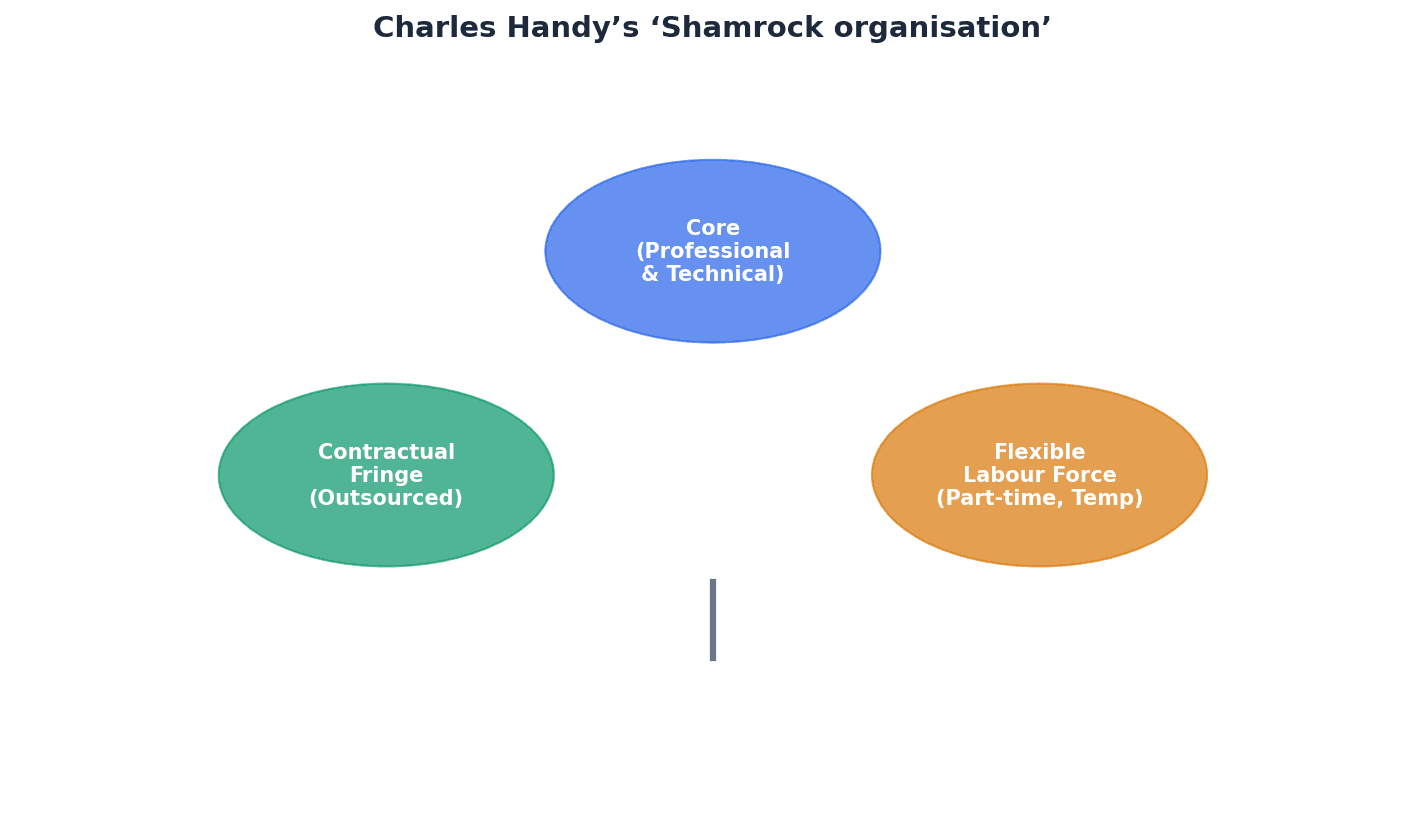
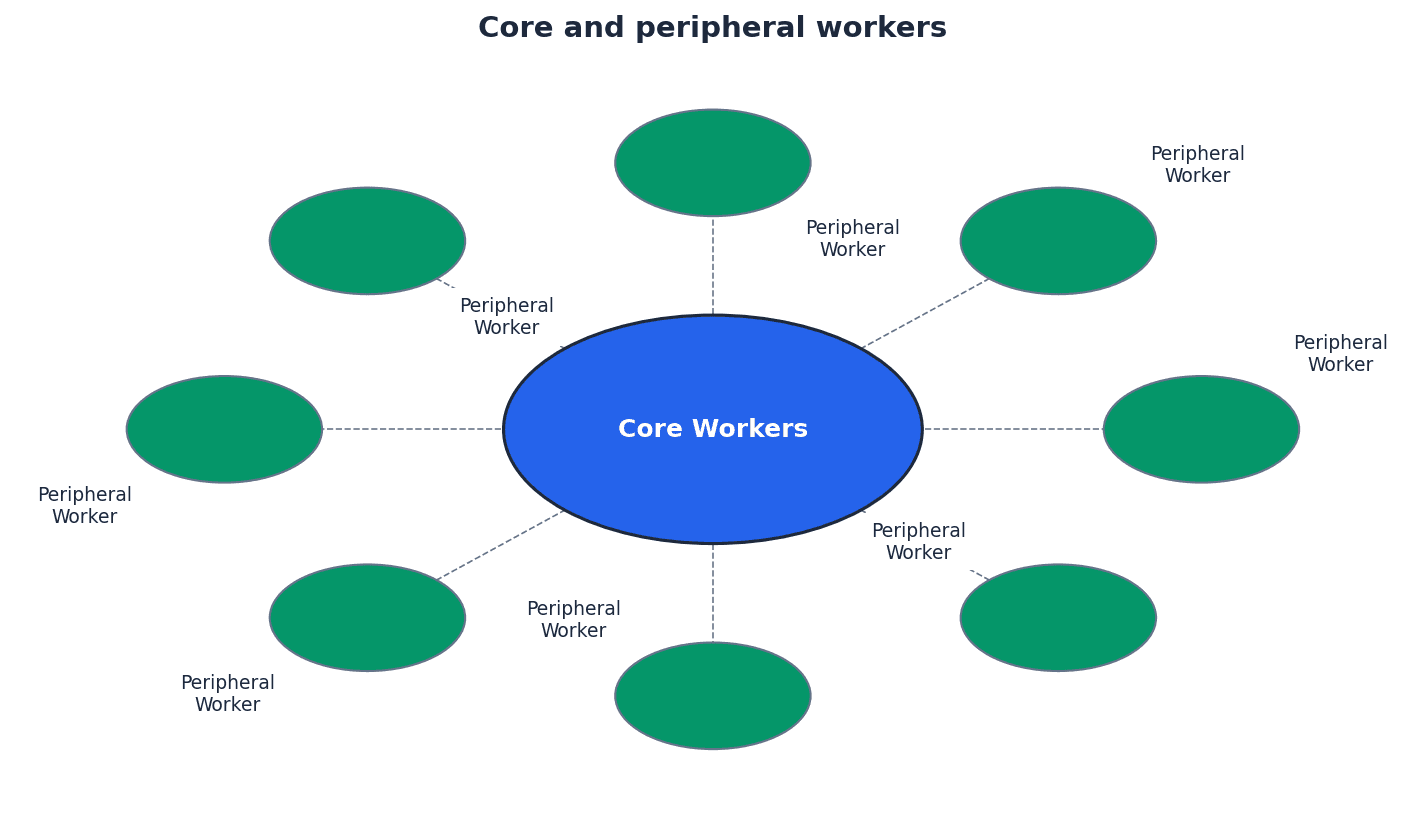
core workers — Key employees that a business wants to retain on a long-term basis, often offered permanent and full-time contracts with competitive salaries and benefits.
These workers are considered crucial to the business's future success, often possessing specialist skills or knowledge. Businesses typically adopt a soft HRM approach towards them, investing in their training and development to ensure high morale and loyalty. They are the essential foundation and load-bearing walls of a building; indispensable to stability and growth.
peripheral workers — Employees who perform less important tasks or are relatively easy to replace, often employed on part-time, temporary, zero-hours, or gig contracts.
Businesses typically adopt a hard HRM approach towards peripheral workers to maintain flexibility and control labour costs. Their employment is often adjusted based on demand, and they may receive fewer benefits and training opportunities. They are like the decorative elements or temporary fixtures of a building that can be easily changed or removed without affecting the core structure.
When analysing core workers, link their treatment to soft HRM strategies, focusing on how investment in their development and motivation contributes to long-term business success and competitive advantage.
When discussing peripheral workers, connect their employment to hard HRM strategies and the benefits of flexibility and cost control for the business, while also considering the potential negative impacts on motivation and loyalty.
flexitime arrangements — Flexible working schedules that allow employees to choose their own working hours within certain limits, often requiring them to be present during core hours.
This arrangement offers employees greater control over their work-life balance, which can improve motivation and attract skilled recruits. For employers, it can extend the working day and improve customer service. It is like a library with flexible opening hours, where staff choose shifts as long as the library is covered during peak times.
Students often think flexitime means employees can work whenever they want, but actually there are usually core hours when all employees must be present, and overall weekly hours targets.
home working — An arrangement where employees perform their job tasks from their home rather than commuting to a central office.
Home working can reduce employee travel time and business accommodation costs, while also making jobs more attractive to a wider talent pool. However, it can make performance assessment and social contact more difficult. It is like a remote control for a TV; you can operate it from a distance without being physically present.
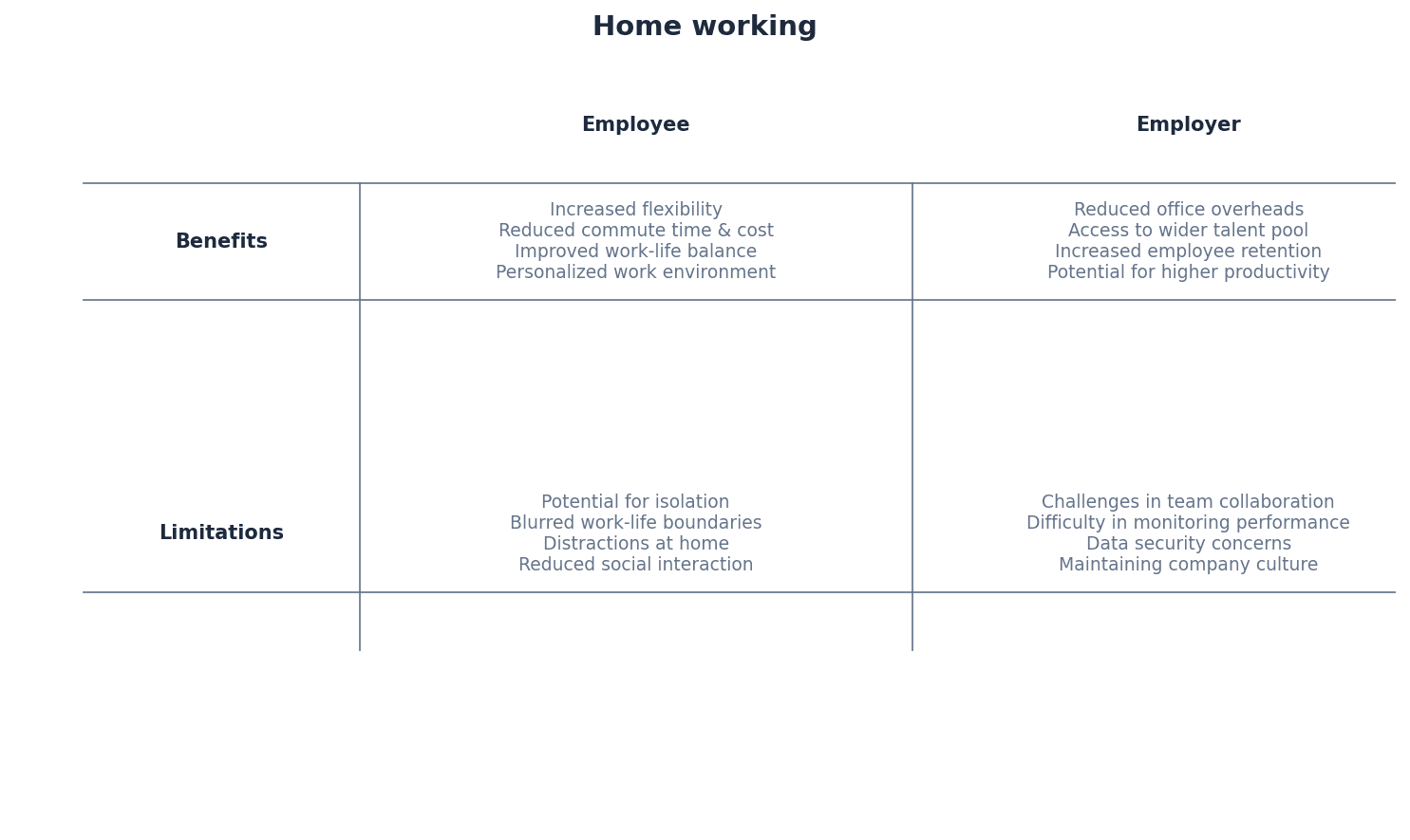
annualised hours contracts — Employment contracts where an employee's total working hours are specified over a year, with a core period of regular hours and the remaining time used flexibly as needed by the business.
These contracts provide businesses with high flexibility to match staffing levels to fluctuating demand, as workers can be called in during busy periods. Employees gain some flexibility in planning, but may also face short-notice work requests. It is like a bank account with a yearly allowance of hours, where withdrawals for extra work can be made flexibly.
job sharing — An arrangement where two or more part-time employees share the responsibilities and duties of a single full-time job role.
Job sharing allows businesses to retain experienced employees who might otherwise leave due to family commitments or a desire for a better work-life balance. It can also lead to increased productivity from less stressed workers. It is like two drivers sharing a long journey, ensuring completion without either becoming overly fatigued.
compressed working hours — An arrangement where employees work their full-time hours in fewer days, for example, working four 10-hour days instead of five 8-hour days.
This offers employees longer weekends or more days off, which can be attractive for those with long commutes or specific family needs. However, longer workdays might not suit everyone and can impact daily attendance levels. It is like fitting a week's worth of groceries into fewer, larger bags; the total amount is the same, but organised differently.
Employee performance can be analysed using a range of measures, including labour productivity and absenteeism. Labour productivity measures the output per worker, indicating efficiency. Absenteeism, on the other hand, quantifies the proportion of scheduled workdays lost due to employee absence, providing insight into employee motivation and well-being.
Absenteeism rate
Used to measure the proportion of scheduled workdays lost due to employee absence. Can be calculated for the whole business, a department, or an individual.
If given data on employee absence, always calculate the absenteeism rate. Use the result as quantitative evidence to support your arguments about motivation or the success of an HRM strategy.
Businesses can employ various strategies to improve employee performance, ranging from hard approaches focused on control and efficiency to soft approaches emphasising motivation and development. One significant soft strategy is Management by Objectives (MBO), which aims to align individual efforts with organisational goals through collaborative target setting.
Management by Objectives (MBO) — A system designed to motivate and coordinate a workforce by dividing the company’s overall aim into specific, agreed-upon targets for each division, department, and individual.
MBO involves a collaborative process where managers and workers discuss and agree on objectives, ensuring that individual efforts align with organisational goals. This approach can enhance motivation through job enrichment and delegation. It is like a relay race where each runner has a specific, agreed-upon distance and target time, contributing to the team's success.
Students often think MBO is just about setting targets, but actually a key feature is the discussion and agreement of these targets with employees, which is crucial for motivation and effectiveness.
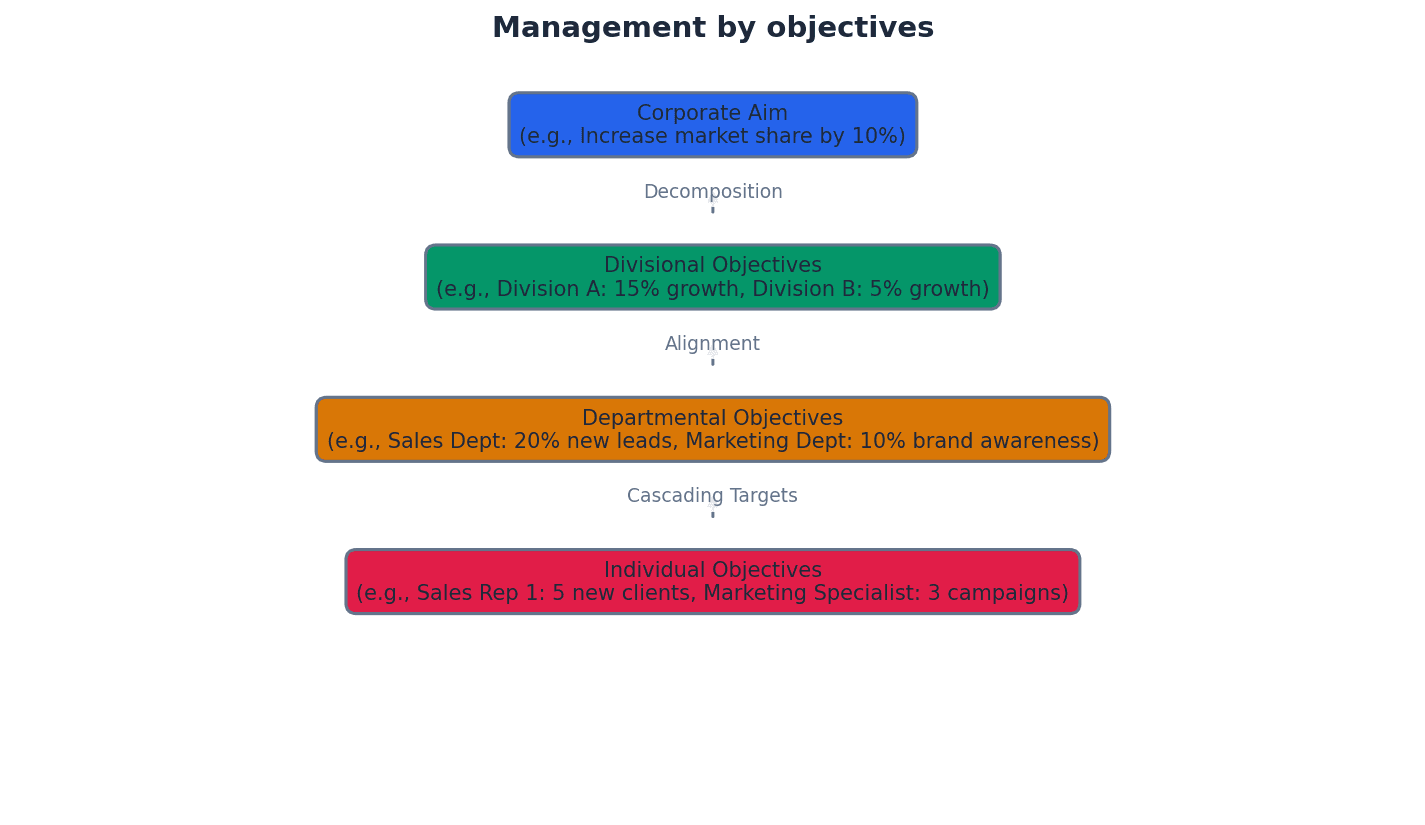
When analysing MBO, highlight the importance of employee participation and agreement for its success, linking it to Theory Y management. Discuss both benefits (coordination, motivation) and limitations (time-consuming, targets becoming outdated). Use command words like 'analyse' or 'evaluate'.
Information Technology (IT) and Artificial Intelligence (AI) are increasingly transforming HRM practices. They offer benefits such as improved efficiency in recruitment, performance monitoring, and managing flexible work arrangements. However, their increased use also presents limitations, including potential concerns about dehumanisation, data privacy, and the need for significant investment.
Always use context when evaluating Hard vs. Soft HRM. The best approach depends on the industry, the nature of the workforce (core vs. peripheral), and the business's objectives.
For any HRM strategy (e.g., home working, MBO), provide a balanced evaluation. Discuss both the potential benefits (e.g., cost savings, higher motivation) and the drawbacks or limitations (e.g., communication issues, implementation costs).
Explicitly link HRM strategies to overall business objectives. Explain *how* a flexible workforce helps a business respond to fluctuating demand, or *how* MBO helps achieve corporate profit targets.
When discussing IT/AI in HRM, analyse its strategic impact. Go beyond listing uses and evaluate how it improves efficiency or decision-making, while also considering potential negative consequences like employee alienation.
Advantages & Disadvantages
Hard HRM
Soft HRM
Evaluation Starters
Essay Structure Guide
Introduction
Begin by defining Human Resource Management (HRM) and briefly outlining the two main strategic approaches: hard and soft HRM. State the purpose of your essay, for example, to evaluate the impact of different HRM strategies on business performance or to assess the changing role of IT in HRM.
Conclusion
Summarise your main arguments, reiterating the key differences and impacts of various HRM strategies. Provide a final, reasoned judgment on the overall effectiveness or appropriateness of different approaches, perhaps concluding that a hybrid approach is often most effective. Reiterate the strategic importance of HRM in achieving overall business objectives.
This chapter delves into the core principles of marketing, defining it as a management process focused on identifying, anticipating, and satisfying customer needs profitably. It explores market dynamics through demand and supply, distinguishes between consumer and industrial markets, and analyses key strategies like market orientation, segmentation, and customer relationship management.
Marketing — Marketing is the management process responsible for identifying, anticipating and satisfying customer requirements profitably.
Marketing is a comprehensive process that goes beyond just selling; it involves understanding what customers want, predicting future demand, and fulfilling these needs in a way that generates profit for the business. It acts as the crucial link between a business and its customers, much like a chef who first consults customers, then prepares and serves a meal to their satisfaction, ensuring they return.
Students often think marketing is just advertising and selling, but actually it encompasses a much broader range of activities from market research and product design to pricing and distribution.
Marketing objectives — Marketing objectives are the specific, measurable goals that a marketing department aims to achieve within a given timeframe.
These objectives provide clear direction for the marketing department, guiding their efforts towards specific targets. They are essential for contributing to the achievement of the business's overall corporate objectives, much like a football team's objective to increase ticket sales by 10% supports its corporate goal of winning the league.
Students often think marketing objectives are separate from corporate objectives, but actually they must be linked and focused on helping the business achieve its overall targets.
When analysing marketing objectives, ensure you explain how they contribute to the broader corporate objectives and why their measurability is important for assessing business success.
Marketing plays a vital role in connecting a business with its customers by identifying and satisfying their needs profitably. Marketing objectives, such as increasing market share or brand awareness, are specific, measurable goals that guide the marketing department. These objectives are crucial because they provide direction and must be closely aligned with the overall corporate objectives of the business to ensure coordinated efforts towards achieving success.
Demand — Demand refers to the quantity of a product that consumers are willing and able to buy at various prices over a period of time.
For most products, as the price falls, the quantity demanded typically rises, and vice versa, which is represented by a downward-sloping demand curve. This concept highlights that demand is not merely a desire but also requires the consumer's ability to purchase, similar to how fewer people will buy a concert ticket if the price is very high, but more will if it drops.
Students often think demand is just a desire for a product, but actually it also requires the ability to purchase it.
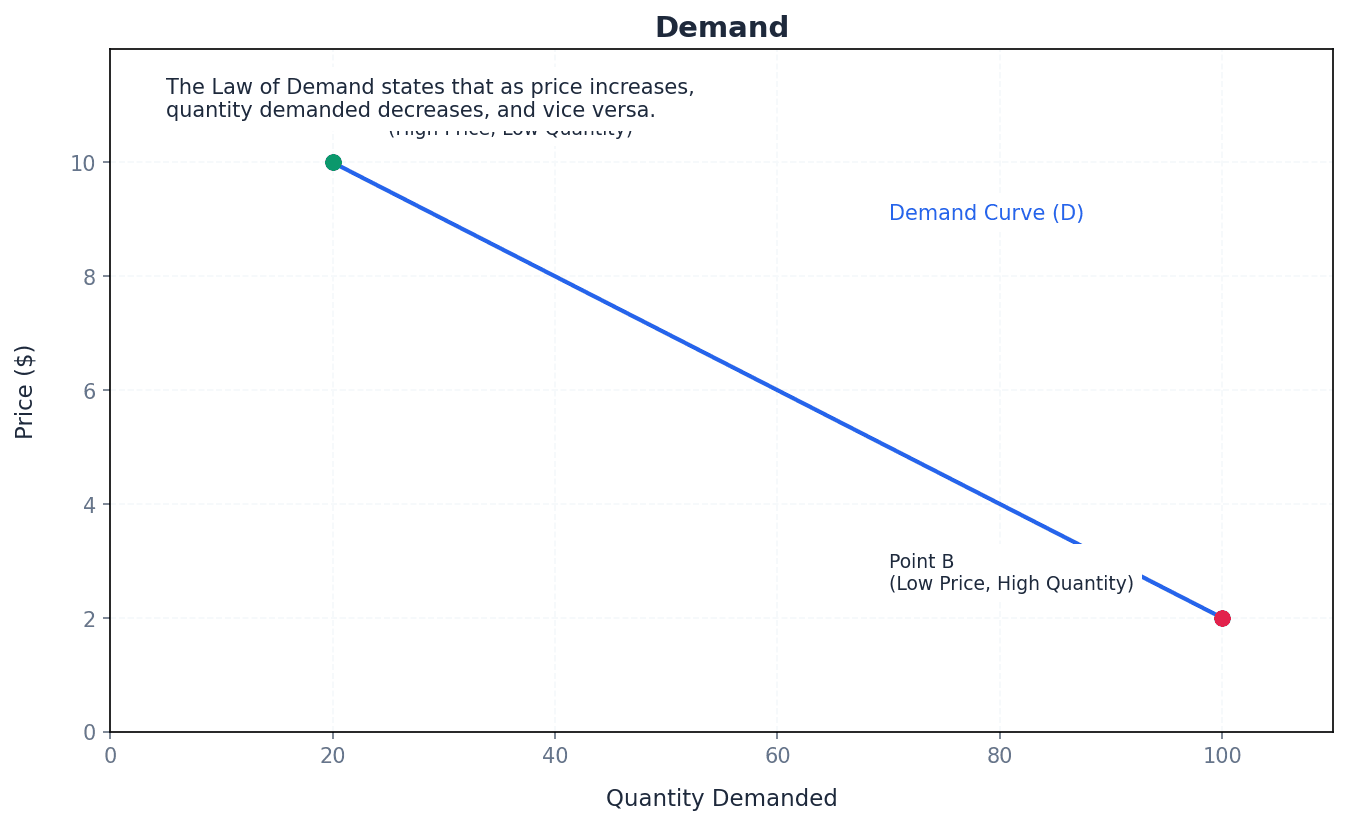
Determinants of demand — Determinants of demand are factors other than price that can cause the entire demand curve to shift.
These factors include consumer incomes, the prices of substitute and complementary goods, population size and structure, fashion and taste, and advertising and promotion spending. A change in any of these will lead to a new demand curve, for example, a heatwave increasing the demand for ice cream at every price.
Students often confuse determinants of demand with price changes, but actually price changes cause movements along the demand curve, while determinants cause the entire curve to shift.
When discussing demand, remember to distinguish between a movement along the demand curve (due to price change) and a shift of the demand curve (due to changes in determinants of demand).
Supply — Supply refers to the quantity of a product that businesses are willing and able to offer for sale at various prices over a period of time.
Businesses are generally motivated to supply more of a product if its price rises, as this increases potential profits, leading to an upward-sloping supply curve. This is similar to a baker who will bake and sell more loaves if the price of bread increases.
Students often think supply is just the amount of product available, but actually it also includes the willingness of businesses to sell at a given price.
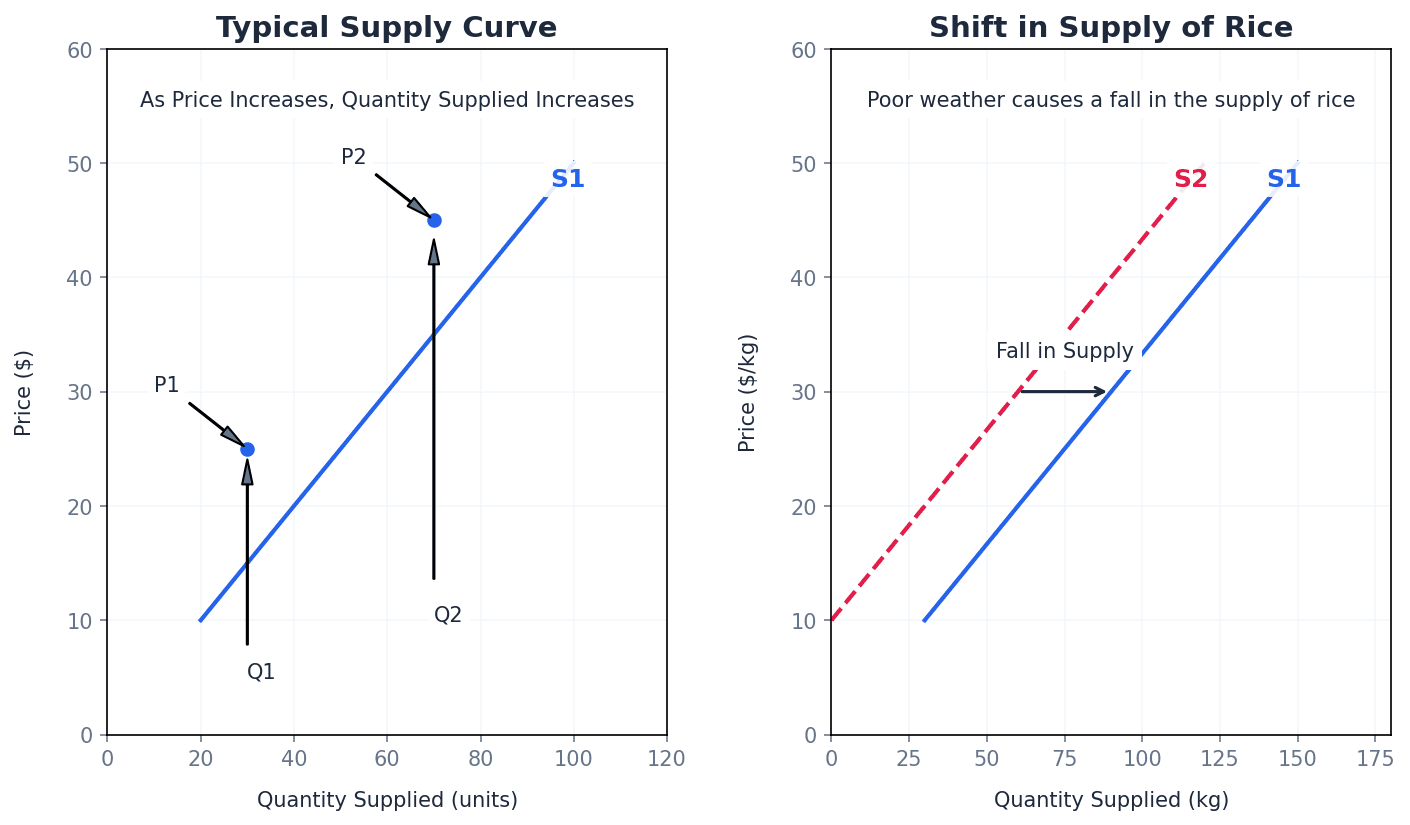
Determinants of supply — Determinants of supply are factors other than price that can cause the entire supply curve to shift.
These factors include costs of production, government taxes or subsidies, weather conditions, and advances in technology. For instance, if the cost of flour for a baker increases, they might supply less bread at every price, shifting the entire supply curve.
Students often confuse determinants of supply with price changes, but actually price changes cause movements along the supply curve, while determinants cause the entire curve to shift.
When analysing changes in supply, clearly state which determinant is responsible for the shift and explain how it impacts the quantity supplied at all price levels.
Equilibrium price — The equilibrium price is the price level at which the quantity demanded equals the quantity supplied in a market.
At this price, the market is cleared, meaning there is no excess demand or supply. If the price is above equilibrium, there will be excess supply, pushing prices down; if below, there will be excess demand, pushing prices up, much like a seesaw balancing perfectly.
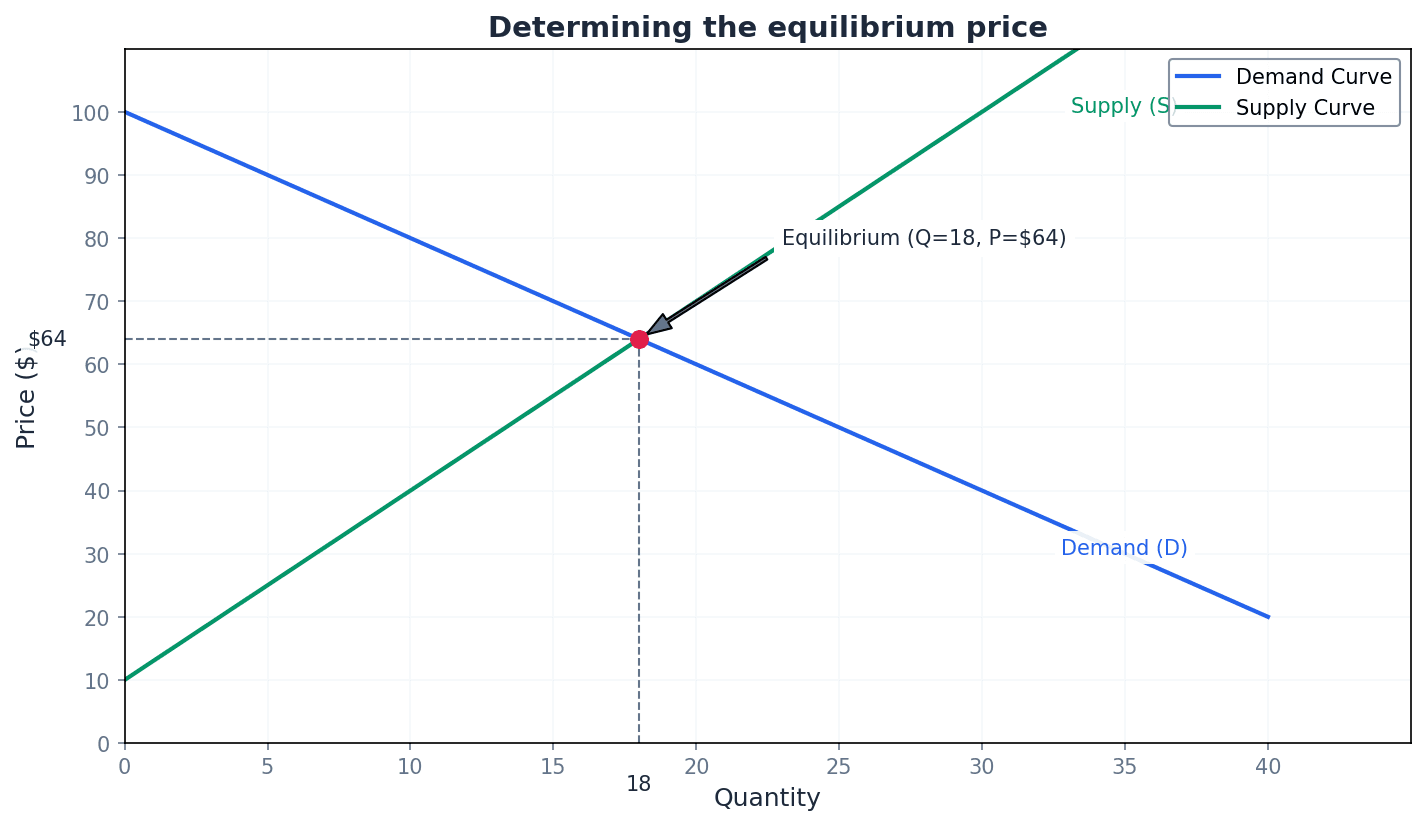
When illustrating equilibrium price on a diagram, ensure both demand and supply curves are correctly drawn and labelled, with the intersection clearly marked as the equilibrium point.
Industrial market — An industrial market deals with products bought by businesses for use in their operations or for resale.
This market includes products like specialist industrial machines, trucks, office supplies, and raw materials. Selling in industrial markets often involves specialist sales employees and focuses on building long-term relationships, similar to a car manufacturer purchasing steel and robotic assembly lines.
Consumer market — A consumer market deals with products bought by the final users of the products for personal consumption.
These products range from mobile phones and holidays to fashion clothing. Consumer products are often categorised into convenience, shopping, and speciality products, each requiring distinct marketing approaches, such as when you buy a new smartphone for personal use.
When comparing industrial and consumer markets, focus on differences in product complexity, buyer power, purchasing process, and promotional methods.
Customer orientation — Customer orientation is a marketing approach where the business focuses on identifying, anticipating, and satisfying customer needs and wants.
This approach prioritises extensive market research to produce what consumers desire, thereby reducing the risk of product failure and extending product lifespans. A restaurant that constantly seeks feedback and adapts its menu based on customer preferences exemplifies customer orientation.
Product orientation — Product orientation is a marketing approach where the business focuses on inventing, developing, and efficiently producing high-quality products, assuming consumers will purchase them.
This approach believes that innovation and quality alone will attract buyers, often with less initial emphasis on consumer research. A company inventing a revolutionary gadget, confident in its quality, without extensive prior market research, is product-oriented.
Students often think product orientation is always a bad strategy, but actually it can be successful for truly innovative products or where quality/safety is paramount, such as in pharmaceuticals or advanced medical equipment.
For questions on market orientation, always provide a balanced argument. Discuss the benefits of being market-oriented while also acknowledging situations where a product-oriented approach might be suitable.
Market size — Market size is the total quantity or value of products sold by all businesses in a market over a given time period.
Measured in units sold (volume) or revenue generated (value), market size helps managers assess the attractiveness of a market, calculate market share, and identify trends of growth or decline. For example, counting all smartphones sold in a country in a year, by units or total money spent, measures market size.
Market growth — Market growth is the percentage increase in the total size of a market (either by volume or value) over a period of time.
This metric indicates whether a market is expanding or contracting, influenced by factors like economic growth, consumer incomes, and technological changes. If the total number of electric cars sold increases by 20% year-on-year, that represents market growth for electric cars.
Students often think market growth automatically means increased sales for every business in that market, but actually a business's sales can fall even in a growing market if its market share declines.
Market share — Market share is the proportion of total market sales (by volume or value) that a particular business or product achieves.
Calculated as a percentage, an increasing market share signifies successful marketing strategies relative to competitors. The product with the highest share is known as the brand leader, much like if Coca-Cola sells 40 million out of 100 million soft drinks, it has a 40% market share.
Market Share
Used to measure the relative success of a business's marketing strategy. Can be calculated in volume or value terms.
Don't just calculate market share. Always comment on the significance of the result or the implications of a change in market share for the business.
Brand leader — A brand leader is the product or brand that has the highest market share within a particular market.
Being a brand leader offers advantages such as increased sales, greater willingness from retailers to stock and promote the product, and the ability to use this status in advertising. For example, if Apple sells more smartphones than any other company, the iPhone is the brand leader.
Convenience products — Convenience products are consumer products purchased frequently, often on impulse, and sold to a large target market.
These products are typically low-priced and widely available, requiring minimal purchasing effort from consumers, such as grabbing a chocolate bar at the supermarket checkout.
Shopping products — Shopping products are consumer products that usually require some planning and research by consumers before being purchased, and are not bought frequently.
Consumers compare features, prices, and quality across different brands before deciding, like when researching different laptop models before buying one.
Speciality products — Speciality products are consumer products bought infrequently, often expensive, and associated with strong brand loyalty.
Consumers are willing to make a special effort to purchase these products due to their unique characteristics or brand image, such as buying a luxury sports car or a bespoke designer dress.
Mass marketing — Mass marketing is a marketing strategy that focuses on selling the same standardised product to the entire market, aiming for high sales levels and often low prices.
This approach targets a broad market with an undifferentiated product, potentially leading to lower average costs due to economies of scale and extensive publicity. Selling a universally popular soft drink like Coca-Cola with the same basic advertising message is an example.
Niche marketing — Niche marketing is a marketing strategy focused on selling differentiated products to a very small, specific section of the total market with unique needs.
This approach targets customers who desire differentiated products and are often willing to pay higher prices for exclusivity. It allows small businesses to thrive and can create status for larger firms, such as a company making only left-handed scissors for professional tailors.
When evaluating strategies like mass vs. niche marketing, always use the case study context. Justify which is more appropriate for THAT specific business and its market.
Market segmentation — Market segmentation is the process of dividing a total market into distinct groups of consumers who share similar characteristics and needs.
The goal is to precisely define a target market and design products specifically for these groups, aligning with a customer-oriented approach. This is like a clothing store dividing customers into 'teenagers' and 'young professionals' to offer different styles and promotions.
When discussing market segmentation, link the chosen method (e.g., demographic) to a specific element of the marketing mix (e.g., price, promotion).
Geographic segmentation — Geographic segmentation divides a market based on consumer tastes and preferences that vary between different geographic areas, often due to cultural, social, and climatic differences.
Businesses use this to adapt products or marketing strategies to specific locations, such as a fast-food chain offering different menu items in India compared to the USA to cater to local tastes.
Demographic segmentation — Demographic segmentation divides a market based on population data and trends, using factors such as age, gender, income, family size, social class, and ethnic background.
These factors help create a consumer profile, enabling businesses to tailor products, pricing, and promotion strategies to specific groups, like a toy company designing different toys for toddlers and teenagers.
Psychographic segmentation — Psychographic segmentation divides a market based on differences in people’s lifestyles, personalities, values, and attitudes.
These factors, often influenced by social class, group consumers by their opinions, interests, and leisure activities. For example, a travel company offering 'adventure holidays' to outgoing, risk-taking individuals uses psychographic segmentation.
Customer relationship marketing (CRM) — Customer relationship marketing (CRM) is a marketing strategy focused on developing customer loyalty by gathering information about individual customers to adapt marketing tactics to their specific needs.
The aim is to retain existing customers, which is often more cost-effective than acquiring new ones, through targeted marketing, customer service, and regular communication. A coffee shop remembering your favourite drink and offering personalised discounts is practicing CRM.
Students often think CRM is just about having a database of customer names, but actually it's about actively using that data to personalise interactions and build long-term loyalty.
Always explain how marketing activities must be coordinated with other departments, such as finance (for budgets) and operations (for production capacity).
Advantages & Disadvantages
Market Orientation vs. Product Orientation
Mass Marketing vs. Niche Marketing
Evaluation Starters
Essay Structure Guide
Introduction
Start by defining key terms like 'marketing' and briefly outlining the scope of the essay. State your overall argument or stance on the question posed.
Conclusion
Summarise your main arguments without introducing new information. Reiterate your overall stance, providing a final, well-reasoned judgement that directly answers the essay question. Emphasise the dynamic nature of marketing and the need for adaptability.
This chapter explores market research, defining its purpose and differentiating between primary and secondary data sources. It evaluates the usefulness and limitations of various research methods, including the importance of sampling and potential biases. The chapter also covers the analysis and interpretation of both quantitative and qualitative data, using statistical measures and visual representations.
Market research — Market research is a broad and far-reaching process where data is collected to impact most business decisions.
It involves gathering clues (data) from various sources to understand the market, identify customers, and predict future sales trends. This data helps businesses identify market features, reduce new product launch risks, and predict future demand changes, rather than just determining if consumers will buy a product.
Students often think market research is only about surveys, but actually it encompasses a wide range of data collection and analysis methods, including observation, focus groups, and analysis of existing data.
When asked to 'analyse the purposes of market research', ensure you explain how each purpose (e.g., identifying market features, reducing risk) benefits the business, rather than just listing them. Use phrases like 'this allows the business to...' or 'this helps to avoid...'.
Primary research — Primary research is the first-hand collection of data by an organisation for its own specific needs.
This data is original and collected directly from the source, such as through surveys, interviews, or focus groups. It is like tasting the batter yourself and asking friends for immediate feedback on your specific cake, providing tailored, up-to-date information especially useful for new markets or products.
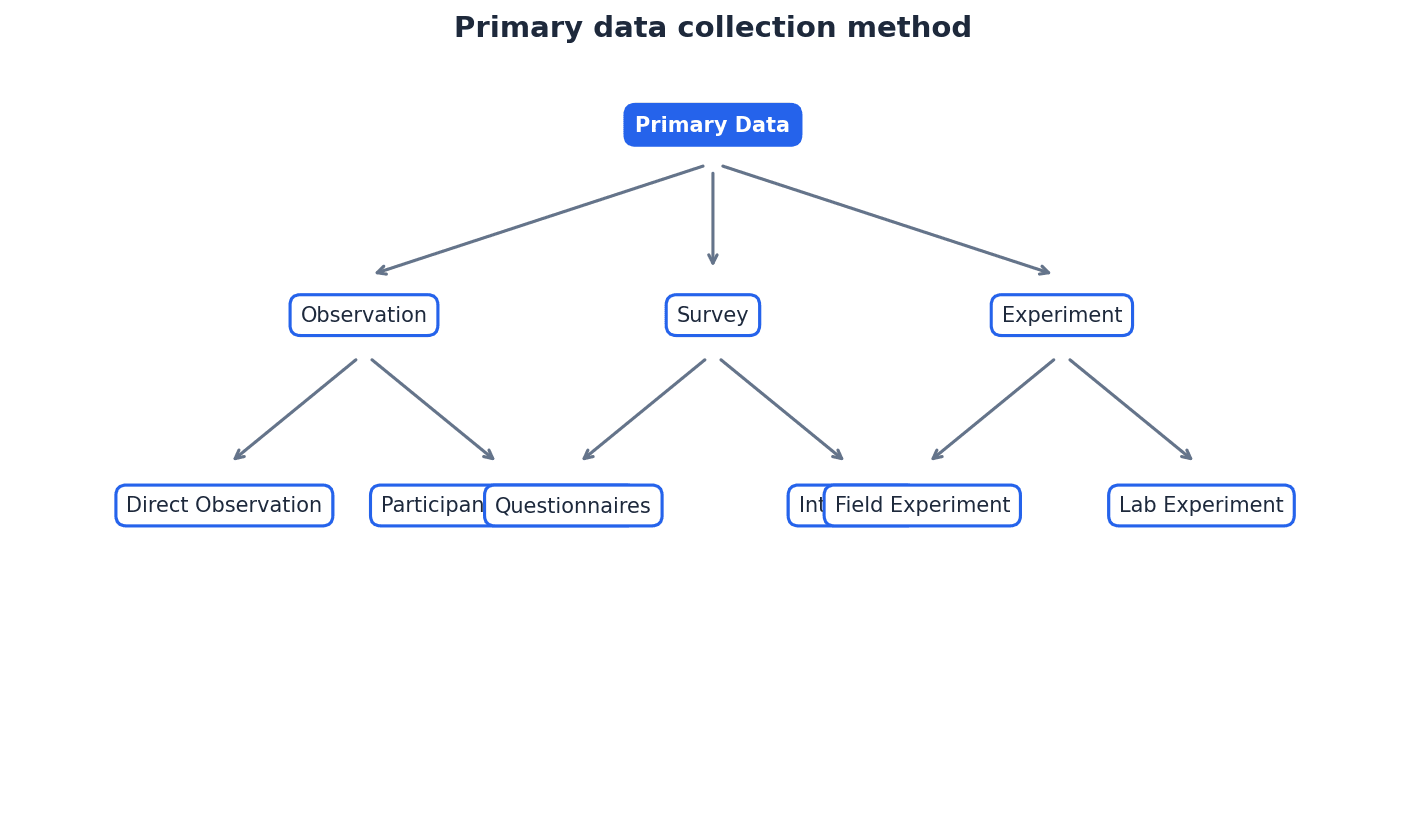
Secondary research — Secondary research is the use and analysis of data that already exists, having been originally collected by another organisation, often for a different purpose.
This data is readily available from sources like government reports, trade organisations, or internal company records. It is like looking up existing cake recipes in cookbooks or online, providing a broad overview of market conditions generally cheaper and quicker to obtain than primary data.
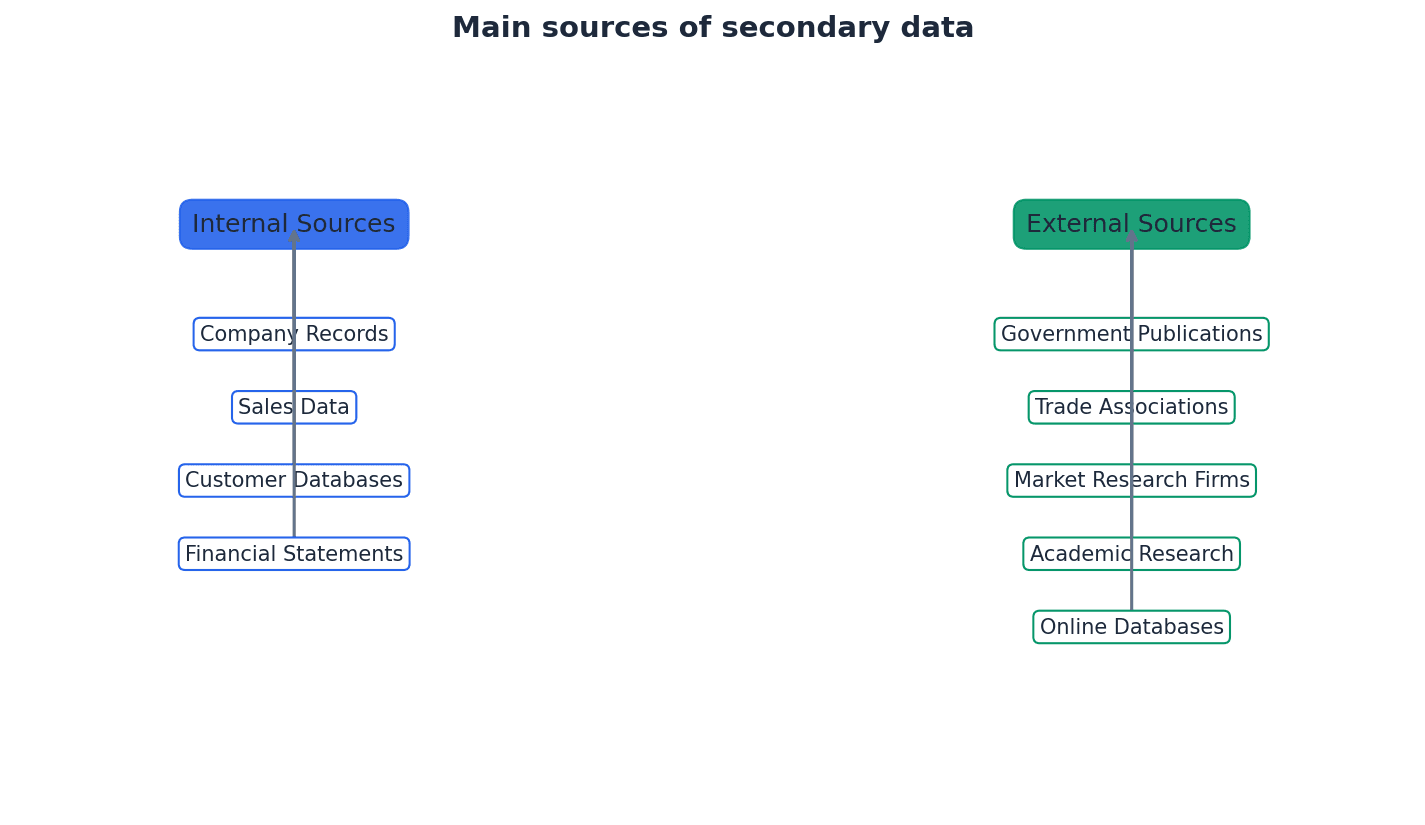
Students often think primary research is always better than secondary research, but actually it can be more expensive and time-consuming, and may not be necessary if sufficient secondary data already exists.
Students often think secondary data is always reliable because it's 'official', but actually it can be out of date, not specific to the business's needs, or incomplete, leading to inaccurate conclusions.
When evaluating primary research, consider both its benefits (specificity, up-to-date) and limitations (cost, time, sampling bias). Use comparative language when discussing its usefulness relative to secondary research.
When asked to 'evaluate the usefulness of secondary research', ensure you discuss both its advantages (cost, speed, broad overview) and disadvantages (out-of-date, not specific, availability) and provide a reasoned judgement based on the context.
Big data — Big data is a term used to describe the vast amounts of publicly available data on websites, social media posts, retail purchase records and healthcare records.
This immense volume of data offers new business possibilities if analysed carefully, providing insights into consumer behaviour and market trends. However, its sheer size can make analysis challenging and costly, requiring powerful search tools and skilled data analysts.
Students often think big data is easy to use because it's 'available', but actually it requires specialised tools and expertise to analyse and extract useful insights, which can be expensive for individual businesses.
Sampling — Sampling is the process of choosing a representative subset of the total potential target market to gather evidence from in market research.
It is used because it is often impossible or too expensive and time-consuming to collect data from the entire population. The larger and more representative the sample, the more confidence can be placed in the results, much like taking a spoonful to taste a pot of soup.
When explaining 'the need for sampling', link it directly to the impracticality of surveying the entire population due to cost, time, or inability to identify everyone. When discussing 'limitations', focus on sample size and representativeness leading to bias.
Sampling bias — Sampling bias occurs when the results from a sample are different from those that would have been obtained if the whole target population had been questioned.
This happens when the sample is not truly representative of the entire population, leading to inaccurate conclusions. For example, asking only drama club students about a new uniform would bias the results, as their opinions might not reflect the entire student body.
Students often think any sample is good enough, but actually a sample must be sufficiently large and representative to avoid sampling bias and ensure the results accurately reflect the wider population.
Quantitative data — Quantitative data is numerical data that can be analysed using statistical techniques.
This type of data focuses on measurable quantities, such as sales figures or number of customers, providing objective insights. It is like counting apples in a basket, giving precise numbers that can be used to identify trends and calculate averages.
Students often think quantitative data tells the whole story, but actually it often needs to be complemented by qualitative data to understand the 'why' behind the numbers.
Qualitative data — Qualitative data aims to understand why consumers behave in a certain way or how consumers might react to the launch of a new product, based on opinions, attitudes and beliefs.
This type of data is non-numerical and provides in-depth insights into customer needs and wants, answering questions like 'why' or 'how'. It is like asking someone to describe the taste of an apple, providing descriptive, subjective information gathered through methods like focus groups.
Students often think qualitative data is less important because it's not numerical, but actually it provides crucial context and understanding behind quantitative trends, helping businesses make more informed strategic decisions.
Quantitative data can be analysed using statistical techniques, particularly measures of central tendency, also known as averages. These include the mean, mode, and median, each offering a different perspective on the typical value within a dataset. Understanding these averages helps businesses interpret numerical information and identify trends.
Mean — The arithmetic mean is an average calculated by summing all the values in a set of data and dividing by the number of values.
It is the most commonly used average and includes all data in its calculation, making it a good indicator of overall central tendency. However, it can be significantly affected by extreme results, much like how a single very tall friend can skew the average height of a group.
Mode — The mode is the most frequently occurring value in a set of data.
It is easily observed, especially when data is ordered, and provides a clear indication of the most popular or common item. For example, if 'blue' is the most popular colour in a survey, it is the mode. However, it may be of limited value if there is no recurring item or if there are multiple modes.
Median — The median is the middle item in a range of ordered data.
It is less influenced by extreme results than the mean, making it more appropriate when there are a few very high or very low values. For an even number of values, it is the mean of the two middle results, much like finding the height of the person exactly in the middle of a line.
Median (odd number of values)
This formula identifies the position of the median item in an ordered dataset when the total number of values is odd, where 'n' is the number of values.
Students often think the mean is always the 'best' average, but actually it can be misleading if there are outliers (very high or low values) in the data, in which case the median might be more appropriate.
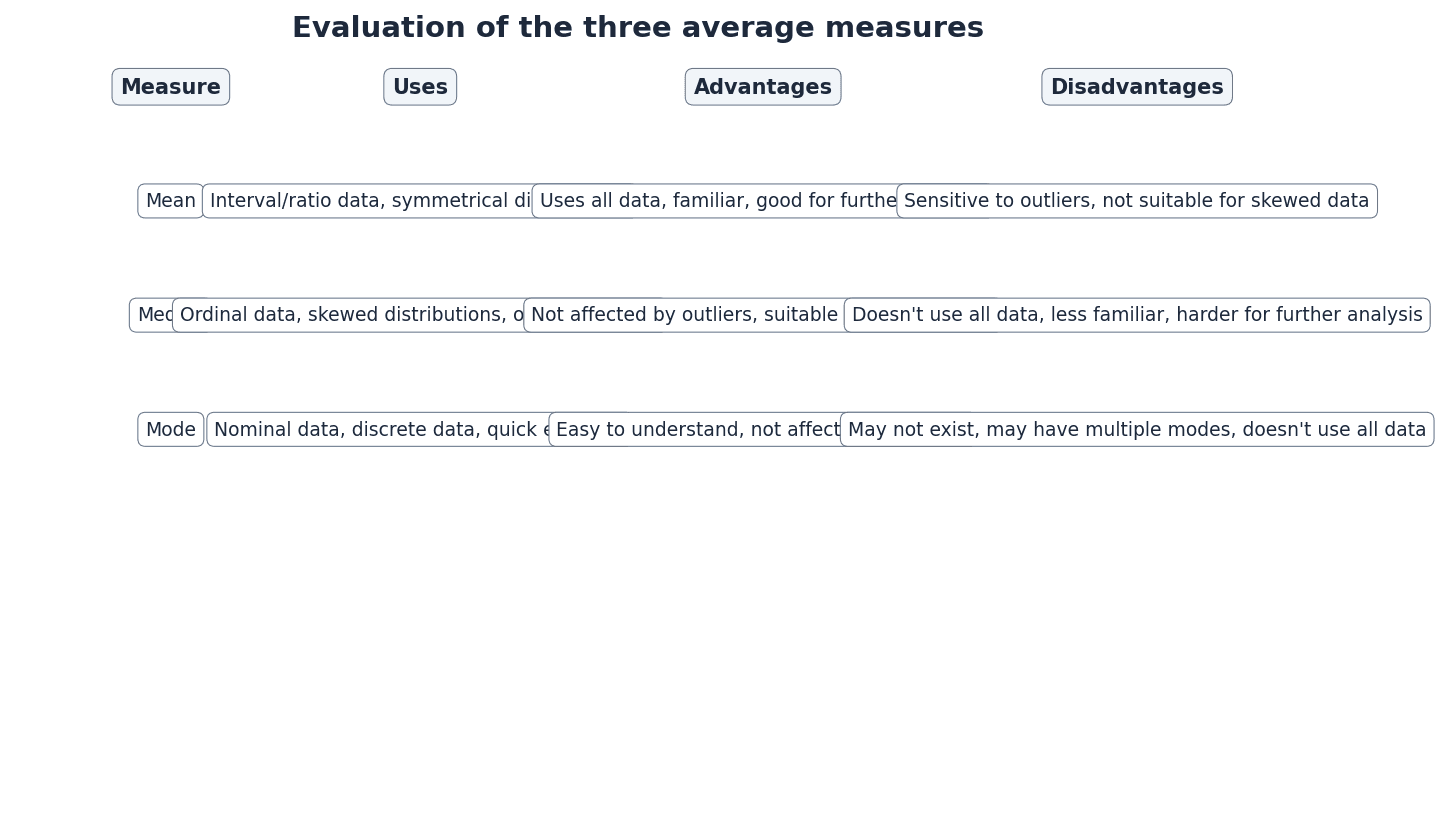
Beyond averages, understanding the spread or dispersion of data is crucial for a complete analysis of quantitative information. The range is a key measure that provides a quick indication of the variability within a dataset. This helps businesses understand how consistent or varied their data points are.
Range — The range is a measure of data dispersion calculated as the difference between the highest and lowest results in a set of data.
It is the easiest and most widely used measure of spread, providing a quick indication of the variability within the data. For example, if the tallest person is 2m and shortest is 1.5m, the range is 0.5m. However, it can be distorted by extreme results (outliers).
Range
Measures the spread or dispersion of data by finding the difference between the maximum and minimum values in the dataset.
Market research data, both quantitative and qualitative, is often presented visually to make it easier to understand and interpret. Tables, charts, and graphs are common tools used to summarise findings and highlight key trends or comparisons. These visual aids are essential for communicating insights effectively to stakeholders.
Angle of section (pie graph)
Used to calculate the angle for each segment in a pie graph, ensuring the proportions are accurately represented, where 'Total value' is the sum of all numerical values and 'Value of section' is the numerical value for a specific category.
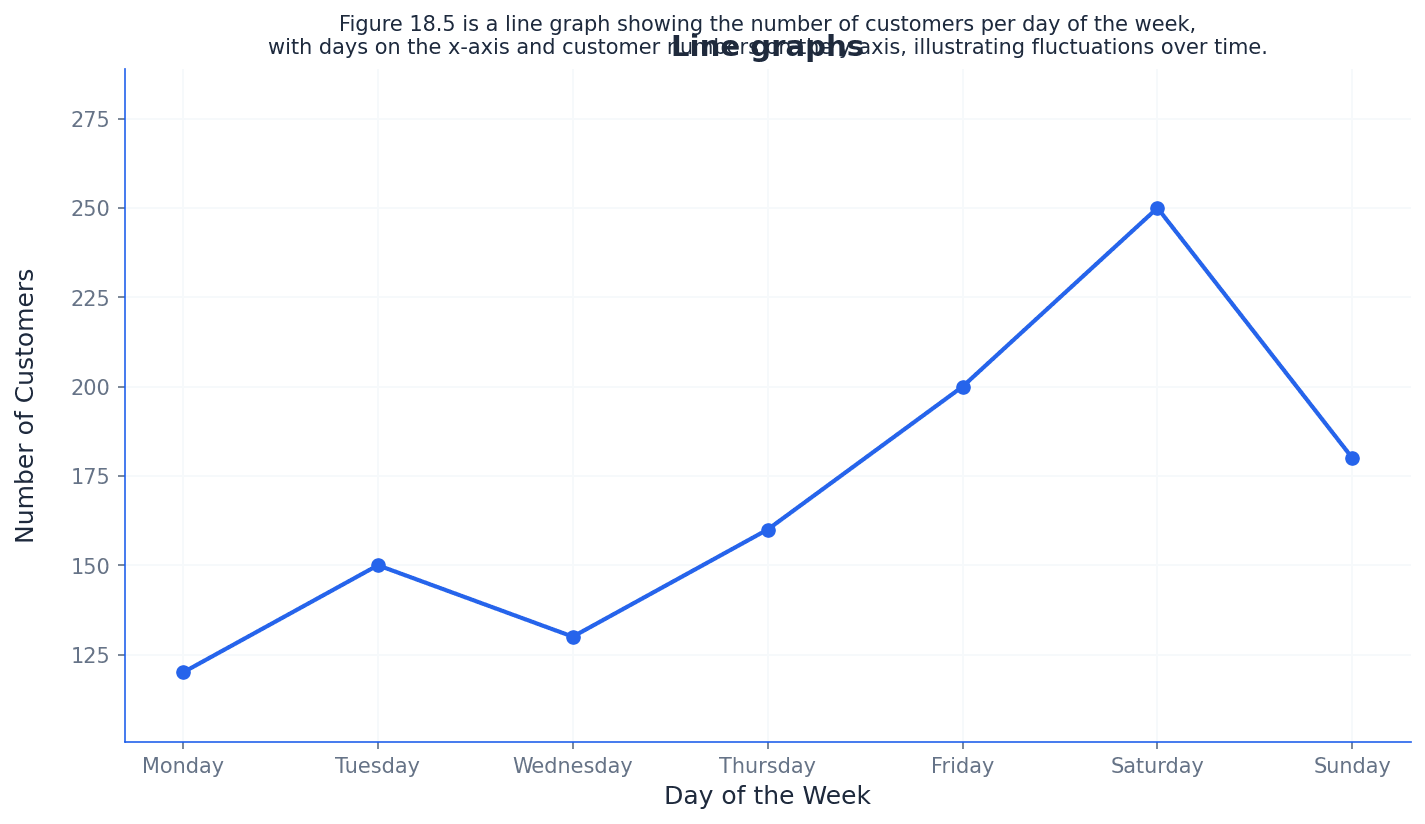
For data response questions, don't just state the figures from a table or chart. Interpret them in the context of the business scenario provided.
When asked to recommend a research method, justify your choice by linking its advantages directly to the specific needs of the business in the case study.
Advantages & Disadvantages
Primary Research
Secondary Research
Evaluation Starters
Essay Structure Guide
Introduction
Begin by defining market research and briefly outlining its overall purpose for businesses. State the key areas you will cover in your essay, such as data sources, sampling, and data analysis, to address the question directly.
Conclusion
Summarise the main arguments, reiterating the critical role of market research in reducing risk and informing strategic decisions. Provide a final, reasoned judgement on the overall reliability and usefulness of market research, perhaps by stating that its value is maximised when methods are chosen carefully and data is interpreted critically.
This chapter explores the marketing mix, focusing on product and price decisions. It covers product development, differentiation, branding, and portfolio analysis using tools like the product life cycle and Boston Matrix. Various pricing methods, including cost-based, competition-based, and new product strategies, are also explained.
marketing mix — A range of tactical decisions for marketing a product.
The marketing mix, often called the 4Ps (product, price, promotion, place), involves interrelated decisions that must be coordinated to present a consistent image and sell products profitably. For services, 'people' and 'process' are also considered important, much like deciding on ingredients, price, promotion, and place for a successful cake.
Students often think the 4Ps are independent decisions, but actually they are interrelated and must be carefully coordinated to avoid confusing customers.
product — The term 'product' includes consumer and industrial goods and services.
A product encompasses both tangible attributes, like a smartphone's screen size, and intangible attributes, such as a brand's reputation for innovation or social status, that consumers consider when making purchasing decisions. Getting the product right is crucial for customer loyalty and long-term sales success.
Students often think 'product' only refers to physical goods, but actually it includes services and the intangible attributes that influence consumer perception and value.
price — Price is the amount paid by customers for a product.
Determining the appropriate price is a vital component of the marketing mix, as it significantly impacts consumer demand, value added, revenue, profit, and the psychological brand image of a product. The price of a concert ticket, for example, signals popularity and affects attendance, contributing to overall revenue.
Students often think price is only about covering costs, but actually it's a strategic tool that influences demand, brand perception, and competitive positioning.
When asked to analyse the marketing mix, ensure you discuss how the different elements (e.g., product quality and price) complement each other to achieve marketing objectives.
Product decisions are fundamental to a marketing mix. They involve defining what the business offers, including both tangible features and intangible attributes like brand image. Getting the product right is crucial for meeting customer expectations, creating a unique selling point (USP), and fostering customer loyalty and long-term sales success.
new product development (NPD) — New product development (NPD) is crucial to the success of some businesses.
NPD is vital for businesses to adapt to changing consumer tastes, increasing competition, technological advancements, and to find new growth opportunities. For a computer game company, NPD is like constantly creating new game titles or updating existing ones to keep players engaged and stay ahead of rivals in a fast-paced market.
Students often think NPD is only about completely novel inventions, but actually it also includes products new to a company or new to a specific market, as well as significant updates to existing products.
product differentiation — Product differentiation can be an effective way of distancing a business from its rivals and creating competitive advantage.
This strategy involves making a product stand out from competitors by offering unique features, design, or customer service. Effective differentiation often leads to a unique selling point (USP), much like a coffee shop differentiating itself with unique blends and a cozy reading nook.
unique selling point (USP) — An effective product differentiation creates a USP.
A USP is a feature or benefit that makes a product unique and superior to its competitors, giving consumers a compelling reason to choose it. Domino's 'It arrives in 30 minutes or it's free' is a USP because it offers a specific, measurable benefit that competitors don't guarantee.
brand — The brand is the distinguishing name or symbol that is used to differentiate one manufacturer’s products from another.
Branding creates a powerful image or perception in consumers' minds, giving products a unique identity. A strong brand can influence purchasing decisions and build customer loyalty, often based on intangible attributes. While 'mobile phone' is the product, 'Apple iPhone' is the brand, evoking perceptions of quality, design, and status.
product positioning — Product positioning is done using techniques such as market mapping.
This involves analysing how a new brand will relate to other brands in the market in the minds of consumers, based on key features important to them (e.g., price, quality, image). It helps identify market gaps. For example, a car manufacturer might position a new model as 'affordable luxury'.
When evaluating product decisions, consider both tangible features and intangible attributes like branding, and how they contribute to meeting customer expectations and creating a USP.
Product portfolio analysis helps businesses make strategic decisions about when to launch new products or update existing ones. It involves techniques like the product life cycle and Boston Matrix to assess the market standing of a firm's products, assisting in planning marketing strategies and achieving a balanced portfolio.
product life cycle — The life cycle of a product records the sales of that product over time.
It consists of stages: introduction, growth, maturity/saturation, and decline. Understanding these stages helps businesses plan marketing-mix decisions and manage a balanced product portfolio. A popular song, for instance, goes through introduction, growth, maturity, and eventually decline.
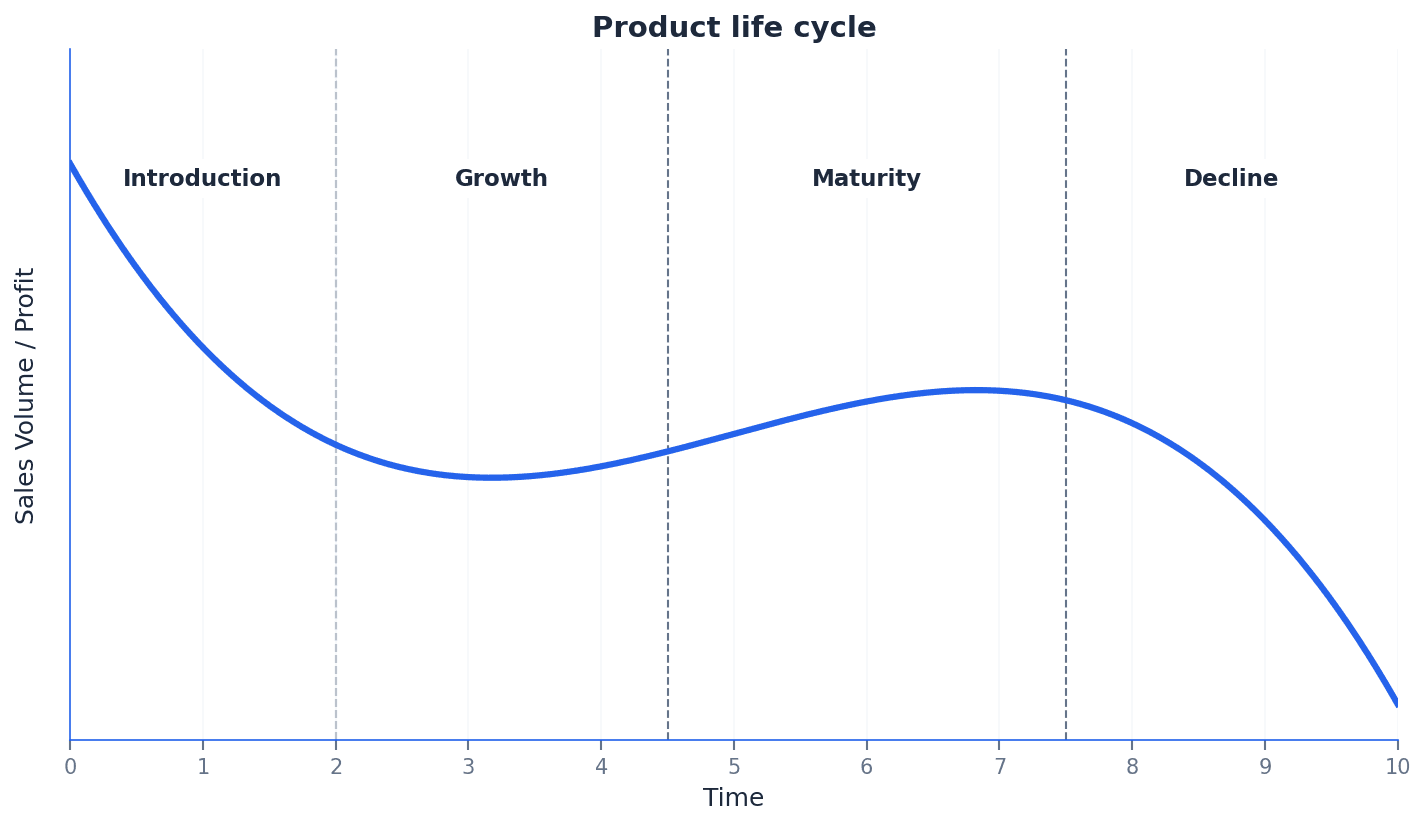
Students often think the length of each stage is fixed, but actually the duration of introduction, growth, maturity, and decline varies significantly between different products.
extension strategies — These strategies aim to lengthen the life of an existing product before the market demands a completely new product.
Examples include selling in new markets, repackaging, relaunching, or finding new uses for the product. They are implemented during the maturity stage to prevent or delay decline, much like refreshing a classic car model with new colours to extend its appeal.
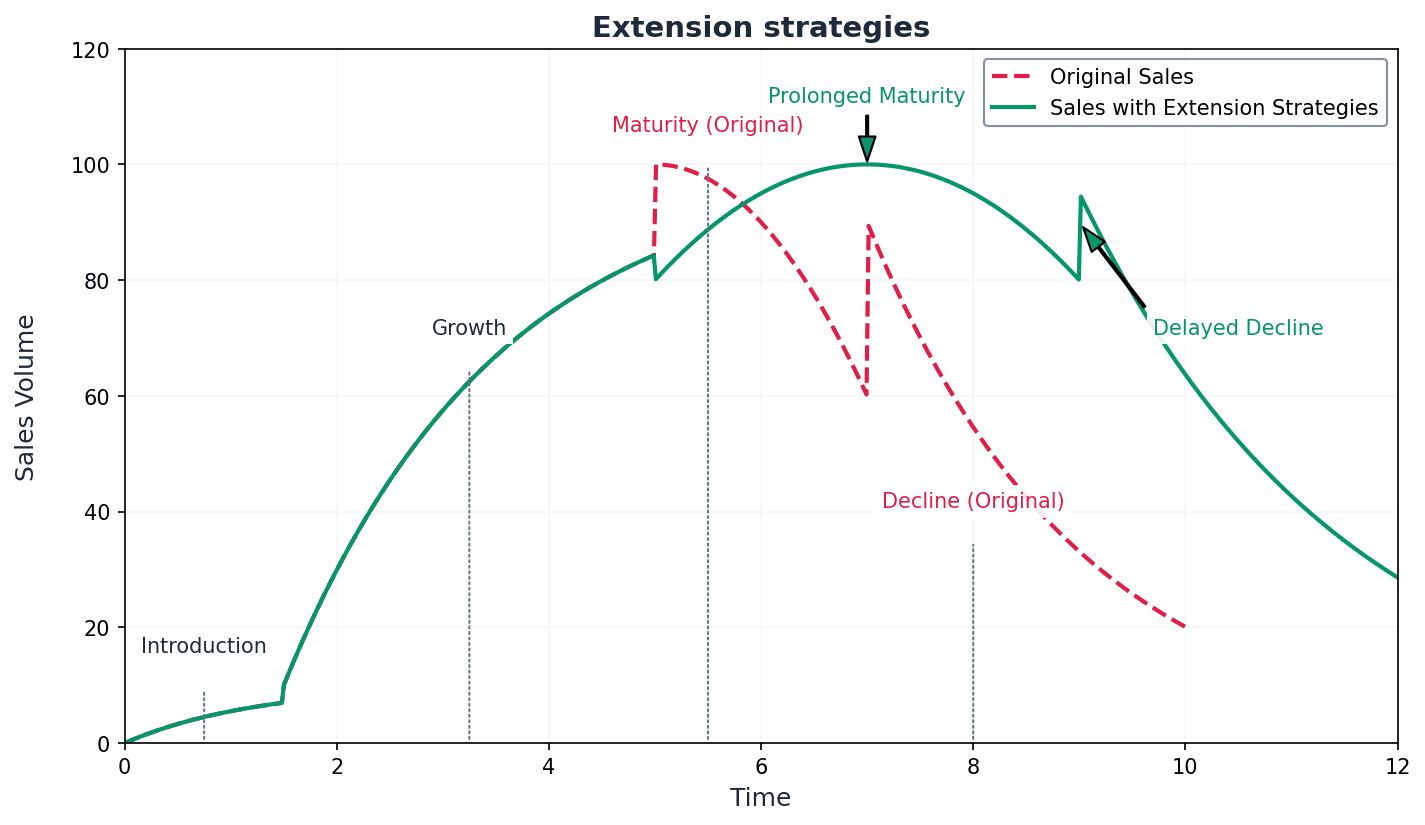
balanced portfolio — A balanced portfolio means that as one product declines, other products are being developed and introduced to take its place.
This ensures a steady cash flow, as successful products finance new ones, and maintains factory capacity. It helps a business avoid over-reliance on a single product, similar to a fruit farmer growing different crops to ensure continuous income.
Boston Matrix — This method of analysing the market standing of a firm’s products and the product portfolio of a business was developed by the Boston Consulting Group.
It classifies products based on market share and market growth into 'cash cows', 'stars', 'question marks', and 'dogs', helping businesses plan future marketing strategies and resource allocation. It's like a sports team manager assessing players' performance and potential.
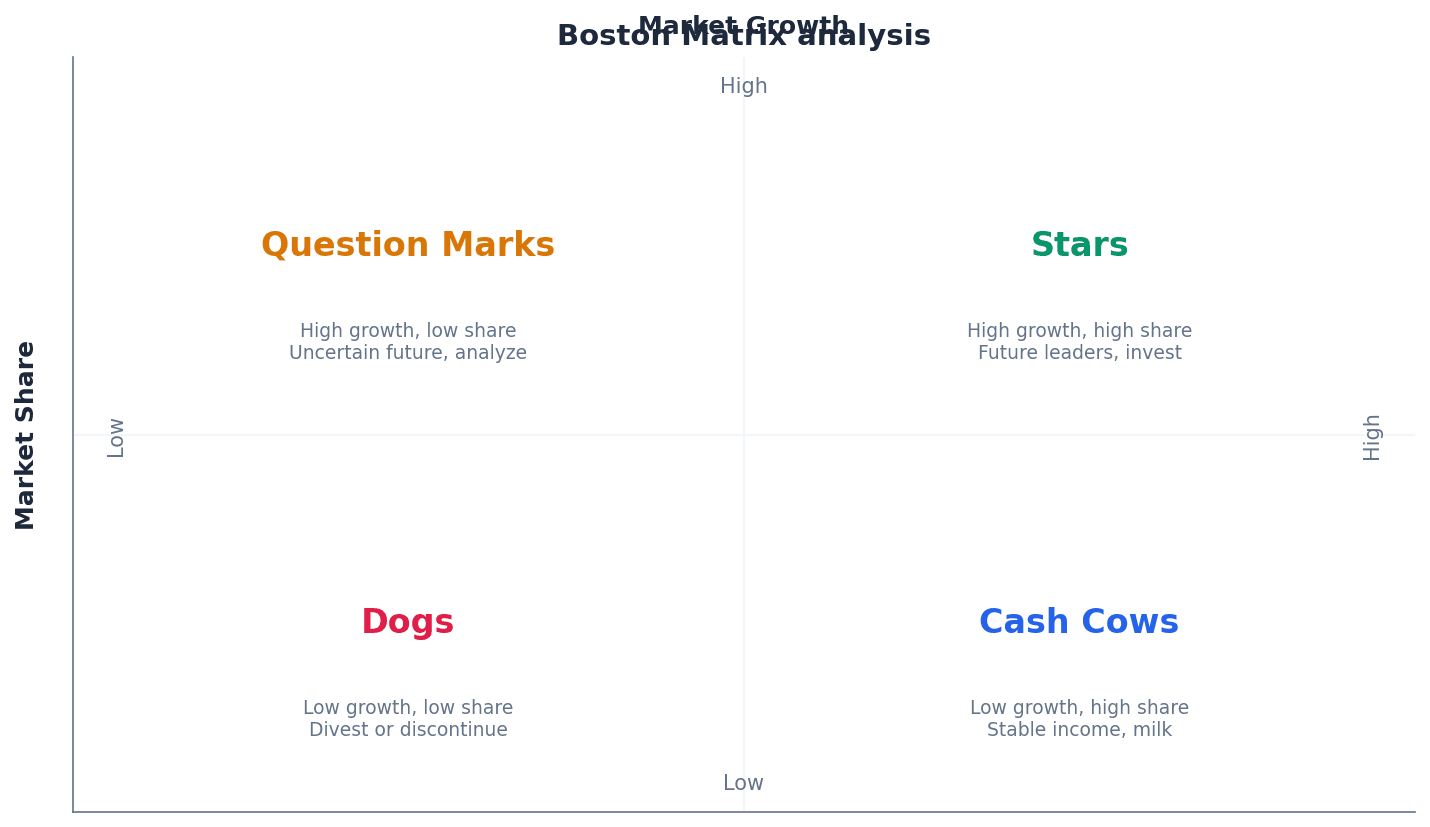
Students often think the Boston Matrix provides definitive strategic choices, but actually it is a planning tool that highlights products needing strategic action, not a guarantee of success.
cash cow — A well-established product in a mature market, typically profitable and creating a high positive cash flow.
Cash cows have high market share but low market growth. They generate significant income with low promotional costs, which can be used to finance other products in the portfolio, such as question marks. A classic, best-selling novel is a cash cow for its publisher.
star — A successful product performing well in an expanding market, with high market growth and high market share.
Stars generate high income but often require significant promotional investment to maintain their market position in fast-changing markets. The business aims to maintain their market leadership, much like a newly launched smartphone model quickly gaining market share.
question mark — A product with high market growth but low market share, consuming resources but generating little return.
Question marks are often newly launched products with uncertain futures. They require heavy promotion to become established, with finance potentially coming from cash cows. Decisions may involve revising design or withdrawal, similar to a new streaming service with few subscribers but high market potential.
dog — A product with low market growth and low market share, offering little to the business in terms of existing sales or future prospects.
Dogs are typically unprofitable and may need to be replaced or withdrawn from the market. The business might decide to divest from this sector altogether, like an outdated flip phone model in today's smartphone market.
When applying the Boston Matrix, clearly define each quadrant and explain the appropriate marketing strategies (building, holding, milking, divesting) for products in each category. Also, state its limitations.
Pricing is a critical component of the marketing mix, significantly impacting demand, revenue, and brand image. Managers determine the appropriate price by considering various factors, including costs, competitive conditions, business objectives, and price elasticity of demand. Different pricing methods are employed depending on the product's nature and market situation.
mark-up pricing — Mark-up pricing is often used by retailers.
Retailers add a percentage mark-up to the unit cost of each item bought from the producer or wholesaler. The size of the mark-up depends on demand, competition, and the product's life cycle stage. For example, a clothing store buying a shirt for 30.
cost-plus pricing — Cost-plus pricing is often used by manufacturers.
The business calculates or estimates the total cost per unit and then adds a fixed profit mark-up. It ensures all costs are covered but may not consider market conditions. A custom furniture maker, for instance, calculates wood, labour, and overhead costs, then adds a profit margin.
contribution-cost pricing — The contribution-cost pricing method does not try to allocate the fixed costs to specific products.
Instead, it calculates a variable cost per unit and adds an amount (contribution) towards fixed costs and profit. It is flexible and allows for consideration of competition. A T-shirt printer might charge a price that covers the shirt and ink, plus an amount contributing to machine costs and rent.
loss leaders — This involves the setting of very low prices for some products, possibly even below variable costs (meaning a negative contribution).
The aim is to attract consumers who will then buy other, more profitable products. It is often used for complementary goods, where the loss on one item is offset by profits on another. A supermarket selling milk cheaply hopes customers will buy other groceries.
price discrimination — This pricing method is often used in markets where it is possible to charge different groups of consumers different prices for the same product.
It requires different consumer groups, the ability to prevent resale between groups, and different price elasticities of demand. Examples include discounts for children or the elderly at a cinema, where different groups have varying willingness to pay.
dynamic pricing — The dynamic pricing method involves setting constantly changing prices when selling products to different customers, especially online through e-commerce.
Prices vary according to demand patterns or knowledge about a particular consumer's ability to pay. It is common in industries like airlines where prices can change rapidly, meaning no two passengers might pay the same fare.
When introducing new products, businesses often choose between two primary strategies: penetration pricing or market skimming. The choice depends on factors such as market competitiveness, product innovation, and the desired speed of market entry and profit maximisation.
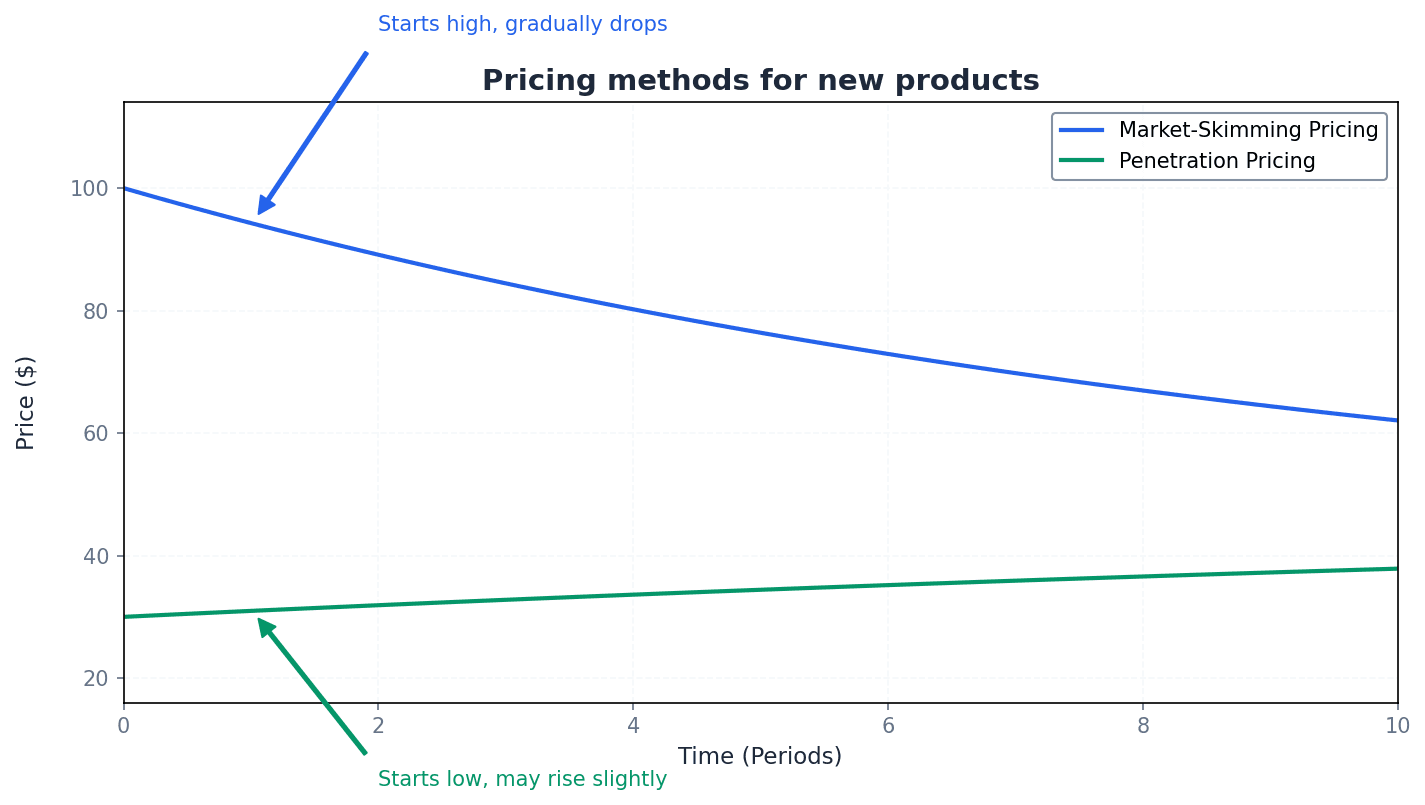
penetration pricing — Firms tend to adopt penetration pricing because they are attempting to use mass marketing and gain a large market share.
This strategy involves setting a low initial price for a new product to attract a large customer base quickly. If successful, the price may be slowly increased during the growth stage, similar to a new streaming service offering a very low introductory fee.
market skimming — The aims of market skimming are to maximise short-run profits before competitors enter the market with a similar product.
This strategy involves setting a high initial price for a new, innovative product to target early adopters and create an exclusive image. Prices are typically lowered as competition increases, much like a new high-tech gadget being sold at a very high price to early enthusiasts.
When evaluating pricing decisions, consider not only costs but also competitive conditions, business objectives, price elasticity of demand, and whether it's a new or existing product.
Demonstrate higher-level understanding by explaining how product and price decisions are linked, e.g., how a premium product design justifies a price skimming strategy.
Advantages & Disadvantages
New Product Development (NPD)
Product Life Cycle (PLC) Analysis
Evaluation Starters
Essay Structure Guide
Introduction
Begin by defining the marketing mix and briefly introducing the importance of product and price decisions. State your overall argument or stance on the question posed.
Conclusion
Summarise your main arguments, reiterating the critical roles of product and price in the marketing mix. Provide a final, well-justified judgement or recommendation, considering the interrelationship of the 4Ps and the dynamic nature of business environments.
This chapter explores promotion and place, two essential elements of the marketing mix. It details various promotion methods, including advertising, sales promotion, and direct promotion, alongside the rapid growth of digital marketing. The chapter also examines the importance of branding and packaging, and discusses different distribution channels, highlighting factors influencing their selection for an integrated marketing strategy.
Promotion mix — The combination of all forms of promotion used by a business for any product.
The promotion mix includes advertising, direct promotion, and sales promotion. It is like a chef creating a dish: the promotion mix is the blend of different spices and ingredients (promotion methods) used to make the dish (product) appealing to diners (consumers). The allocation of the promotion budget across these different forms is a key decision for businesses to achieve their objectives.
Students often think promotion mix is just advertising, but actually it encompasses all communication tools a business uses to inform, persuade, and remind consumers about its products.
Advertising — Communicating information about a product or business through the media, such as radio, TV and newspapers.
Advertising aims to increase awareness, create brand images, and ultimately drive sales. It is like a megaphone for your product, broadcasting its message to a wide audience through various channels. It can be informative, providing details about a product, or persuasive, focusing on creating a distinct brand identity.
Distinguish between informative and persuasive advertising in your answers, providing examples for each type to demonstrate a deeper understanding.
Informative advertising — Adverts that give information about a product to potential purchasers, rather than just trying to create a brand image.
This style is most effective for new products or when communicating significant changes in price, design, or specification. It is like a product's instruction manual, clearly laying out what it is and what it does, focusing on factual details like price, technical specifications, or features.
Persuasive advertising — Adverts trying to create a distinct image or brand identity for the product.
This form is common in markets with little product differentiation, aiming to create a perceived difference in consumers' minds. It is like a fashion show for a product, where the goal is to make it look desirable and unique, often focusing on emotional appeal or lifestyle associations rather than factual details.
Sales promotion — Generally aims to achieve short-term increases in sales, whereas advertising often aims to achieve returns in the long run through building customer awareness of and confidence in the product.
Sales promotion includes incentives like price offers, loyalty programs, and 'buy one get one free' (BOGOF) deals. It is like a temporary 'flash sale' or a special coupon, designed to stimulate immediate purchase or stocking, and can be directed at final consumers (pull strategy) or distribution channels (push strategy).
Students often confuse sales promotion with advertising, but actually sales promotion focuses on short-term incentives to buy, while advertising builds long-term brand awareness and image.
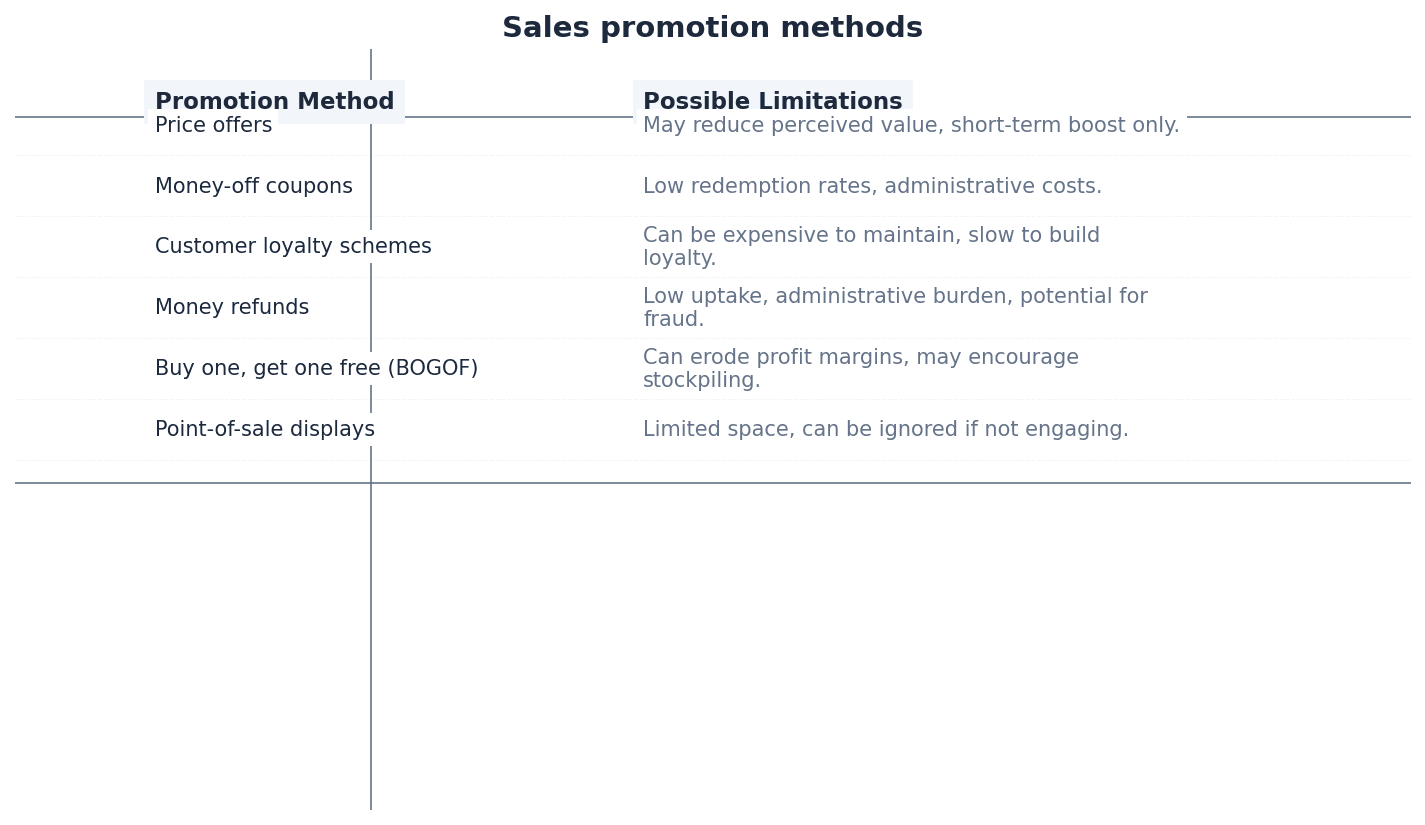
Direct promotion — Methods that do not use a paid-for medium, unlike advertising.
This category includes direct mail, telemarketing, and personal selling. Direct promotion is like a personal conversation or a letter addressed specifically to you, allowing for more targeted communication that can be effective for specific customer segments or complex products.
A promotion campaign can have various objectives, such as increasing awareness, building brand image, or boosting short-term sales. When making promotion-mix decisions, businesses must consider factors like the product's stage in its life cycle, the target audience, the budget available, and the nature of the market. The effectiveness of promotional spending should be measured through metrics like sales figures, brand awareness surveys, or web traffic analysis to justify whether a campaign was successful.
When asked to 'analyse' or 'evaluate' promotion mix decisions, ensure you discuss the interplay and balance between different methods, not just individual methods in isolation.
Digital promotion — The fastest-growing form of promotion, using the latest technology to get messages to customers.
This includes social media marketing, email marketing, online advertising, smartphone marketing, search engine optimisation (SEO), and viral marketing. Digital promotion is like using a highly targeted laser beam to reach specific customers online, offering worldwide coverage, low cost, and easy tracking.
Students often think digital promotion is only for young people, but actually its reach is expanding across all demographics, and businesses must adapt to its rapid evolution.
Search engine optimisation (SEO) — Businesses that use e-commerce (sell online) locate their websites on search engines such as Google, Bing, Yahoo and Baidu (China). They need to use SEO to make sure that their content appears among the first results of a search.
SEO involves methods like optimising content for specific keywords to achieve a high ranking on search engine results pages. It is like making sure your shop is on the busiest street in town, so that when people are looking for what you sell, your shop is one of the first they see. It is crucial for online businesses to remain competitive and visible.
Viral marketing — Makes use of all types of digital marketing. The essence of viral marketing is to create a post, video, meme or similar short form of content that spreads across the web like a virus.
This involves promoting content across multiple channels over a short period, often by identifying influencers to spread the message. Viral marketing is like a digital chain letter, but instead of being a nuisance, it's a captivating message that people eagerly share with their friends and networks, aiming for rapid, widespread dissemination through user sharing.
When discussing digital promotion, focus on its benefits like personalisation, global reach, and measurability, but also address limitations such as global competition and the need for up-to-date skills.
Packaging plays a crucial role in promotion by protecting the product, providing information, and attracting consumer attention. It can reinforce brand image and differentiate a product on the shelf. Branding, which involves giving a name to a product or range of products, is equally important. Effective branding aids consumer recognition, differentiates products from competitors, and gives products an identity, potentially increasing brand recall, consumer loyalty, and allowing for higher profit margins.
Brand — The name given by a firm to a product or a range of products.
Branding aims to aid consumer recognition, differentiate products from competitors, and give products an identity. A brand is like a product's unique personality and reputation; it's what makes it stand out in a crowd and what people remember it by. Effective branding can increase brand recall, consumer loyalty, and allow for higher profit margins.
Students often think a brand is just a logo, but actually it encompasses the entire perception, identity, and reputation of a product or company in the minds of consumers.
Own-label brands — Product ranges launched by retailers under their own store name.
Retailers purchase these goods from producers who add the retailers' labels. Own-label brands are like a supermarket's 'house brand' of cereal – it's made by a manufacturer but sold under the supermarket's name, often at a lower price. This strategy gives retailers marketing control, reasonable quality products, and often benefits from bulk discounts, while potentially creating competition for manufacturers' own brands.
Distribution — The process of how products should pass from manufacturer to the final customer.
Distribution involves making decisions about 'place' in the marketing mix, ensuring the right product reaches the right consumer at the right time and in a convenient manner. It is like the postal service for products, ensuring they get from the sender (manufacturer) to the recipient (consumer) efficiently and conveniently. It encompasses various channels from direct selling to multi-intermediary routes.
Students often confuse distribution decisions with transportation methods; distribution is about how and where the product is sold, while transportation is just the physical delivery method.
The choice of distribution channel is a critical 'place' decision in the marketing mix. Businesses must select channels that align with their product, target market, and overall marketing strategy. Various channels exist, each with distinct advantages and disadvantages regarding cost, control, market coverage, and consumer convenience. These include direct selling, single-intermediary, and two-intermediaries channels, alongside the rapidly growing e-commerce model.
Direct selling — This direct route from manufacturer to consumer is also referred to as the zero-intermediary channel.
With no intermediaries, the manufacturer retains complete control over the marketing mix and profit margins. Direct selling is like a farmer selling produce directly at a farmers' market – no middleman, just straight from the producer to the consumer. It's common for infrequent, large-quantity, bulky, or purpose-built goods, and has grown significantly with e-commerce.
Students often think direct selling is only for small businesses, but actually large companies increasingly use it, especially with the rise of e-commerce, to maintain control and capture higher margins.
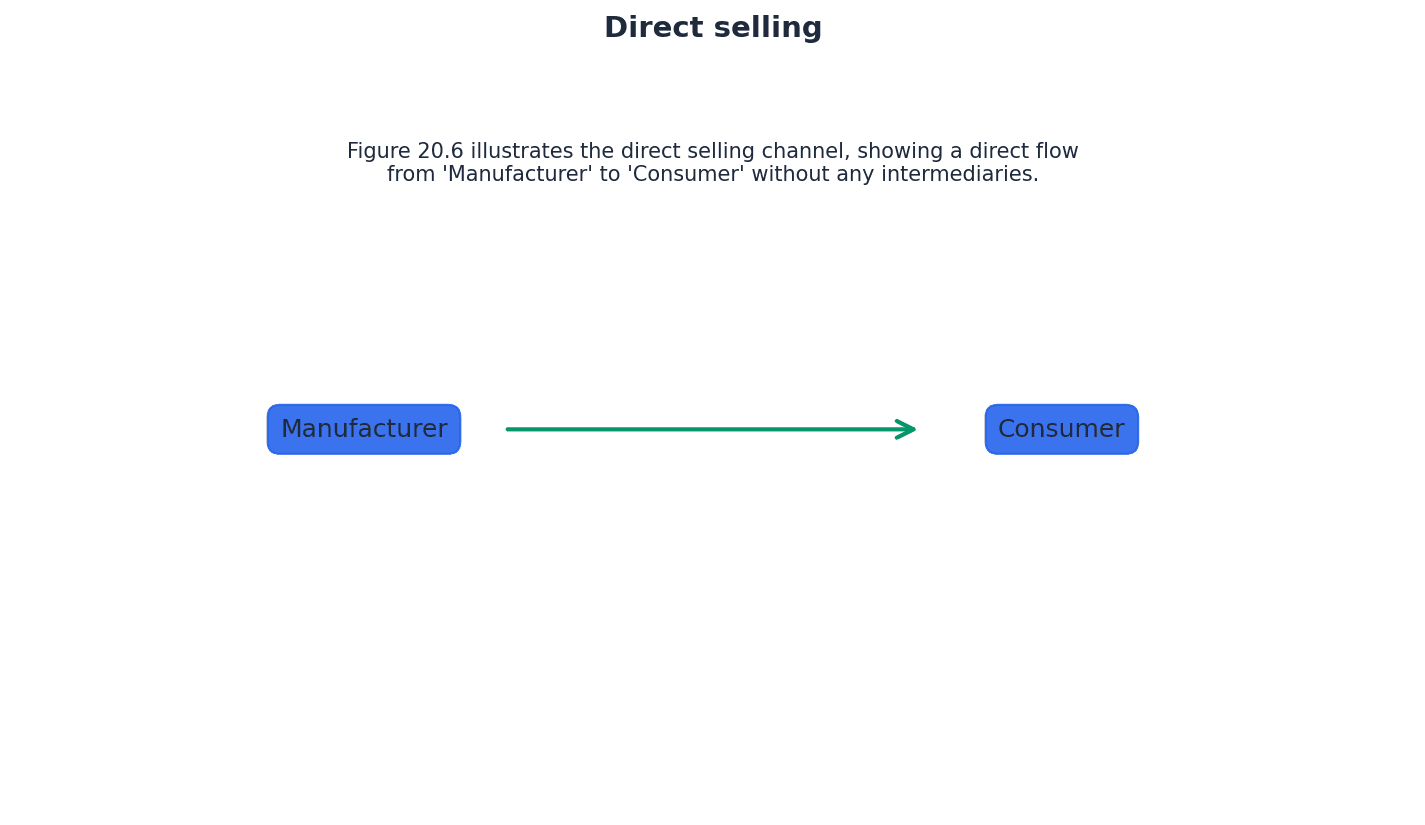
Single-intermediary channel — A channel of distribution where products flow from manufacturer to a single intermediary (like a retailer or agent) and then to the consumer.
This channel is common for consumer goods, especially with large retailers who manage their own storage and distribution. This is like buying a book from a large bookstore chain – the publisher sells to the bookstore, and the bookstore sells to you. Retailers incur inventory costs and provide display and after-sales service.
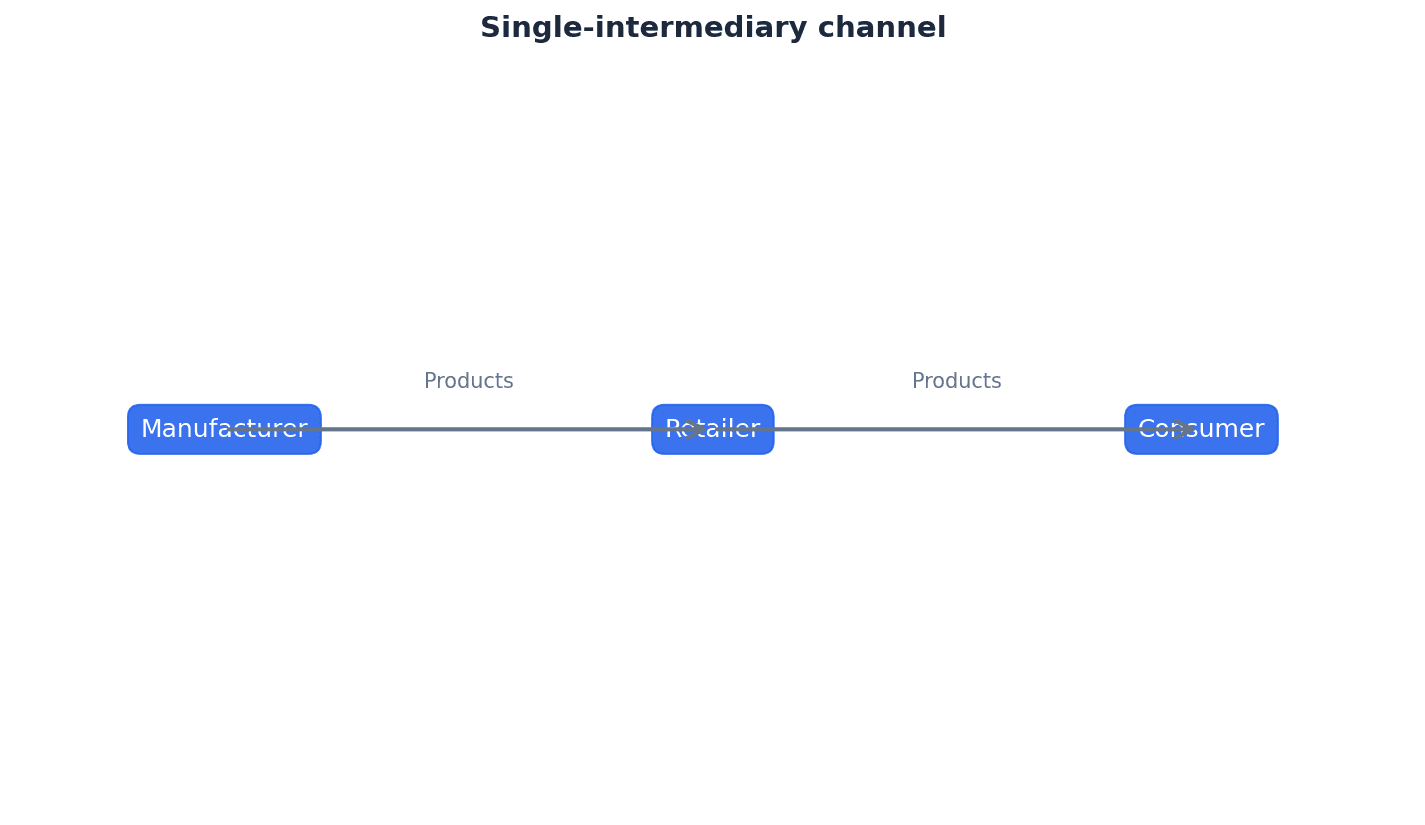
Two-intermediaries channel — A traditional channel of distribution where products move from manufacturer to wholesaler, then to retailer, and finally to the consumer.
Wholesalers buy in bulk from producers, reducing producers' inventory costs, and then sell in smaller quantities to retailers. This is like a small corner shop buying sweets from a wholesaler, who bought them from the manufacturer – there are two steps between the factory and your hands. This channel slows down the distribution chain and involves two profit mark-ups.
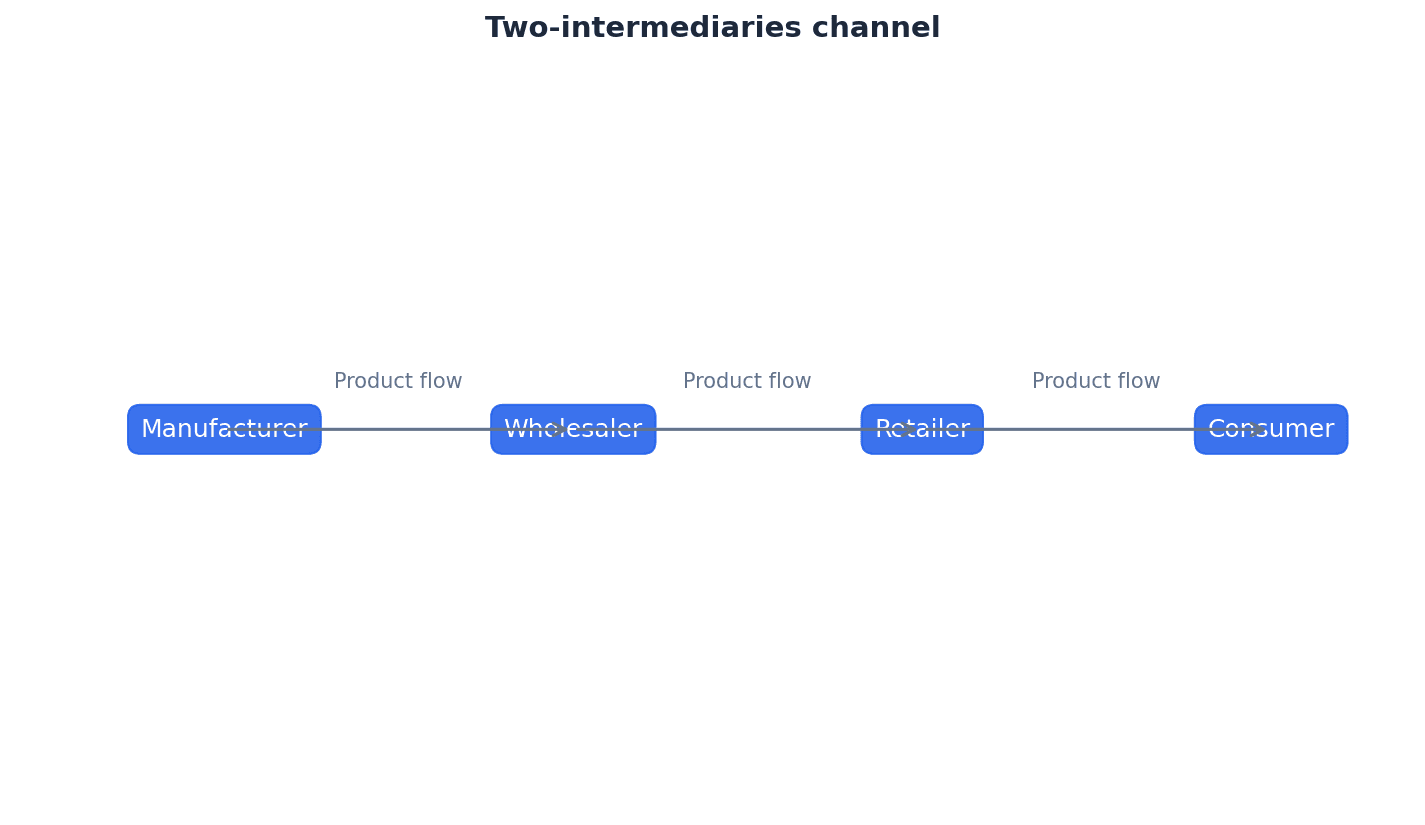
E-commerce — One of the fastest-growing ways of selling and distributing to customers, involving online marketing.
E-commerce offers worldwide reach, relatively low costs, and the ability to track customer data. E-commerce is like having a shop that's open 24/7 to the entire world, where customers can browse and buy from their couch. However, it faces limitations such as consumers' inability to physically inspect goods, potential return increases, and internet security concerns.
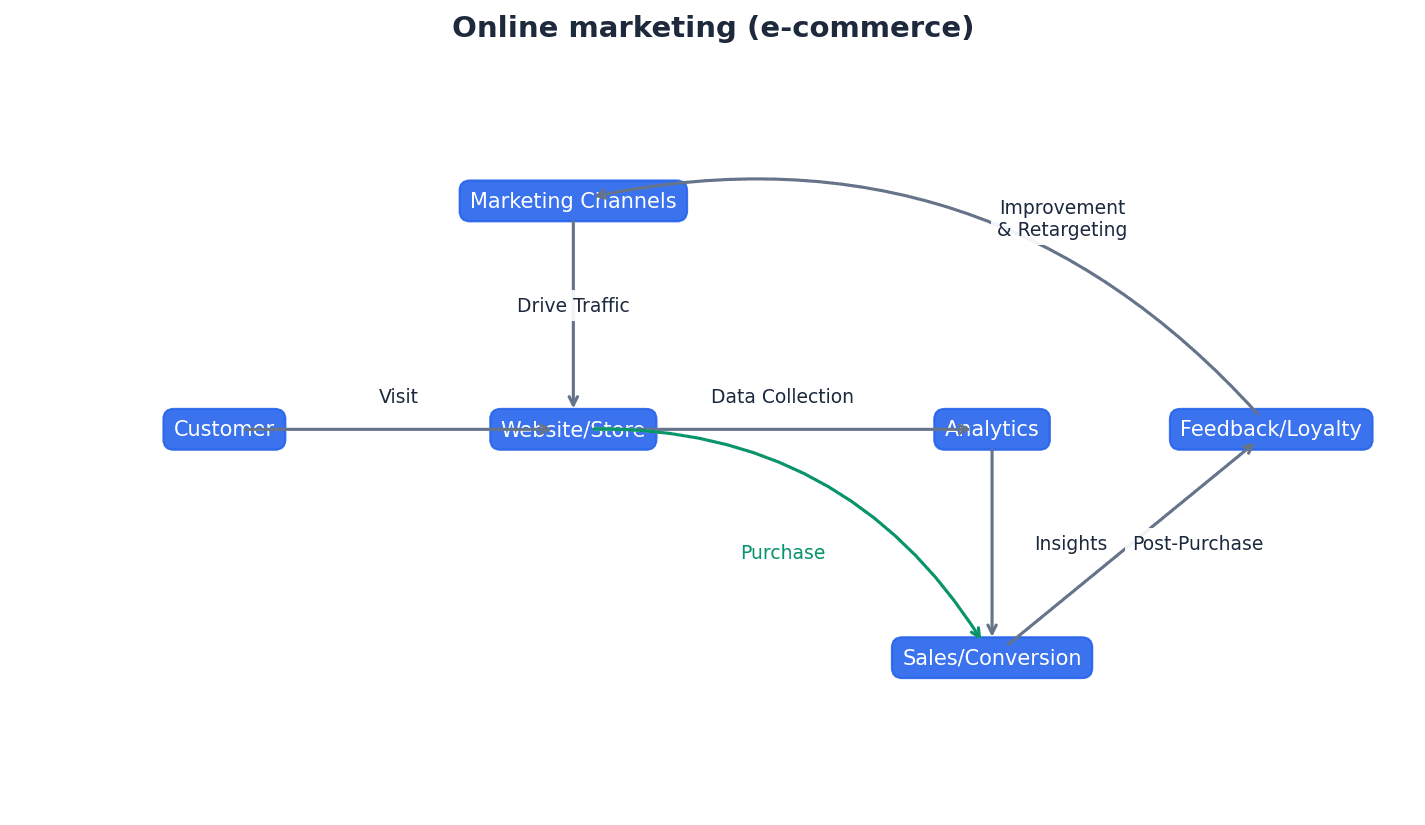
The selection of a distribution channel is influenced by several factors, including the nature of the product (e.g., perishable, bulky, complex), the size and geographical spread of the market, the desired level of control over the marketing mix, and the financial resources of the business. An integrated marketing strategy requires that promotion and place decisions work cohesively with product and price to achieve overall business objectives.
When recommending a distribution channel, analyse the factors influencing the choice. Explain WHY a direct channel might be better than using intermediaries for a particular product or business.
Show higher-level understanding by explaining how Promotion and Place decisions must be integrated with Price and Product for a coherent and effective marketing mix.
When discussing the promotion mix, always justify your choice of methods by linking them to the specific business context, product type, and target audience in the case study.
Advantages & Disadvantages
Digital Promotion
Direct Selling (Zero-Intermediary Channel)
Evaluation Starters
Essay Structure Guide
Introduction
Start by defining the marketing mix elements of promotion and place, and briefly outline their importance in achieving marketing objectives. State the main arguments you will present regarding the different methods and channels.
Conclusion
Summarise your main arguments, reinforcing the idea that promotion and place decisions must be integrated with the entire marketing mix for overall effectiveness. Provide a final, justified recommendation or conclusion based on the evaluation of the different methods and channels, considering the specific context of the question.
This chapter explores key marketing analysis tools, focusing on elasticity of demand to understand how changes in price, income, or promotion affect demand and business decisions. It also details the new product development process and the critical role of research and development, concluding with an examination of sales forecasting methods and their impact on various business functions.
price elasticity of demand (PED) — This relationship between price changes and the size of the resulting change in demand is known as price elasticity of demand (PED).
PED measures the responsiveness of demand to a change in price. A high PED indicates that demand is very sensitive to price changes, while a low PED indicates that demand is relatively insensitive. For example, if the price of a luxury car increases, people might easily choose not to buy it (elastic demand), but if the price of bread increases, people will likely still buy it because it's essential (inelastic demand).
Students often think that a negative PED value means demand is falling, but actually the negative sign simply indicates an inverse relationship between price and quantity demanded, and it is the numerical value (ignoring the sign) that determines elasticity.
inelastic demand — The percentage change in demand is less than the percentage change in price.
For products with inelastic demand, a price increase will lead to a smaller proportionate change in demand, resulting in an increase in total revenue. Conversely, a price reduction will lead to a smaller proportionate change in demand, reducing revenue. This is common for necessities or products with few substitutes, such as life-saving medicine where demand doesn't change much even if the price goes up significantly.
Students often think inelastic demand means demand doesn't change at all, but actually it means demand changes by a smaller proportion than the price change.
elastic demand — The percentage change in demand is greater than the percentage change in price.
For products with elastic demand, if the price is reduced, there will be a bigger proportionate increase in demand, leading to an increase in total revenue. If the price is increased, demand will fall by a greater proportion, reducing total revenue. This is typical for luxury goods or products with many substitutes, like a specific brand of smartphone where consumers might switch to a competitor if its price increases.
Students often think elastic demand means demand changes a little, but actually it means demand changes by a larger proportion than the price change.
product differentiation — All businesses attempt to increase brand loyalty with influential advertising and promotional campaigns, and by making their products more distinct.
This strategy aims to make a product stand out from competitors' offerings, often through unique features, branding, or marketing. Successful product differentiation can reduce price elasticity of demand, allowing businesses to charge higher prices and build stronger customer loyalty. For example, a unique coffee shop offering artisanal blends differentiates itself from a generic chain.
Students often think product differentiation is just about making a product look different, but actually it's about creating perceived value and uniqueness in the minds of consumers, which can be achieved through various aspects like quality, service, or branding.
Price elasticity of demand (PED)
The value is normally negative, but the numerical value (ignoring the minus sign) is important for interpretation. Businesses use PED to make informed pricing decisions and predict the impact of price changes on total revenue.
When calculating PED, remember to ignore the negative sign for interpretation, but always show it in your calculation. When evaluating, discuss both pricing decisions and wage increase decisions, linking them to revenue impacts.
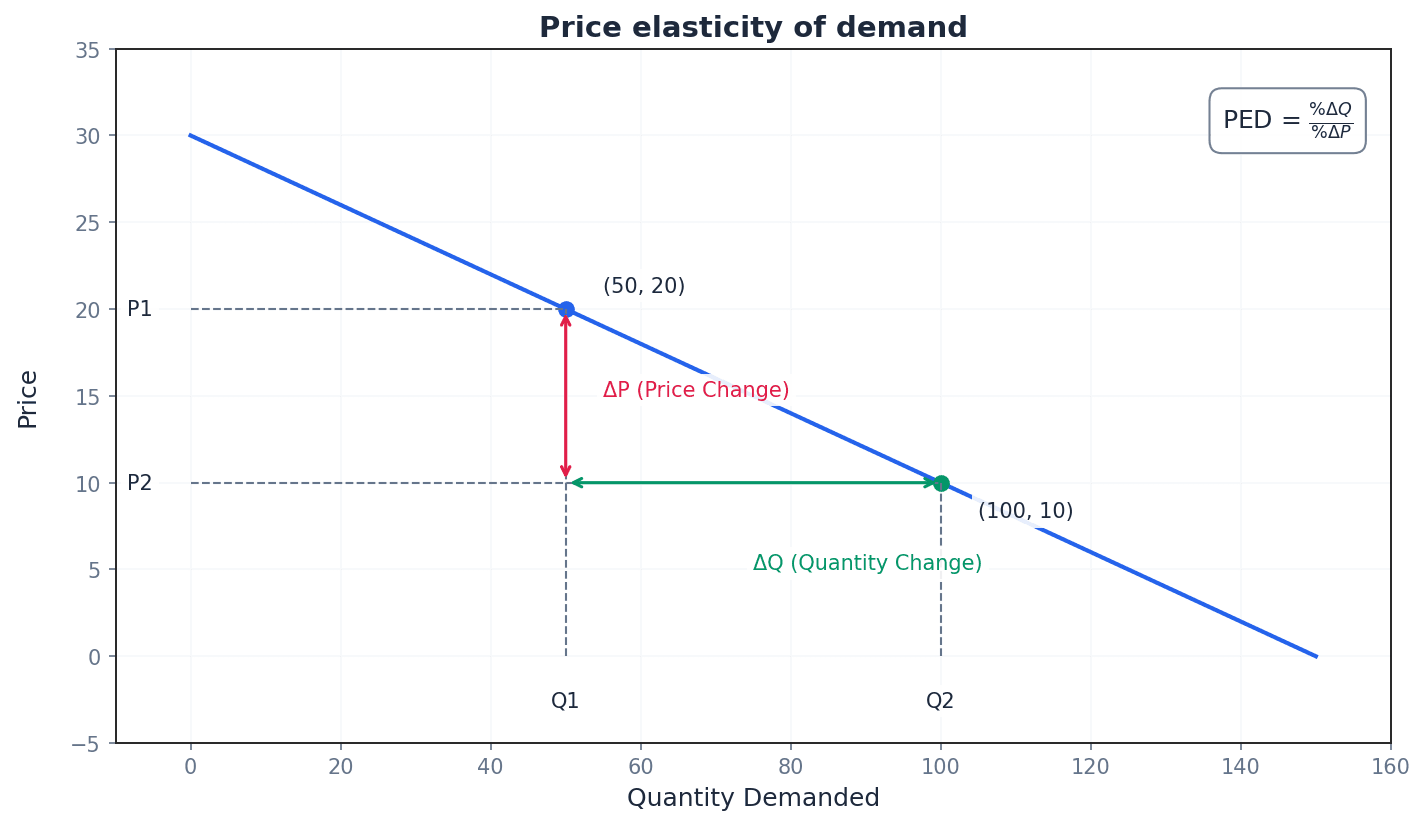
Understanding price elasticity of demand is crucial for businesses. For products with inelastic demand, a price increase will lead to a smaller proportionate change in demand, increasing total revenue. Conversely, for products with elastic demand, a price reduction will lead to a bigger proportionate increase in demand, also increasing total revenue. This knowledge guides pricing strategies to maximise revenue.
Income elasticity of demand
The sign (positive or negative) is important for interpretation (normal vs. inferior goods). This measures how demand responds to changes in consumer income.
inferior good — Quantity of demand for inferior goods rises as income falls, and falls when incomes rise.
Inferior goods are products for which demand decreases as consumer income increases, and vice versa. They typically have negative income elasticity of demand, meaning consumers switch to higher-quality or more expensive alternatives when their incomes improve. For example, when someone's income is low, they might buy a lot of instant noodles, but as their income rises, they might opt for more expensive, healthier meal options.
Students often think 'inferior' means poor quality, but actually it refers to how demand for the product changes in relation to consumer income, not necessarily its inherent quality.
normal good — It is referred to as a normal good.
Normal goods are products for which demand increases as consumer income increases, and decreases as consumer income falls. They have positive income elasticity of demand, reflecting the typical consumer behavior of buying more of most goods when they have more disposable income, such as new clothes or restaurant meals.
Students often confuse 'normal good' with 'necessity', but actually a normal good simply has positive income elasticity, while a necessity has a very low positive income elasticity.
Understanding income elasticity helps businesses anticipate how changes in economic conditions and consumer incomes will affect demand for their products. Businesses can use this information to adjust production levels, marketing strategies, and product portfolios, especially during periods of economic growth or recession. For instance, a business selling normal goods might expect increased sales during an economic boom.
Promotional elasticity of demand
The result is usually positive; a result above 1 indicates elastic demand, below 1 indicates inelastic demand. This measures the responsiveness of demand to changes in promotional spending.
Promotional elasticity of demand helps businesses assess the effectiveness of their advertising and promotional campaigns. A high promotional elasticity suggests that increased spending on promotion will lead to a proportionately larger increase in demand, making such campaigns cost-effective. Conversely, a low elasticity indicates that promotional spending has less impact on demand, prompting businesses to reconsider their marketing mix.
Students often assume that elasticity calculations are always accurate and relevant for future changes, but actually they quickly become outdated due to changing market conditions and other variables.
The new product development process is a systematic approach to bringing new products to market, crucial for innovation and maintaining competitiveness. It involves several distinct stages, from initial idea generation to the full-scale launch of the product, each designed to reduce risk and ensure commercial success.
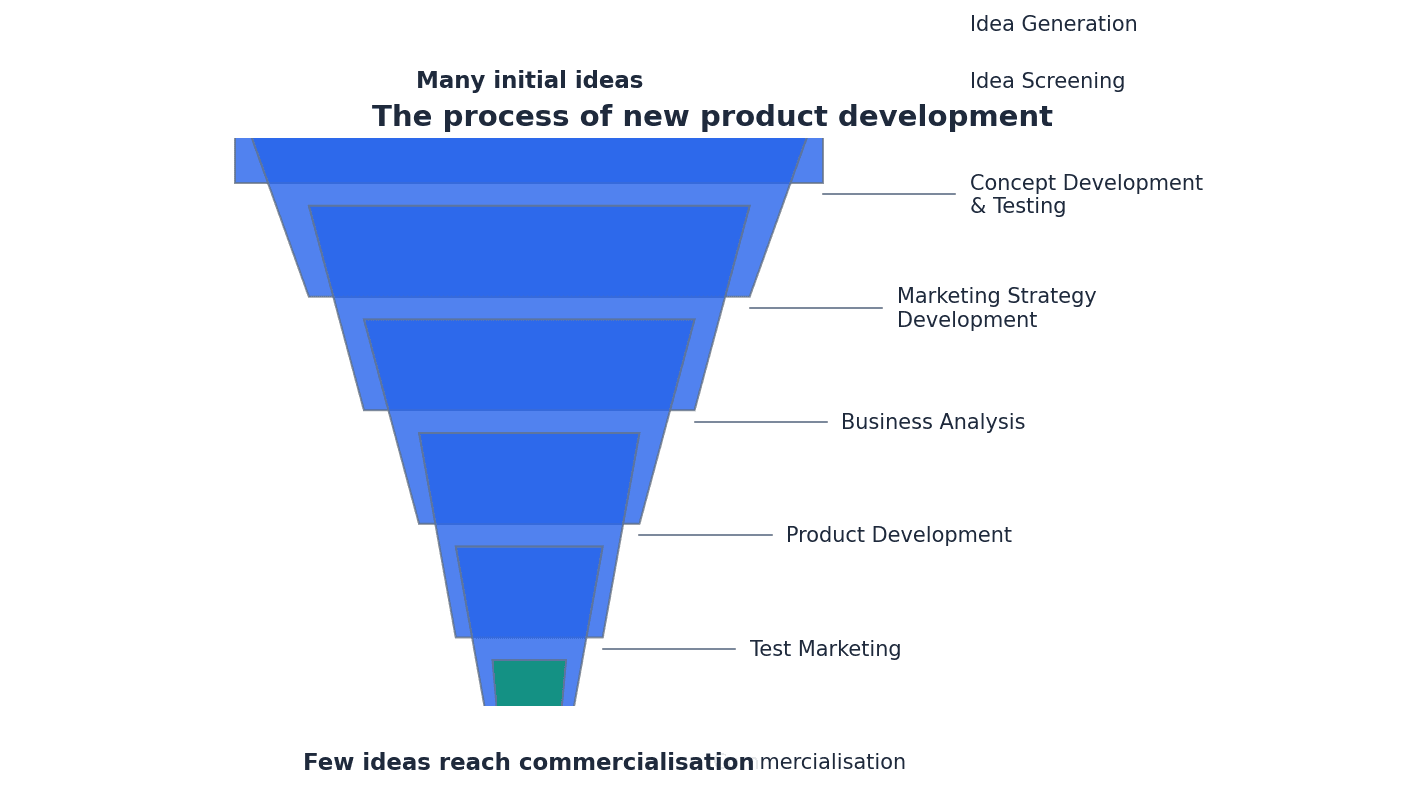
Generating new ideas — All new product innovations must start with an initial idea.
This is the first stage of new product development, where ideas for new products are sourced from various places such as R&D departments, market research, employees, sales staff, and brainstorming sessions. The goal is to gather a wide range of potential concepts before filtering them, much like brainstorming for a school project where all ideas are considered initially.
Students often think new ideas only come from R&D, but actually many valuable ideas can come from employees, market research, or even adapting competitors' products.
Idea screening — The purpose of this stage is to eliminate those ideas that stand the least chance of being commercially successful.
This second stage of NPD involves evaluating initial product ideas against criteria like consumer benefits, technical feasibility, and potential profitability. It's a crucial step to avoid wasting resources on developing unviable products, ensuring only promising ideas proceed, similar to a talent show audition where weak acts are quickly eliminated.
Concept development and testing — This stage takes the product idea a step further by asking key questions about what features the product should have, the likely cost of these to manufacture and who the consumers are likely to be.
In this third stage, the product idea is refined into a detailed concept, exploring specific features, benefits, target consumers, and manufacturing costs. Market research is often used to test consumer reactions to the concept before physical development begins, much like creating a detailed blueprint for a house and showing it to potential buyers for feedback.
Students often confuse concept testing with product testing, but actually concept testing focuses on the idea and its features, while product testing involves a physical prototype.
Business analysis — This stage considers the likely impact of the new product on the company’s costs, sales and profits.
The fourth stage of NPD involves a detailed financial and strategic assessment of the product concept. This includes estimating sales volume, market share, break-even points, financing needs, patent potential, and fit with the existing product mix, to determine its overall business viability, akin to creating a comprehensive business plan for a new venture.
Product testing — This is concerned with the technical performance of the product and whether it is likely to meet consumers’ expectations.
The fifth stage involves developing a prototype and testing its technical performance under typical-use conditions. Feedback from focus groups is gathered, and the product is adapted based on these results to ensure it meets both technical standards and consumer expectations, similar to test driving a prototype car in various conditions.
Test marketing — A small test market needs to be identified.
This sixth stage involves launching the product in a limited, representative market segment to observe actual consumer behavior and gather feedback before a full-scale launch. It helps reduce the risks and potential negative publicity associated with a product failing after a widespread introduction, much like releasing a new movie in a few selected cities first.
Commercialisation — This stage is the full-scale launch of the product.
The final stage of NPD, where the product is introduced to the entire target market, marking the introduction phase of the product life cycle. This involves implementing a full promotional strategy and ensuring widespread distribution to make the product available to consumers, similar to the grand opening of a new store.
Research and development (R&D) — This is a very expensive process and not all businesses will have a research and development (R&D) department.
R&D involves systematic investigation to create new products or processes, or to improve existing ones. It is crucial for innovation and maintaining competitiveness in many industries, but it is also a risky and costly investment with no guaranteed success, much like a scientist trying countless experiments to discover a new medicine.
Students often think R&D always leads to successful products, but actually many R&D projects fail to result in commercially viable innovations.
R&D is vital for businesses to innovate, gain competitive advantage, and potentially charge premium prices for unique products. However, it is a very expensive process with significant risks and no guarantee of success. The level of R&D expenditure by a business is influenced by factors such as industry competitiveness, available financial resources, and the potential for patent protection.
Sales forecasting is essential for businesses to plan production, manage inventory, allocate resources, and make informed financial decisions. It involves predicting future sales levels using both quantitative and qualitative techniques. Accurate forecasts help various business functions, from operations to human resources, to prepare effectively for future demand.
Extrapolation — It means basing future predictions on past results.
Extrapolation is a basic sales forecasting method that involves extending a trend line from past sales data into the future. It assumes that past sales patterns will continue unchanged, making it most effective for short-term forecasts in stable conditions, like drawing a straight line on a graph of past growth to guess future growth.
Students often assume extrapolation is always accurate, but actually its accuracy diminishes significantly over longer periods or when external factors change.
Time series analysis is a quantitative forecasting method that breaks down past sales data into components: trend, seasonal fluctuations, cyclical fluctuations, and random fluctuations. Moving averages are used within this method to smooth out short-term fluctuations and identify the underlying trend in sales data, which can then be used for forecasting.

trend — The quarterly moving average is known as the trend of the data.
In time series analysis, the trend represents the underlying long-term movement or direction of sales data, after seasonal, cyclical, and random fluctuations have been smoothed out. Identifying the trend helps in understanding the general growth or decline of sales over time, much like seeing the overall direction a river flows despite small ripples.
seasonal fluctuations — The difference between the actual sales and this trend must have been largely due to seasonal fluctuations.
Seasonal fluctuations are regular, predictable variations in sales that occur within a year, often linked to specific seasons, holidays, or times of the day/week. Identifying these helps businesses plan inventory, staffing, and promotions for specific periods, such as ice cream sales being higher in summer.
cyclical fluctuations — This method is more complex than simple graphical extrapolation. It allows the identification of underlying factors that are expected to influence future sales. These are: the trend, seasonal fluctuations, cyclical fluctuations, random fluctuations.
Cyclical fluctuations are longer-term, less predictable variations in sales that typically span several years, often linked to the overall economic business cycle (e.g., boom, recession). They are distinct from seasonal patterns as their periodicity is not fixed, similar to the ups and downs of the economy affecting big-ticket items.
Students often confuse cyclical fluctuations with seasonal fluctuations, but actually cyclical patterns are longer-term and less regular than seasonal ones, often tied to economic cycles.
random fluctuations — This method is more complex than simple graphical extrapolation. It allows the identification of underlying factors that are expected to influence future sales. These are: the trend, seasonal fluctuations, cyclical fluctuations, random fluctuations.
Random fluctuations are unpredictable, irregular variations in sales data caused by unforeseen events such as natural disasters, sudden changes in consumer tastes, or unexpected competitor actions. These are difficult to forecast and cannot be smoothed out by regular methods, like a sudden major news story impacting sales.
Qualitative sales forecasting methods rely on expert judgment and opinions rather than historical data. These methods are particularly useful when historical data is scarce, for new products, or in rapidly changing markets. They offer insights that quantitative methods might miss, though they can be subjective.
Sales force composite — An overall sales forecast can be obtained by asking all sales staff for their individual estimates of future sales to their customers and then adding these estimates together.
This qualitative forecasting method gathers sales predictions directly from sales representatives, who have close contact with customers and market trends. It is quick and cheap but may lack awareness of broader economic factors or be influenced by sales staff optimism, like asking each salesperson for their individual car sales estimates.
Delphi method — With the Delphi method, a facilitator collects opinions from a panel of experts who are sent detailed questionnaires asking for their judgement about possible future events, such as demand levels or technology changes that could affect consumer taste and demand levels.
This qualitative forecasting technique involves collecting and refining opinions from a panel of anonymous experts through multiple rounds of questionnaires. Summarized results from each round are fed back to the experts, encouraging them to revise their forecasts towards a consensus, leading to more accurate predictions, similar to anonymous judges refining scores.
Jury of experts — The jury of experts uses senior managers within the business, who meet and develop forecasts based on their knowledge of their specific areas of responsibility.
Also known as the jury of executive opinion, this qualitative method involves senior managers within a business meeting to combine their collective knowledge and experience to develop sales forecasts. It is quicker and cheaper than the Delphi method but may lack external market perspectives, like a company's top executives pooling knowledge to set sales targets.
Link forecasting to specific business decisions. Explain HOW a sales forecast impacts decisions in operations (production levels), finance (cash flow budgets), and HR (staffing levels).
Evaluate the limitations of the data provided. For sales forecasting, always mention that quantitative methods rely on past data and may not predict the future accurately if market conditions change.
In NPD questions, don't just list the stages. Explain the purpose of each stage in reducing the risk of a failed product launch, for example, 'Test marketing provides real-world sales data before a costly national launch'.
For elasticity calculations, always state the formula, show your working, and then interpret the result in the context of the business. E.g., 'PED is -0.4 (inelastic), so the business can increase price to raise total revenue'.
Advantages & Disadvantages
New Product Development (NPD) Process
Research and Development (R&D)
Evaluation Starters
Essay Structure Guide
Introduction
Begin by defining the key terms from the question (e.g., elasticity of demand, new product development, sales forecasting) and briefly outlining the scope of your answer. State your overall argument or stance.
Conclusion
Summarise your main arguments, reiterating the importance of marketing analysis tools for business decision-making. Provide a final, balanced judgment on the overall effectiveness and limitations of these tools, perhaps suggesting that a combination of methods is often most effective.
This chapter explores the critical role of planning a coordinated and consistent marketing strategy, linking it directly to clear marketing objectives. It details the components of a comprehensive marketing plan, including situational analysis and budget, and assesses the benefits and limitations of such planning. The chapter also examines the transformative impact of IT and AI on marketing decisions and data analysis, alongside evaluating strategies for entering international markets, contrasting pan-global marketing with global localisation.
Marketing planning — The process of developing an appropriate marketing strategy.
This involves setting marketing objectives, conducting situational analysis, defining the marketing strategy and mix, and allocating a budget. Like creating a detailed travel itinerary before a big trip, marketing planning outlines where the business wants to go (objectives), how it will get there (strategy), and what resources it needs (budget). It is a continuous process that helps businesses achieve their goals.
Students often think marketing planning is a one-off event. Remember that it is actually a continuous strategic planning cycle that involves regular review and adaptation.
Marketing objectives — Specific, measurable, achievable, relevant, and time-bound goals that marketing strategies aim to achieve.
These objectives provide focus for the marketing plan and allow for monitoring of progress. They can be expressed in terms of sales levels, market share, sales growth, or profit margins. If a football team's overall mission is to win the league, a marketing objective might be to win the next three games by a certain margin, providing a clear, short-term target.
Students often think marketing objectives are just general aims. Remember that they must be SMART (Specific, Measurable, Achievable, Relevant, Time-bound) to be effective for monitoring and evaluation.
When evaluating marketing strategies, always link them back to how they help achieve specific, measurable marketing objectives. Different objectives require different strategies.
Marketing strategy — The overall plan of action to be taken to achieve the marketing objectives.
This involves decisions on approaches like mass or niche marketing, selling to existing or new markets, and developing new markets. If marketing objectives are the destination, the marketing strategy is the chosen route (e.g., highway, scenic backroads) to get there, influencing all subsequent travel decisions. It guides the specific tactics of the marketing mix.
Students often think marketing strategy is just about promotion. Remember that it encompasses the broader approach to achieving objectives, including product, price, and place decisions.
Planning a marketing strategy is crucial for businesses to achieve their goals. It involves developing a detailed marketing plan that outlines the strategy to achieve SMART objectives, including situational analysis, the marketing mix, budget, and timescale. An effective marketing strategy must be coordinated, ensuring all elements work together, consistent, reinforcing the brand message, and focused on a specific target market to maximise impact.
When asked to 'analyse' the importance of marketing planning, ensure you explain how each stage (e.g., setting SMART objectives, market research) contributes to reducing risk and achieving business goals.
A comprehensive marketing plan typically includes a purpose and mission statement, a situational analysis based on market research, clearly defined marketing objectives, the chosen marketing strategy, and the specific marketing mix (Product, Price, Place, Promotion). It also details the marketing budget, an executive summary, and a timescale for implementation. Reviewing the marketing plan is a continuous process, allowing for adaptation to changing market conditions and ensuring ongoing relevance.
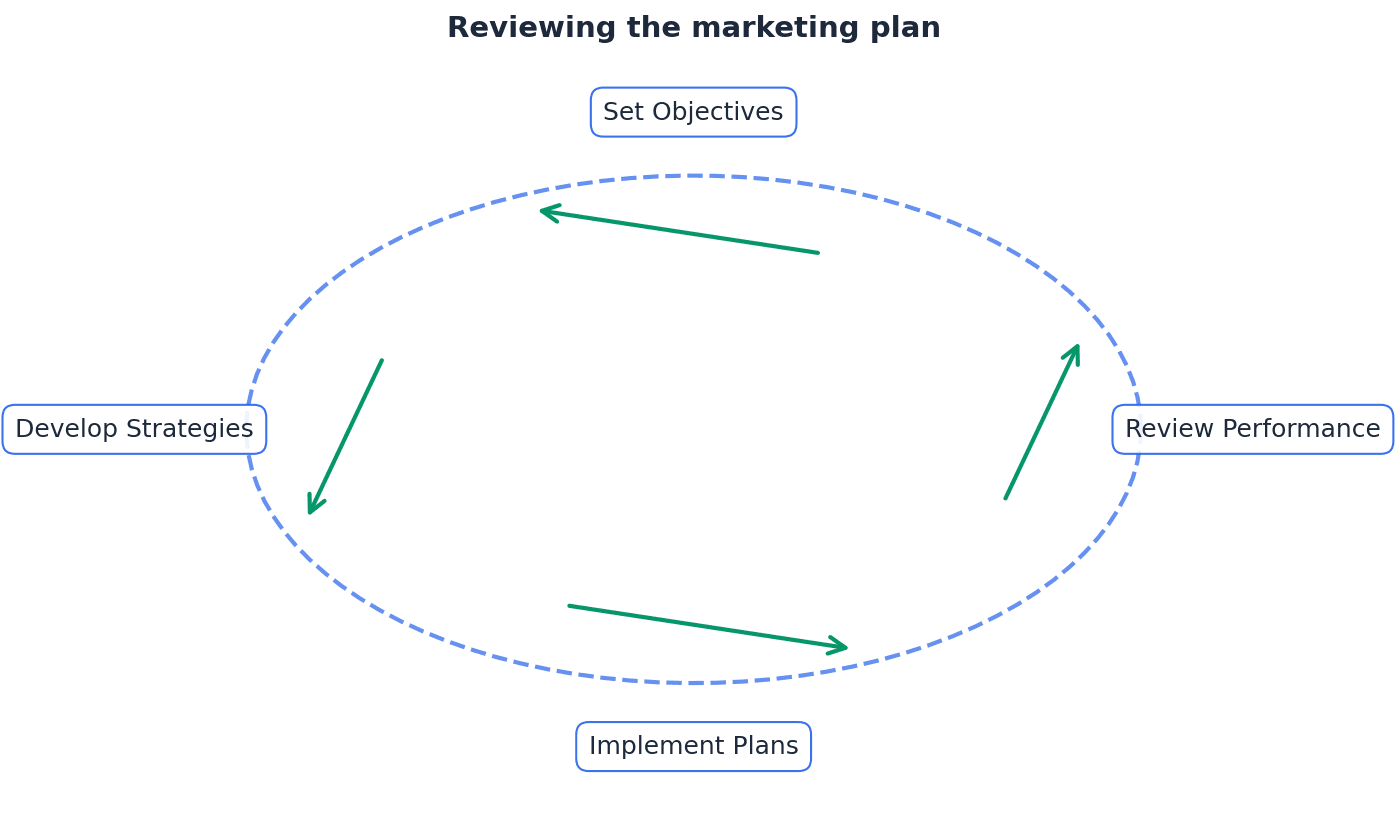
Information Technology (IT) and Artificial Intelligence (AI) are transforming marketing by enhancing data analysis, personalisation, and predictive modelling. IT applications facilitate market research and customer relationship management, while AI can be used for predictive analytics to forecast customer demand, employ chatbots for 24/7 customer service, and automate targeted advertising. However, limitations include the cost of implementation, data privacy concerns, and the potential for algorithmic bias.
In questions about IT/AI, give specific examples. Instead of 'improves data analysis', say 'uses predictive analytics to forecast customer demand' or 'employs AI chatbots for 24/7 customer service'.
Globalisation — The increasing interdependence of world economies as a result of the growing scale of cross-border trade of commodities and services, flow of international capital and wide and rapid spread of technologies.
This process has accelerated due to reduced trade barriers and the growth of multinational companies, leading to increased international trade and freer movement of capital and workers. Imagine the world as a single, interconnected marketplace where goods, services, money, and even people can move more freely, rather than many separate national markets.
Students often think globalisation only benefits large multinational corporations. Remember that it also creates opportunities for smaller businesses to access new markets and cheaper resources, though it also increases competition.
Globalisation has made international marketing increasingly important for businesses seeking new sales opportunities and economies of scale. When entering international markets, businesses must identify and select appropriate markets, considering economic, legal, and cultural differences, as well as differences in business practices. The choice of international marketing strategy typically falls into two main approaches: pan-global marketing or global localisation.
Use the CLES framework (Cultural, Legal, Economic, Social) to structure your analysis of the challenges and opportunities of entering a new international market.
Pan-global marketing strategy — A marketing strategy that adopts standard products, brand messages and promotional campaigns across the whole world or major parts of it.
This approach treats the entire world as a single market, aiming for cost reductions through economies of scale and establishing a consistent global brand identity. It assumes reducing differences in consumer tastes. Like a global fast-food chain selling the exact same burger, with the same branding and advertising, in every country, regardless of local preferences.
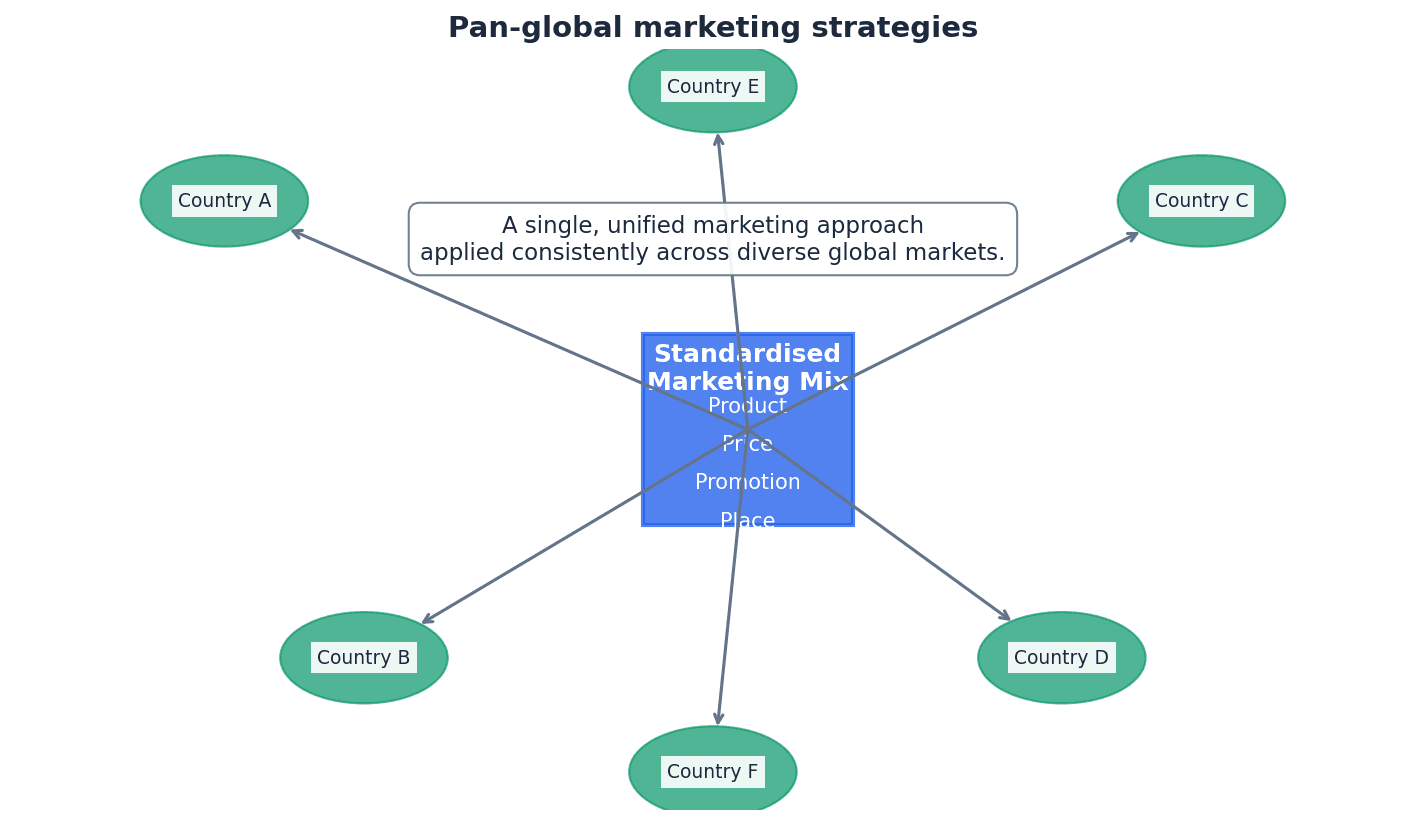
Students often think pan-global marketing means no adaptation at all. Remember that some minor adjustments might still be made, though the core product and message remain standardised.
Global localisation — An approach to international marketing that adapts a global marketing mix to suit local needs and conditions, often summed up as 'Thinking global – acting local'.
This strategy recognises that substantial differences still exist in consumer needs across countries, leading to modifications in product, price, promotion, and place to appeal to specific local markets. A global coffee chain offering different local pastries and coffee blends in each country, while maintaining its core brand identity and service standards, exemplifies this approach.
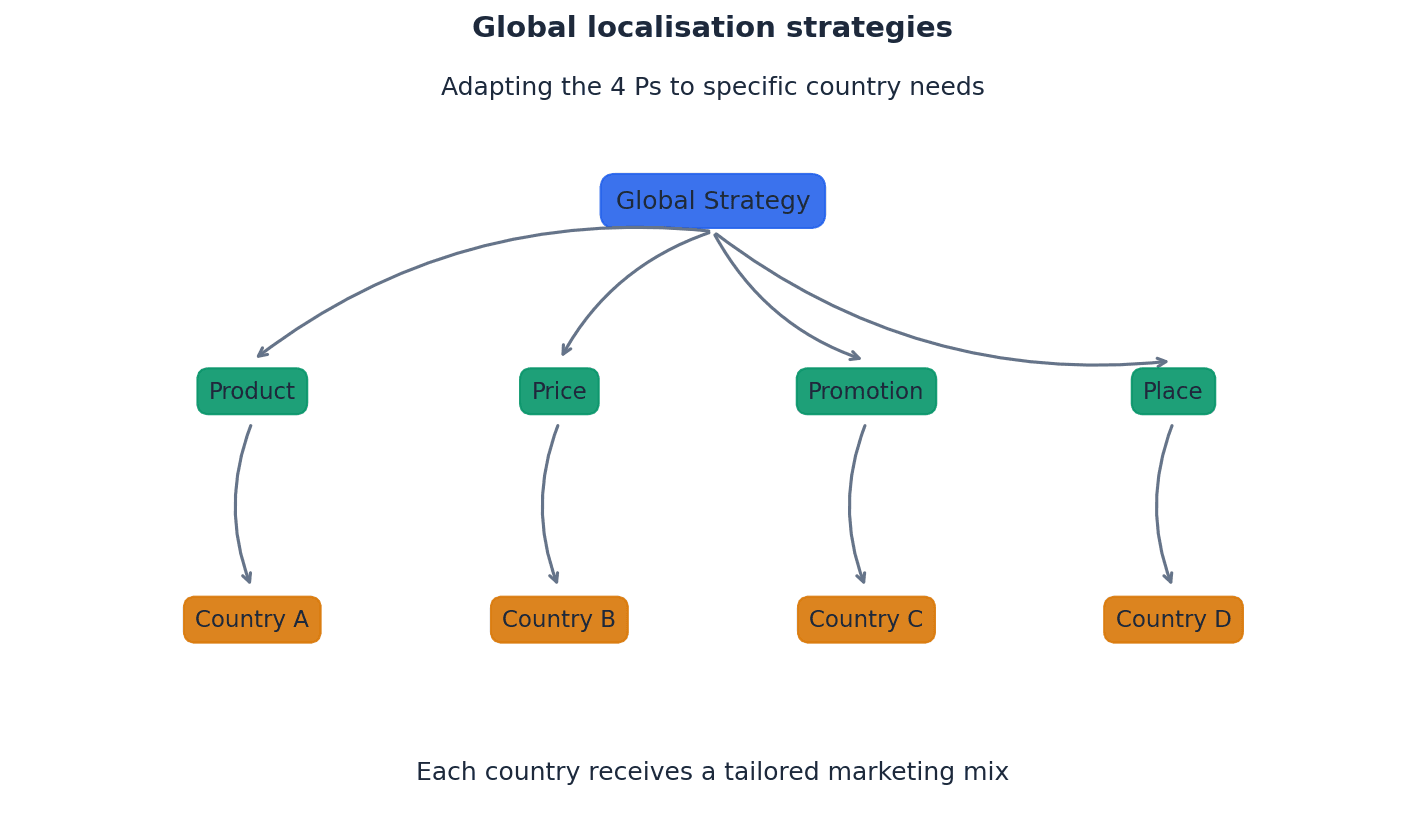
Students often think global localisation means completely different marketing in every country. Remember that it involves adapting specific elements of a global strategy while retaining some overarching brand consistency.
When evaluating pan-global strategies, consider the trade-off between cost savings from standardisation and the potential loss of market share due to failure to meet local cultural or legal requirements.
When recommending a global localisation strategy, ensure you justify which elements of the marketing mix (product, price, promotion, place) would need adaptation and why, referencing specific cultural, economic, or legal factors.
Businesses can enter international markets through various methods, each with different levels of risk, control, and profit potential. These include exporting products, international franchising, joint ventures, licensing agreements, and direct investment in foreign subsidiaries. The selection of the most appropriate method depends on factors such as the business's resources, risk appetite, and the specific characteristics of the target market.
When recommending an international entry method, justify your choice by analysing the trade-off between risk, control, and profit potential in the context of the specific business in the case study.
For evaluation questions, provide a balanced argument and a justified conclusion. For example, weigh the cost-saving benefits of a pan-global strategy against the potential for higher sales from global localisation.
Advantages & Disadvantages
Marketing Planning
Pan-global Marketing Strategy
Evaluation Starters
Essay Structure Guide
Introduction
Begin by defining key terms such as marketing strategy and marketing objectives. Briefly outline the importance of planning and coordination in achieving business goals, and state your overall argument or stance on the question.
Conclusion
Summarise your main arguments, reiterating the importance of a well-planned, coordinated, and consistent marketing strategy. Provide a final, justified conclusion that directly answers the essay question, weighing the various factors discussed and offering a nuanced perspective.
This chapter introduces operations management, focusing on the transformational process of converting inputs into outputs to add value. It differentiates between production and productivity, and efficiency and effectiveness, highlighting their importance for business success. The chapter also explores various production methods and the growing importance of sustainability in operations.
Operations management — Operations management is concerned with the use of resources called inputs (factors of production) – land, labour and capital – to provide outputs in the form of goods and services.
This involves planning, organising, and overseeing the processes to convert inputs into outputs efficiently and effectively. The goal is to produce goods and services of the required quality and quantity, at the right time, and in the most cost-effective way, ultimately aiming for added value. Think of a chef in a restaurant: operations management is everything from ordering ingredients (inputs), preparing the food (transformational process), to serving the meal (output) while ensuring quality and speed.
Factors of production — Factors of production are the resources or inputs required for all business operations.
These fundamental resources are typically categorised as land, labour, capital, and enterprise. Their effective management is crucial for the transformational process to create goods and services. Imagine building a house: the land is where it stands, the labourers are the builders, the capital is the tools and machinery, and the enterprise is the architect and project manager coordinating everything.
Students often believe 'capital' only refers to money, rather than physical assets like machinery and equipment. Remember that in business operations, capital refers to physical assets like machinery and equipment.
When asked to 'explain' operations management, ensure you mention inputs, transformational process, outputs, and the objective of added value.
Transformational process — The transformational process is the way businesses change factors of production into finished goods.
This process involves converting inputs (resources) into outputs (goods and services) through various operational stages. The aim is to add value, meaning the finished products are sold for a higher value than the cost of the inputs. It's like baking a cake: the ingredients (flour, sugar, eggs) are inputs, the mixing and baking are the transformational process, and the finished cake is the output, which is worth more than the raw ingredients.
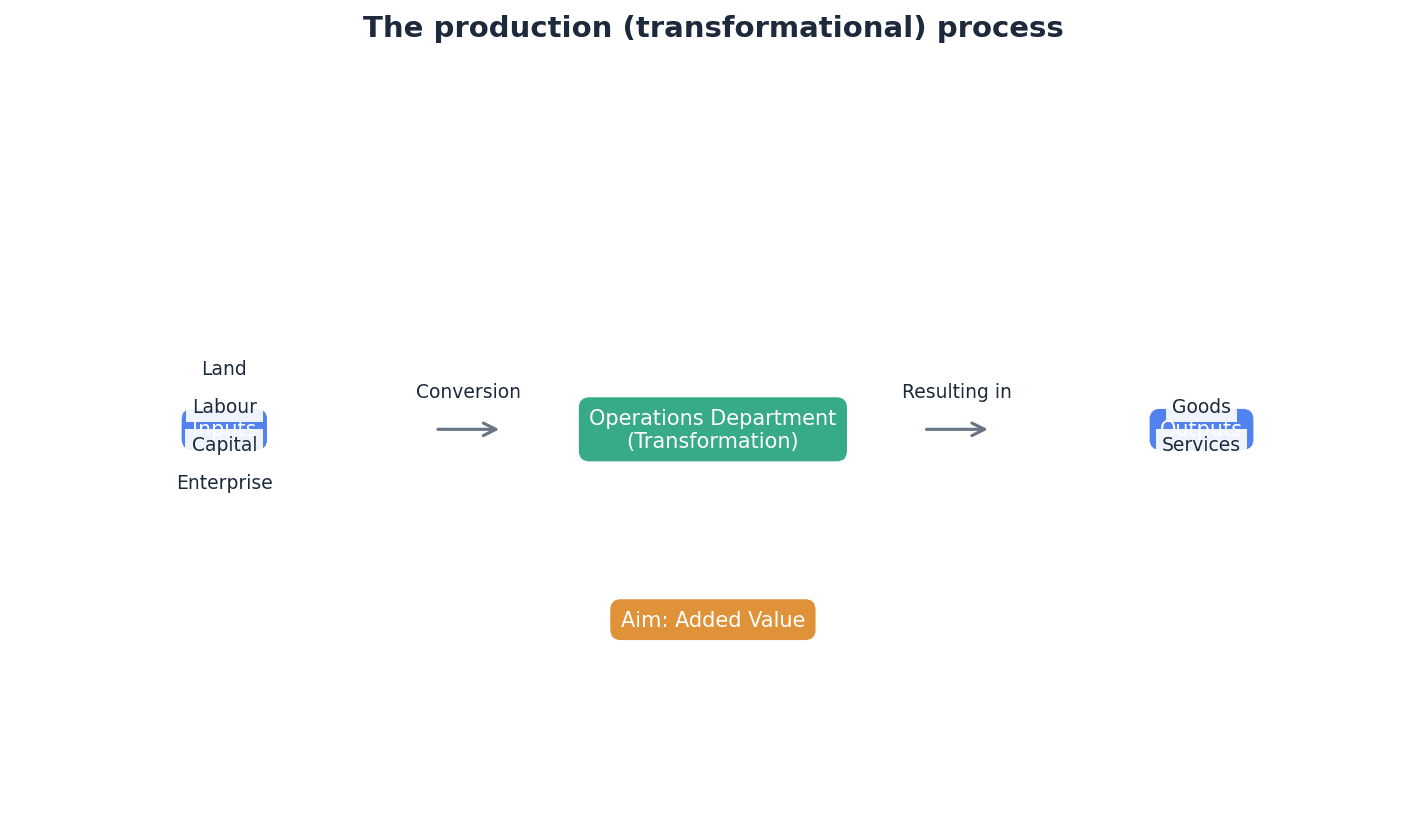
Added value — Added value means selling the finished products for a higher value than the cost of the inputs.
This is a key objective of operations, achieved by managing efficiency, quality, flexibility, and innovation. It can also be influenced by product design and branding, which encourage consumers to pay more. Buying raw coffee beans for 5 means you've added $4 of value through processing, branding, and service.
When defining 'transformational process', explicitly mention the conversion of inputs into outputs and the objective of added value.
Production — Production means the making of tangible goods, such as computers, and the provision of intangible services, such as banking.
It refers to the overall activity of creating goods and services. The level of production is an absolute measure of the quantity of output produced in a given period. If a factory makes 100 cars in a day, that's its level of production. It's simply the total amount made.
Productivity — Productivity is a relative measure concerned with how efficiently inputs are converted into outputs.
It is a crucial factor determining competitiveness, as raising productivity reduces the average cost per unit of output. This can allow a business to reduce prices or increase profit margins. If one baker makes 100 loaves of bread in an hour and another makes 150 loaves in an hour with the same resources, the second baker has higher productivity.
Students often confuse 'production' (total output) with 'productivity' (efficiency of output per input). Remember that production is the total output, while productivity measures the efficiency of input conversion.
Labour productivity
Measures the efficiency of labour input; higher values indicate greater efficiency. Used to compare performance over time or between businesses.
Distinguish clearly between 'production' (total output) and 'productivity' (efficiency of output per input) in your answers to avoid losing marks.
Productivity is vital for business success as it directly impacts competitiveness. By raising productivity, businesses can reduce the average cost per unit of output, which in turn allows them to either lower prices to gain market share or increase profit margins. This efficiency in converting inputs to outputs is a key driver for long-term viability.
Efficiency — Efficiency is measured by productivity, indicating how well resources are used to produce output.
It focuses on minimising waste and costs in the production process. A business is efficient if it produces goods or services at the lowest possible unit cost. An efficient car uses less fuel to travel the same distance, just as an efficient factory uses fewer resources to produce the same number of goods.
Effectiveness — Effectiveness is achieved only if the customer’s needs are met.
It means meeting objectives beyond just operational efficiency, specifically satisfying customers' needs profitably. For long-term success, effectiveness is more important than just producing at the lowest unit cost. An efficient baker might make bread very cheaply, but if customers prefer cakes, then making bread is not effective for meeting market demand.
Students often think 'efficiency' (doing things right) is the same as 'effectiveness' (doing the right things, meeting customer needs). Remember that efficiency is about 'doing things right' (low cost), while effectiveness is about 'doing the right things' (meeting customer needs).
When evaluating efficiency, link it directly to cost reduction, waste minimisation, and productivity improvements. Avoid using it interchangeably with effectiveness.
While efficiency focuses on optimal resource use and cost minimisation, effectiveness ensures that the products or services actually meet customer needs and business objectives. Both are crucial for business success; a business can be highly efficient but ineffective if it produces goods that no one wants. Therefore, the most successful businesses achieve both: they make a product customers want (effective) using the minimum resources possible (efficient).
Sustainability — Sustainability refers to businesses cleaning up their operations and minimising their impact on future generations.
This involves reducing energy use, carbon emissions, and the use of non-biodegradable materials, as well as using recycled materials and manufacturing recyclable products. It addresses growing global concerns about pollution and climate change. Think of a reusable water bottle instead of single-use plastic bottles; the reusable bottle is a more sustainable choice because it reduces waste and resource consumption over time.
Students often assume sustainability is solely an environmental issue, overlooking its economic and social dimensions. Remember that it also encompasses economic viability and social equity, ensuring long-term business and societal well-being.
When evaluating sustainability, consider both the benefits (e.g., improved brand image, cost savings) and potential limitations (e.g., high initial investment, impact on competitiveness) for a business.
Labour intensive — Labour intensive production relies heavily on human workers rather than machinery.
This approach is common in small businesses producing specialist, customised products. It offers interesting work and low machine costs but can result in low output levels and product quality dependent on individual worker skill. A bespoke tailor making a custom suit by hand is labour intensive, as opposed to a factory mass-producing suits with machines.
Capital intensive — Capital intensive production relies heavily on machinery and equipment rather than human labour.
This method is used for mass-produced goods, offering economies of scale, consistent quality, and low unit costs. However, it involves high fixed costs, financing costs, and maintenance, and is susceptible to technological obsolescence. An automated car manufacturing plant with robots on the assembly line is capital intensive, requiring significant investment in machinery.
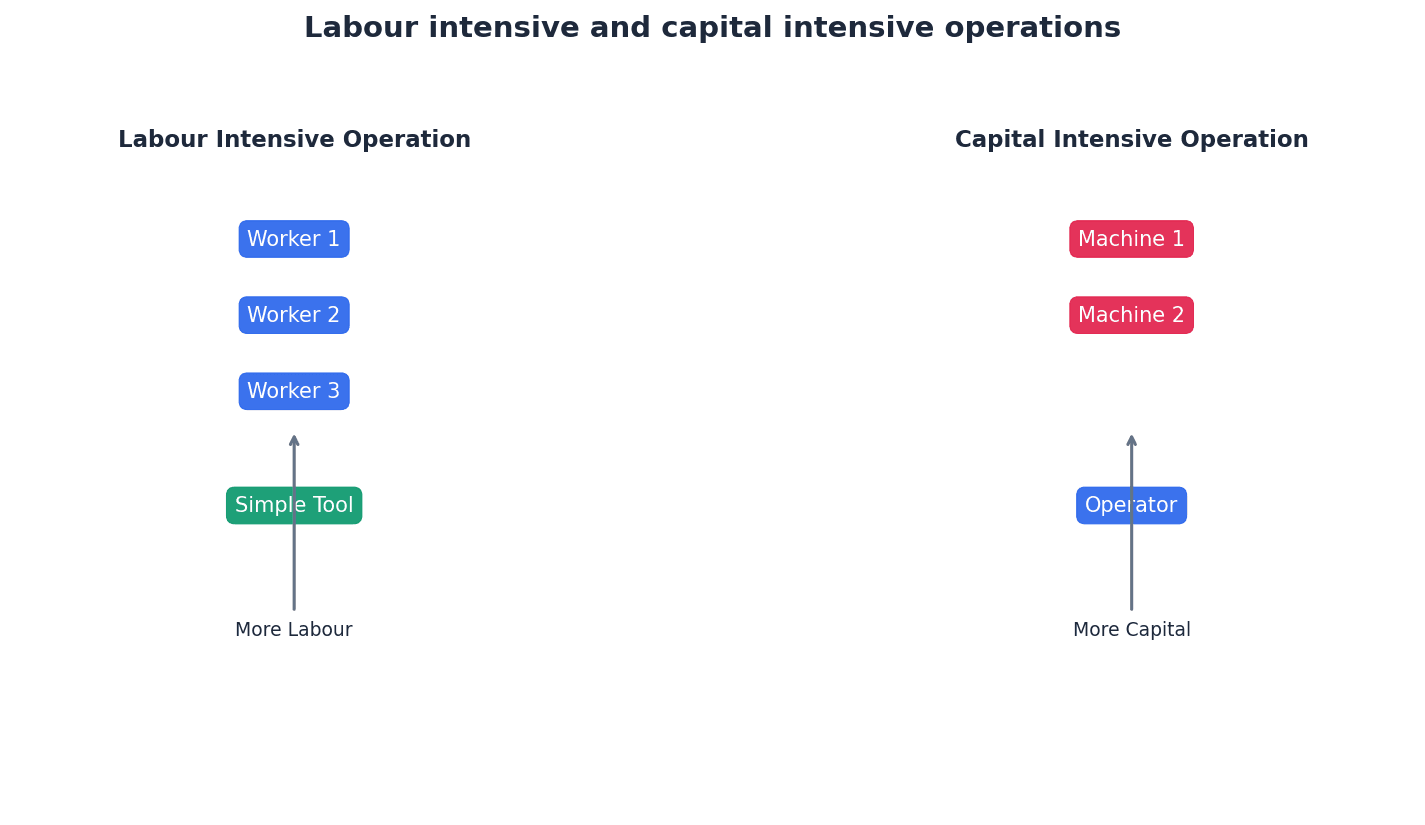
When evaluating labour intensive operations, discuss both the advantages (e.g., flexibility, customisation) and disadvantages (e.g., high unit costs, skill dependency) in relation to the product's nature.
The choice between labour-intensive and capital-intensive operations depends heavily on the nature of the product, the scale of production, and the desired level of customisation. Labour-intensive methods are suitable for unique, high-value products where human skill is paramount, while capital-intensive methods are ideal for standardised products requiring high volume and consistent quality. Each approach presents distinct trade-offs in terms of costs, flexibility, and output.
Job production — Job production is used for the production of single, one-off products, which are often unique.
Each individual product is completed before the next is started, making it often labour intensive and expensive. It allows for specialised products and can be motivating for workers who take pride in producing the whole item. A custom wedding cake baker uses job production, creating each cake uniquely for a specific client.
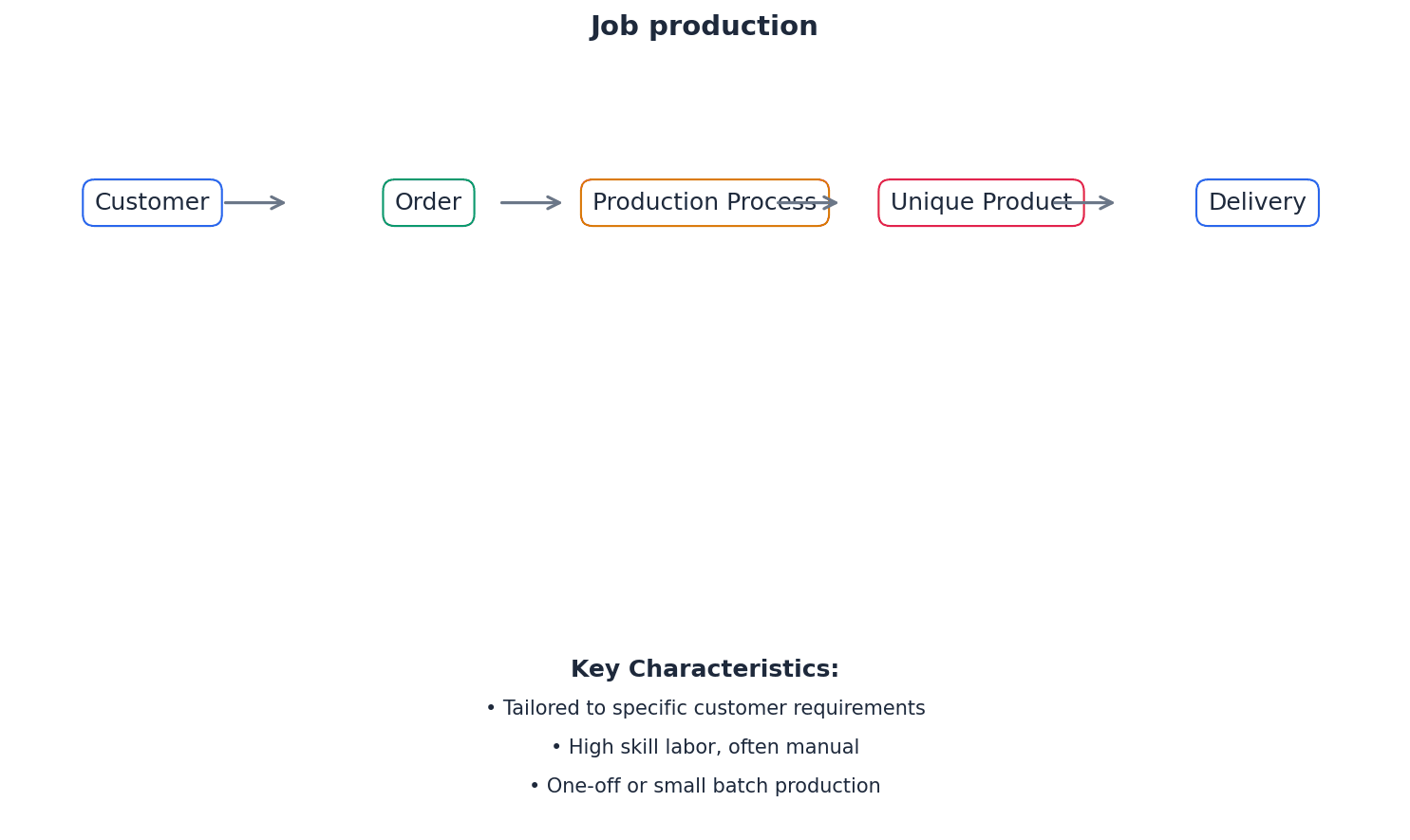
Batch production — Batch production involves the production of identical products in groups, where all units in a batch go through each production stage together before moving to the next.
This method allows for some economies of scale and division of labour, and batches can be easily altered to match demand. However, it can lead to high work-in-progress inventory and requires cleaning/adjusting machinery between batches. A bakery making 500 identical bread rolls at once uses batch production; all rolls are mixed, then shaped, then baked together.
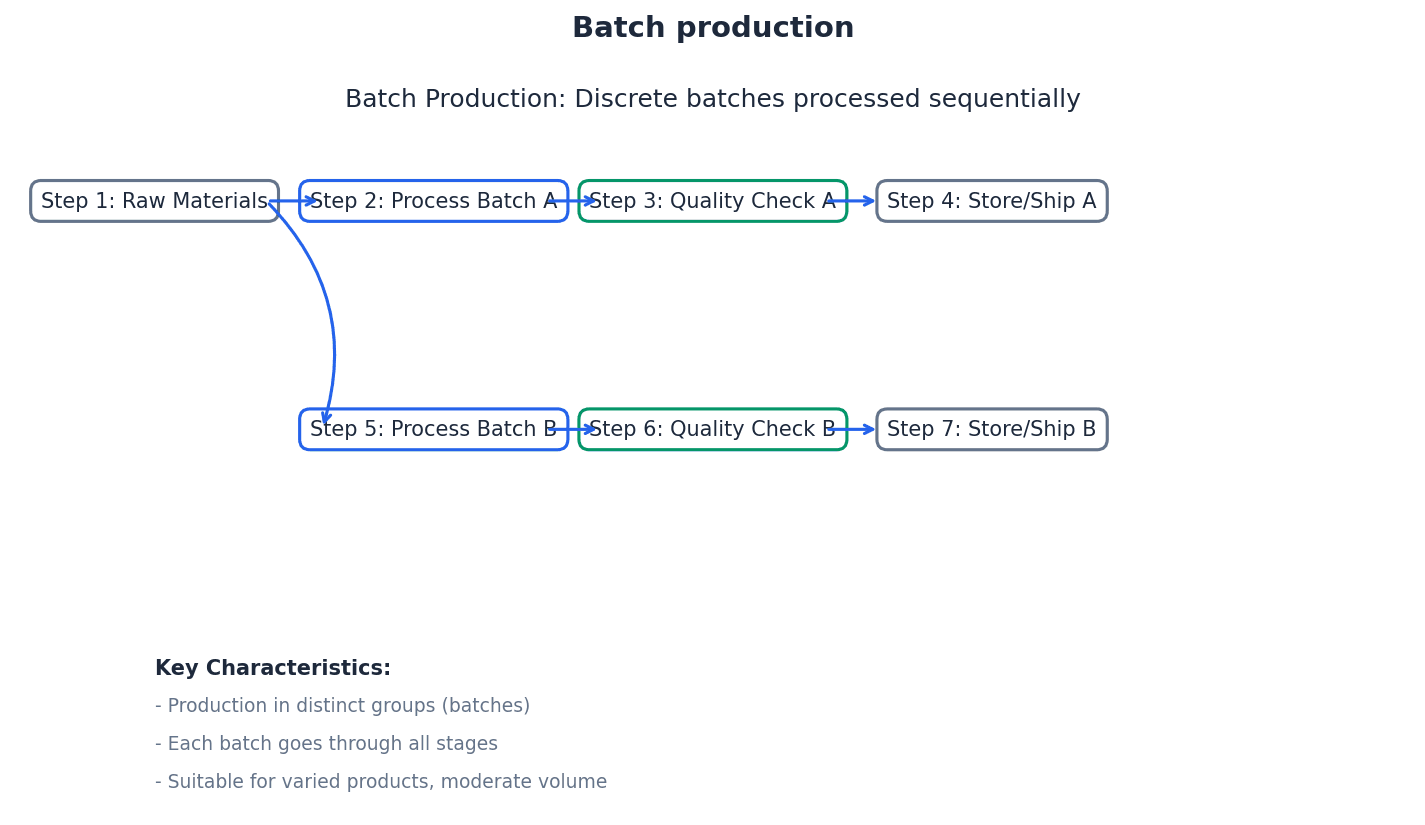
Flow production — Flow production is a method where individual products move from stage to stage of the production process without waiting for any other products, producing large quantities of standardised items.
Often called mass production, it suits high and consistent demand, offering low labour costs due to mechanisation, consistent quality, and simplified inventory control. However, it requires high initial set-up costs and can lead to repetitive, demotivating work. A car assembly line is a classic example of flow production, where each car moves continuously through different stations until it's complete.
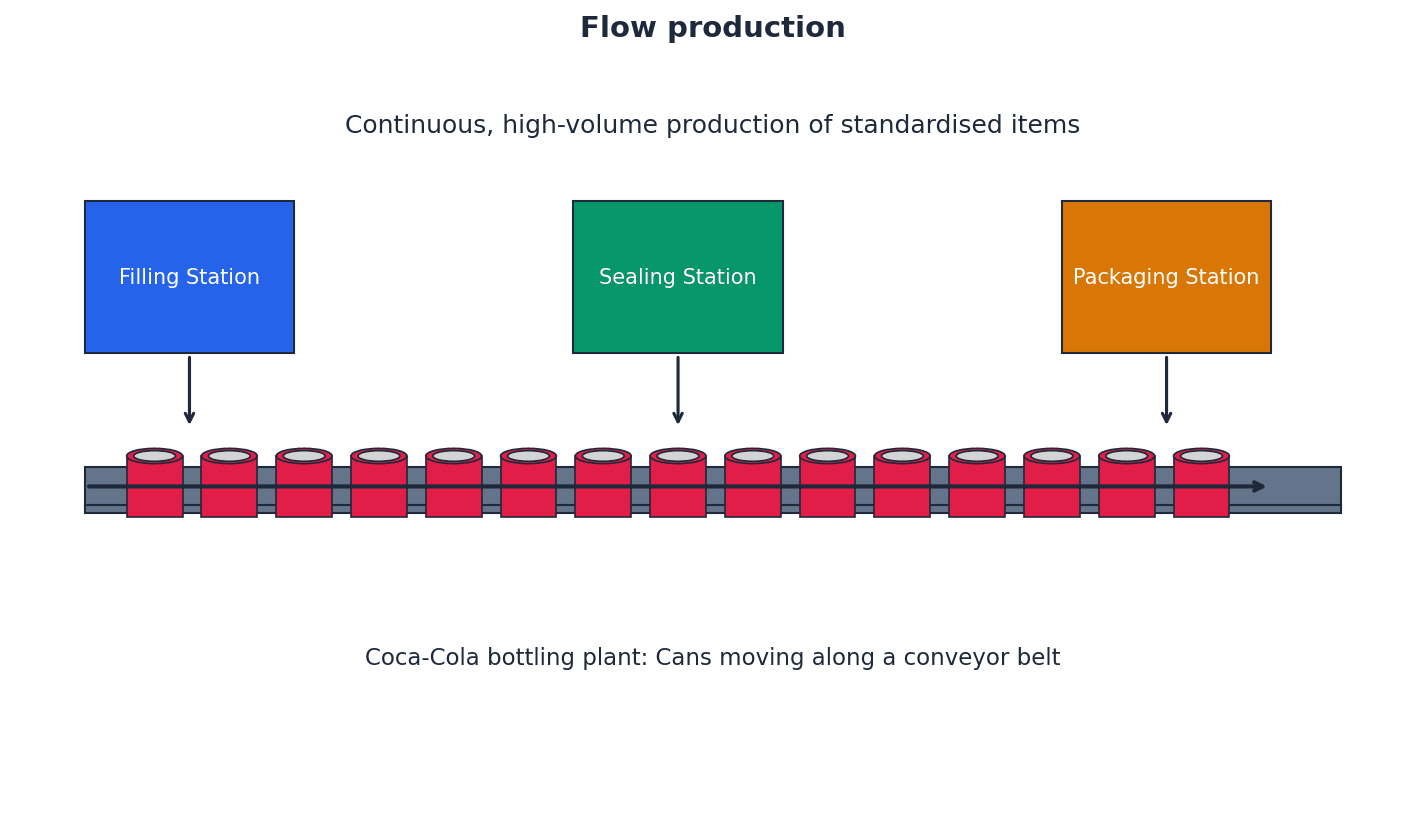
Mass customisation — Mass customisation combines advanced flexible computer-controlled technology and multi-skilled workers to use production lines to make a range of products with variations at high volume.
This method allows businesses to offer customised products at competitive prices, moving away from mass marketing to focused or differentiated marketing. It requires flexible capital equipment, skilled workers, and product designs with standardised and interchangeable parts. Designing your own Nike shoes online, choosing colours and materials, while they are still produced on a high-volume factory line, is an example of mass customisation.
Students often think mass production methods offer no flexibility, but modern techniques like mass customisation allow for variations. Remember that mass customisation is a sophisticated production method that leverages technology to offer product variety while maintaining low unit costs.
When discussing mass customisation, highlight its ability to combine the benefits of flow production (low unit costs) with the benefits of job production (customer-specific variations), and the technological requirements.
The selection of an appropriate operations method – job, batch, flow, or mass customisation – is critical and depends on factors such as product uniqueness, volume of demand, and desired flexibility. Switching between these methods can be challenging, involving significant costs for new equipment, staff training, and potential disruption to existing output. Businesses must carefully evaluate these trade-offs to ensure the chosen method aligns with their strategic objectives and market demands.
When recommending a change in production methods, always discuss the potential problems, such as the cost of new equipment, staff training, and disruption to output.
For questions on efficiency vs. effectiveness, explain that the most successful businesses achieve both: they make a product customers want (effective) using the minimum resources possible (efficient).
Advantages & Disadvantages
Labour Intensive Operations
Capital Intensive Operations
Evaluation Starters
Essay Structure Guide
Introduction
Start by defining operations management and the core concepts relevant to the question, such as productivity, efficiency, or the specific production methods being discussed. Briefly outline the scope of your essay.
Conclusion
Summarise your main arguments without introducing new information. Provide a reasoned judgment or recommendation based on your evaluation, directly answering the question. Emphasise the most critical factors for success in the given scenario.
This chapter explores inventory management, detailing why businesses hold inventories, the associated costs, and the benefits of effective management. It covers traditional inventory systems, including control charts, and evaluates the Just-in-Time (JIT) system in comparison to Just-in-Case (JIC) management, highlighting the importance of supply chain management.
inventory-out costs — The financial impacts for a firm resulting from holding very low inventory levels.
These costs arise when a business cannot meet customer demand due to insufficient stock, leading to lost sales, production stoppages, and the need for urgent, expensive special orders from suppliers. Imagine a popular ice cream shop that runs out of its most popular flavour on a hot day; customers will go to another shop, resulting in lost sales and potentially a damaged reputation.
Students often think inventory-out costs are only about lost sales, but they also include costs like idle equipment, wasted labour, and special delivery charges for urgent orders.
Optimum inventory level — The inventory level at which the total costs of holding inventory and the costs of running out of inventory are at their lowest point.
This level represents the most efficient balance between the expenses of storing goods (storage, opportunity cost, risk of obsolescence) and the potential losses from not having enough stock (lost sales, production delays, special order costs). Think of a Goldilocks scenario for inventory: not too much (high holding costs), not too little (high stock-out costs), but just right to minimise overall expenses.
Students often think the optimum inventory level means zero inventory, but it's the point where the combined costs of holding and running out are minimised, which usually involves some level of inventory.
When asked to discuss optimum inventory levels, refer to the trade-off between holding costs and inventory-out costs, and explain how different factors can shift this optimum point.
economic order quantity (EOQ) — The optimum order size for each product that minimises the total inventory costs, considering both holding costs and ordering costs.
EOQ balances the benefits of bulk ordering (lower ordering costs, discounts) against the costs of holding larger inventories (storage, opportunity cost, obsolescence). It's like deciding how many boxes of cereal to buy at once: buying too few means frequent trips to the store (high ordering cost), but buying too many means they might go stale or take up too much space (high holding cost). EOQ finds the 'just right' amount.
Students often think EOQ is always about ordering the largest possible quantity for discounts, but it's about finding the most cost-effective quantity that balances all relevant costs.
You will not be asked to calculate EOQ, but you must be able to analyse the factors that influence its magnitude for a given business context.
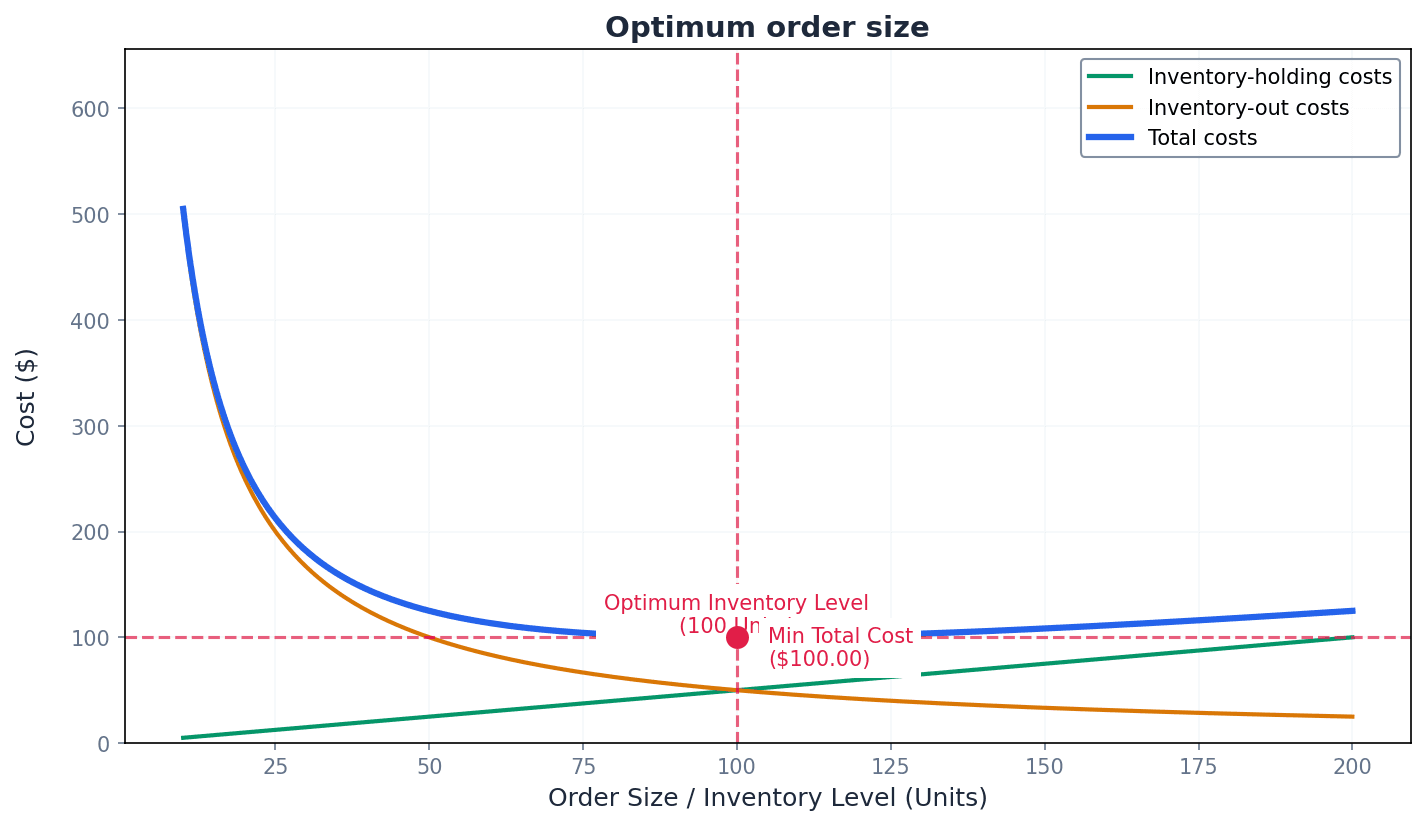
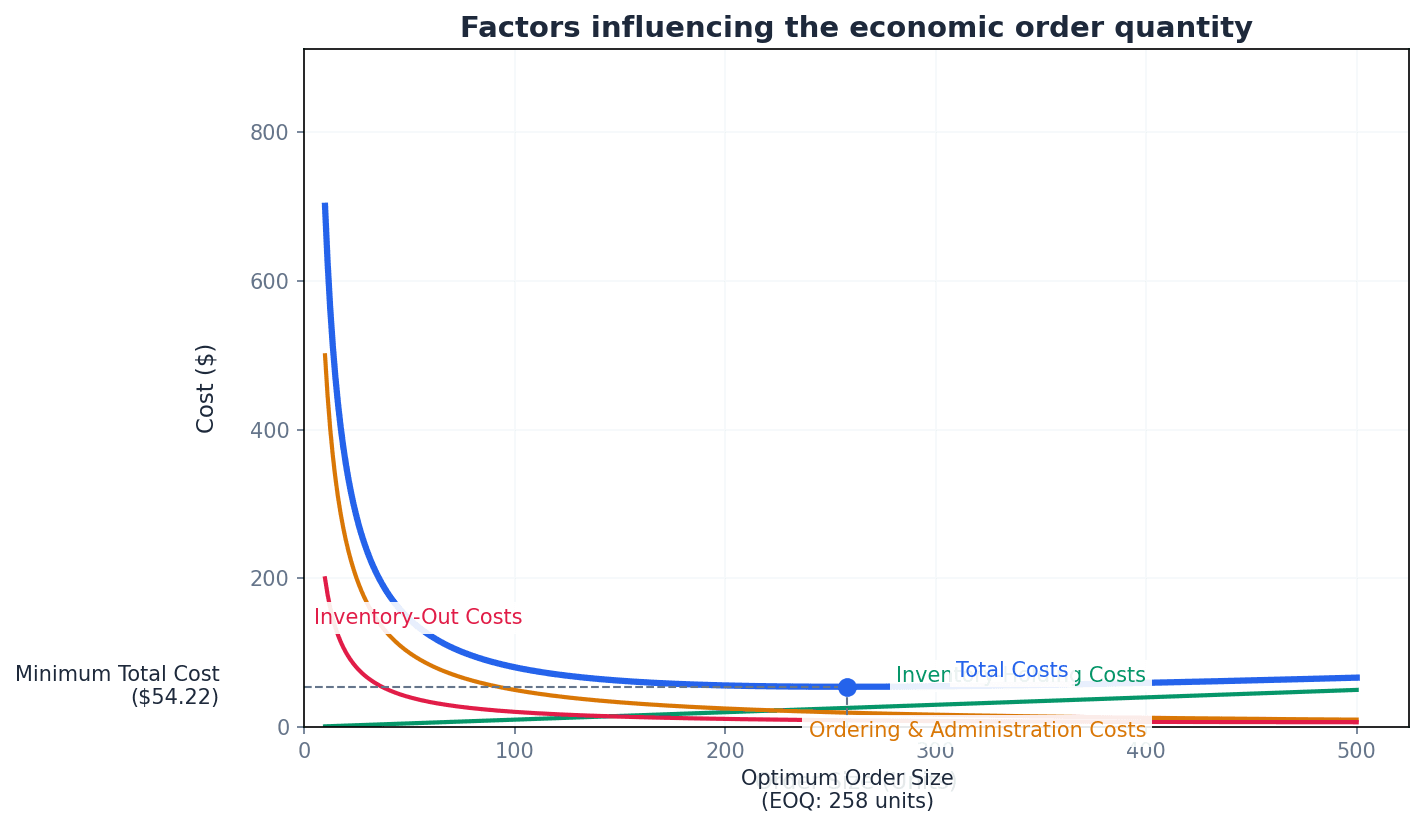
Businesses hold inventory to meet unexpected demand, gain purchasing economies of scale, and avoid production stoppages. However, holding inventory incurs significant costs, including storage expenses, insurance, and the risk of obsolescence or damage. Balancing these holding costs against the potential inventory-out costs is crucial for effective inventory management.
Buffer inventories — The minimum inventory level held by a business to guard against unforeseen changes in demand or delays in delivery.
Also known as safety stock, buffer inventories provide a cushion to ensure continuous production or sales even if there are unexpected supply chain disruptions or sudden increases in customer demand. Think of a car's fuel light coming on: you still have a small amount of fuel left (buffer) to get you to the nearest petrol station, preventing you from being stranded.
Students often think buffer inventories are 'excess' stock, but they are a planned minimum to mitigate risks and ensure operational continuity.
Maximum inventory level — The highest level of inventory a business plans to hold, often limited by storage space or financial costs.
This level is typically determined by adding the economic order quantity to the buffer level for a specific item. Exceeding this level would incur excessive storage costs, opportunity costs, and increased risk of obsolescence or damage. Imagine your refrigerator: you can only fit so much food inside. The maximum inventory level is like the fridge being completely full.
Re-order quantity — The amount of inventory ordered from a supplier each time new stock is needed.
This quantity is influenced by the economic order quantity (EOQ) and aims to balance ordering costs with holding costs. It is the size of the delivery that replenishes the stock. When you buy a new pack of pens, the re-order quantity is the number of pens in that pack.
Lead time — The period of time between placing an order with a supplier and receiving the delivery of the goods.
This time period is crucial for inventory planning as it dictates when an order must be placed to avoid running out of stock. Longer or more unreliable lead times necessitate higher re-order levels and buffer inventories. When you order a custom-made piece of furniture, the lead time is how long you have to wait from placing the order until it arrives.
Students often think lead time is just the delivery time, but it actually includes all stages from order placement to goods being available for use.
Re-order level — The inventory level at which a new order for supplies is placed with a supplier.
This level is determined by the lead time and the rate of inventory usage. When stock falls to this point, an order is automatically triggered to ensure that new supplies arrive before the buffer inventory is depleted. It's like the 'low fuel' warning light in your car; it tells you when to refuel so you don't run out before reaching a petrol station.
Students often think the re-order level is the same as the buffer inventory, but the re-order level is typically higher than the buffer, allowing for lead time before stock hits the buffer.
Traditional inventory management systems often utilise inventory control charts to visually track stock levels over time. These charts illustrate the maximum inventory level, the re-order level, the lead time for deliveries, and the buffer inventory. By monitoring these elements, businesses can manage stock replenishment to avoid both excessive holding costs and costly stock-outs.
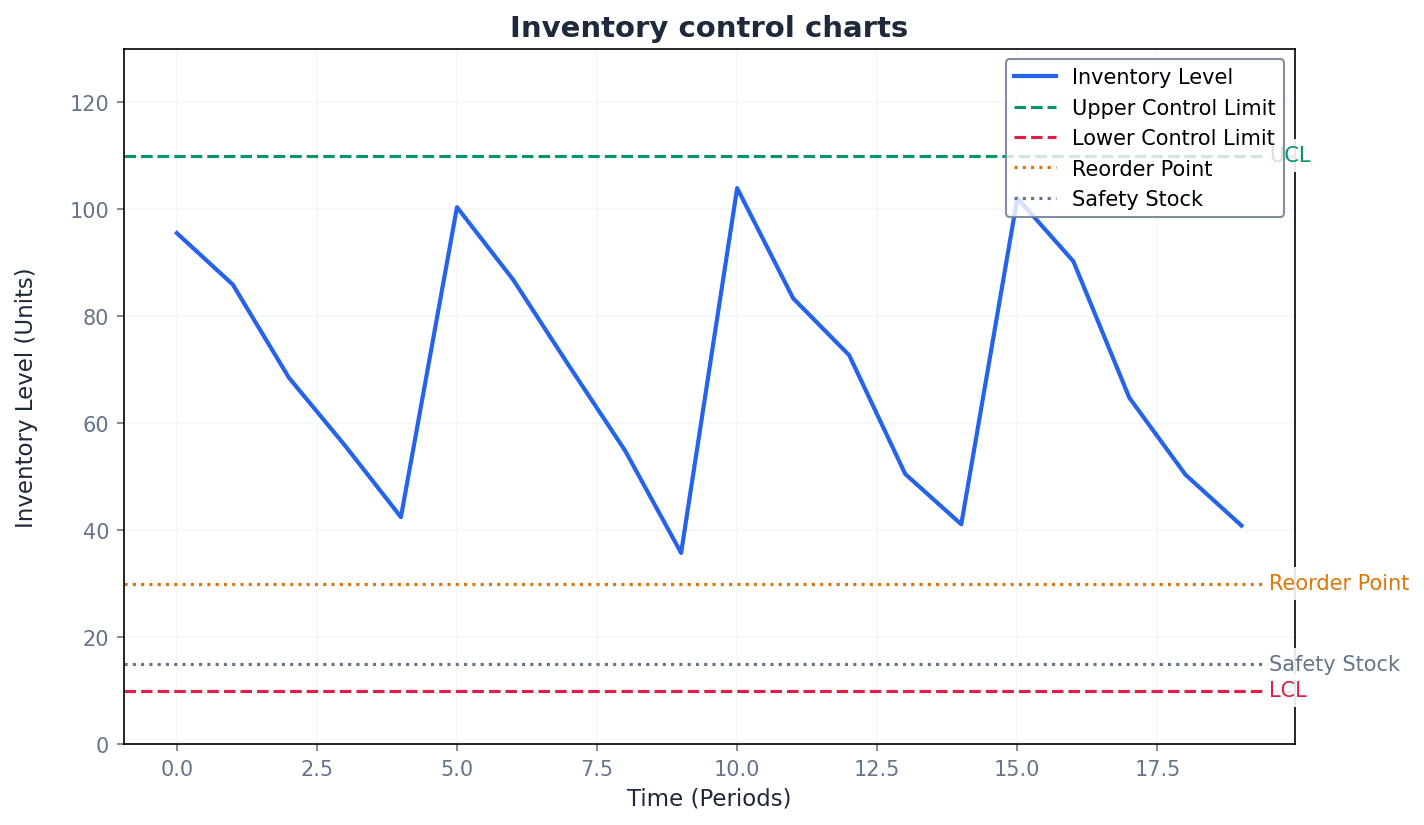
When discussing inventory control charts, clearly identify the buffer inventory level and explain its purpose in mitigating risks like unreliable suppliers or fluctuating demand.
On an inventory control chart, the re-order level is the horizontal line indicating when an order is placed, leading to a subsequent increase in inventory after the lead time.
Supply chain management — A management function focused on minimising costs and improving customer service by effectively managing the flow of goods, information, and finances from raw materials to the final customer.
This involves establishing strong communication with suppliers, optimising transport systems, speeding up production and new product development, and minimising waste across all stages. Its goal is to enhance operational efficiency and profitability. Think of it as the conductor of an orchestra, ensuring all the different sections play in harmony and on time to deliver a perfect performance to the customer.
Students often think supply chain management is just about logistics, but it encompasses strategic relationships, information flow, and financial management across the entire network.
When analysing the importance of supply chain management, link it directly to benefits like improved customer service, reduced operating costs, and increased profitability, providing specific examples.
Just-in-time (JIT) inventory management — An inventory management system that aims to achieve zero buffer inventories by ensuring components and supplies arrive just as they are needed on the production line, and finished goods are delivered to customers as soon as they are completed.
JIT minimises holding costs and waste by eliminating excess stock. It requires highly reliable suppliers, flexible production, accurate demand forecasts, and strong employee-employer relationships to succeed, as any disruption can halt production. Imagine a chef who only orders ingredients for each dish right before they need to cook it, ensuring everything is fresh and no food goes to waste.
Students often think JIT means never having any inventory, but it means having minimal inventory, precisely when and where it's needed, rather than holding large buffers.
just-in-case (JIC) inventory management — A traditional inventory management system that focuses on holding high buffer inventory levels to ensure a business never runs out of stock, 'just in case' there is a hold-up in supplies or an unforeseen increase in demand.
JIC prioritises avoiding stock-outs and production delays by maintaining significant reserves of raw materials, work-in-progress, and finished goods. While it offers security, it incurs higher holding costs and risks of obsolescence compared to JIT. It's like always keeping a full pantry and freezer at home, so you're prepared for unexpected guests or a snowstorm.
Students often think JIC is inherently inefficient, but it can be a rational strategy for businesses facing high uncertainty in demand or unreliable supply chains, where stock-out costs are very high.
The Just-in-Time (JIT) and Just-in-Case (JIC) systems represent contrasting approaches to inventory management. JIT aims for minimal inventory, reducing holding costs and waste, but relies heavily on reliable suppliers and accurate forecasting. In contrast, JIC maintains high buffer inventories to guard against disruptions and unexpected demand, offering security but incurring higher holding costs and risks of obsolescence. The choice between them depends on a business's specific context, industry, and supply chain reliability.
When evaluating JIT, discuss both its significant benefits (reduced costs, flexibility) and its critical drawbacks (vulnerability to supply disruptions, increased delivery costs), linking them to specific business contexts.
When comparing JIT and JIC, clearly outline the trade-offs: JIC offers security against disruptions but at higher holding costs, while JIT offers cost savings and flexibility but with higher risk.
When evaluating JIT vs JIC, always use the context of the business. JIT suits predictable markets with reliable suppliers, while JIC is safer for volatile conditions.
Advantages & Disadvantages
Just-in-Time (JIT) Inventory Management
Just-in-Case (JIC) Inventory Management
Evaluation Starters
Essay Structure Guide
Introduction
Begin by defining inventory management and briefly outlining the two main approaches: Just-in-Time (JIT) and Just-in-Case (JIC). State your overall argument regarding which approach is 'better' or under what conditions each is more appropriate.
Conclusion
Summarise your main arguments, reiterating the trade-offs between JIT and JIC. Conclude by reinforcing the idea that effective inventory management is about finding the optimum balance for a given business, often a hybrid approach, and that continuous monitoring is essential.
This chapter explores capacity utilisation, a key measure of operational efficiency, and its impact on a business's average fixed costs. It evaluates the benefits and limitations of both high and low capacity utilisation, along with strategies for managing capacity issues. The chapter also assesses the rapid growth of outsourcing, its advantages and disadvantages, and the importance of identifying core business activities.
Capacity utilisation — Capacity utilisation measures the proportion of a business's total possible level of sustained output that is currently being used.
This is a key indicator of operational efficiency, calculated as current output divided by maximum capacity, multiplied by 100. For example, if a taxi driver can work 10 hours a day but only drives for 5 hours, their capacity utilisation is 50%. High utilisation helps spread fixed costs over more units, thereby reducing average fixed costs.
Excess capacity — Excess capacity occurs when a business is operating at less than its full capacity, meaning it has unused production potential.
This situation leads to low levels of capacity utilisation and higher unit fixed costs because fixed costs are spread over fewer units of output. It can be a short-term issue due to seasonal demand or a long-term problem stemming from economic recession or technological changes, much like a restaurant with 100 seats only filling 30 on a quiet night.
Capacity shortage — Capacity shortage occurs when the demand for a business's products exceeds its current output capacity.
This is the opposite of excess capacity, meaning the business cannot meet all customer orders with its existing resources. Management options depend on the cause and likely duration of the excess demand, ranging from outsourcing to investing in expansion, similar to a popular concert venue selling out instantly with many more people still wanting tickets.
Outsourcing — Outsourcing involves contracting out non-core business activities or functions to external specialist businesses.
This can include services, components, or even finished goods, often done to reduce costs, increase flexibility, improve company focus on core activities, or access specialist expertise not available internally. For instance, a small hotel might outsource its laundry services to a professional cleaning company instead of buying its own machines and hiring staff.
Offshoring — Offshoring is a specific type of outsourcing that involves buying in services, components, or completed products from businesses operating in low-wage economies abroad.
It is primarily driven by the potential for significant cost reductions due to lower labour costs in other countries. An American smartphone company, for example, might offshore its manufacturing to a factory in Vietnam to take advantage of these lower production costs.
Core activities — Core activities are the main objectives and tasks that are central to a business's primary purpose and overall reputation.
These are the functions that management should concentrate on and are generally less suitable for outsourcing due to their critical importance to the business's identity and success. For a restaurant, cooking and serving food are core activities, while cleaning windows might be considered non-core.
Rate of capacity utilisation
This formula is used to measure the proportion of a business's potential output that is currently being used. The result is always expressed as a percentage.
Capacity utilisation is a crucial measure of operational efficiency because it directly impacts a business's average fixed costs. When a business operates at a higher rate of capacity utilisation, its fixed costs, such as rent and machinery depreciation, are spread over a larger volume of output. This reduces the average fixed cost per unit, which can lead to higher profitability. Conversely, low capacity utilisation means fixed costs are spread over fewer units, resulting in higher average fixed costs per unit.
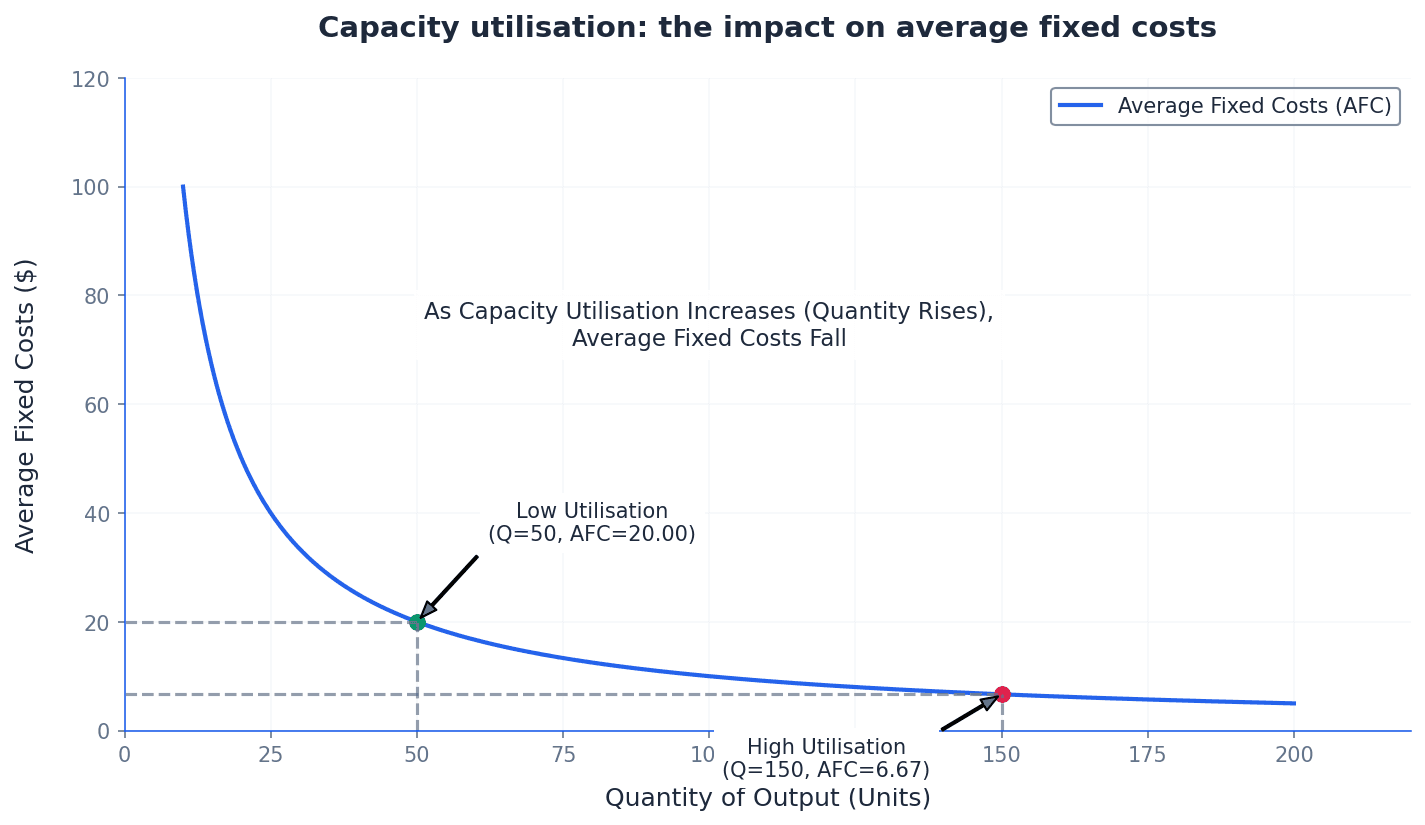
Students often think 100% capacity utilisation is always ideal, but actually it can lead to employee stress, lack of maintenance time, and inability to accept new orders. It also leaves no margin for error or flexibility.
Excess capacity occurs when a business is operating below its full potential, leading to higher unit fixed costs. This can be a short-term issue, perhaps due to seasonal demand, or a long-term problem caused by economic recession or technological changes. Strategies for managing short-term excess capacity might include flexible production, while long-term solutions could involve rationalisation, research and development, or even diversification.
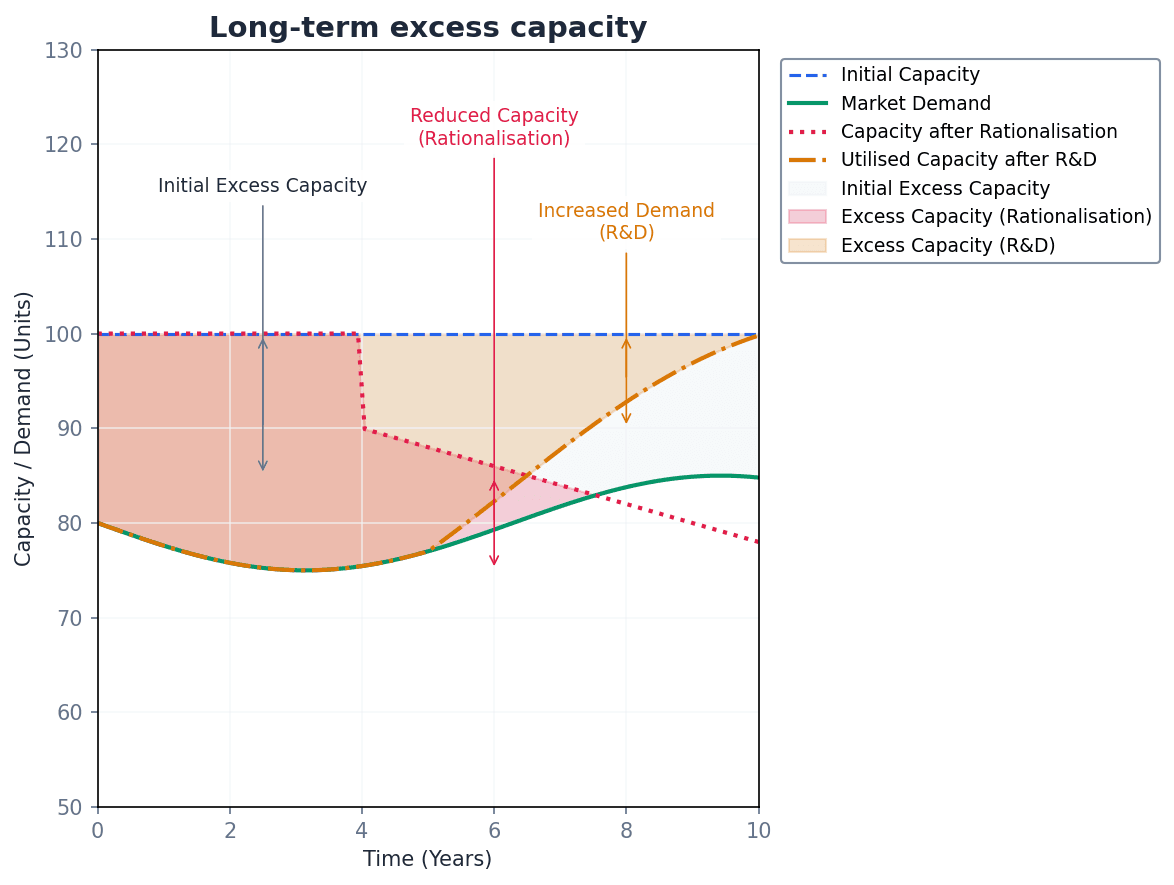
When evaluating solutions for excess capacity, consider both short-term (e.g., flexible production) and long-term (e.g., rationalisation, R&D) options, and their respective advantages and disadvantages.
Students often think excess capacity only means wasted resources, but actually it can provide flexibility to handle unexpected demand increases or production issues. It is not the same as a complete shutdown.
A capacity shortage arises when demand for a business's products exceeds its current output capacity, meaning the business cannot meet all customer orders. This can lead to lost sales, customer dissatisfaction, and a shrinking market share if not addressed effectively. Management options depend on the cause and likely duration of the excess demand, ranging from immediate actions like outsourcing to long-term strategies such as investing in facility expansion.
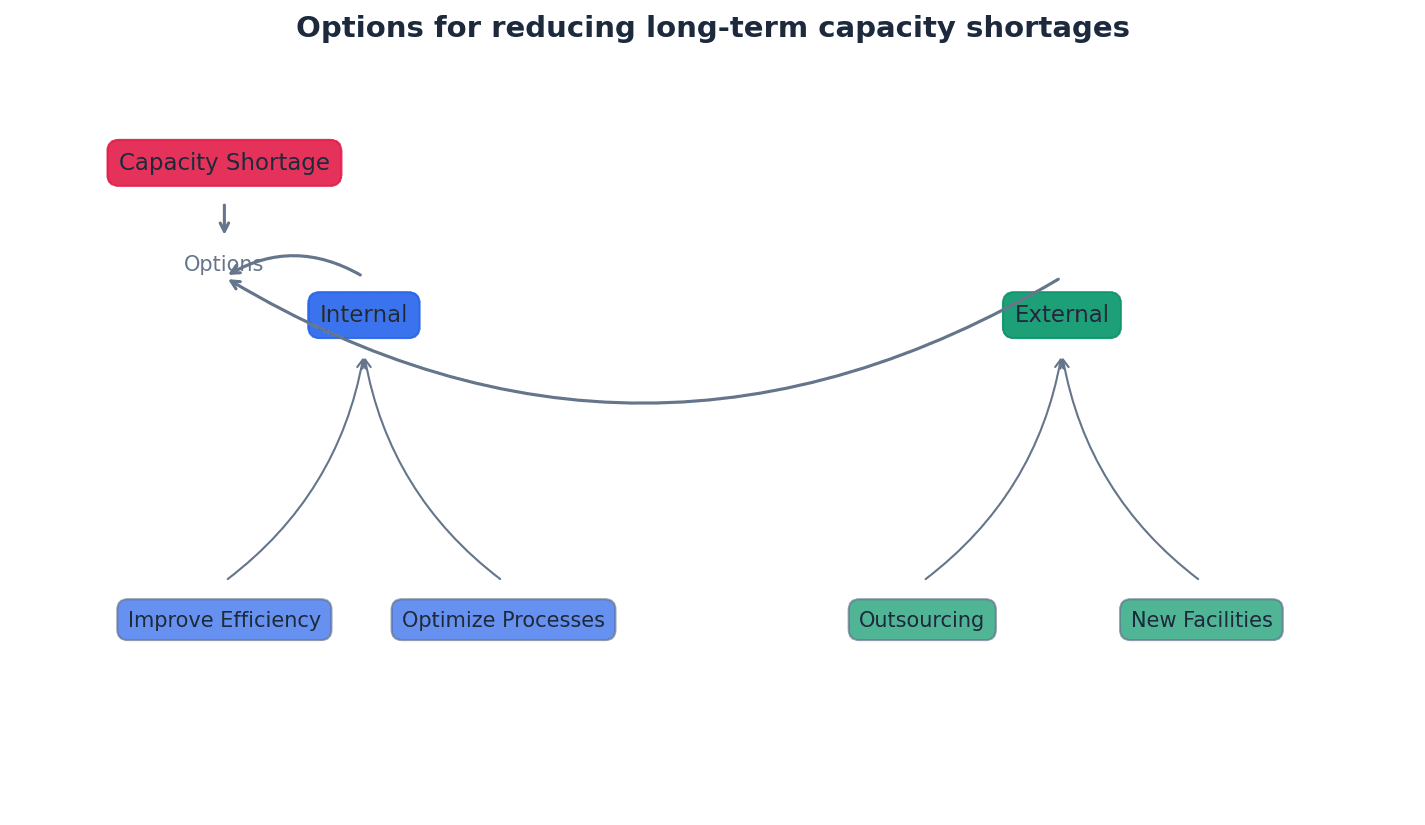
When discussing capacity shortage, ensure you analyse both the immediate actions (e.g., outsourcing) and long-term strategies (e.g., facility expansion), weighing their costs, benefits, and risks.
Students often think capacity shortage is always a good problem to have, but actually it can lead to lost sales, customer dissatisfaction, and a shrinking market share if not addressed.
Outsourcing has seen rapid growth due to several compelling reasons. Businesses often contract out non-core activities to reduce costs, as external specialists may achieve economies of scale or operate in lower-wage economies. It also increases flexibility, allowing businesses to scale operations up or down more easily. Furthermore, outsourcing enables a business to focus on its core activities and access specialist expertise that may not be available internally, thereby improving overall efficiency and competitiveness.
Students often think outsourcing is only about cost reduction, but actually it can also be driven by a need for specialist skills, increased flexibility, or improved company focus.
When evaluating outsourcing decisions, remember to consider both the financial implications (cost savings) and non-financial factors such as quality control, customer resistance, security risks, and corporate social responsibility.
Students often think offshoring is the same as outsourcing, but actually offshoring is a subset of outsourcing where the external provider is located in a different country, typically for cost advantages.
When discussing offshoring, explicitly link it to ethical considerations and corporate social responsibility, as these are common areas for evaluation in exam questions.
Students often think any activity can be outsourced if it saves money, but actually outsourcing core activities can severely damage a business's brand, quality, and competitive advantage.
When evaluating outsourcing, always consider whether the activity is 'core' or 'non-core' to the business, as this significantly influences the appropriateness and risks of outsourcing.
For outsourcing questions, provide a balanced evaluation. Weigh the financial benefits against qualitative drawbacks like loss of control and potential damage to brand reputation.
Advantages & Disadvantages
High Capacity Utilisation
Low Capacity Utilisation (Excess Capacity)
Evaluation Starters
Essay Structure Guide
Introduction
Begin by defining the key terms relevant to the question, such as capacity utilisation and outsourcing. Briefly outline the scope of your essay, indicating the main arguments you will present regarding benefits, limitations, and evaluation.
Conclusion
Summarise your main arguments without introducing new information. Provide a final, reasoned judgment or recommendation based on your evaluation. Reiterate the importance of a balanced approach to capacity management and outsourcing, considering both quantitative and qualitative factors.
This chapter explores the crucial decisions businesses make regarding their location and the scale of their operations. It examines the various factors influencing location choices and the reasons businesses expand, detailing how economies of scale can reduce unit costs and diseconomies of scale can increase them.
optimal location — An optimal location decision is one that selects the best site for a new business or for relocating an existing one.
The optimal location is the best site for a business, aiming to maximise long-term profits. This often involves a compromise, balancing conflicting benefits and drawbacks, such as high fixed costs against potential sales, or the low costs of a remote site against challenges in labour supply. For instance, choosing the best spot for a lemonade stand means finding a place with many thirsty people (high sales potential) but also where rent isn't too high, balancing these factors.
Students often think the optimal location is always the cheapest, but actually it's the one that maximises long-term profit by balancing costs and revenues. Additionally, students often think the 'best' location is static, but actually cost, local competitors, and other factors can change over time, necessitating relocation.
When evaluating location decisions, consider both quantitative (e.g., costs, revenue) and qualitative (e.g., image, government incentives) factors, and explain how they might conflict.
Location decisions are critical to the success of a business as they significantly impact long-term profitability. An optimal site helps a business achieve its objectives by balancing various quantitative and qualitative factors. For example, a well-positioned high street shop may have high sales potential but will incur higher rental charges compared to a similar-sized shop out of town.
Businesses consider both quantitative and qualitative factors when making location and relocation decisions. Quantitative factors include site and other fixed costs such as buildings, labour costs, transport costs, potential revenue, and government grants. Profit estimates are crucial in assessing the financial viability of a location. For instance, a factory in a remote industrial estate might have low rental costs but could face problems recruiting suitably trained employees.
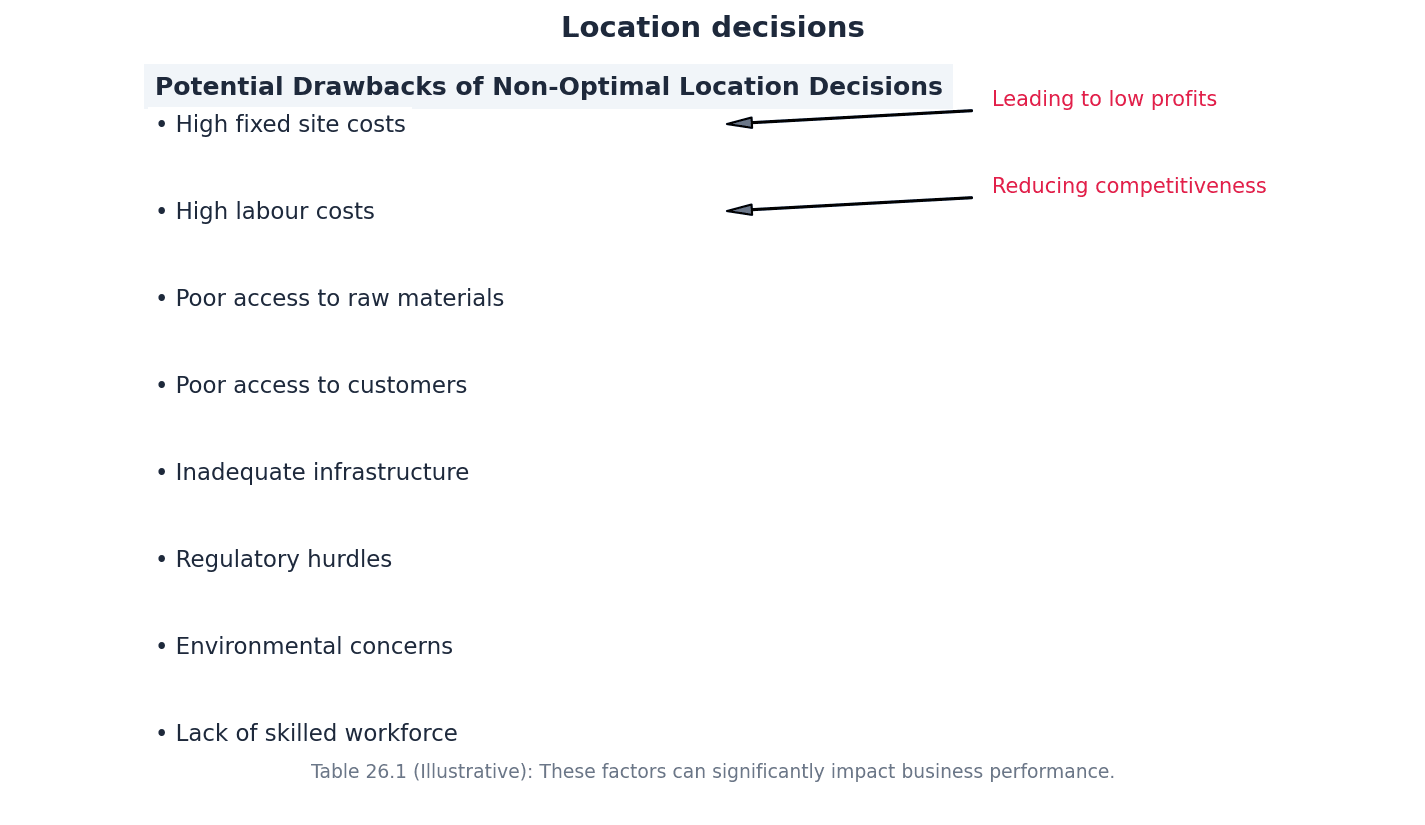
economies of scale — These are cost benefits that arise for businesses as they increase their scale of operations.
Economies of scale lead to lower unit costs of production as a business grows, making it difficult for smaller businesses to compete. These benefits can be substantial and include purchasing, technical, financial, marketing, and managerial advantages. It's like buying in bulk at a warehouse store: the more you buy, the cheaper the price per item, similarly, large businesses get discounts on materials.
Students often think 'economies of scale' just means producing more, but actually it refers to the *reduction in average costs* that results from increasing the *scale of operations* (using more of all inputs). Students also often confuse 'producing more' with 'increasing the scale of operations'. Producing more can be done by raising capacity utilisation with existing resources, while increasing the scale of operations means using more (or less) of *all* resources.
When asked about economies of scale, do not just list them; explain *how* each type leads to a reduction in unit costs for the specific business in the question.
Businesses may want to increase their scale of production to benefit from internal economies of scale, which reduce unit costs. These include purchasing economies (bulk-buying discounts), technical economies (using specialised machinery), financial economies (easier access to cheaper finance), marketing economies (spreading advertising costs over more units), and managerial economies (employing specialist managers). These benefits arise from the business's own growth.
diseconomies of scale — Diseconomies of scale are those factors that increase unit costs as the scale of operations increases beyond a certain size.
These factors typically relate to management problems in controlling and directing very large organisations, leading to inefficiencies and higher average costs. Examples include communication problems, alienation of the workforce, and poor coordination. Imagine trying to organise a small family dinner versus a huge wedding; the wedding is much harder to coordinate and ensure everyone is happy, leading to more stress and potentially higher costs per guest.
Students often confuse diseconomies of scale with simply having high costs, but actually it specifically refers to the *increase in average costs* that occurs *because* the business has grown too large. Also, students often think that economies of scale cease and diseconomies begin at a single, identifiable point, but actually the process is gradual, with some economies continuing while diseconomies gradually increase.
When discussing diseconomies of scale, link them directly to management challenges in large organisations and explain how these challenges lead to an *increase in unit costs*.
As a business grows too large, it can experience internal diseconomies of scale, which increase unit costs. These are often caused by communication problems within the vast organisation, leading to misunderstandings and delays. The workforce may also experience alienation, feeling less connected to the company's goals, which can reduce productivity. Poor coordination across different departments or divisions can also lead to inefficiencies and wasted resources.
External economies of scale are benefits that arise from the growth of the entire industry in a particular area, rather than from a single firm's growth. For example, a skilled labour pool or improved infrastructure can benefit all businesses in that industry. Conversely, external diseconomies of scale occur when the growth of the industry or economy leads to increased unit costs for all firms, such as local congestion or increased competition for resources.
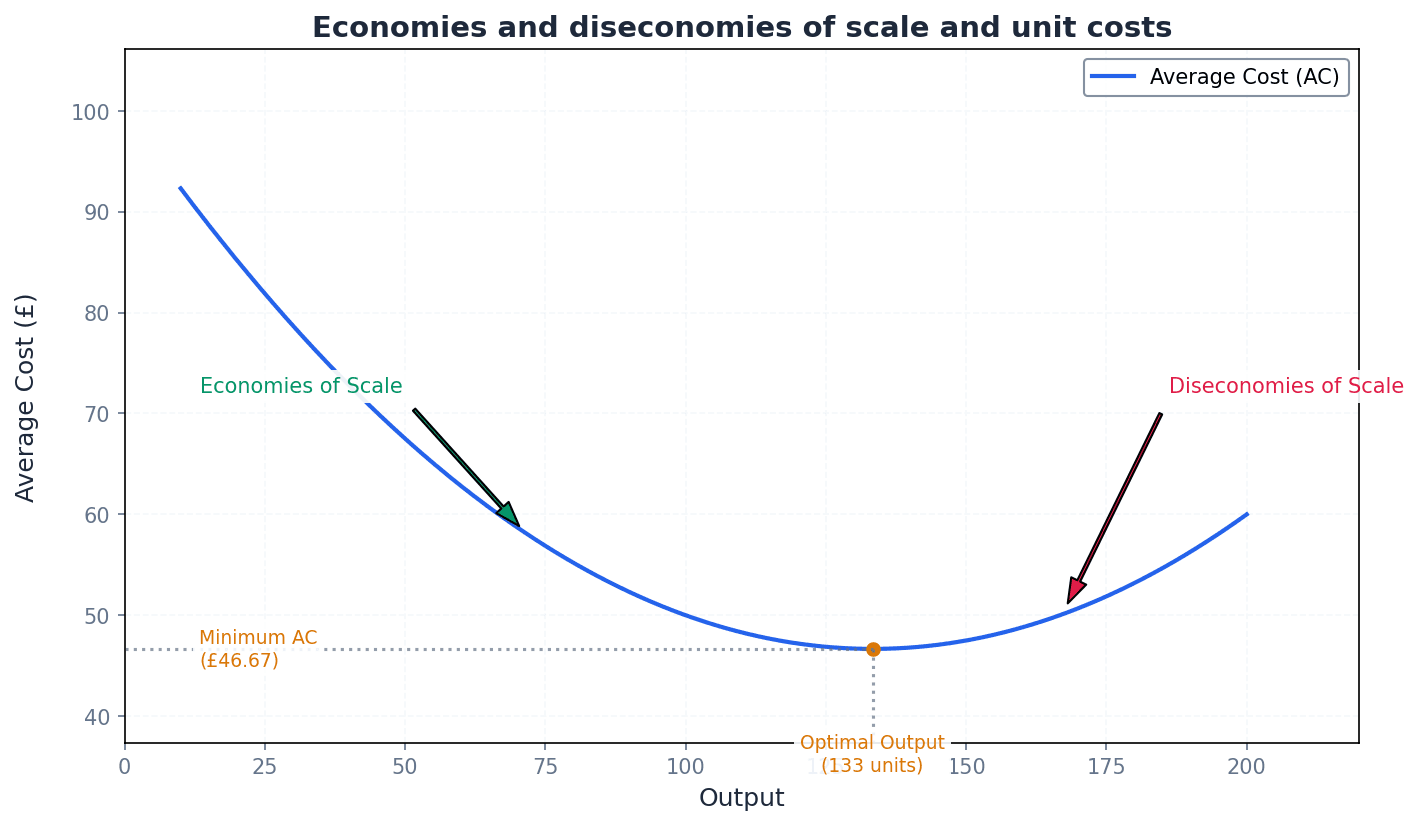
Always link economies and diseconomies of scale directly to their impact on *average unit costs* to show you understand the core concept.
In evaluation, argue that the 'optimal' scale is a moving target. A business can avoid diseconomies through strategies like decentralisation, improving the point at which they set in.
Advantages & Disadvantages
Optimal Location for a Business
Increasing the Scale of Operations (Economies of Scale)
Evaluation Starters
Essay Structure Guide
Introduction
Start by defining the key terms from the question (e.g., optimal location, economies of scale) and briefly outlining the scope of your essay. State your main argument or thesis.
Conclusion
Summarise your main arguments, reiterating your thesis. Provide a final, balanced judgment on the importance of location and scale decisions for long-term business success, acknowledging the complexities and compromises involved.
This chapter defines quality as meeting customer expectations and explores its importance for business competitiveness and profitability. It differentiates between quality control (inspection-based) and quality assurance (prevention-based), and evaluates Total Quality Management (TQM) and benchmarking as key strategies for continuous improvement.
Quality — Meeting customer expectations.
A quality product does not necessarily have to be the best possible or made with the highest quality materials, but it must meet consumer expectations and be fit for purpose, considering its price point. For example, a budget smartphone that reliably makes calls and texts demonstrates quality by meeting lower expectations for its price.
Students often think quality means 'the best possible product', but actually it means 'meeting customer expectations for a given price'. Quality is a relative concept, dependent on the product's price and consumer expectations.
When defining quality, always refer to 'customer expectations' and 'fitness for purpose' rather than just 'high standards' to gain full marks.
Quality control — Based on inspection or checking, usually of the completed product or of the service as it is being provided to a consumer.
This approach focuses on detecting faults at the end of the production process, often involving qualified inspectors. It aims to correct faulty products and the processes that caused them, much like a chef tasting a dish just before it leaves the kitchen to ensure it meets standards.
Students often think quality control prevents all faults, but actually it primarily detects faults after they have occurred, often at the final stage. Quality control is a reactive process based on inspection of finished products to find defects.
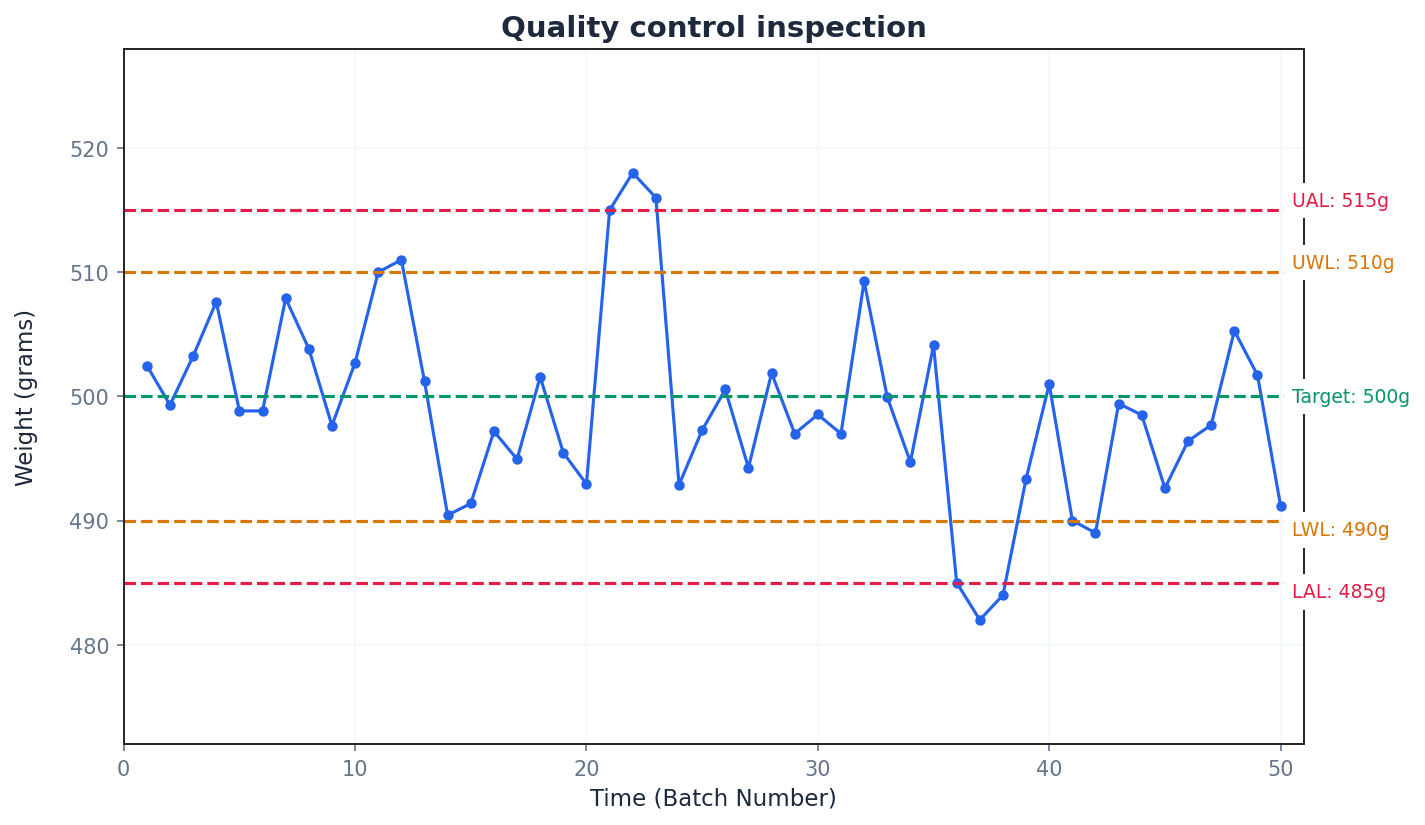
Quality assurance — Based on setting agreed quality standards at all stages of production to ensure that customers’ satisfaction is achieved.
This approach focuses on preventing poor quality by designing products for fault-free manufacture and involving all workers in self-checking against established standards throughout the production process. It's like a car assembly line where each worker checks their specific task against a standard before passing it to the next stage, ensuring quality is built in.
Students often think quality assurance is just about final inspection, but actually it involves setting and checking standards at every stage of production, from design to after-sales. Quality assurance is a proactive process focused on preventing defects by setting standards at every stage of production.
When explaining quality assurance, emphasise 'prevention' and 'responsibility of all employees' as key differentiators from quality control, and mention benefits like ISO 9000 accreditation.
Quality is crucial for business competitiveness and profitability. High quality enhances business competitiveness by building brand loyalty, reducing waste and rework costs, and potentially allowing for premium pricing. When discussing the importance of quality, link it directly to business objectives like profitability, market share, and brand reputation.
Total quality management (TQM) — Based on the principle that everyone within a business has a contribution to make to the overall quality of the finished product or service.
TQM is a philosophy that requires a significant cultural change, empowering all employees to take responsibility for the quality of their work, treating the next person in the process as an 'internal customer', with the aim of achieving zero defects. It's like an orchestra where every musician is committed to playing their part perfectly, knowing each contributes to the overall quality of the performance.
Students often think TQM is just another quality control technique, but actually it's a holistic management philosophy that integrates quality into every aspect and employee responsibility. TQM is a comprehensive management philosophy requiring cultural change.
When evaluating TQM, discuss the need for strong senior management commitment and cultural change, and link it to concepts like job enrichment and empowerment for higher-level analysis.
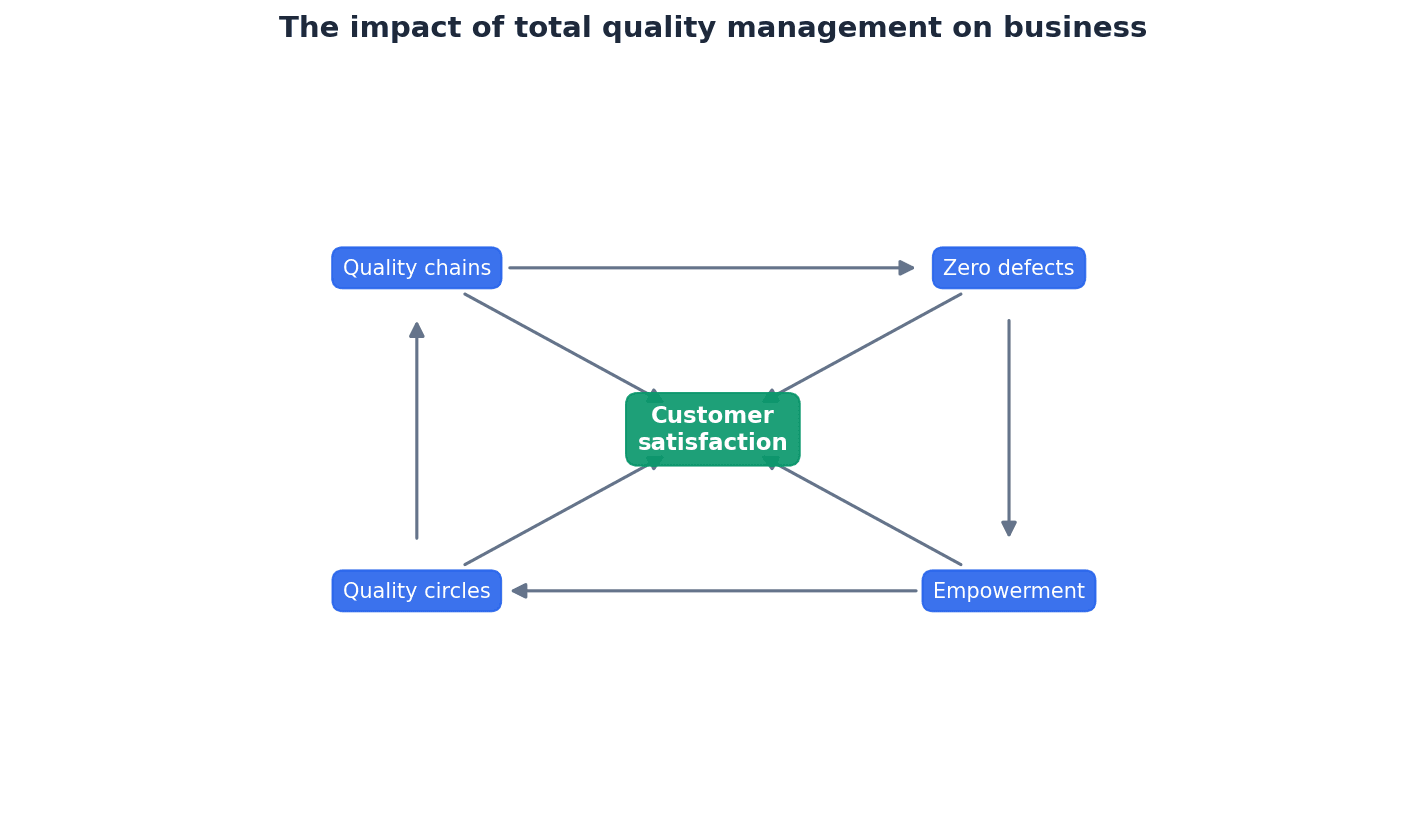
Quality chains — Departmental relationships where every department is obliged to meet the standards expected by its internal customer(s).
This concept is central to TQM, where every worker views the next person in the production process as their customer, ensuring that the quality of work passed on meets the required standards. It's like a relay race where each runner must pass the baton perfectly to the next to ensure overall success.
Students often think 'quality chains' refer to a series of quality checks, but actually it describes the interconnected internal customer-supplier relationships within a business, where each link strives for quality.
Benchmarking — A comparison exercise between a particular business and the best in the industry.
This process identifies areas where a business needs to improve its quality and productivity by comparing its performance indicators against those of leading competitors or best-performing divisions within the same company. It's like a runner comparing their race times and training methods to the fastest runners in their league to identify areas for improvement.
Students often think benchmarking is just about copying competitors, but actually it's about identifying best practices, setting ambitious targets, and adapting processes to meet or exceed those standards. Benchmarking is sometimes seen as merely copying competitors, rather than identifying best practices and adapting them for improvement.
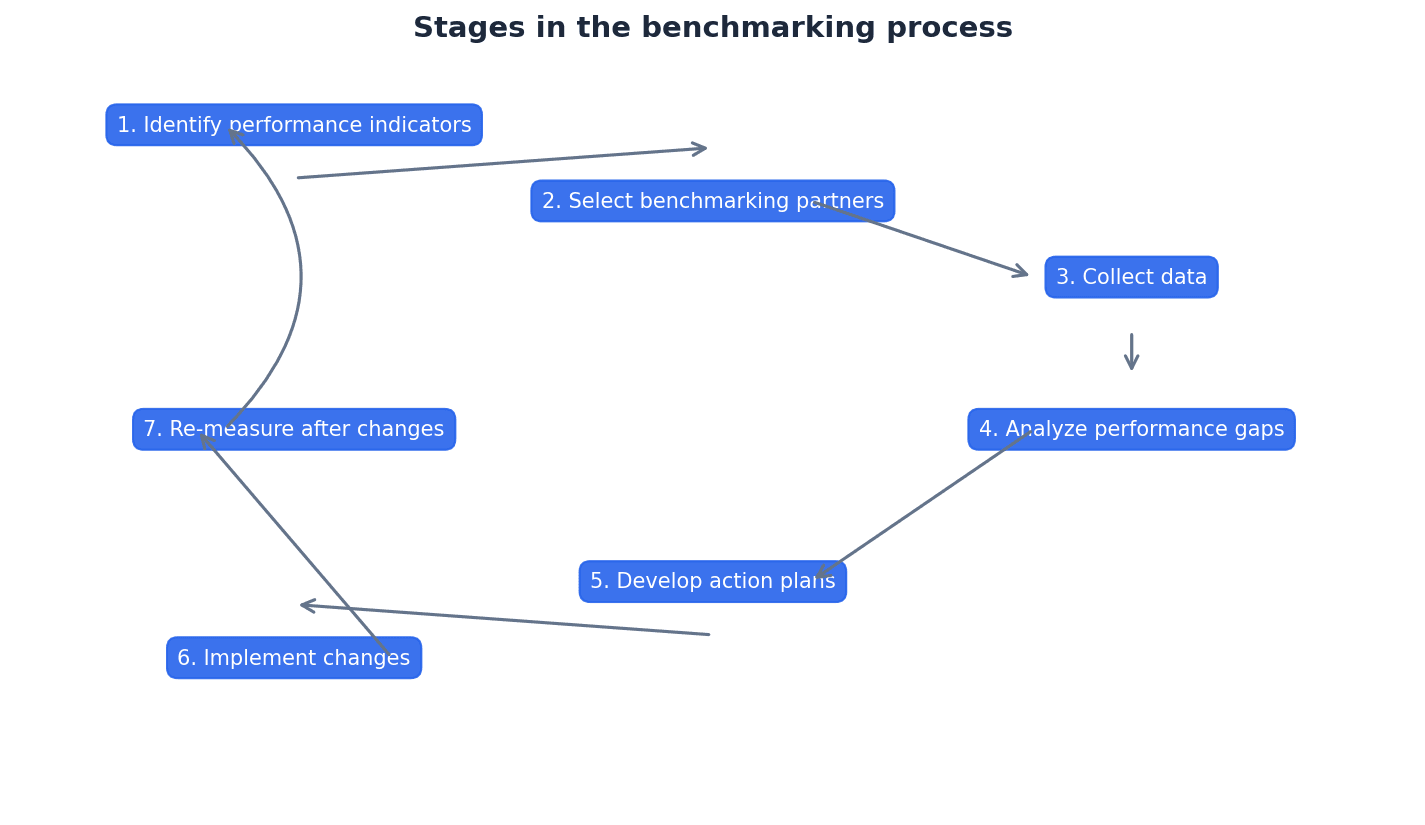
When discussing benchmarking, explain the stages involved and highlight its role in increasing international competitiveness and identifying customer priorities, while also noting limitations like data availability.
In evaluation questions, always balance the costs of implementing a quality system against its benefits (e.g., cost of TQM training vs. benefit of reduced waste and higher sales).
Use the terms 'proactive' for QA/TQM and 'reactive' for QC to demonstrate a clear understanding of the fundamental difference.
Advantages & Disadvantages
Quality Control (QC)
Quality Assurance (QA)
Evaluation Starters
Essay Structure Guide
Introduction
Begin by defining quality as meeting customer expectations and briefly outlining the quality management concepts to be discussed (e.g., QC, QA, TQM, Benchmarking). State your overall argument or stance on the effectiveness of these methods.
Conclusion
Summarise your main arguments, reiterating the importance of quality management for competitiveness and profitability. Provide a final, balanced judgement on the overall effectiveness of the discussed methods, perhaps suggesting that a combination of approaches is often most effective.
This chapter covers operations strategy, examining factors like IT and AI that influence decisions, and the critical need for flexibility and innovation. It evaluates the impact of Enterprise Resource Planning (ERP) and various lean production techniques such as Kaizen and cell production. Finally, it analyses key elements of operations planning, including the usefulness of Critical Path Analysis (CPA) and network diagrams for efficient project management.
Operational flexibility — The ability of a business to adapt the volume of output, change delivery time schedules, and respond to customer demand for unique product specifications.
Operational flexibility is crucial for businesses to improve efficiency by quickly adjusting to unpredictable changes in market demand. For example, a restaurant that can quickly adjust its staffing levels and ingredient orders based on daily customer reservations demonstrates this flexibility. It can be achieved through various methods like increasing capacity, outsourcing, holding inventories, or employing a flexible workforce.
When analysing operational flexibility, link it to specific business contexts and explain how different methods (e.g., multi-skilled workforce, mass customisation) contribute to it, showing application (AO2).
Students often think flexibility only means changing output volume, but actually it also includes adapting delivery times and customising products to meet specific customer needs.
Process innovation — New ways of producing goods or delivering services that lead to lower-cost and more effective production methods.
Process innovation can transform the efficiency of a manufacturing system, making a business more competitive by reducing costs and improving effectiveness. The invention of the assembly line, which dramatically reduced the time and cost of manufacturing cars, is a prime example. Other examples include robots in manufacturing, faster machines, and internet tracking of deliveries.
Distinguish clearly between product innovation and process innovation in your answers (AO1). When evaluating process innovation, consider its impact on cost, quality, speed, and potential for competitive advantage (AO3).
Students often think innovation only refers to new products, but actually process innovation focuses on improving how things are made or delivered, which can be equally or more impactful on competitiveness.
Computer-aided design (CAD) — This type of IT software may be developed for specific applications, such as architectural designs, and is widely used for computer animation, special effects, and designing physical products.
CAD allows engineers to create detailed 3D models and analyse design variations interactively, reducing product development costs and time to market. Think of an architect using advanced software to design a building in 3D, testing different layouts and materials virtually before any physical construction begins, saving time and money. It improves product quality and accuracy by minimising the need for costly physical prototypes.
Students often think CAD is only for visual design, but actually it performs calculations for optimum shape and size and is used throughout the engineering process for analysis of component assemblies and manufacturing methods.
Computer-aided manufacturing (CAM) — A CAM system usually seeks to control the production process through automation, carried out by robotic tools such as lathes, milling machines, and welding machines.
CAM systems achieve high precision and consistency in manufacturing by controlling processes with computers, leading to reduced quality problems and faster production. Imagine a robot arm in a car factory precisely welding parts together based on computer instructions, rather than a human doing it manually, ensuring every weld is identical and perfect. When integrated with CAD, it enables mass customisation and increased competitiveness.
Students often think CAM replaces all human workers, but actually it automates repetitive tasks, freeing up employees for higher-level work, and still requires human oversight for quality assurance and problem-solving.
Enterprise resource planning (ERP) — A system that links all business functions, such as manufacturing, marketing, human resources, and finance, through one software platform using a single database program.
ERP coordinates and links all business systems to complete customer orders efficiently, from inventory control and supply ordering to human resource planning and invoicing. Imagine a central nervous system for a business, where every department is connected and shares information instantly, allowing for coordinated and efficient responses to any situation. It improves efficiency by reducing waste, utilising capacity better, and enhancing inter-departmental coordination.
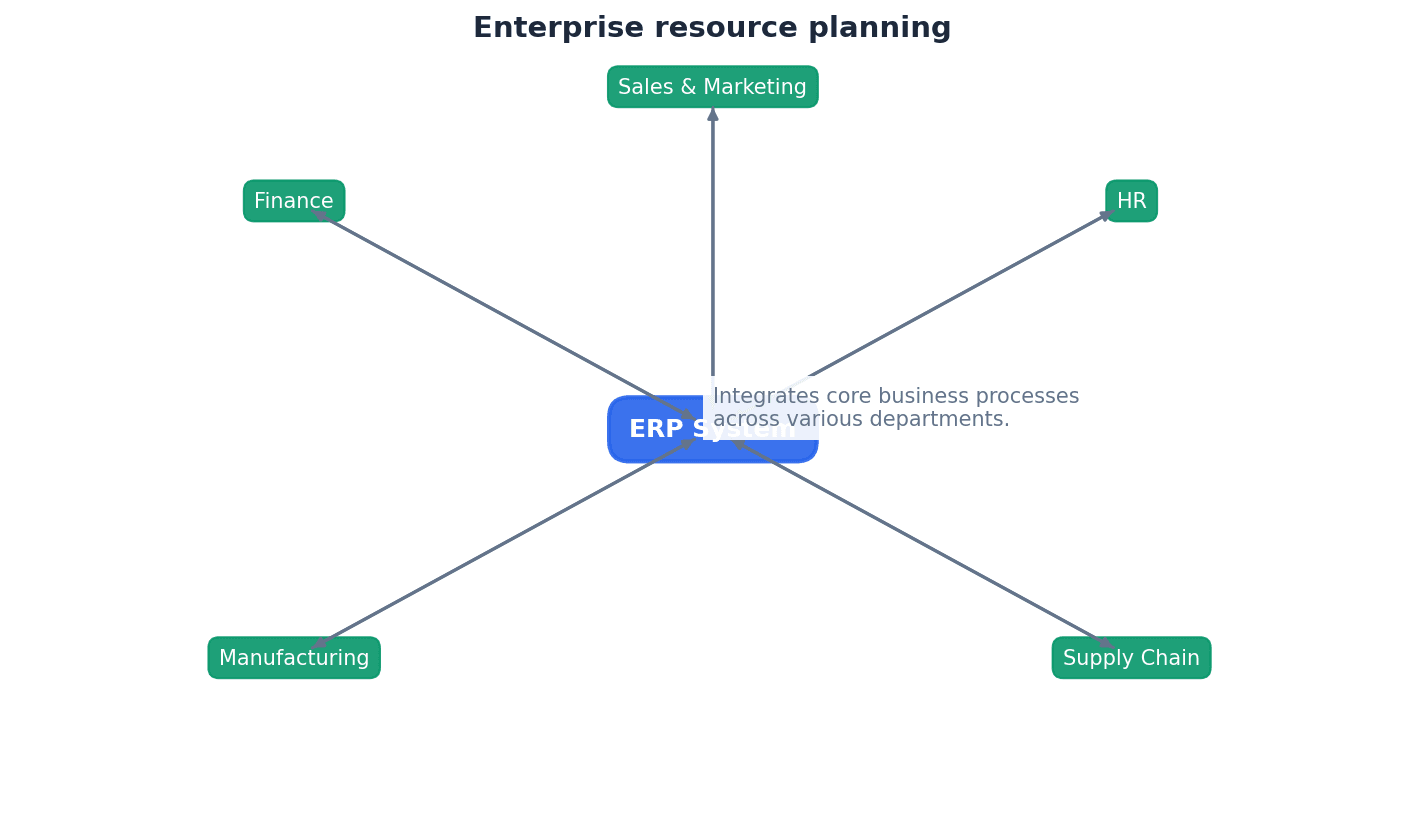
When evaluating ERP, discuss both its significant benefits (e.g., cost reduction, improved customer service, better management information) and its limitations (e.g., high costs, training needs, resistance to change, implementation time) to demonstrate balanced analysis (AO3).
Students often think ERP is just a fancy accounting software, but actually it integrates all core business processes across departments, providing a holistic view and control over operations, not just financial data.
Lean production — Any business process that aims to reduce waste and produce quality output with fewer resources, cutting out anything that adds complexity, cost, and time without adding value to the customer.
Originating in Japan, lean production focuses on eliminating sources of waste such as excessive transportation, inventory, movement, waiting time, over-production, over-processing, defects, and underutilised talent. Think of a chef preparing a meal with minimal fuss: only ordering ingredients as needed, having all tools within reach, and ensuring no food is wasted, resulting in a high-quality dish with less effort and cost. It leads to increased efficiency, lower costs, and improved quality.
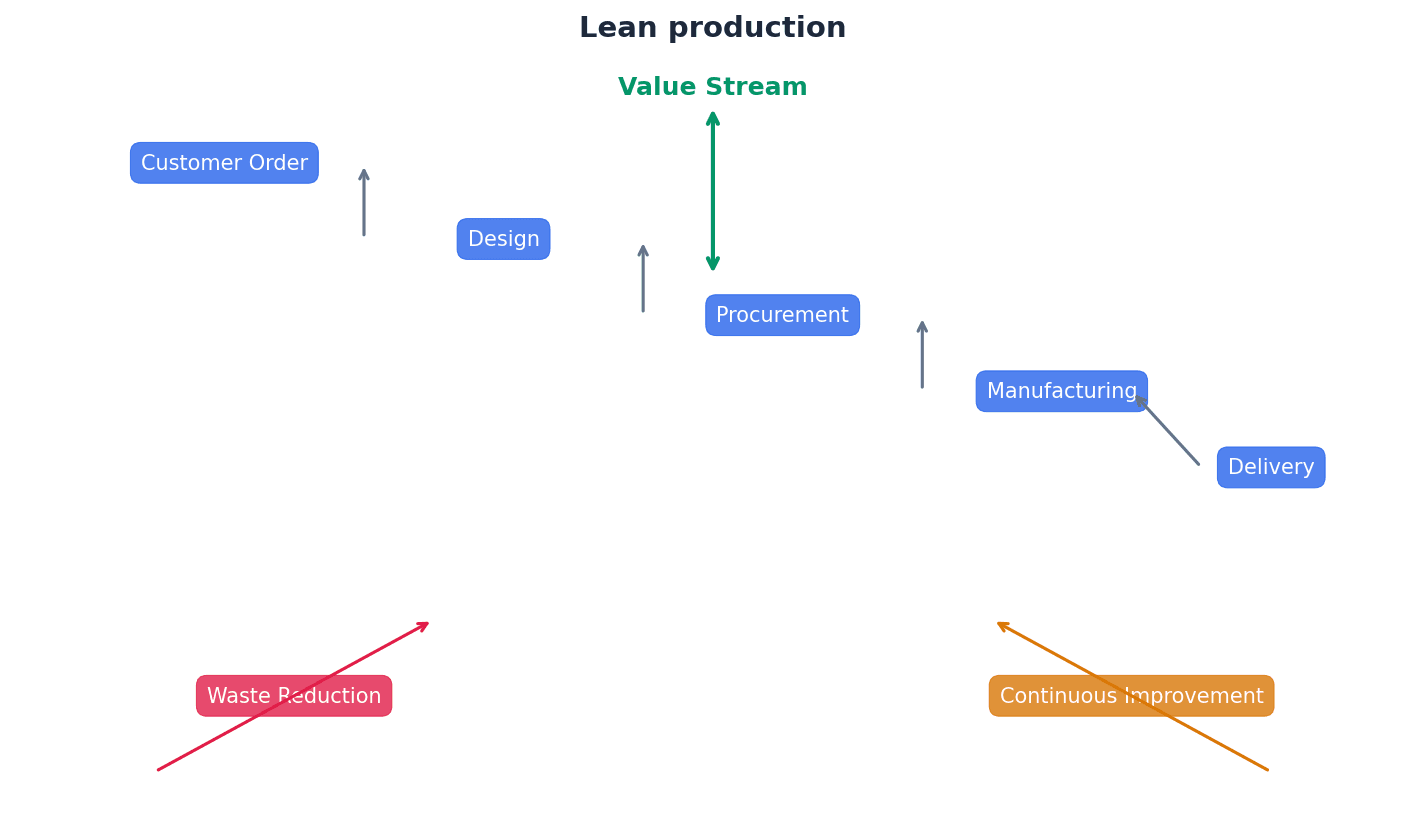
When analysing lean production, ensure you identify and explain specific techniques (e.g., Kaizen, JIT, cell production) and link them directly to the reduction of different types of waste (AO2). Evaluate its impact on sustainability.
Students often think lean production is just about cutting costs, but actually its primary aim is to eliminate waste to improve overall efficiency and quality, which then leads to cost reductions.
Kaizen — A philosophy of continuous improvement where all employees contribute to improving business efficiency and product manufacturing methods through a series of small, ongoing changes.
Kaizen empowers workers, who often have the most hands-on experience, to suggest improvements to quality or productivity. Imagine a sports team constantly reviewing their performance after every game, making small adjustments to their strategy and individual techniques, rather than waiting for a major overhaul once a season. It relies on teamworking and a management culture that values employee involvement, leading to significant efficiency gains over time.
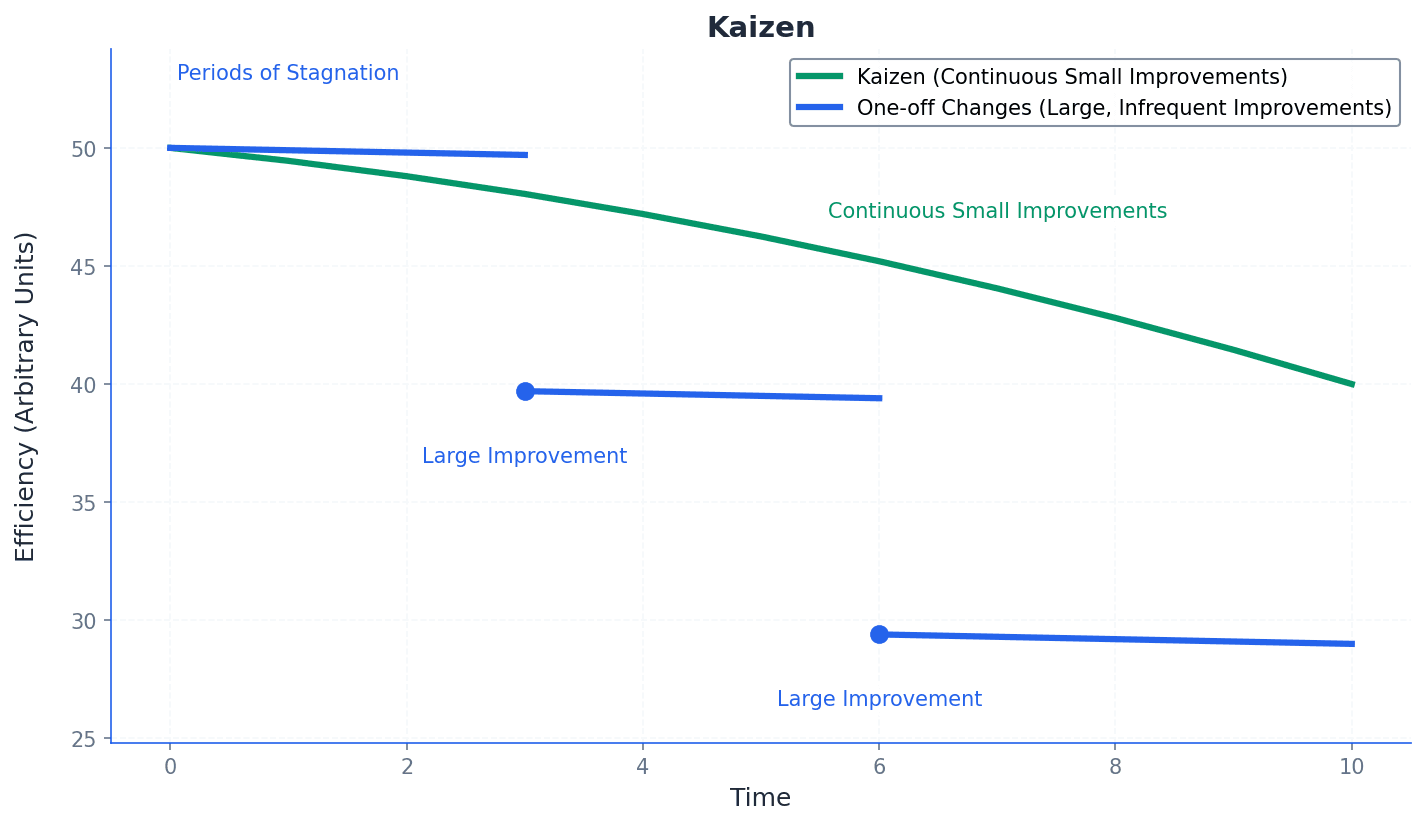
When discussing Kaizen, link it to Herzberg's theory of job enrichment and employee motivation (AO2). Evaluate the conditions necessary for its success, such as management culture and empowerment, and its potential limitations (AO3).
Students often think Kaizen involves only large, one-off investments in new technology, but actually it emphasises small, incremental improvements suggested by employees, which accumulate to significant gains.
Quality circles — Small groups of employees who meet regularly to discuss quality issues, investigate problems, and present solutions to management, or implement improvements if empowered.
Quality circles are a Japanese-originated approach to quality improvement based on worker involvement and participation. A group of nurses in a hospital meeting weekly to discuss how to reduce patient waiting times or improve medication delivery, pooling their collective experience to find practical solutions, is an example. They leverage the knowledge and experience of employees to enhance quality and boost motivation through participation.
Simultaneous engineering — A method of developing new products where the stages of design, market research, costing, and engineering tasks are all done at the same time, rather than sequentially.
This approach saves significant time in new product development, allowing products to reach the market much faster than traditional sequential methods. Instead of a relay race where one runner passes the baton to the next, simultaneous engineering is like a team working together on different parts of the same project at the same time, all contributing to the final goal. It helps businesses stay competitive in fast-changing markets and prevents new products from becoming obsolete during development.
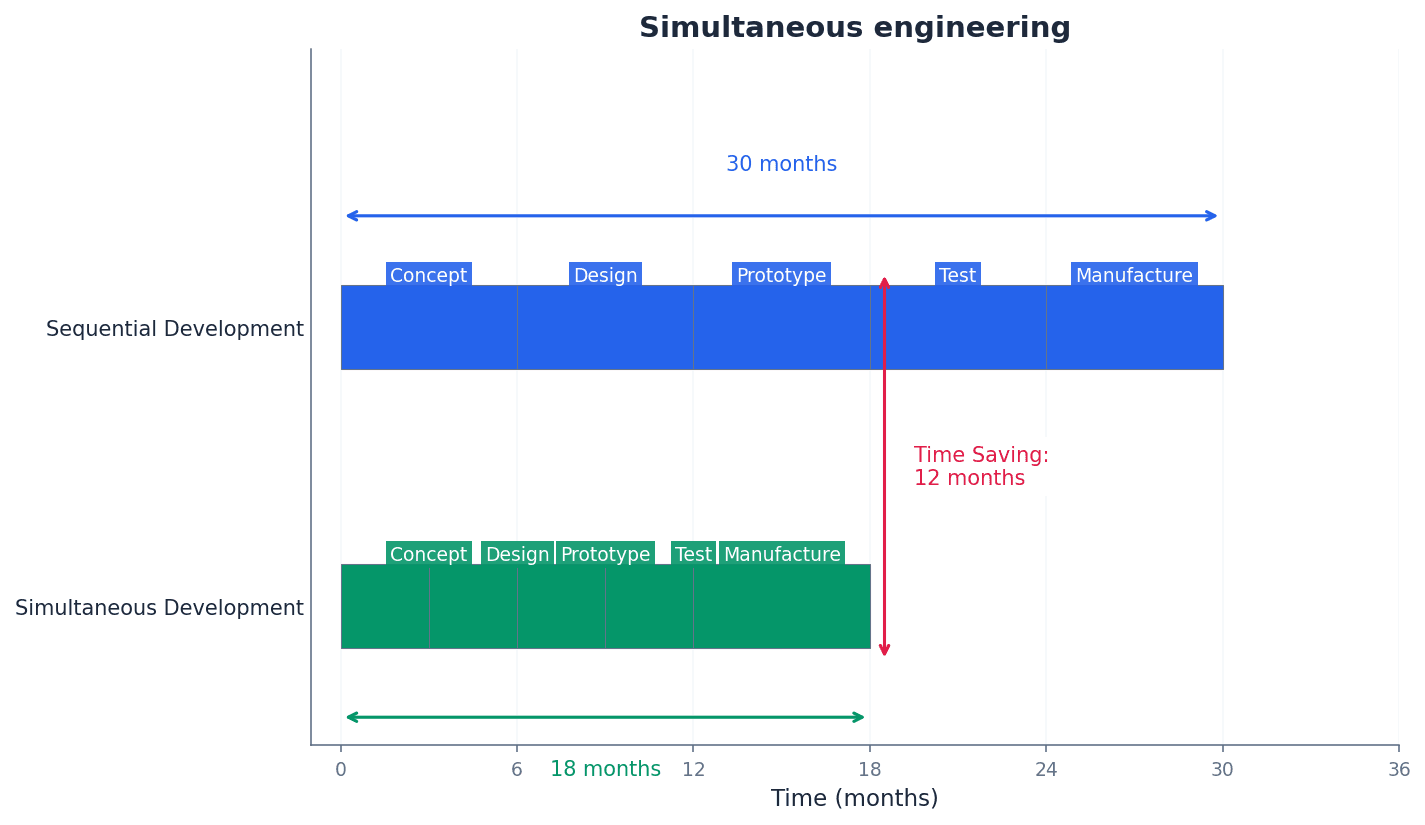
Cell production — A form of flow production where the production line is split into several self-contained mini-production units (cells), with each cell producing a complete unit of work.
Each cell has a team leader and multi-skilled workers, fostering increased teamwork, commitment, and a sense of ownership over the complete unit. Instead of an assembly line where each worker adds one tiny part to a car, imagine small teams each building an entire engine or a complete car door from start to finish. It avoids the monotony of traditional flow production and improves productivity.
Critical path analysis (CPA) — A project management technique that uses network diagrams to indicate the shortest possible time in which a project can be completed and identifies the critical activities that must be finished on time.
CPA helps managers plan and control complex projects by sequencing tasks, estimating durations, and identifying activities that, if delayed, will delay the entire project. Imagine planning a road trip with multiple stops; CPA helps you figure out the absolute minimum time the trip will take and which specific legs of the journey you absolutely cannot delay if you want to arrive on schedule. It allows for efficient resource allocation and accurate delivery date predictions.
When evaluating CPA, discuss both its benefits (e.g., accurate delivery dates, efficient resource use, control tool) and limitations (e.g., guesswork in duration estimates, cost of implementation, reliance on management skill) to achieve a balanced argument (AO3).
Students often think CPA guarantees project success, but actually it is a planning and control tool; its effectiveness depends on accurate estimates, skilled management, and motivated employees to execute the plan.
Network diagram — A visual representation used in critical path analysis where arrows indicate activities and circles (nodes) indicate the end of each activity, showing the sequence of tasks in a project.
Network diagrams help to identify the critical path by visually mapping out all project activities and their dependencies. Think of a flowchart for a complex recipe, where each step is an activity and the completion of one step allows the next to begin, showing you the entire cooking process visually. They are essential for calculating earliest start times (EST) and latest finish times (LFT) for each activity.
Students often think all paths on a network diagram are equally important, but actually only the critical path determines the minimum project duration; other paths have 'float time' and can be delayed without affecting the overall project completion.
Critical path — The sequence of activities in a project that must be completed on time for the project to be finished in the shortest possible time, having no float time.
Any delay in an activity on the critical path will directly delay the entire project. In a chain, the critical path is like the weakest link; if that link breaks, the whole chain fails. Similarly, if any critical activity is delayed, the entire project is delayed. Identifying the critical path allows managers to focus resources and monitoring efforts on these crucial activities to ensure timely project completion.
Earliest start time (EST) — The earliest time each activity can begin, taking into account all of its preceding activities.
The EST is calculated by working forwards through the network diagram, taking the longest route to each node. If you're baking a cake, the EST for putting it in the oven is after all ingredients are mixed and the oven is preheated, not before. It helps in scheduling resources and ordering materials just in time for when they are needed.
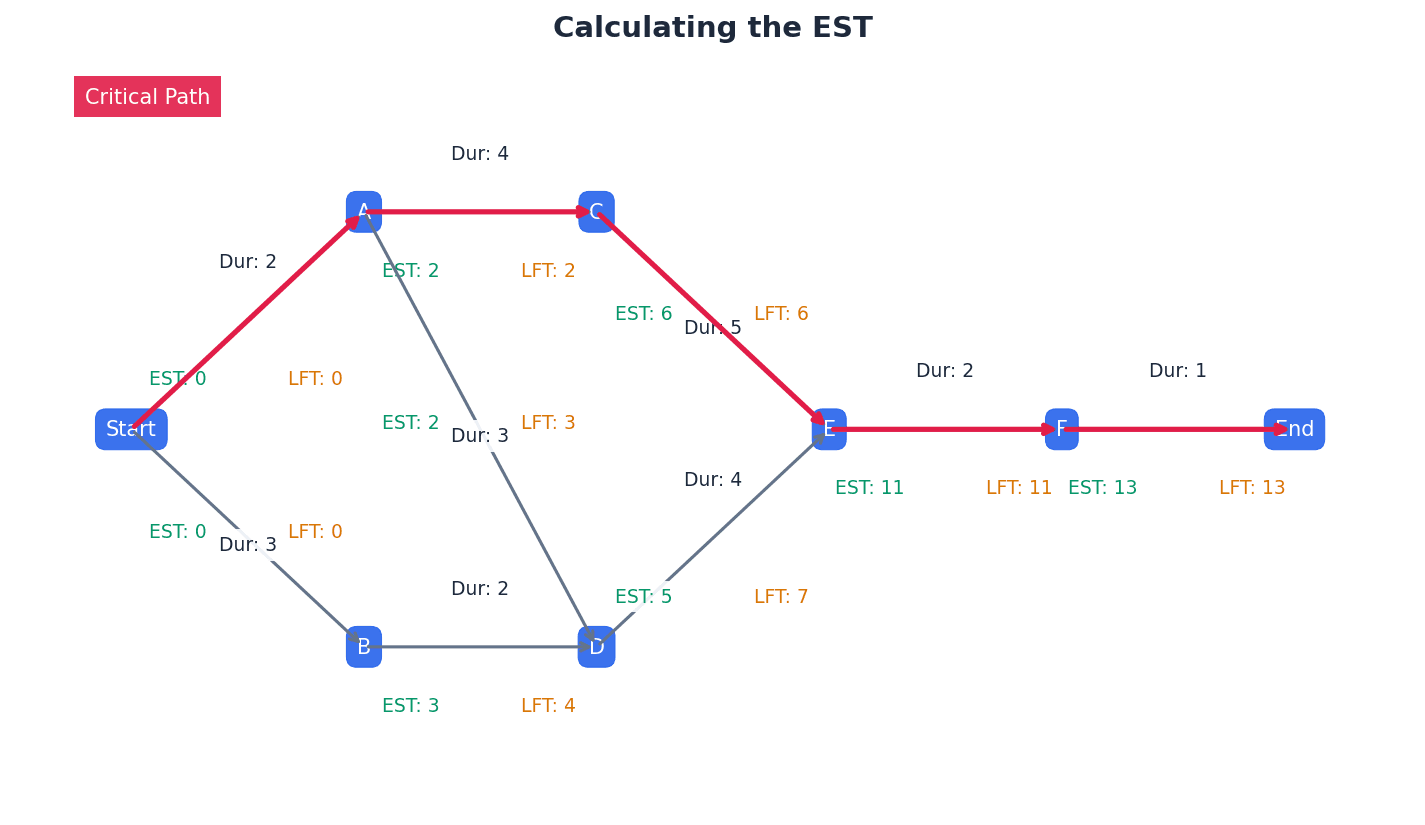
When calculating ESTs, always work from left to right on the network diagram and remember to take the maximum value if multiple paths converge at a node (AO1).
Latest finish time (LFT) — The latest time an activity can finish without delaying the whole project.
The LFT is calculated by working backwards from the project's total duration. If you have a deadline for a school project, the LFT for finishing a specific section is the latest you can complete it without jeopardising the final submission date. It serves as a control tool, allowing managers to check if activities are on schedule and identify potential delays before they impact the overall project completion.
When calculating LFTs, work from right to left on the network diagram and remember to take the minimum value if multiple paths diverge from a node (AO1).
Float time — The amount of spare time available for non-critical activities, allowing them to be delayed without extending the total project duration.
Float time provides flexibility in scheduling and resource allocation. Imagine having a buffer of extra time in your schedule for a non-urgent task; if something unexpected comes up, you can use that buffer without affecting your main deadline. It allows managers to reallocate resources from non-critical activities to critical ones if delays occur, optimising resource use.
Total float — The amount of time an activity can be delayed without delaying the entire project.
Total float is calculated as LFT - duration - EST. If you have a week-long task that needs to be done by the end of the month, and the project finishes on the 25th, but you could finish it by the 20th, you have 5 days of total float. It indicates the maximum flexibility for an activity without impacting the overall project completion date or changing the critical path.
Total float
Used to calculate the maximum time an activity can be delayed without delaying the entire project. LFT is Latest Finish Time, EST is Earliest Start Time, and duration is the activity's duration.
Free float — The amount of time an activity can be delayed without delaying the start of any subsequent activity.
Free float is calculated as EST (next activity) - duration - EST (this activity). If you finish your part of a group project early, the extra time you have before the next person needs your work is your free float. It is a more restrictive measure than total float, focusing on the immediate impact on dependent tasks.
Free float
Used to calculate the maximum time an activity can be delayed without delaying the start of any subsequent activity. EST (next activity) is the Earliest Start Time of the activity immediately following, and EST (this activity) is the Earliest Start Time of the current activity.
Dummy activity — An activity shown by a dotted line on a network diagram that does not consume either time or resources, but shows a logical dependency between other activities.
Dummy activities are included in network diagrams to prevent illogical paths from being created and to correctly represent complex dependencies where one activity depends on the completion of multiple preceding activities, but not all of them. Imagine a rule that says you can't start painting a room until both the walls are plastered and the floor is covered. The 'floor covered' step might not take time itself, but it's a necessary condition, represented by a dummy activity.
When asked to construct or interpret a network diagram, ensure all activities are represented by arrows, nodes are correctly numbered, and dependencies are accurately shown, including dummy activities where necessary (AO1, AO2).
When evaluating CPA, always balance its benefits (e.g., resource planning) with its limitations (e.g., reliance on accurate estimates, can become complex).
Advantages & Disadvantages
Enterprise Resource Planning (ERP)
Lean Production
Evaluation Starters
Essay Structure Guide
Introduction
Begin by defining operations strategy and briefly outlining the key areas it encompasses, such as efficiency, quality, and responsiveness. State the main arguments you will present regarding the factors influencing operations decisions or the impact of specific techniques.
Conclusion
Summarise your main arguments, reiterating the most significant influences or impacts. Provide a final, balanced judgment on the overall effectiveness or importance of the operations strategies discussed, perhaps suggesting which factors are most critical or how they interact for optimal performance.
This chapter explores the essential role of finance in business, distinguishing between short-term and long-term needs, and capital versus revenue expenditure. It details various internal and external funding sources, including retained earnings, bank loans, and share capital, while also analysing working capital management and key factors influencing finance decisions for business success.
Start-up capital — The cash injections from the owner(s) to purchase essential capital equipment and, possibly, premises when setting up a business.
This initial finance is crucial for new businesses to acquire the necessary assets to begin operations, much like the initial funds needed to buy ingredients and equipment before opening a small bakery. Without sufficient start-up capital, a business may struggle to establish itself and become operational.
When asked to explain the need for finance, specify 'start-up capital' for new businesses, linking it to initial asset purchases.
Working capital — The day-to-day finance needed to pay bills and expenses and to build up inventories, calculated as current assets minus current liabilities.
Working capital is essential for a business's short-term liquidity and operational continuity, similar to daily spending money for groceries and bills, distinct from savings for a house down payment. Insufficient working capital can lead to illiquidity and potential business failure, while excessive working capital can represent an opportunity cost.
Students often think working capital is just cash, but actually it includes all current assets (like inventory and receivables) minus current liabilities.
Working Capital
Used to assess a business's short-term liquidity and operational finance needs, where current assets are convertible to cash within one year and current liabilities are debts due within one year.
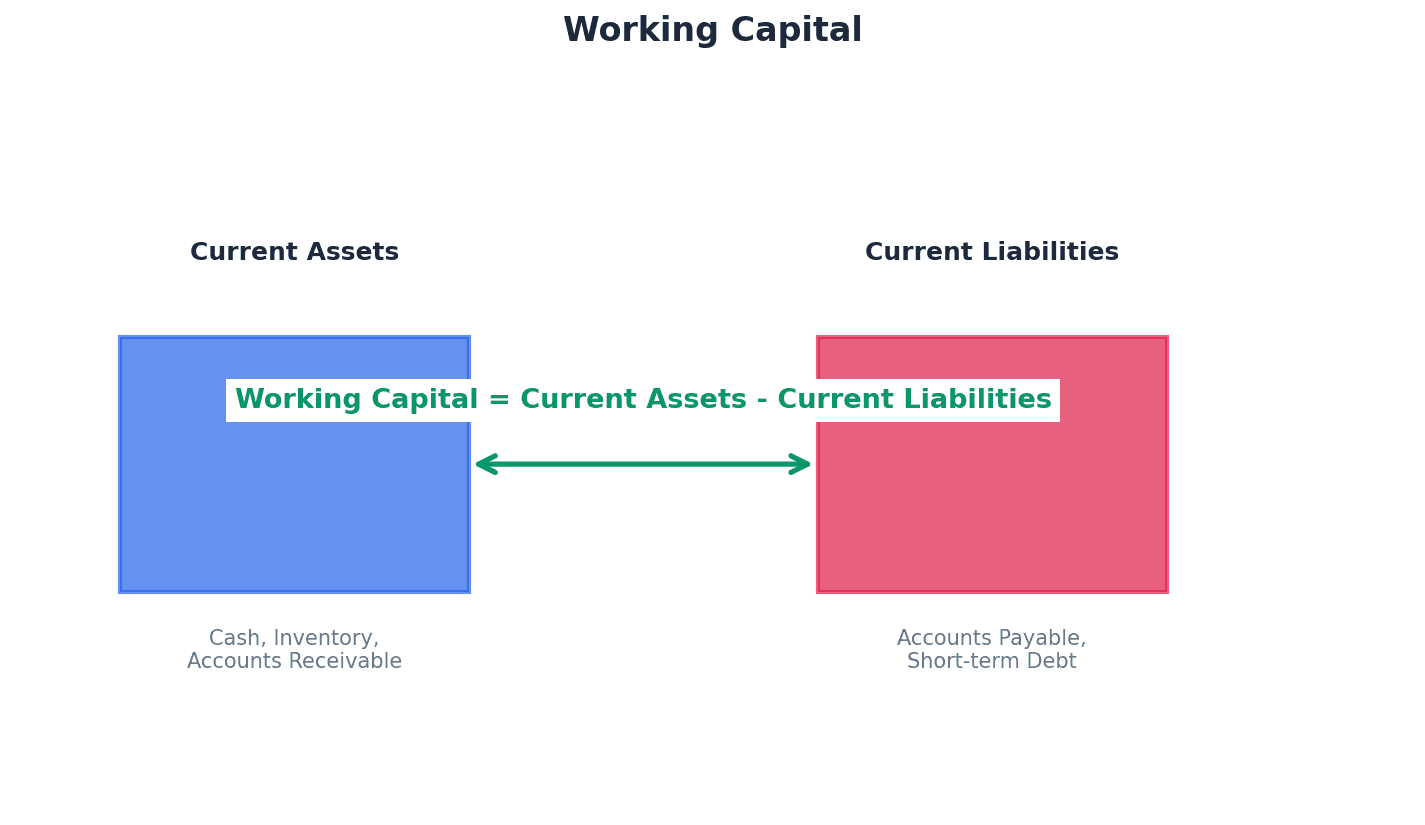
When analysing the importance of working capital, discuss both the risks of too little (illiquidity) and the opportunity cost of too much, linking it to the working capital cycle.
Businesses require finance for various critical reasons, broadly categorised into start-up capital for initial asset purchases, working capital for day-to-day operations, and capital expenditure for expansion or acquiring non-current assets. Understanding these distinct needs is crucial for selecting appropriate funding sources and ensuring business success. A common pitfall is confusing cash with profit; a business can be profitable but still face liquidity issues if it lacks sufficient cash.
Students often confuse cash and profit, leading to misunderstandings about business liquidity versus profitability.
A key distinction in business finance is between capital expenditure and revenue expenditure. Capital expenditure involves spending on non-current assets, such as machinery or buildings, which are expected to provide benefits for more than one year. In contrast, revenue expenditure covers the day-to-day running costs of a business, like wages, rent, and utility bills. This differentiation is vital for financial planning and selecting appropriate long-term or short-term finance sources.
Students often think all finance needs are the same, failing to differentiate between short-term and long-term finance requirements.
Administration — A process where specialist accountants are appointed to try to keep a failing business operational and find a buyer for it.
This is a legal process initiated when a business faces financial difficulties, often due to lack of finance, to attempt rescue before liquidation. The administrators aim to preserve the business or maximise value for creditors, much like a patient on life support where doctors try to stabilise them before deciding on long-term treatment.
Distinguish administration from liquidation; administration is a rescue attempt, while liquidation is the winding up of the business.
Students often think administration means the business has already failed, but actually it's an attempt to prevent outright failure and liquidation.
Bankruptcy — A legal process that begins when a business fails due to lack of finance, leading to the liquidation of its assets.
Bankruptcy is the formal declaration of a business's inability to pay its debts, triggering a legal procedure to sell off assets, similar to a person declaring bankruptcy where their assets are sold to pay off debts. The primary goal is to raise funds to repay creditors as much as possible.
Use 'bankruptcy' to describe the legal status of insolvency, and 'liquidation' for the process of selling assets to pay debts.
Students often think bankruptcy is the same as administration, but actually bankruptcy is the legal state that often follows administration if rescue efforts fail, leading to liquidation.
Liquidation — The legal process of selling off the assets of a bankrupt business to raise as much finance as possible to pay back its creditors.
This is the final stage for a failed business, where all assets are converted into cash to settle outstanding debts, much like selling off all belongings at a garage sale to pay off credit card debt. It signifies the end of the business's operations.
When discussing business failure, link liquidation directly to the repayment of creditors from asset sales, not just closure.
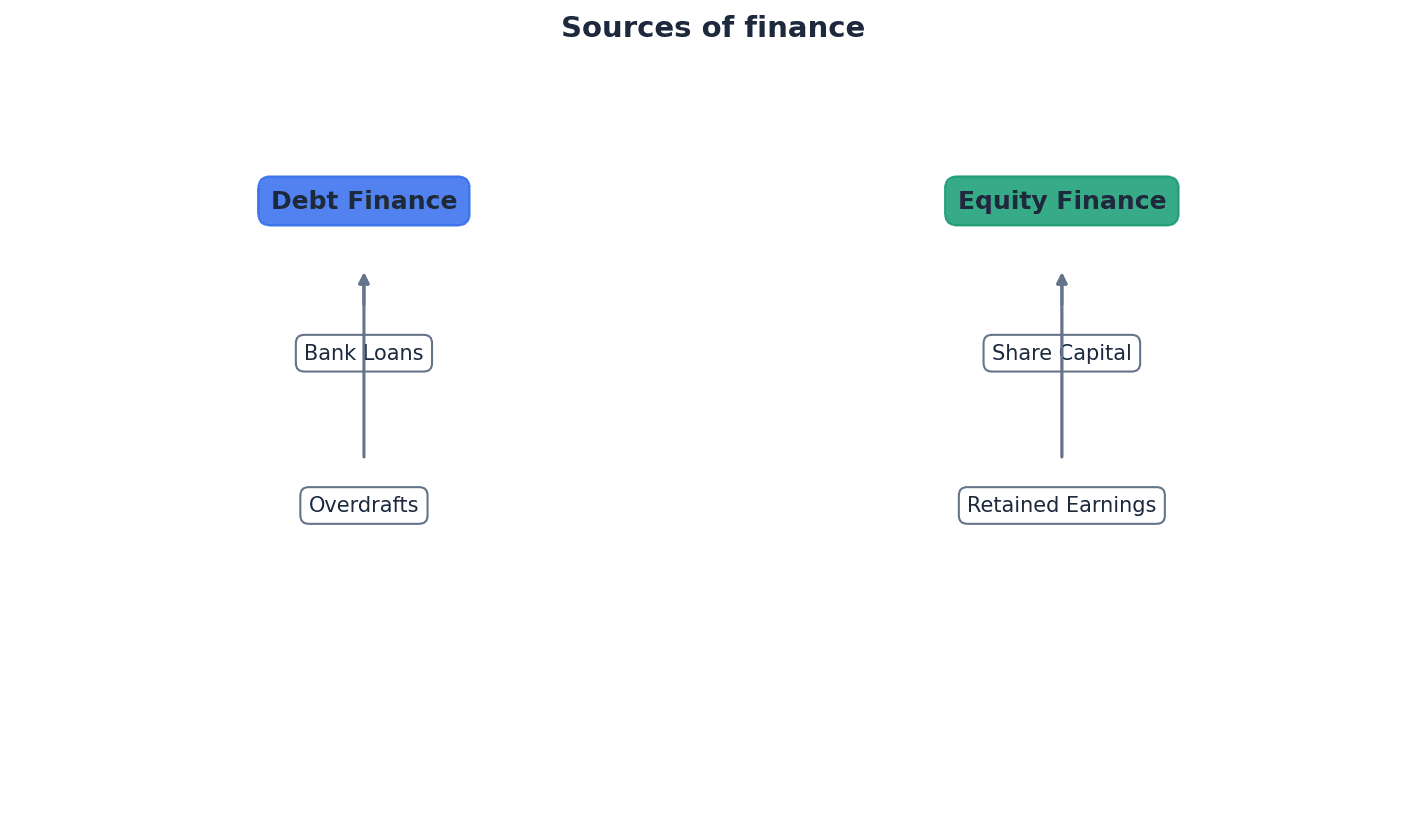
Internal sources of finance are generated from within the business itself, offering a potentially cheaper and more accessible option. Key internal sources include retained earnings (retained profit), which is profit kept within the business for reinvestment rather than distributed as dividends. Other methods involve the sale of unwanted assets or a sale and leaseback arrangement for non-current assets, converting them into cash while retaining their use. While internal finance avoids external borrowing costs, it carries an opportunity cost, as these funds could have been used elsewhere, such as for shareholder dividends.
Students often assume internal finance is 'free' without considering opportunity costs or the impact on growth.
Bank overdraft — A flexible short-term external source of finance where a bank allows a business to spend more money than it has in its account, up to an agreed limit.
Overdrafts are useful for managing short-term cash flow fluctuations, such as unexpected payments or delayed customer receipts, acting like a temporary safety net on a bank account. They are flexible but can incur high interest charges and can be recalled by the bank at short notice.
Highlight the flexibility and short-term nature of overdrafts, but also mention the high interest rates and the risk of recall by the bank.
Trade credit — A short-term external source of finance obtained by delaying payment to suppliers for goods or services received.
This effectively means suppliers become creditors, providing goods without immediate payment, thus financing the purchasing business, much like buying groceries now and paying for them next week. However, taking too long to pay can result in losing discounts for quick payment, which is an indirect cost.
When discussing trade credit, mention the benefit of delayed payment but also the potential cost of lost discounts for prompt payment.
Debt factoring — A short-term external source of finance where a business sells its claims on trade receivables to a debt factor to obtain immediate cash.
This helps businesses improve their liquidity by converting accounts receivable into cash quickly, especially when customers are given long credit periods, similar to selling a future lottery ticket win for an immediate, smaller cash payment. The debt factor pays less than the full value of the debt, making a profit when the customer eventually pays.
Focus on debt factoring as a way to improve short-term cash flow and liquidity, but acknowledge the cost of discounting the debt.
Hire purchase — A form of credit for purchasing an asset over a period of time, allowing the purchasing business to own the asset after regular payments.
This avoids a large initial cash outlay for an asset, spreading the cost over time through regular payments that include interest and partial capital repayment, much like buying a car on an instalment plan. Interest rates can be higher than bank loans, but ownership transfers to the business.
Distinguish hire purchase from leasing by emphasising that ownership of the asset transfers to the business with hire purchase.
Leasing — A long-term external source of finance involving a contract with a leasing company to acquire and use an asset without necessarily purchasing it.
Businesses make regular payments over the agreement's life, avoiding the upfront cash purchase and reducing risks associated with outdated or unreliable equipment, as the leasing company often handles repairs and updates, similar to renting an apartment instead of buying a house. It improves short-term cash position but can be a high-cost option, and the business typically does not own the asset.
Debentures — A long-term external source of finance where a company issues bonds to investors, agreeing to pay a fixed rate of interest each year for the life of the debenture.
Debentures represent a loan to the company, which must be repaid at maturity, often up to 25 years, much like a government bond. They provide a fixed income stream to investors and do not require collateral over non-current assets, though convertible debentures can be converted into shares.
Emphasise that debentures are debt, not equity, and highlight the fixed interest payments and eventual repayment, unless convertible.
Students often think debentures are shares, but actually they are a form of loan (debt capital) with fixed interest payments, not equity.
Business mortgages — Loans offered by banks and other financial institutions specifically for a business to purchase premises, secured by the property itself.
These are long-term loans, similar to residential mortgages, used for acquiring real estate. The interest rate can be fixed or variable, and the property acts as collateral, meaning the lender can sell it if the business defaults, just like a home mortgage.
Specify that business mortgages are for property purchases and are secured by the property, distinguishing them from general bank loans.
Share capital — Permanent finance raised by limited companies through the issue and sale of shares to investors, which never has to be repaid unless the company is liquidated.
This is equity capital, representing ownership in the company, much like selling small pieces of a lemonade stand to friends who then own a part of it and share in the profits. It provides permanent funds for expansion and asset purchase, and dividends are paid from profits after tax, unlike loan interest which is tax-deductible.
Clearly differentiate share capital (equity) from loan capital (debt) by focusing on ownership, repayment obligations, and dividend vs. interest payments.
Students often confuse debt capital (loans, debentures) with equity capital (shares), overlooking differences in ownership, repayment, and tax implications.
Rights issue of shares — A method for public limited companies to raise further capital by selling additional shares to existing shareholders, usually in proportion to their current holdings.
This method is relatively cheap as it avoids public promotion costs and does not dilute the ownership of existing shareholders if they all buy their allocation, similar to a club offering its current members the first chance to buy more tickets. However, it can increase the supply of shares, potentially reducing the existing share price in the short term.
When discussing rights issues, highlight the benefit of maintaining existing ownership structure and lower costs, but also mention the potential for a short-term fall in share price.
Venture capital — Long-term investment funds provided by specialist organisations or wealthy individuals to business start-ups or small to medium-sized businesses that find it difficult to raise capital from other sources.
Venture capitalists take on high risks, often investing in innovative or complex projects, in exchange for a share of future profits or a significant equity stake in the business, much like a wealthy patron funding a promising but unproven artist. They provide crucial funding for high-growth potential but risky ventures.
Emphasise that venture capital is for high-risk, high-growth potential businesses and involves giving up a share of ownership or future profits.
Microfinance — The provision of small capital sums to entrepreneurs, particularly important in developing, relatively low-income countries, often to individuals with no access to traditional banking services.
Microfinance enables very poor people to start small enterprises, helping to generate income and improve living standards, like a tiny loan from a friend to buy materials for a small craft business. While it addresses a critical need, interest rates can be high due to administration costs, and there's a risk of debt for failed ventures.
When discussing microfinance, focus on its role in supporting entrepreneurship in developing countries and its impact on poverty, while also noting potential drawbacks like high interest rates.
Crowd funding — An increasingly significant source of finance for new business start-ups where entrepreneurs promote their business idea to many people, who each invest a small sum.
This method leverages online platforms to gather small investments from a large number of individuals, often when traditional banks are unwilling to lend, much like passing a hat around a large crowd online. Investors may receive interest, an equity stake, or simply make a donation, depending on the venture. It also provides promotion but carries risks of idea copying and high investor record-keeping.
Highlight crowd funding's benefits for start-ups struggling with traditional finance and its promotional aspect, but also mention the administrative burden and risk of idea theft.
When making finance decisions, managers must consider several critical factors to ensure business success and avoid failure. These include the business's legal structure, as unincorporated businesses have different options than limited companies. The amount of finance needed, the purpose for which it is required (e.g., short-term working capital vs. long-term capital expenditure), and the associated costs (interest rates, dilution of ownership) are also crucial. Evaluating these factors helps in recommending and justifying the most appropriate source of finance for different business needs.
Students often think unincorporated businesses have the same finance options as limited companies, neglecting the restriction on selling shares.
Always justify your choice of finance by explicitly linking it to the specific need mentioned in the case study (e.g., 'A long-term bank loan is appropriate for purchasing new machinery because...').
In your conclusion, make a clear recommendation for the most suitable source of finance and provide a well-supported justification based on your analysis.
Advantages & Disadvantages
Retained Earnings (Internal Finance)
Bank Loans (Debt Capital)
Evaluation Starters
Essay Structure Guide
Introduction
Begin by defining business finance and briefly outlining why businesses need it (start-up, working capital, capital expenditure). State the purpose of your essay, which is to evaluate various sources of finance and recommend the most appropriate for a given scenario.
Conclusion
Summarise the main arguments, reiterating the importance of matching the source of finance to the business's specific needs and circumstances. Make a clear, justified recommendation for the most appropriate source(s) of finance for the scenario presented in the question, drawing directly from your analysis and evaluation.
This chapter explores the vital role of cash flow for business survival, differentiating it from profit. It covers the creation, interpretation, and benefits of cash flow forecasts, while also examining common causes of cash flow problems and evaluating strategies to improve a business's cash position.
Cash flow forecasts — Estimates of future cash inflows and cash outflows, usually on a month-by-month basis.
These forecasts are crucial for financial planning, especially for new businesses, as they help predict potential cash shortages and ensure sufficient liquidity to meet obligations. They differ from profit forecasts by focusing solely on the movement of cash. Think of a cash flow forecast like a personal budget for your monthly income and expenses; it helps you see if you'll have enough money to pay your bills at the end of each month, regardless of how much you 'earned' but haven't yet received.
Trade receivables — Money owed to the business by customers for goods or services supplied on credit.
Managing trade receivables is vital for cash flow, as delays in collection can lead to liquidity problems. Businesses often offer credit to be competitive, but this requires careful control to ensure timely payments. If you lend money to a friend for lunch, that friend becomes your 'trade receivable' until they pay you back. The longer they take to pay, the longer you're out of pocket.
Overtrading — When a business expands rapidly, paying for increased wages and materials months before receiving cash from additional sales, leading to serious cash flow shortages.
This phenomenon can occur even in successful, expanding businesses, as the cash outflow for growth outpaces the cash inflow from new sales, creating a liquidity crisis. It highlights the difference between profit and cash flow. Imagine building a huge new house (expansion) that requires you to buy all the materials and pay all the builders upfront, but you only get paid for the house once it's finished and sold months later. You might run out of money for daily expenses before the payment comes in.
Debt factors — Specialist financial institutions that buy claims on trade receivables from other businesses that have an immediate need for cash.
This method provides immediate cash to a business by selling its outstanding invoices, but it comes at a cost as the debt factor will pay less than 100% of the invoice value to make a profit. It's a way to accelerate cash inflow. If you have a gift card for a store but need cash immediately, you might sell it to someone else for slightly less than its face value. The buyer is like a debt factor, giving you cash now but making a small profit.
Trade payables — Money owed by the business to its suppliers for goods or services purchased on credit.
Managing trade payables involves strategically delaying payments to suppliers to improve the business's own cash flow. However, this must be balanced against maintaining good relationships with suppliers and avoiding loss of discounts. If you buy groceries on credit from a local shop, you become a 'trade payable' to that shop until you pay your bill. The longer you take to pay, the longer you keep your cash.
Closing cash balance
Used to calculate the cash position at the end of a specific period (e.g., month). A negative closing balance indicates a need for an overdraft or additional finance.
Cash is critical for business survival, as it enables a firm to pay its immediate bills, such as wages, rent, and suppliers. Without sufficient cash, a business, even a profitable one, can face liquidity problems and ultimately failure. Understanding and managing cash flow is therefore paramount for financial stability.
Students often confuse cash flow with profit. Remember that cash flow is the actual movement of money in and out of the business, while profit is revenue minus costs, which may include non-cash items or credit transactions.
Cash flow forecasts are essential tools for financial planning, providing estimates of future cash inflows and outflows over a specific period, typically month-by-month. Their primary purpose is to predict potential cash shortages, allowing businesses to take proactive measures to secure finance or adjust operations. A typical forecast details expected cash receipts (inflows) and payments (outflows), leading to a net cash flow and a closing cash balance for each period.
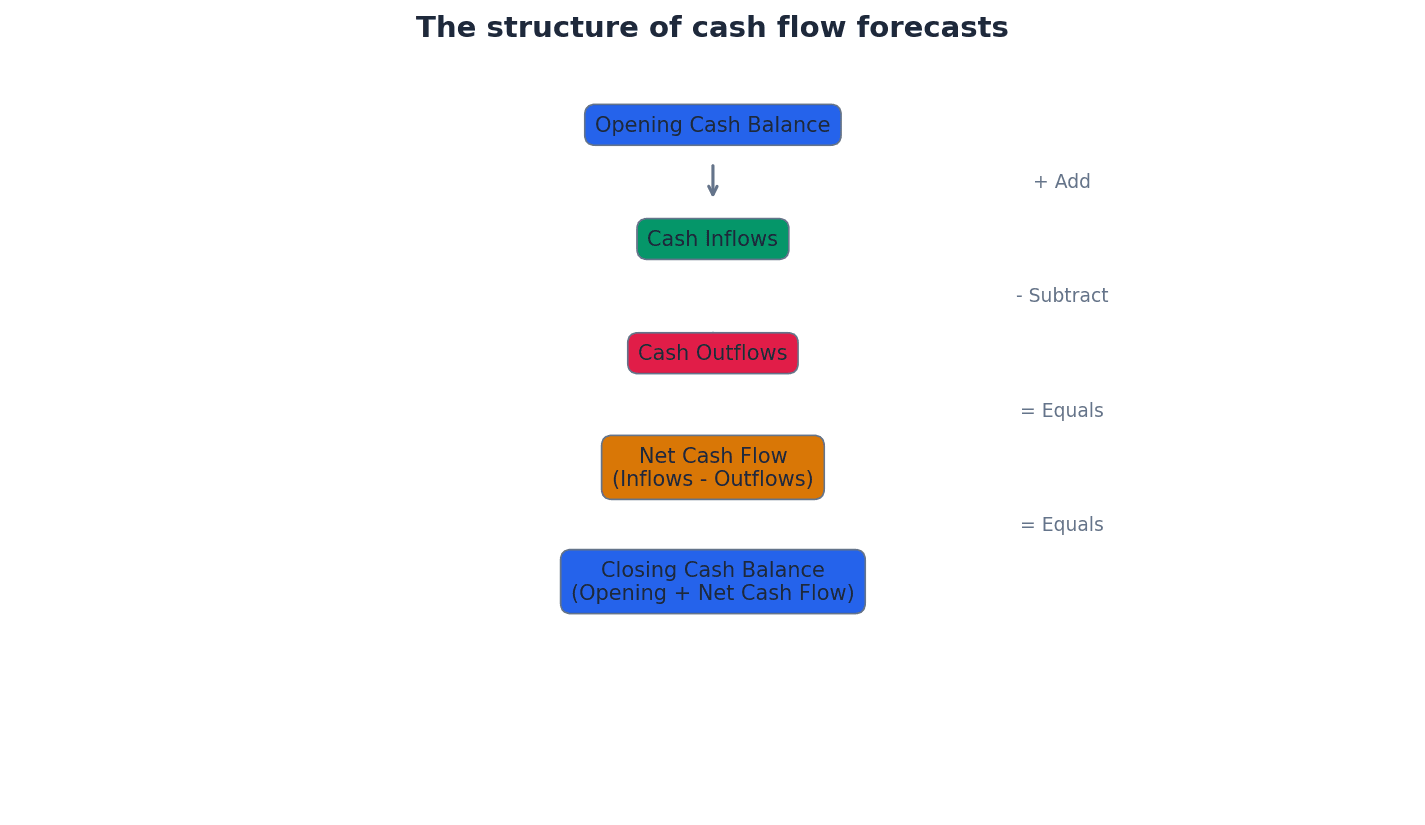
When asked to analyse the purpose or benefits of cash flow forecasts, ensure you link them directly to managing liquidity, identifying potential shortfalls, and securing finance, rather than just stating they predict sales.
Students often think forecasts are actual accounts and are always accurate. Remember, a cash flow forecast is an estimate based on assumptions and can be invalidated by unexpected events.
Businesses can encounter cash flow problems due to various factors, including a lack of effective financial planning and poor credit control. Allowing customers too long to pay their debts (trade receivables) can significantly reduce cash inflows. Rapid expansion, known as overtrading, can also lead to severe cash shortages as outflows for growth outpace inflows from new sales. Unexpected events, such as economic downturns or supply chain disruptions, can further exacerbate these issues.
When analysing reasons for cash flow problems, 'expanding too rapidly' (overtrading) is a key point. Ensure you explain the mechanism: cash outflows for expansion occur before cash inflows from increased sales are realised.
Students often think rapid expansion is always a sign of success. Remember, it can lead to overtrading and severe cash flow problems if not properly financed, even for a profitable business.
Businesses can improve their cash position by focusing on two main strategies: increasing cash inflows and reducing cash outflows. Increasing inflows might involve stricter credit control, offering discounts for early payment from customers, or using debt factors. Reducing outflows could involve negotiating longer credit periods with suppliers (managing trade payables) or carefully managing inventory levels.
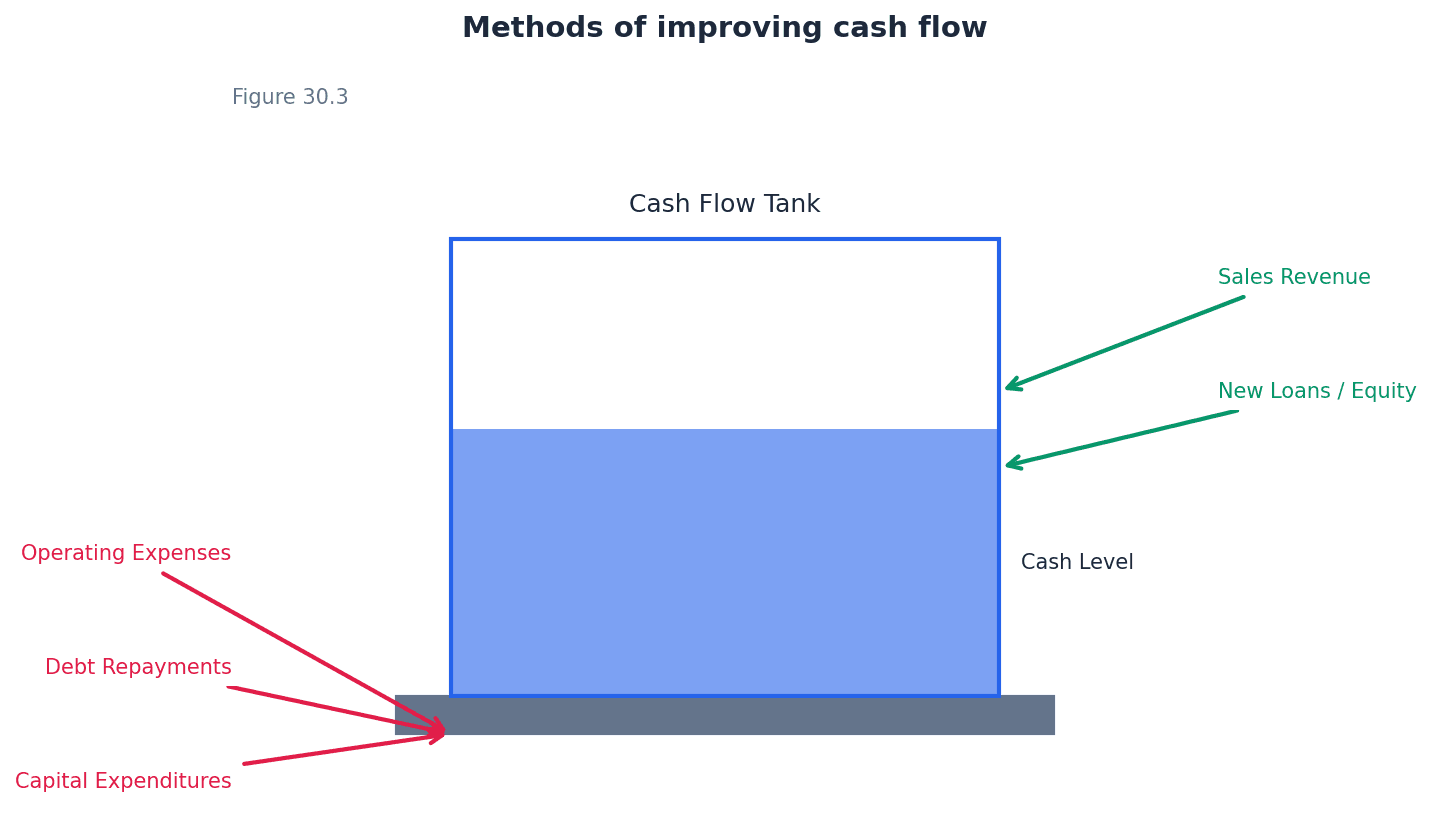
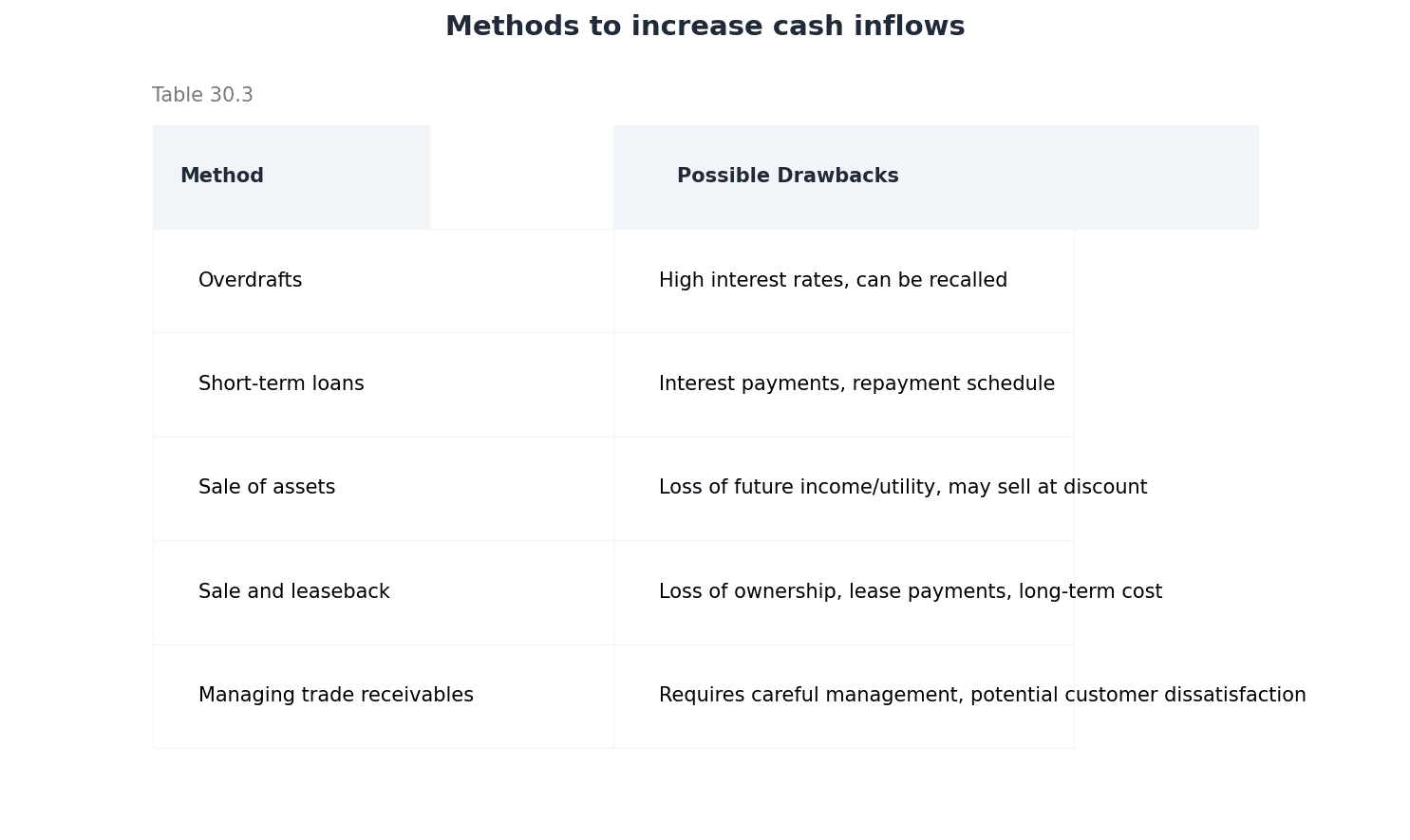
When discussing methods to improve cash flow by managing trade receivables, evaluate the potential drawbacks, such as losing customers if credit terms are too strict or reducing profit margins if discounts are offered for early payment.
Students often think trade receivables are always a good thing because they represent sales. Remember, they can cause cash flow problems if not managed effectively, as the cash has not yet been received.
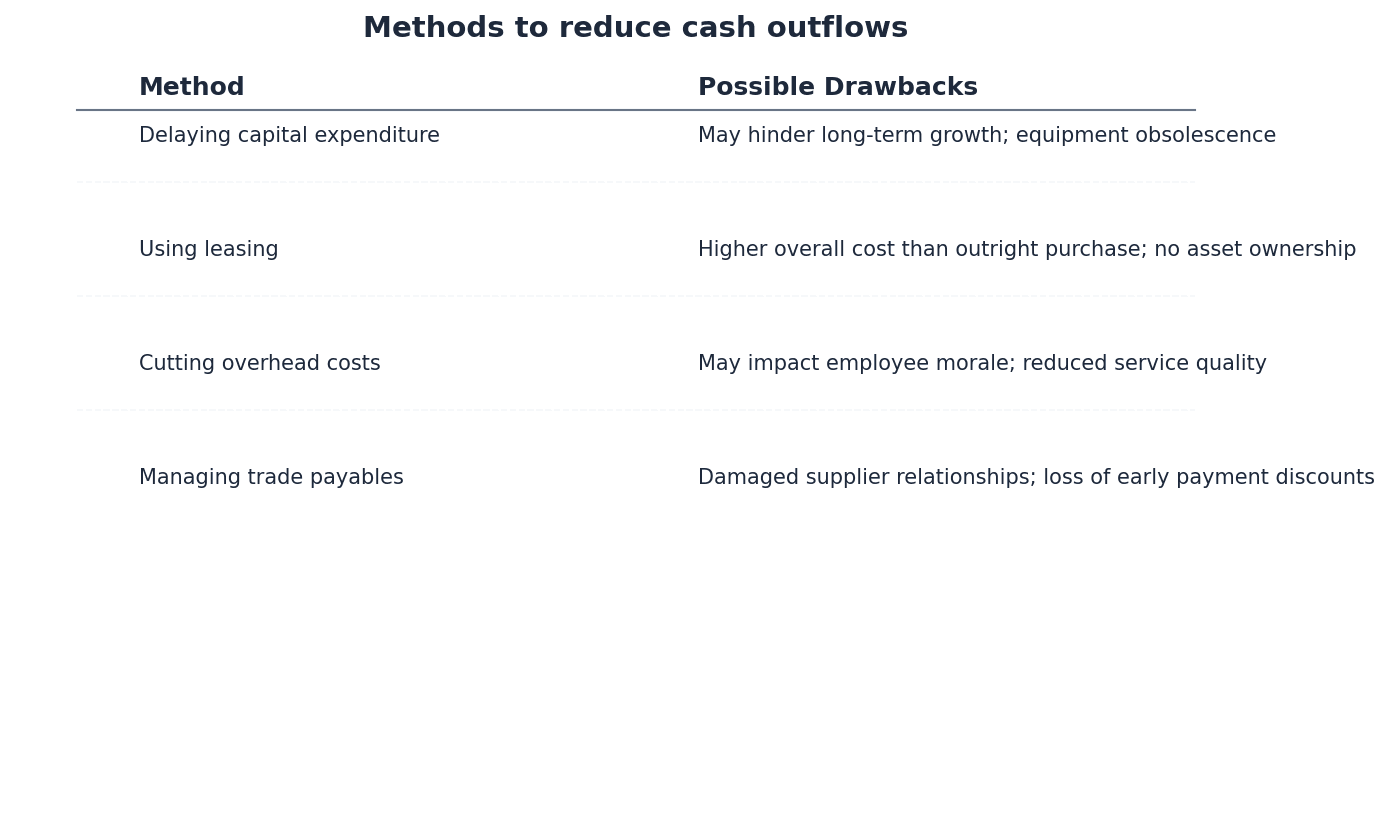
When evaluating debt factoring as a method to improve cash flow, remember to discuss the trade-off: immediate cash inflow versus the cost (loss of full value) and potential impact on customer relationships if the factor becomes involved in collection.
Students often think selling claims to debt factors means the business gets the full value of the debt. Remember, debt factors charge a fee, meaning the business receives less than the full amount.
When discussing managing trade payables to improve cash flow, ensure you consider the potential negative impacts on supplier relationships and the possibility of losing valuable discounts for early payment.
Students often think delaying payments to suppliers is always a good strategy. Remember, it can damage supplier relationships, lead to loss of discounts for prompt payment, or even result in suppliers refusing to offer credit.
When interpreting a forecast, always comment on the closing balance. A negative or consistently falling closing balance is a major red flag, indicating a need for immediate action.
Advantages & Disadvantages
Using Cash Flow Forecasts
Managing Trade Receivables (e.g., stricter credit control, discounts for early payment)
Evaluation Starters
Essay Structure Guide
Introduction
Begin by defining cash flow and its importance, clearly distinguishing it from profit. State the purpose of cash flow forecasts and briefly outline the main areas to be discussed (causes of problems, methods of improvement).
Conclusion
Summarise the key arguments, reiterating the critical importance of cash flow management. Provide a final, justified recommendation or overall judgment on the most effective strategies, considering the trade-offs and the need for a balanced approach to ensure both liquidity and profitability.
This chapter explores the crucial role of cost information in business decision-making, categorising costs into direct, indirect, fixed, and variable. It contrasts full costing, which allocates all costs to products, with contribution costing, focusing on marginal costs and contribution to overheads. The chapter also details break-even analysis, explaining its calculation, interpretation, and evaluation for various business scenarios.
Direct costs — These costs are easy to identify as being incurred by a particular cost centre.
Direct costs are directly attributable to a specific product, service, or department, such as the flour, sugar, and eggs used to bake a specific cake. In manufacturing, these are typically direct labour and materials; in service businesses, it's the cost of goods sold. They are crucial for calculating the marginal cost of a product.
Indirect costs — Indirect costs are often referred to as overheads and are incurred by the business, but they cannot easily be divided up between cost centres.
These costs support the overall operation of the business but are not directly tied to the production of a single unit or service, similar to the rent for a bakery building which supports all products. Examples include rent, administrative salaries, and general marketing expenses. Allocating them accurately across multiple products is a major challenge in costing.
Fixed costs — These do not change when the level of output changes, for example, the rent of a factory or shop.
Fixed costs remain constant in the short run, regardless of the volume of goods or services produced, much like a monthly subscription fee for a streaming service. They are incurred even if no output is generated. Understanding fixed costs is essential for break-even analysis and long-term planning.
Variable costs — These vary as output changes, for example, the direct cost of materials used in making a washing machine or the electricity used to cook a fast-food meal.
Variable costs increase or decrease in direct proportion to the level of output, similar to the cost of ingredients for each burger sold. They are incurred only when production occurs. Identifying variable costs is crucial for calculating marginal cost and contribution.
Semi-variable costs — Semi-variable costs include both a fixed and a variable element.
These costs have a base fixed component that must be paid regardless of output, plus an additional variable component that changes with the level of activity. An example is a mobile phone bill with a fixed line rental and variable data charges. They are more complex to classify than purely fixed or variable costs.
Total costs — The fixed and variable costs of a business can be added together to give total costs in a time period.
Total costs represent the sum of all expenses incurred by a business over a specific period, encompassing both fixed and variable components, like the sum of fixed insurance and variable fuel costs for a car. This figure is essential for calculating overall profit or loss and for break-even analysis.
Students often think all direct costs are variable costs, but actually a direct cost like a specific machine bought for one department might be fixed.
Students often think all indirect costs are fixed, but actually some indirect costs, like electricity for a whole factory, can have a variable element.
When asked to identify direct costs, ensure your examples are clearly and uniquely linked to a single cost centre or product, such as 'wood for a specific table' or 'mechanic's labour for a specific car repair'.
Cost centres — Cost centres are sections of a business to which costs can be allocated or charged.
These can be products, departments, factories, or specific processes, such as the 'Science Department' in a school. Identifying cost centres helps managers monitor and control costs more effectively, allowing for performance assessment and resource allocation decisions. They are not directly responsible for generating revenue.
Profit centres — Profit centres are sections of a business to which both costs and revenues can be allocated.
These are typically divisions, branches, or product lines that are responsible for both generating revenue and incurring costs, allowing their profitability to be measured independently, similar to each branch of a supermarket chain. They are used to assess the performance of managers and divisions.
Overheads — These indirect expenses of a business are usually classified into four main groups: production, selling and distribution, administration, and finance.
Overheads are indirect costs that cannot be directly traced to a specific product or service but are necessary for the overall operation of the business, like the electricity bill for an entire office building. They are a significant challenge in costing methods like full costing, as their allocation can be arbitrary. They are also known as indirect costs.
When identifying cost centres, provide specific examples within a business context, such as 'the assembly department in a factory' or 'the bar in a hotel', and explain that their primary purpose is cost accumulation.
Average cost — The average cost of producing each unit of output is calculated by dividing total costs by output.
Also known as unit cost, this metric provides the cost per unit of production, for example, if a baker spends 5 per cake. It is a fundamental figure for pricing decisions and for comparing the efficiency of production over time or between different products. It is a key input for cost-plus pricing.
Average Cost (Unit Cost)
Used to find the cost of producing each unit of output.
Accurate cost information is critical for effective business decision-making. It enables managers to understand the profitability of products, set appropriate prices, control expenses, and make informed choices about production levels or special orders. Without reliable cost data, businesses risk making suboptimal decisions that could impact their financial health and competitiveness.
Full costing — Full costing allocates all costs to each product.
This method aims to assign both direct and indirect costs to each unit of production, similar to calculating the full cost of a meal by including ingredients, chef's time, and a share of rent and utilities. While straightforward for single-product businesses, it becomes complex for multi-product firms due to the arbitrary nature of overhead allocation. It provides a comprehensive unit cost for pricing decisions.
Students often think full costing provides a perfectly accurate cost for each product, but actually the allocation of indirect costs can be arbitrary and lead to misleading figures.
When evaluating full costing, discuss the challenges of overhead allocation in multi-product firms and how different allocation methods can lead to different unit costs, impacting pricing and decision-making.
Marginal cost — The cost of producing an extra unit is a variable direct cost.
This is the additional cost incurred by producing one more unit of a good or service, such as the $5 cost to make one more T-shirt (fabric, thread, labour). It primarily consists of variable direct costs, as fixed costs do not change with an extra unit of output. It is a key concept in contribution costing and short-run decision-making.
Contribution — The contribution of a product is the revenue gained from selling a product less its marginal (variable direct) costs.
This figure represents the amount each unit sold contributes towards covering the business's fixed overheads and generating profit. For example, if a T-shirt sells for 5, it makes a contribution of $15 towards rent and salaries. It is not the same as profit, as fixed costs still need to be deducted. It is a crucial metric for contribution costing and short-term decision-making.
Students often think contribution is the same as profit, but actually contribution is revenue minus variable costs, while profit is contribution minus fixed costs.
When calculating or explaining contribution, clearly differentiate it from profit by stating that it covers fixed costs and then contributes to profit. Use the formula 'Selling Price - Variable Cost per unit'.
Full costing allocates all costs, both direct and indirect, to each product, providing a comprehensive unit cost often used for long-term pricing and financial reporting. In contrast, contribution costing focuses only on marginal (variable direct) costs, calculating the contribution each unit makes towards covering fixed overheads. This method is particularly useful for short-term operational decisions, such as accepting or rejecting special orders, where only the additional variable costs are relevant.
Contribution costing is highly valuable for 'accept/reject special order' decisions. If a special order generates a positive contribution (i.e., its revenue exceeds its variable costs), it is financially worthwhile to accept, assuming there is spare capacity and it does not negatively impact existing sales. This is because any positive contribution helps cover fixed costs that would be incurred regardless.
Break-even analysis — Break-even analysis is widely used in business as it provides useful information for decision-making.
This technique determines the level of output or sales at which total revenue equals total costs, meaning the business makes neither a profit nor a loss, similar to figuring out how many cups of lemonade to sell to cover all costs. It helps managers understand the minimum sales required to cover costs and assess the impact of changes in price, costs, or output. It can be done graphically or using an equation.
Revenue — Revenue is obtained by multiplying selling price by output level.
This represents the total income generated by a business from its sales of goods or services over a specific period, such as selling 10 T-shirts at 200 total revenue. It is a critical component in profit calculation and break-even analysis. The revenue line on a break-even chart starts at the origin.
Break-even point — The point at which the total costs and sales revenue lines cross is the break-even point.
At this specific level of output, a business's total revenue exactly covers its total costs, resulting in zero profit or loss, like the point where lemonade sales exactly match ingredient and stand rental costs. Producing below this point leads to a loss, while producing above it generates a profit. It is a critical benchmark for business viability.
Break-even Level of Output
Calculates the number of units that must be sold to cover all costs (fixed and variable).
Output for Target Profit
Calculates the number of units that must be sold to achieve a specific profit target.
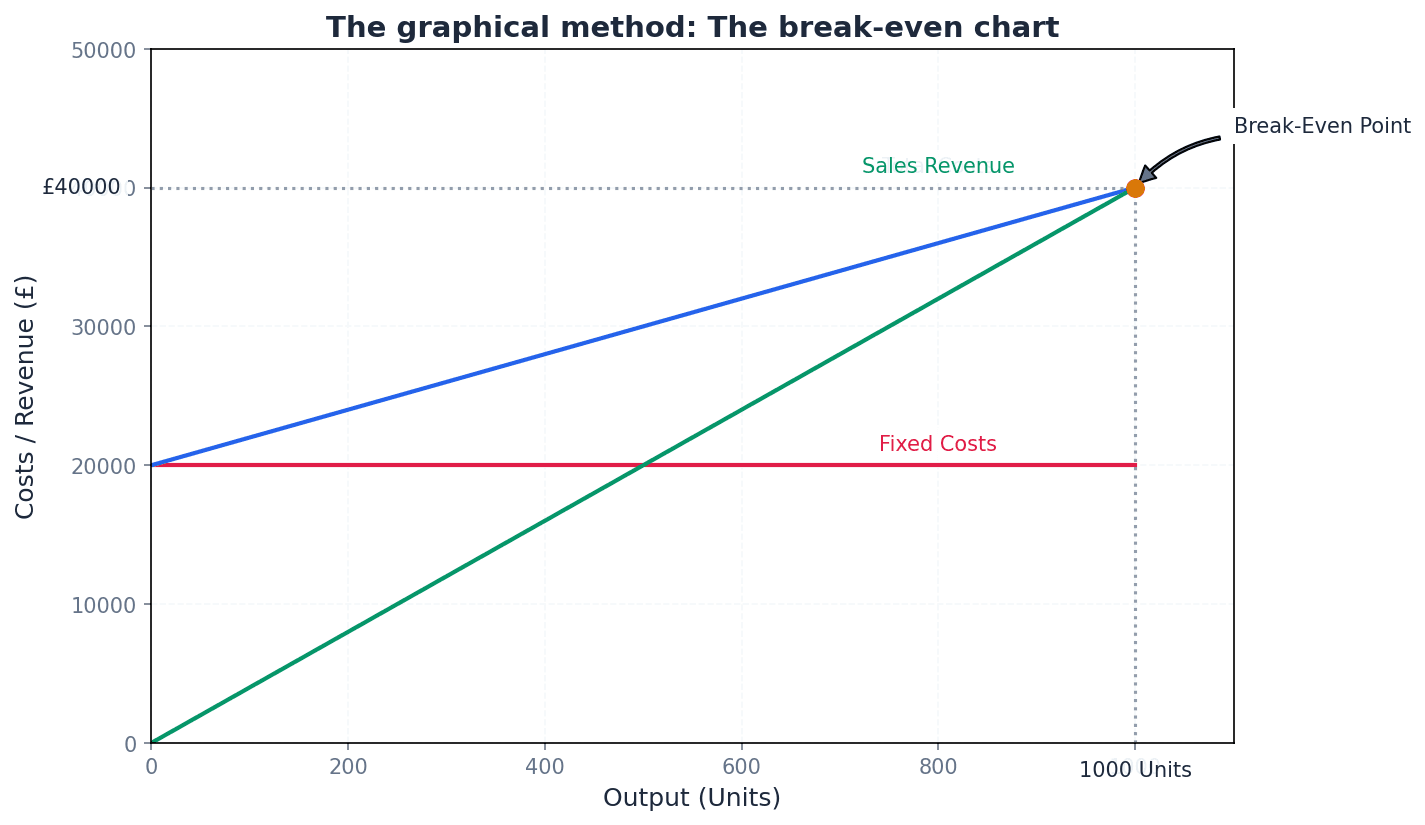
Students often think reaching the break-even point means the business is successful, but actually it only means costs are covered; profitability requires exceeding this point.
Margin of safety — This is a useful indication of how much sales could fall without the business making a loss.
It is the difference between the current level of output (or sales) and the break-even output. For example, if 100 cups of lemonade are needed to break even but 150 are sold, the margin of safety is 50 cups. A higher margin of safety indicates a more secure financial position, as sales can decline significantly before the business starts incurring losses. It can be expressed in units or as a percentage.
Margin of Safety (Units)
Indicates how much sales can fall before the business makes a loss.
Margin of Safety (Percentage)
Expresses the margin of safety as a percentage of the break-even point.
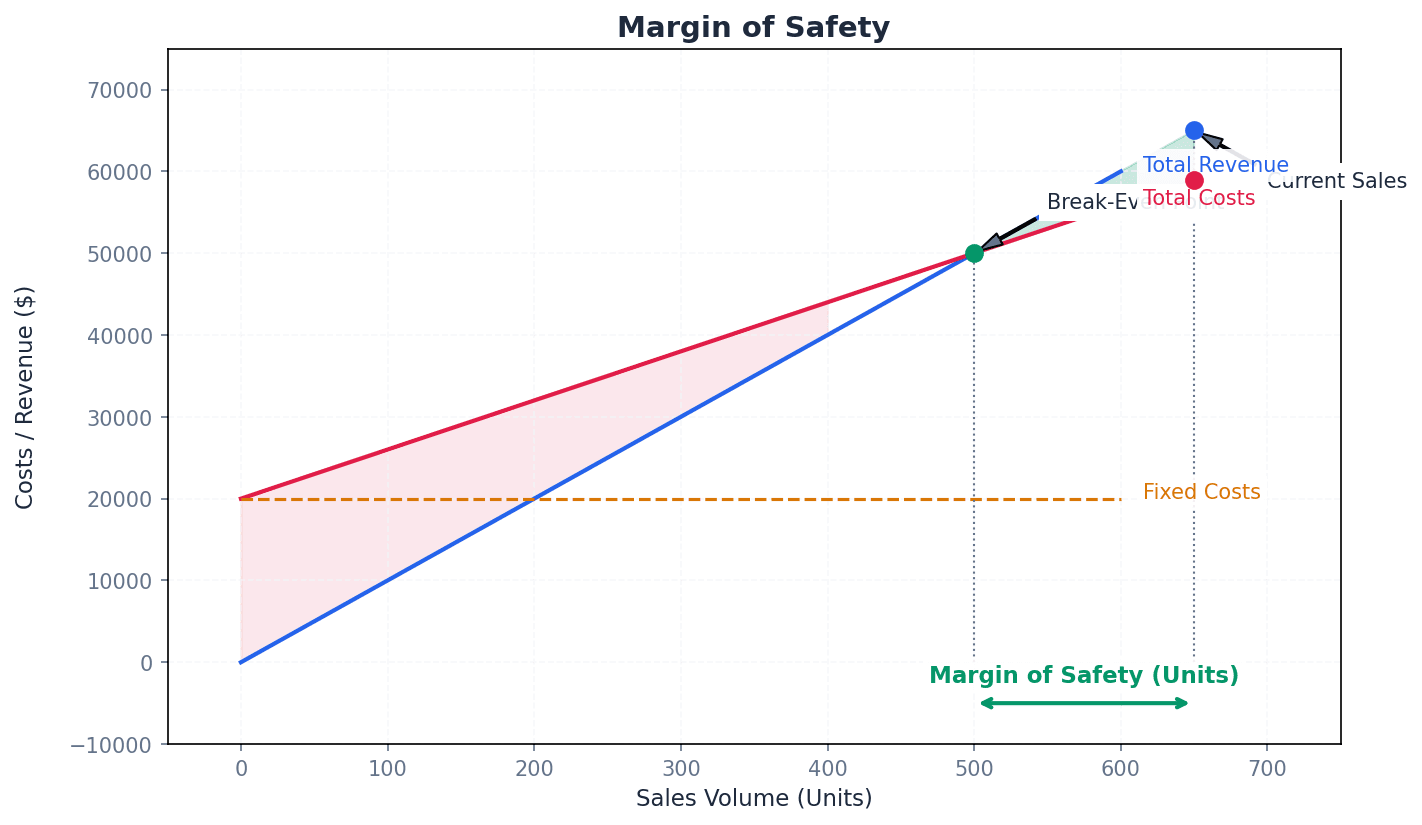
Break-even analysis offers several benefits for businesses. It is easy to understand and provides a clear visual representation of cost, revenue, and profit relationships. It is useful for planning, helping managers determine the minimum sales volume needed to avoid losses, assess the impact of price or cost changes, and set sales targets. It can also support decisions on new products or expansion.
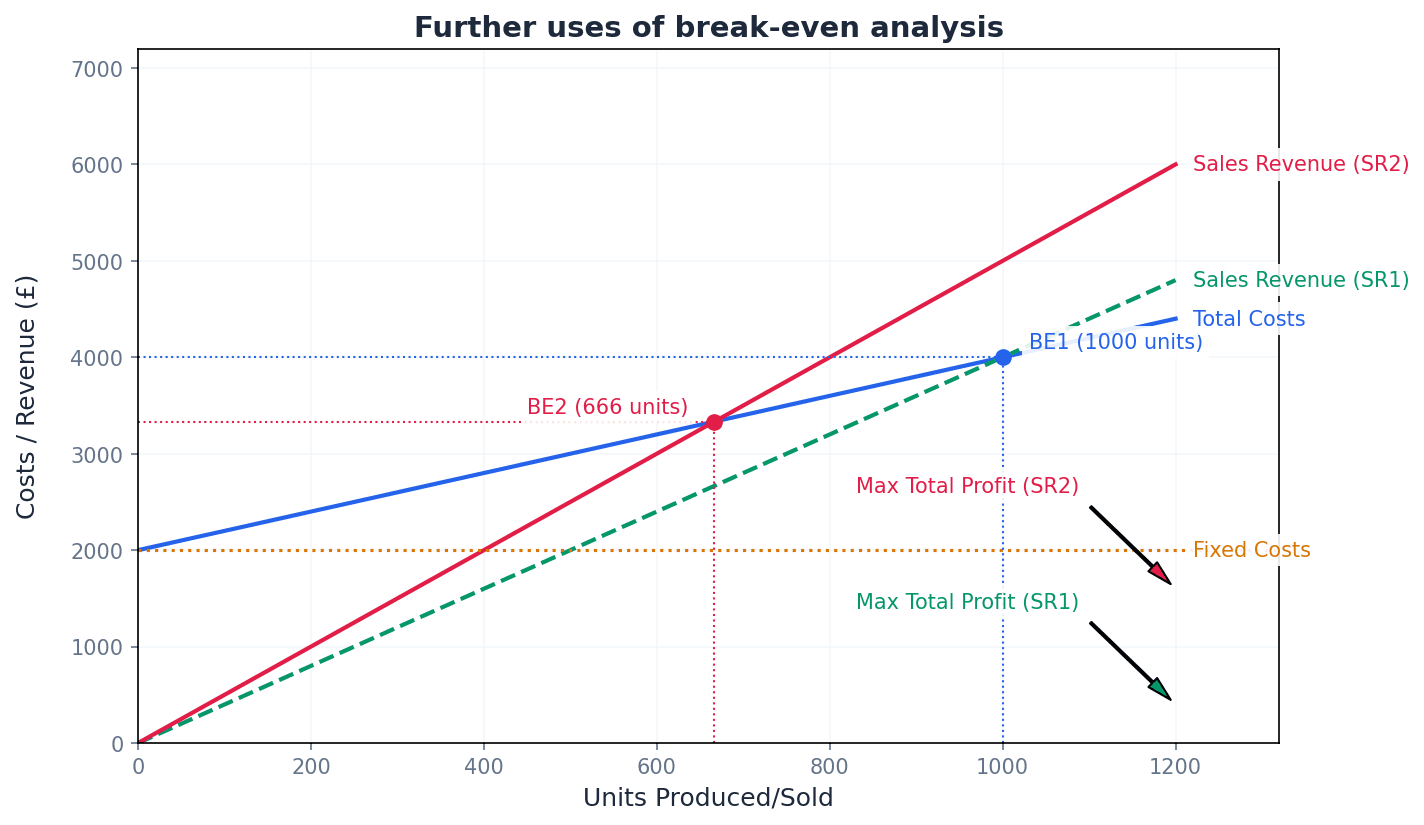
Despite its benefits, break-even analysis has significant limitations. It relies on several simplifying assumptions, such as linear total cost and total revenue lines, which may not hold true in reality. It also assumes that all output produced is sold and that costs can be neatly divided into fixed and variable categories. These assumptions can lead to misleading figures, especially in dynamic business environments.
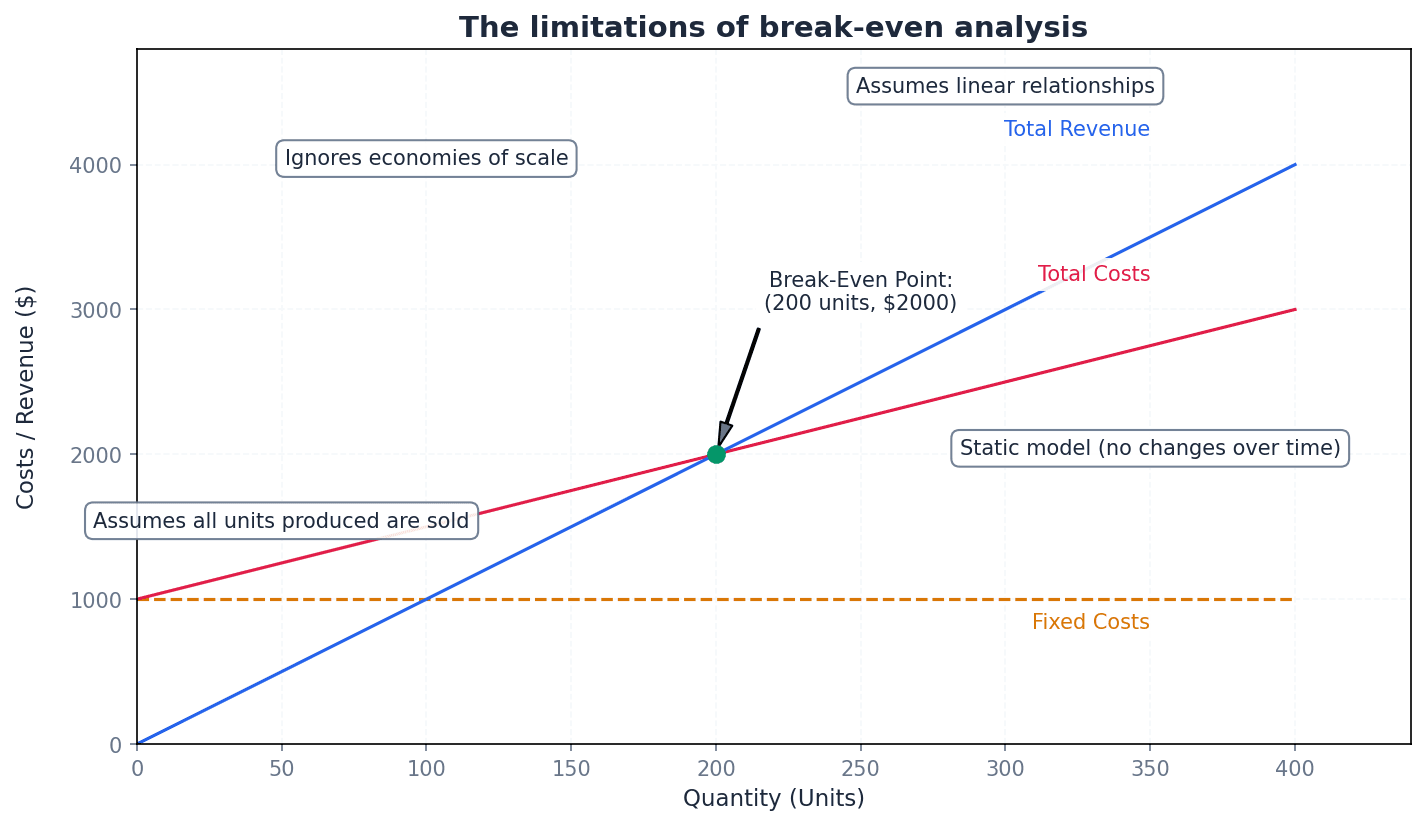
Students often think break-even analysis is always accurate, but actually it relies on several simplifying assumptions (e.g., linear costs/revenues, all output sold) that may not hold true in reality.
When evaluating break-even analysis, discuss both its benefits (e.g., easy to understand, useful for planning) and its limitations (e.g., unrealistic assumptions, ignores inventory, static over time).
Always show your formulas and workings for calculations like break-even, contribution, and margin of safety to secure method marks, even if your final answer is wrong.
When comparing costing methods, link them to their purpose. Full costing is for long-term pricing and reporting; contribution costing is for short-term operational decisions.
Advantages & Disadvantages
Full Costing
Contribution Costing
Evaluation Starters
Essay Structure Guide
Introduction
Begin by defining cost information and briefly stating its importance in business decision-making. Introduce the two main costing approaches (full and contribution) and break-even analysis as key tools.
Conclusion
Summarise the key differences and uses of the costing methods and break-even analysis. Conclude by emphasising that the choice of costing method depends on the specific decision context and that no single method is universally superior.
This chapter explores budgets as crucial financial planning tools, detailing their purpose in setting targets, allocating resources, and monitoring performance. It examines different budgeting methods and introduces variance analysis to assess performance by identifying and interpreting deviations from budgeted figures.
Budget — A financial plan for the future, setting and agreeing financial targets for each section of a business.
Budgets are established for various aspects like sales, revenue, and costs, typically for 12 months broken down monthly. They guide resource allocation and measure performance against targets, much like a personal spending plan where you decide expected earnings and planned expenditures across categories.
Students often think a budget is just a prediction, but actually it is a plan or target that businesses aim to fulfil.
When asked to 'explain' the purpose of budgets, ensure you link it to planning, resource allocation, target setting, coordination, control, and performance measurement for higher marks.
Cost centre — A department or section of a business where costs are incurred but no revenue is directly generated.
Examples include the human resources or research and development departments. Budgets are set for these centres to control their spending, similar to an IT support department in a school that incurs costs for equipment and staff but doesn't directly generate income.
Students often think cost centres are always unprofitable, but actually they are essential departments that support revenue-generating activities, even if they don't directly earn money.
Profit centre — A department or section of a business that incurs costs and also generates revenue, allowing its profitability to be measured.
Examples include individual product divisions or retail outlets. Managers of profit centres are often delegated accountability for setting and reaching budget levels for both costs and revenues, much like a specific branch of a restaurant chain that has its own costs and generates its own revenue.
Financial planning is crucial for businesses to set clear targets, allocate resources effectively, and monitor performance. Budgets serve as essential tools in this process by providing a framework for future financial operations. They help coordinate activities across different departments and ensure that resources are directed towards achieving organisational goals.
Budgets are typically set for a 12-month period, often broken down monthly, to guide resource allocation and measure performance. They establish financial targets for various aspects such as sales, revenue, and costs. Effective budgeting involves careful consideration of market conditions, historical data, and future expectations to create realistic and achievable targets.
Incremental budgeting — A budgeting method that takes last year’s budget and makes changes for the current year based on market conditions, forecasted inflation, and expected changes in output.
This approach adjusts existing budgets rather than starting from scratch, meaning departments only need to justify the changes or increments, not their entire budget. It's like planning your next year's personal spending by taking this year's budget and just adding a bit more for inflation or a new subscription.
Students often think incremental budgeting is always easy and efficient, but actually it can perpetuate inefficiencies from previous years and doesn't allow for fundamental appraisal of resource needs.
Zero budgeting — A budgeting approach that requires all departments and budget holders to justify their entire budget from scratch each year.
This method involves a fundamental review of the work and importance of each budget-holding section, providing an added incentive for managers to defend their section's activities and allowing for significant changes in budget levels. It's like having to justify every single item on your personal spending list each month.
Students often think zero budgeting is always the most efficient, but actually it is very time-consuming and resource-intensive due to the comprehensive review required each year.
Flexible budgeting — A budgeting method that sets new budgets depending on the actual output level achieved, rather than assuming a fixed output level.
This approach adjusts cost budgets proportionally to actual output, making variances more indicative of efficiency changes rather than just differences in output volume, and provides more realistic targets for managers. For example, if you budget for 10 meals for a party but only 8 people show up, a flexible budget would adjust your food cost budget down for 8 meals.
Students often think flexible budgets are only for variable costs, but actually they can be applied to any cost that varies with output, allowing for a more accurate assessment of efficiency.
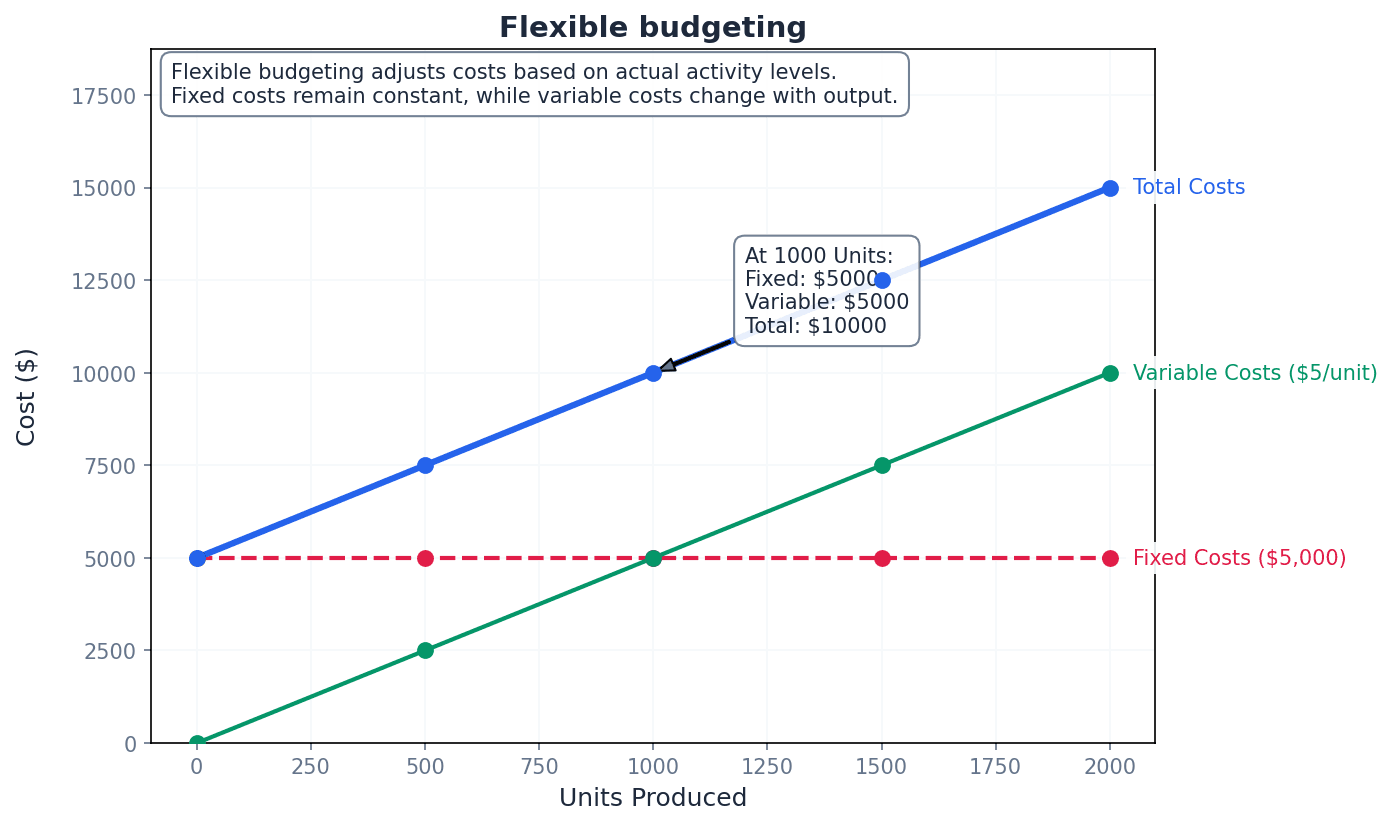
Budgets are not just planning tools; they are also crucial for performance measurement. By comparing actual results against budgeted figures, businesses can assess how well they are performing. This comparison helps identify areas of strength and weakness, allowing managers to take corrective action or replicate successful strategies.
Variance analysis — The process of comparing actual business performance with the original budgets to identify and analyse differences.
This analysis helps managers assess performance, identify problems early, set more realistic future budgets, and make better decisions by understanding the reasons for deviations. It's like comparing your actual spending at the end of the month with your initial budget to understand any differences.
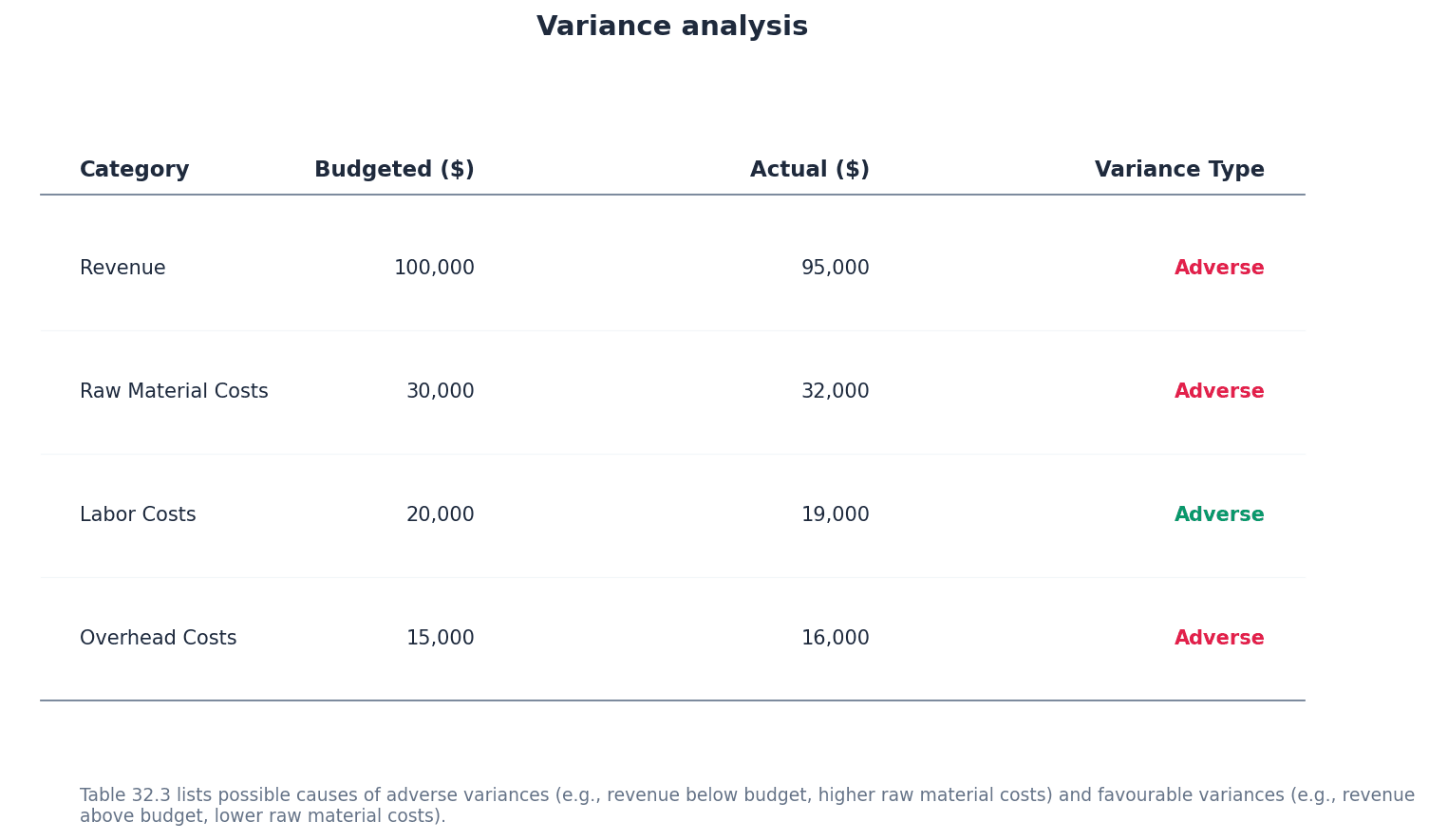
Students often think variance analysis is only about finding negative results, but actually it's equally important to investigate favourable variances to understand why performance exceeded expectations.
When asked to 'analyse' the benefits of variance analysis, link it to identifying problems, improving future budgeting, aiding decision-making, and appraising manager performance, providing specific examples.
Favourable variance — A variance that has the effect of increasing profit above budget.
This can occur if actual revenue is higher than budgeted, or if actual costs are lower than budgeted. For example, if you budgeted to spend 40, the $10 difference is a favourable variance. However, favourable variances also need investigation to ensure they don't mask underlying issues or indicate poor budgeting.
Students often think all favourable variances are good, but actually they can sometimes indicate that the original budget was set too conservatively or that output was lower than planned, which might not be a sign of success.
Adverse variance — A variance that has the effect of reducing profit below budget.
This can occur if actual revenue is lower than budgeted, or if actual costs are higher than budgeted. For instance, if you budgeted to earn 180, the $20 difference is an adverse variance. These variances signal problems that require immediate investigation and remedial action.
Students often think adverse variances always mean poor performance, but actually they can sometimes be due to external factors beyond a manager's control, such as an economic recession or unexpected inflation.
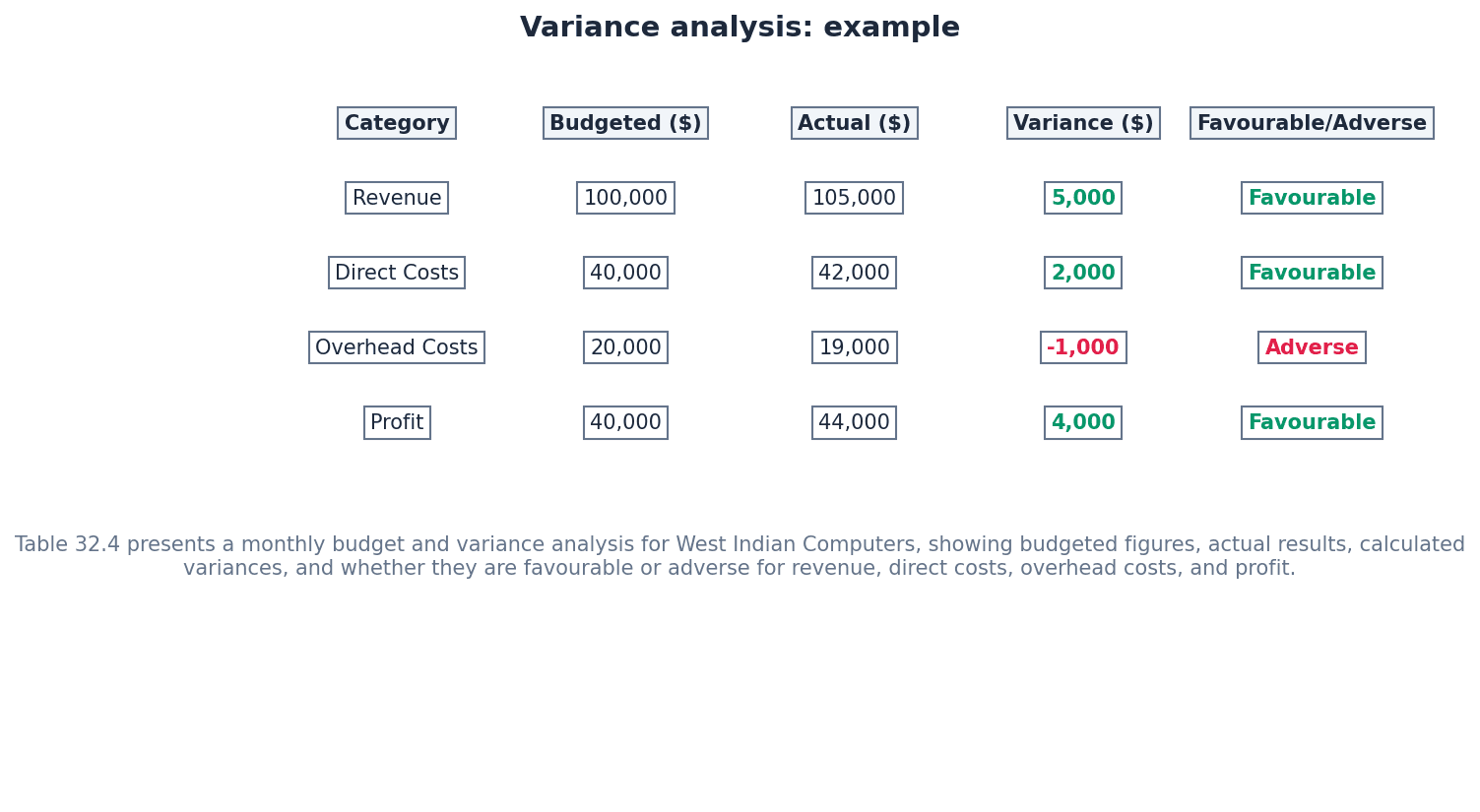
In calculations, always state whether a variance is 'Favourable' (F) or 'Adverse' (A) alongside the final value to secure all marks.
For a fair assessment of performance, explain that actual results should be compared to a flexible budget (adjusted for actual output), not the original static budget.
Advantages & Disadvantages
Setting Budgets
Incremental Budgeting
Evaluation Starters
Essay Structure Guide
Introduction
Begin by defining budgets and briefly outlining their overall importance in financial planning and control for businesses. State the key areas you will discuss, such as different budgeting methods and variance analysis.
Conclusion
Summarise the main arguments, reiterating the importance of budgets as financial planning tools while acknowledging their limitations. Conclude with a balanced statement on how effective budgeting, combined with thorough variance analysis, can significantly contribute to a business's success and strategic decision-making.
This chapter explores the content and importance of key financial statements: the statement of profit or loss and the statement of financial position. It details how to analyse these statements, including various profit figures and the components of assets, liabilities, and equity, while also evaluating inventory valuation and depreciation.
Statement of profit or loss — A financial statement that records the trading activities of a business over a period, showing gross profit, profit from operations, and how profit for the year is distributed.
This statement, also known as an income statement, is crucial for assessing a business's performance over a specific period, usually a year. It details revenue, subtracts various costs and expenses, and ultimately shows the net profit available to shareholders or for reinvestment. Think of it like a personal budget for a year: it shows all the money you earned (revenue), all the money you spent on different things (costs and expenses), and how much money you had left over at the end (profit).
Statement of financial position — A financial statement that records the net wealth or shareholders’ equity of a business at one moment in time.
Also known as a balance sheet, this statement provides a snapshot of a company's assets (what it owns), liabilities (what it owes), and equity (the owners' stake) at a specific date. It must always balance, meaning Assets = Liabilities + Equity. Imagine taking a photograph of your personal finances on a specific day: it shows everything you own (assets like your car, house, savings) and everything you owe (liabilities like loans, credit card debt), with the difference being your net worth (equity).
Businesses need to keep accurate financial records to evaluate their performance, understand their financial health, and make informed decisions. These records allow stakeholders, including owners, investors, and creditors, to assess profitability and solvency. The main types of financial statements, the statement of profit or loss and the statement of financial position, provide a comprehensive overview of a business's financial activities and standing.
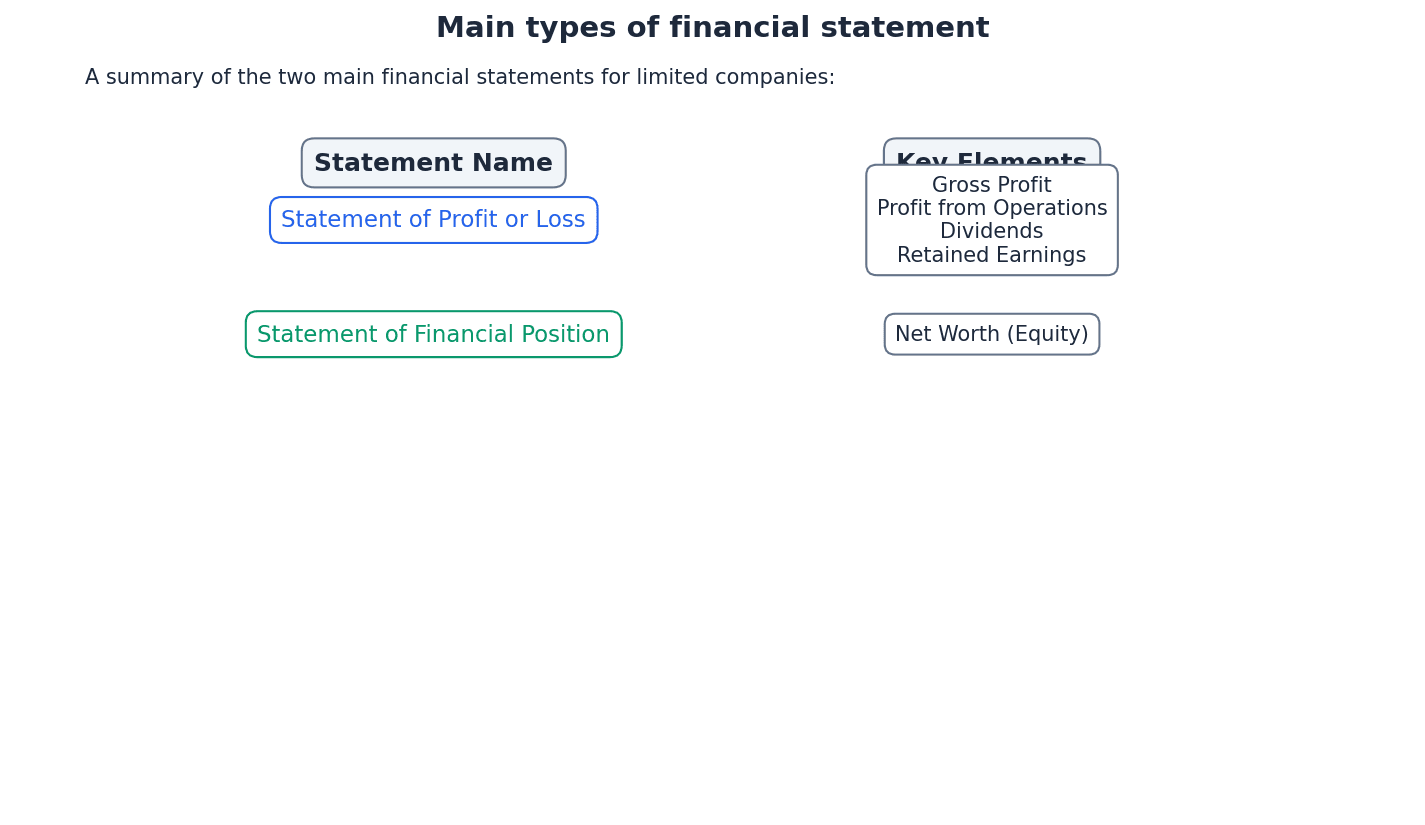
Gross profit — The profit (or loss) made from the trading activities of the business, calculated as revenue minus cost of sales.
This is the first measure of profit on the statement of profit or loss and indicates how efficiently a business is producing or purchasing its goods for sale. It does not account for overhead expenses. If you buy ingredients to bake cakes and sell them, your gross profit is the money you make from selling the cakes minus the cost of the ingredients, before you consider rent for your kitchen or advertising.
Total revenue
Used to calculate the total income from sales before any costs are subtracted.
Cost of sales
Calculates the cost of goods actually sold during the accounting period.
Gross profit
Calculates the profit from trading activities before overheads.
Students often think revenue is the same as profit, but actually revenue is the total income from sales before any costs are subtracted, while profit is what remains after all costs are accounted for.
Be careful to distinguish between 'cost of sales' and 'purchases' when calculating gross profit; cost of sales accounts for changes in inventory.
Profit from operations (Operating profit) — The profit calculated by subtracting expenses (such as overheads) from gross profit.
This figure shows the profitability of a business's core operations before accounting for interest and taxes. It reflects the efficiency of management in controlling day-to-day running costs. After calculating your gross profit from selling cakes, you then subtract other costs like kitchen rent, utility bills, and your own salary. What's left is your operating profit.
Profit before tax — The profit calculated by subtracting interest costs from profit from operations.
This figure represents the profit a company has made before any corporation tax is deducted. It is important for understanding the company's profitability before government levies. This is like your income after all your regular expenses are paid, but before the government takes its share in income tax.
Profit for the year — The final profit figure calculated by subtracting profit (corporation) tax from profit before tax.
This is the net profit after all expenses, including interest and taxes, have been accounted for. It is the amount available for distribution to shareholders as dividends or for retention within the business. This is the actual 'take-home' profit for the business, similar to your net pay after all deductions.
Retained earnings — The portion of profit for the year that is not distributed to shareholders as dividends but is kept within the business for reinvestment.
These accumulated profits are a vital source of internal finance for business growth and expansion. They increase shareholders' equity over time. If you earn money and decide to save some of it in your bank account for future goals instead of spending it all, that saved money is like retained earnings for a business.
Students often think retained earnings are cash reserves, but actually retained earnings are profits reinvested in the business and are not necessarily held as liquid cash.
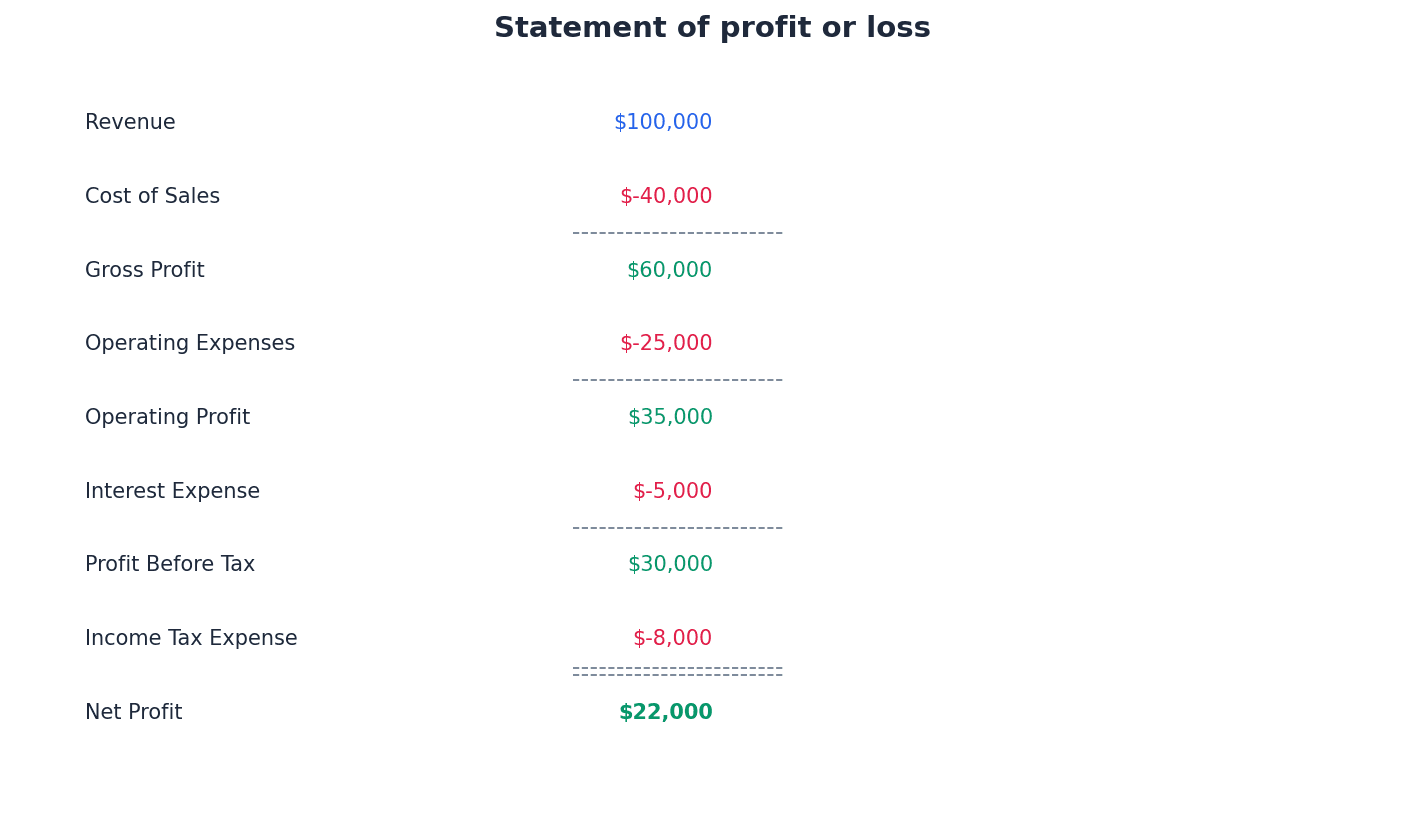
When asked to 'analyse' a statement of profit or loss, you need to break down the figures, identify trends, and explain their significance for the business's performance, often using ratios from Chapter 34.
The statement of financial position provides a snapshot of a business's assets, liabilities, and equity at a specific point in time. It is structured around the fundamental accounting equation: Assets = Liabilities + Equity. Understanding its components is crucial for assessing a company's financial health and solvency.
Non-current assets — Assets owned by the business that are likely to be kept for more than one year, such as land, buildings, vehicles, and machinery.
These are long-term assets that provide benefit to the business over an extended period. They can be tangible (physical) or intangible (non-physical). These are like your big, long-term possessions such as your house or car, which you expect to own and use for many years.
Intangible assets — Non-physical assets that cannot be seen but can contribute value to the business, such as patents, trademarks, copyrights, and goodwill.
These assets are increasingly important in the knowledge-based economy, representing intellectual property or reputation. They are difficult to value and are only recorded on the statement of financial position if acquired through takeover or merger. Think of a famous brand name like Coca-Cola; you can't physically touch the 'brand', but its reputation and recognition have immense value to the company.
Goodwill — The reputation and prestige of a business that gives it value above the value of its physical assets, normally appearing on a statement of financial position only if a business takes over another firm at a cost higher than the net assets of that firm.
Goodwill represents the non-physical value of a business, such as its brand recognition, customer base, or strong management. It is only formally recognised in accounts when one company acquires another for a price exceeding the fair value of its identifiable net assets. If you buy a well-established local bakery for more than the value of its ovens and building, the extra money you paid is for its loyal customers and good reputation – that's goodwill.
Students often think all intangible assets are recorded on the statement of financial position, but actually only those acquired through specific transactions (like takeovers) are typically included.
Current assets — Assets that are expected to be converted into cash or used up within one year, such as inventories, trade receivables, and cash.
These assets are crucial for a business's short-term liquidity and operational needs. Their value directly impacts the working capital of the business. These are like your readily available funds and items you expect to sell or use soon, such as the cash in your wallet, money in your checking account, or groceries in your fridge.
Trade receivables — Customers who have bought goods on credit and owe money to the business.
These are amounts owed to the business by its customers for goods or services delivered but not yet paid for. They are a current asset because they are expected to be collected within a year. If you lend money to a friend who promises to pay you back next month, that friend is your 'trade receivable' – someone who owes you money.
Current liabilities — Debts of the business that have to be paid within one year, such as trade payables, bank overdrafts, and unpaid tax.
These are short-term financial obligations that a business must settle within its operating cycle or one year. They are important for assessing a company's short-term solvency. These are like your monthly bills that are due soon, such as your phone bill, rent, or credit card payments.
Trade payables — Suppliers who have allowed the business credit and are owed money by the business.
These are amounts a business owes to its suppliers for goods or services purchased on credit. They are a current liability because they are typically paid within a short period. If you buy groceries on credit from a store and promise to pay them next week, that store is your 'trade payable' – someone you owe money to.
Students often confuse trade receivables with trade payables, but actually trade payables are money owed BY the business, while receivables are money owed TO the business.
Working capital — The capital available to a business for its day-to-day operations, calculated as current assets minus current liabilities.
Also known as net current assets, working capital is a measure of a company's short-term liquidity and operational efficiency. A positive working capital indicates that a business has enough short-term assets to cover its short-term liabilities. This is like the spare cash you have after paying all your immediate bills, which you can use for daily expenses or unexpected costs.
Working capital
Measures a business's short-term liquidity and operational funds.
Shareholders’ equity — The net worth of the company, representing the owners' stake, comprising share capital and retained earnings.
This is the total amount of capital invested by shareholders plus the accumulated profits that have been retained in the business. It represents the residual claim on assets after all liabilities are paid. If you own a house, your equity is the value of the house minus any outstanding mortgage. It's what you would get if you sold the house and paid off all debts.
Share capital — The capital originally invested in the company through the purchase of shares by owners.
This represents the funds raised by a company from issuing shares to its owners. It is a permanent source of finance and forms part of shareholders' equity. This is like the initial money you put into starting your own business, which you get back only if the business closes down.
Reserves (from shareholders' equity)
Calculates the accumulated retained earnings within shareholders' equity.
Non-current liabilities — Long-term debts owed by the business that are due to be paid over a period of time greater than one year, such as bank loans, commercial mortgages, and debentures.
These are financial obligations that extend beyond one year and are typically used to finance long-term assets or projects. The proportion of non-current liabilities to total capital employed indicates the degree of financial risk. These are like your long-term debts, such as a mortgage on your house or a student loan, which you expect to pay back over many years.
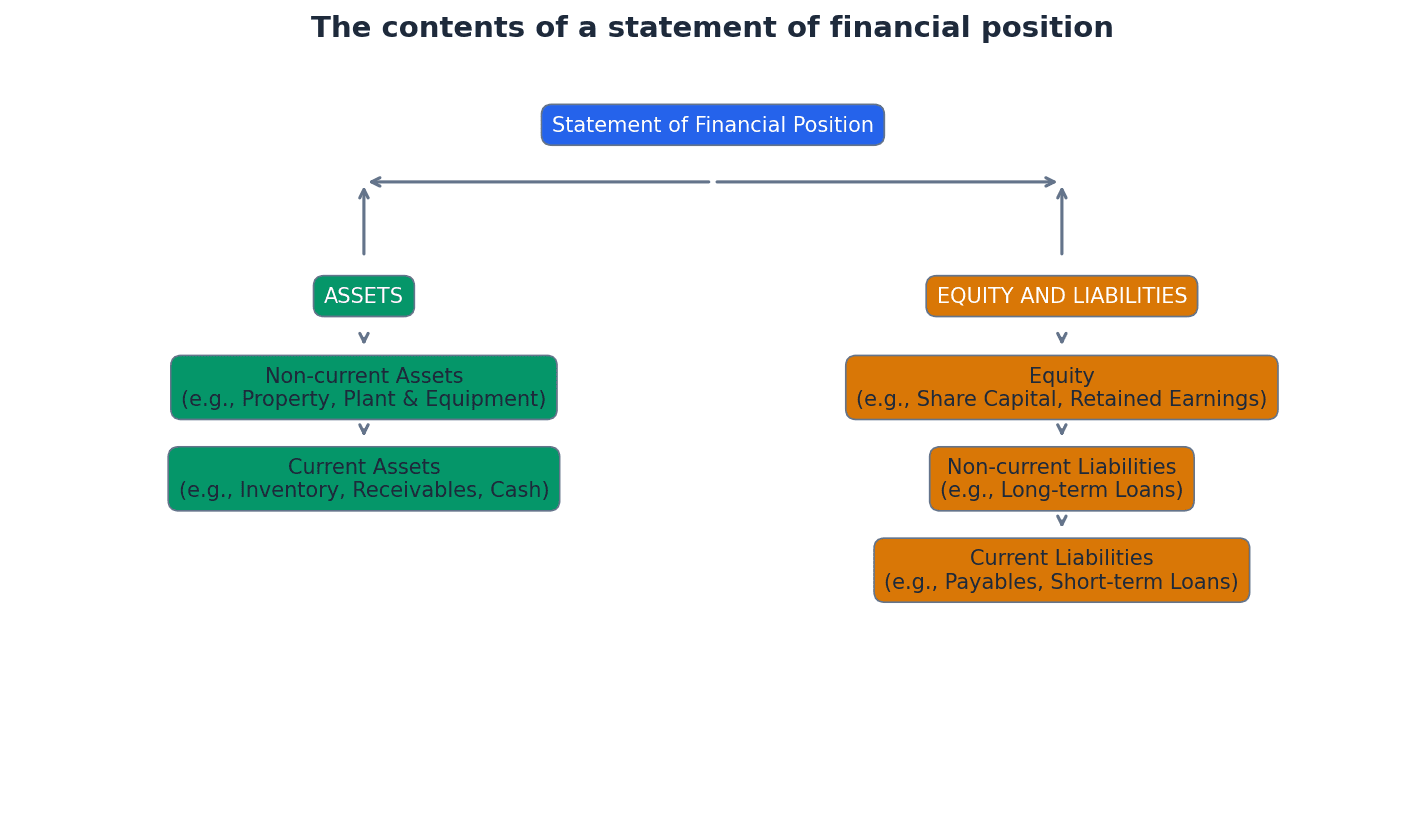
When amending a statement of financial position, remember the double-entry principle: every change must have a balancing entry to ensure total assets still equal total equity and liabilities.
The statement of profit or loss and the statement of financial position are intrinsically linked. The profit for the year, calculated in the statement of profit or loss, directly impacts the retained earnings component of shareholders' equity in the statement of financial position. This connection ensures that the financial records provide a coherent and comprehensive view of the business's performance and financial standing over time.
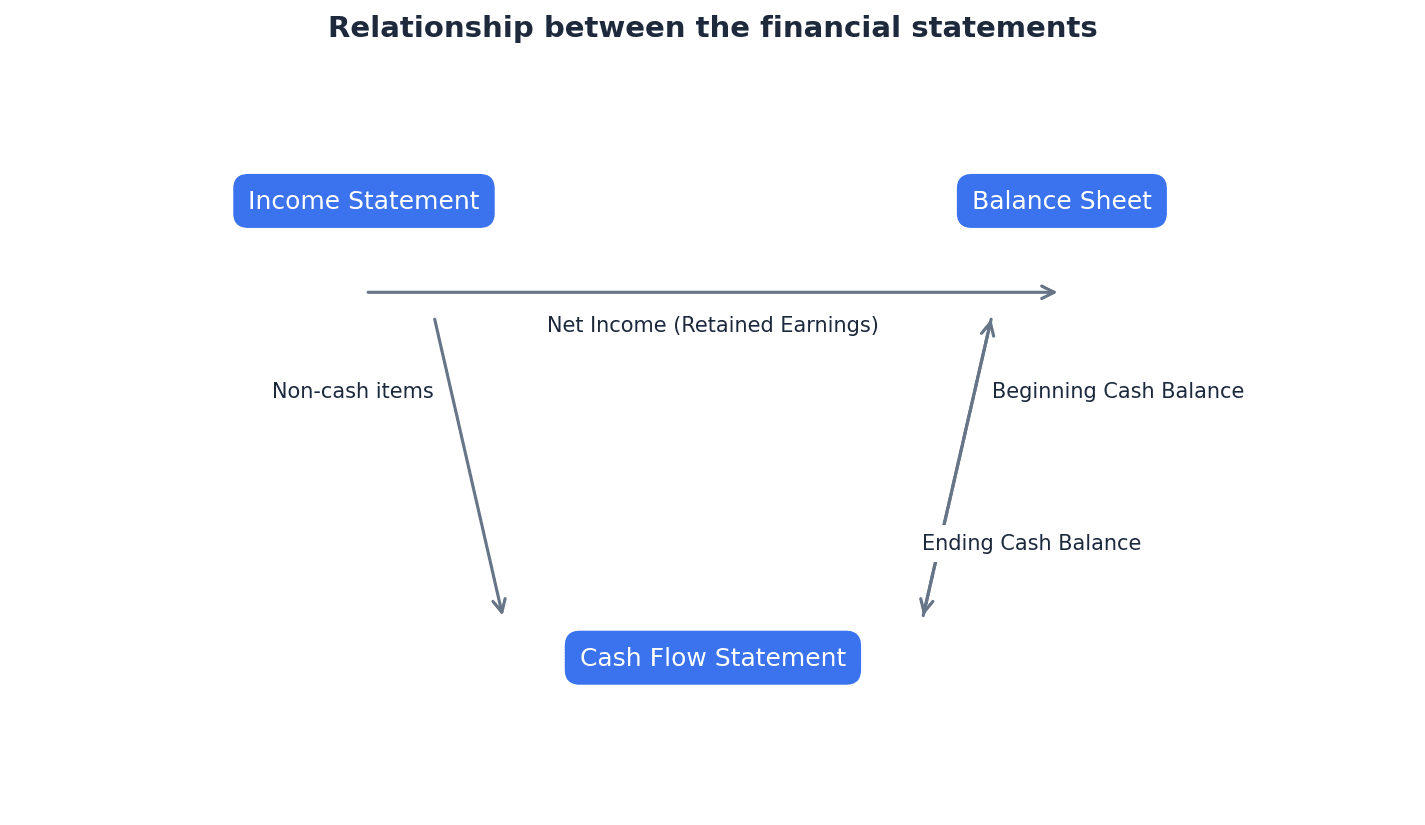
Net realisable value (NRV) — The estimated selling price of inventory in the ordinary course of business less the estimated costs of completion and the estimated costs necessary to make the sale.
Inventories are valued at the lower of historical cost or NRV. This accounting principle (conservatism) ensures that potential losses on inventory are recognised as soon as they are anticipated, providing a more realistic valuation. If you have old stock of clothes that are out of fashion, their NRV is what you could realistically sell them for in a clearance sale, minus any costs of running that sale, even if you originally paid more for them.
Net realisable value (NRV)
Used to value inventory at the lower of cost or NRV, especially for damaged or obsolete goods.
Students often think inventory is always valued at its purchase price, but actually it must be valued at the lower of historical cost or net realisable value.
When calculating inventory valuation, always compare the historical cost with the NRV and choose the lower figure, especially in scenarios involving damaged or obsolete goods.
Depreciation — The decline in value of fixed/non-current assets over time due to normal wear and tear through usage and technological change that makes the asset obsolete.
Depreciation is an accounting method used to allocate the cost of a tangible asset over its useful life. It is recorded as an expense on the statement of profit or loss and reduces the net book value of the asset on the statement of financial position. Think of a new car: as soon as you drive it off the lot, its value starts to drop due to usage and newer models coming out. That loss in value each year is like depreciation.
Students often think depreciation is a cash expense, but actually it is a non-cash expense that reflects the reduction in asset value, not an outflow of cash.
Net book value — The value of an asset on the statement of financial position, calculated as its original cost less accumulated depreciation.
This figure represents the carrying value of an asset after accounting for the portion of its cost that has been expensed over its useful life. It reflects the asset's remaining value to the business. If you bought a laptop for 200 each year, after two years its net book value would be 1000 - $400).
Net book value
Represents the carrying value of an asset on the statement of financial position.
Straight line method of depreciation — A method of calculating depreciation where the annual depreciation charge is the same for each year of the asset's useful life.
This method is simple to calculate and widely used. It assumes that the asset depreciates evenly over its expected useful life, making it easy to predict annual charges. If you buy a 200 of its value each year, consistently.
Annual depreciation (straight line method)
Calculates a constant depreciation charge each year over the asset's useful life.
Be able to calculate depreciation using the straight-line method and explain its impact on both the statement of profit or loss (as an expense) and the statement of financial position (reducing asset value).
When a change is introduced (e.g., buying a new asset), explain its impact on BOTH the Statement of Profit or Loss and the Statement of Financial Position.
Always use the standard layout for financial statements. Marks are awarded for correct structure, headings, and sub-totals (e.g., Gross Profit, Net Assets).
Advantages & Disadvantages
Keeping financial (accounting) records
Straight line method of depreciation
Evaluation Starters
Essay Structure Guide
Introduction
Begin by defining the key financial statements (Statement of Profit or Loss and Statement of Financial Position) and briefly stating their overall purpose in assessing business performance and financial health. Outline the main arguments you will present regarding their importance.
Conclusion
Summarise the main arguments, reiterating the critical role of financial statements in providing transparency and aiding decision-making for various stakeholders. Conclude with a balanced judgment on their overall importance, acknowledging any limitations and the need for careful interpretation.
This chapter focuses on analysing a business's financial health and performance through the calculation and interpretation of various accounting ratios. It covers five key categories: liquidity, profitability, financial efficiency, gearing, and investment, providing insights into a business's ability to meet debts, generate profit, utilise assets, manage debt, and provide returns to shareholders.
Liquidity — Liquidity is a measure of how easily a business could meet its short-term debts or liabilities.
It is crucial for a business's survival, as a shortage of liquid funds can lead to business failure. Liquidity ratios assess the ability of a business to continue trading by examining its working capital, much like having enough cash in your wallet to pay for immediate needs.
Current ratio — The current ratio is a liquidity ratio that compares current assets to current liabilities.
It indicates the extent to which current assets cover current liabilities, typically expressed as a ratio (e.g., 2:1). This is like checking if you have enough quick-access money to pay all your immediate bills.
Current ratio
Expressed as a ratio (e.g., 2:1). A result between 1.5:1 and 2:1 is often recommended, but the ideal ratio varies by industry and trend.
Students often think a very high current ratio is always good, but actually it might suggest too many funds are tied up unprofitably in current assets.
Acid test ratio — The acid test ratio, also known as the quick ratio, is a stricter test of a firm’s liquidity that excludes inventories from current assets.
It provides a clearer picture of a business's ability to pay short-term debts by focusing on the most liquid assets. Inventories are excluded because there's no certainty they will be sold quickly, similar to ignoring items you still need to sell when checking immediate cash.
Acid test ratio
Expressed as a ratio (e.g., 0.75:1). Liquid assets are calculated as Current assets - inventories.
Liquid assets
Used in the acid test ratio calculation to represent assets that can be quickly converted to cash.
Students often think selling inventories for cash improves the current ratio, but actually it only improves the acid test ratio as both cash and inventories are current assets.
When evaluating liquidity, always consider the industry context; a low current ratio might be normal for a food retailer but alarming for a manufacturer.
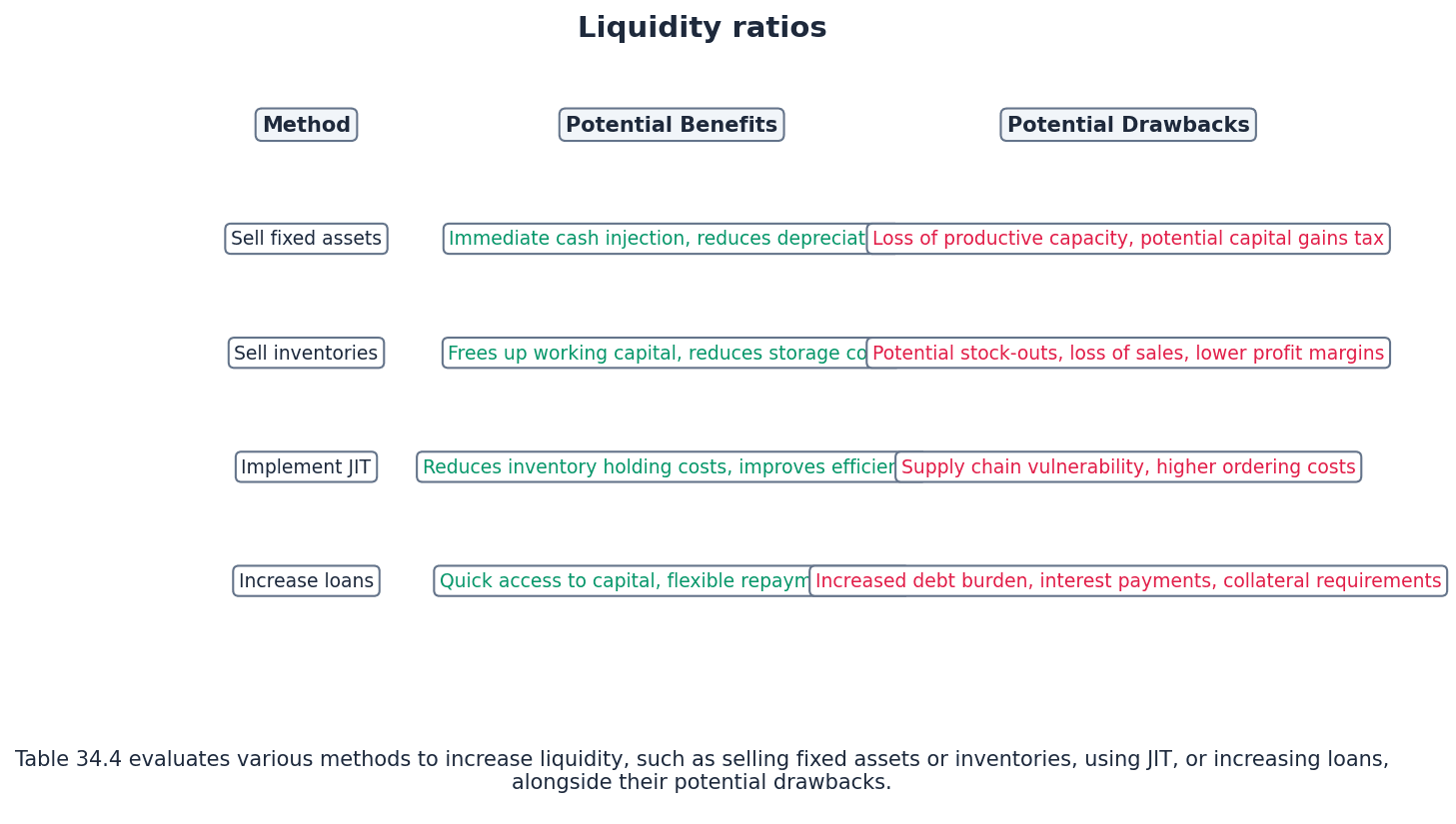
Profitability — Profitability assesses business performance by comparing profit levels with sales or capital invested.
A high level of profit alone does not guarantee high profitability if sales and capital invested are also very high. It measures how effectively a business generates profit relative to its revenue or assets, much like comparing two lemonade stands to see which makes more profit per dollar of sales.
Students often think a high absolute profit figure means a business is successful, but actually profitability ratios are needed to assess efficiency and performance relative to scale.
Gross profit margin ratio — The gross profit margin ratio assesses how successful the management of a business is at converting revenue into gross profit.
It is calculated by dividing gross profit by revenue and multiplying by 100. This ratio indicates the efficiency of a business in managing its cost of sales relative to its revenue, showing how much money is left from each dollar of sales after paying for the direct cost of goods sold.
Gross profit margin ratio
Expressed as a percentage (%). This ratio indicates the efficiency of a business in managing its cost of sales relative to its revenue.
Students often think a higher gross profit figure automatically means higher profitability, but actually a lower gross profit margin can exist with higher gross profit if revenue is disproportionately higher.
Operating profit margin ratio — The operating profit margin ratio measures how successful a business is in converting sales into profit from operations after subtracting overhead expenses.
It is calculated by dividing operating profit by revenue and multiplying by 100. This ratio reflects management's effectiveness in controlling both direct costs and overheads, showing how much money is left from each dollar of sales after paying for direct costs and general running costs.
Operating profit margin ratio
Expressed as a percentage (%). This ratio reflects management's effectiveness in controlling both direct costs and overheads.
Students often state that 'to increase profit margins the business should increase sales', but actually this is only true if revenue increases at a greater rate than the business's costs.
Return on capital employed (RoCE) ratio — The return on capital employed (RoCE) ratio is the most commonly used measure of the profitability of a business, comparing operating profit with the capital invested.
It is often referred to as the primary efficiency ratio, indicating how effectively a business uses its capital to generate profit. A higher ratio signifies greater returns on invested capital, like calculating the percentage return you get on all the money you've put into a business.
Return on capital employed ratio
Expressed as a percentage (%). Capital employed is calculated as non-current liabilities + shareholders’ equity.
Capital employed
Used in the RoCE calculation, representing the total long-term funds invested in the business.
Students often forget to compare RoCE with the interest cost of borrowing finance, but actually if RoCE is less than the interest rate, increasing borrowing will reduce returns to shareholders.
When evaluating profitability, always compare ratios with previous years' results and with companies in the same industry to provide meaningful analysis.
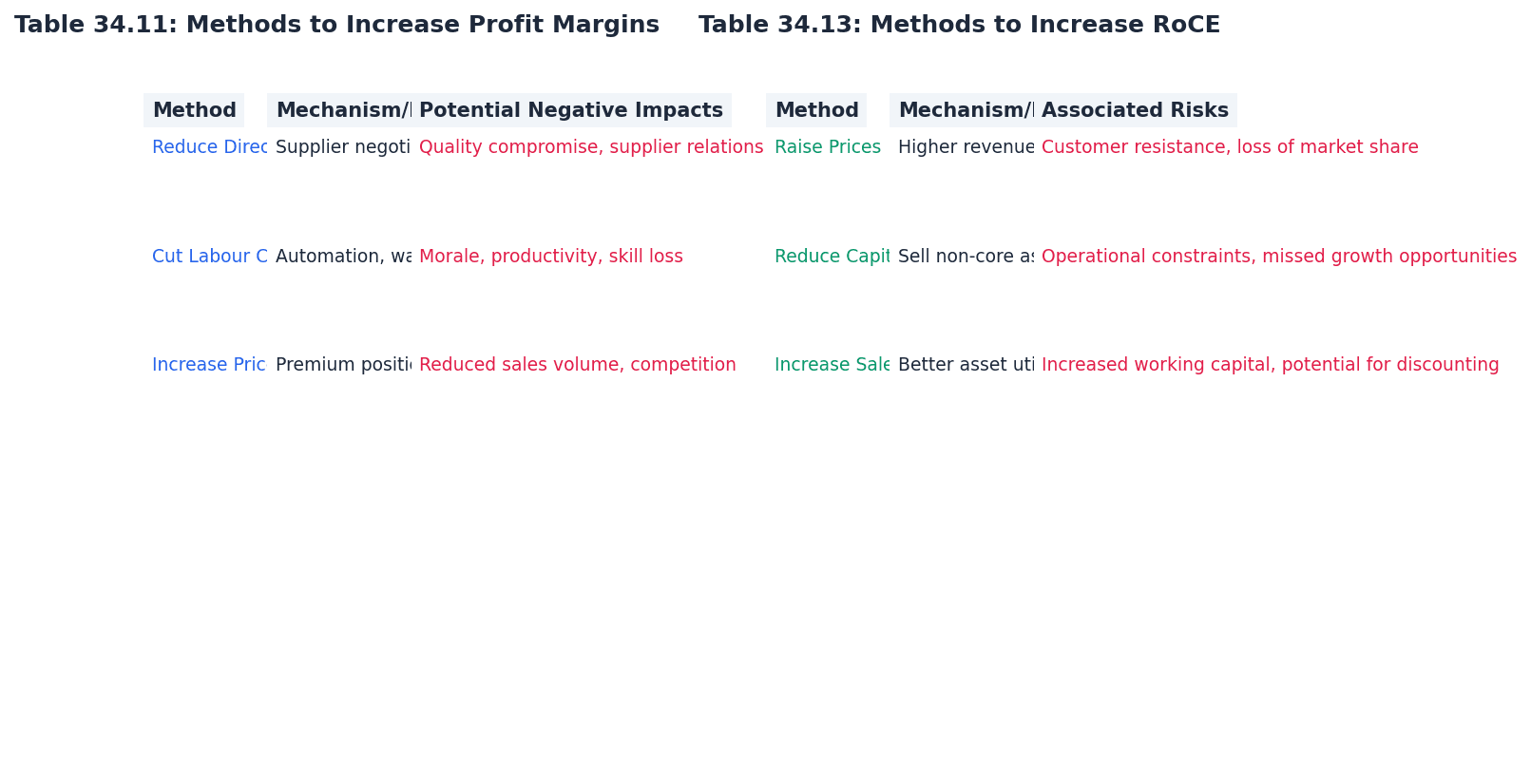
Financial efficiency — Financial efficiency refers to how efficiently the assets or resources of a business are being used by management.
High levels of financial efficiency mean managers are effectively using assets and minimising the need for borrowing, thereby reducing financing costs. It focuses on optimising the use of working capital, similar to a chef efficiently using ingredients and managing payments.
Students often confuse financial efficiency with overall profitability, but actually financial efficiency specifically focuses on the effective use of assets and working capital, which contributes to profitability.
Rate of inventory turnover — The rate of inventory turnover records the number of times the inventory of a business is bought in and resold in a period of time.
A higher number indicates more efficient inventory management, meaning less finance is tied up in inventories. It is calculated by dividing cost of sales by average inventory, much like how many times a grocery store restocks and sells its milk in a year.
Rate of inventory turnover
Expressed as a number of times per period (e.g., 3.125). A higher number indicates more efficient inventory management.
Average inventory
Used in the inventory turnover calculation to provide a representative inventory value over the period.
Students often express inventory turnover as a percentage, but actually it is expressed as a number of times per period (e.g., 12 times per year).
Trade receivables turnover (days) — The trade receivables turnover (days) measures how long, on average, it takes a business to recover payment from customers who have bought goods on credit.
A shorter time period indicates better management of working capital and credit control. It is calculated by dividing trade receivables by credit sales and multiplying by 365, similar to how many days your friends take to pay you back.
Trade receivables turnover
Expressed in days. A shorter time period indicates better management of working capital and credit control.
Students often assume all sales are credit sales when calculating this ratio, but actually only credit sales should be used in the denominator.
Trade payables turnover (days) — The trade payables turnover (days) measures the average length of time the business takes to pay its suppliers.
A longer period means the business retains cash for longer, reducing its working capital needs. It is calculated by dividing trade payables by credit purchases (or cost of goods sold) and multiplying by 365, like how many days you take to pay your own bills.
Trade payables turnover
Expressed in days; can also use cost of goods sold. A longer period means the business retains cash for longer.
Students often think a very long trade payables turnover is always good, but actually it can damage supplier relationships and lead to loss of discounts for quick payment.
When analysing financial efficiency, remember to consider the specific industry, as what is efficient for one business (e.g., a fresh fish retailer) may not be for another (e.g., a car dealer).
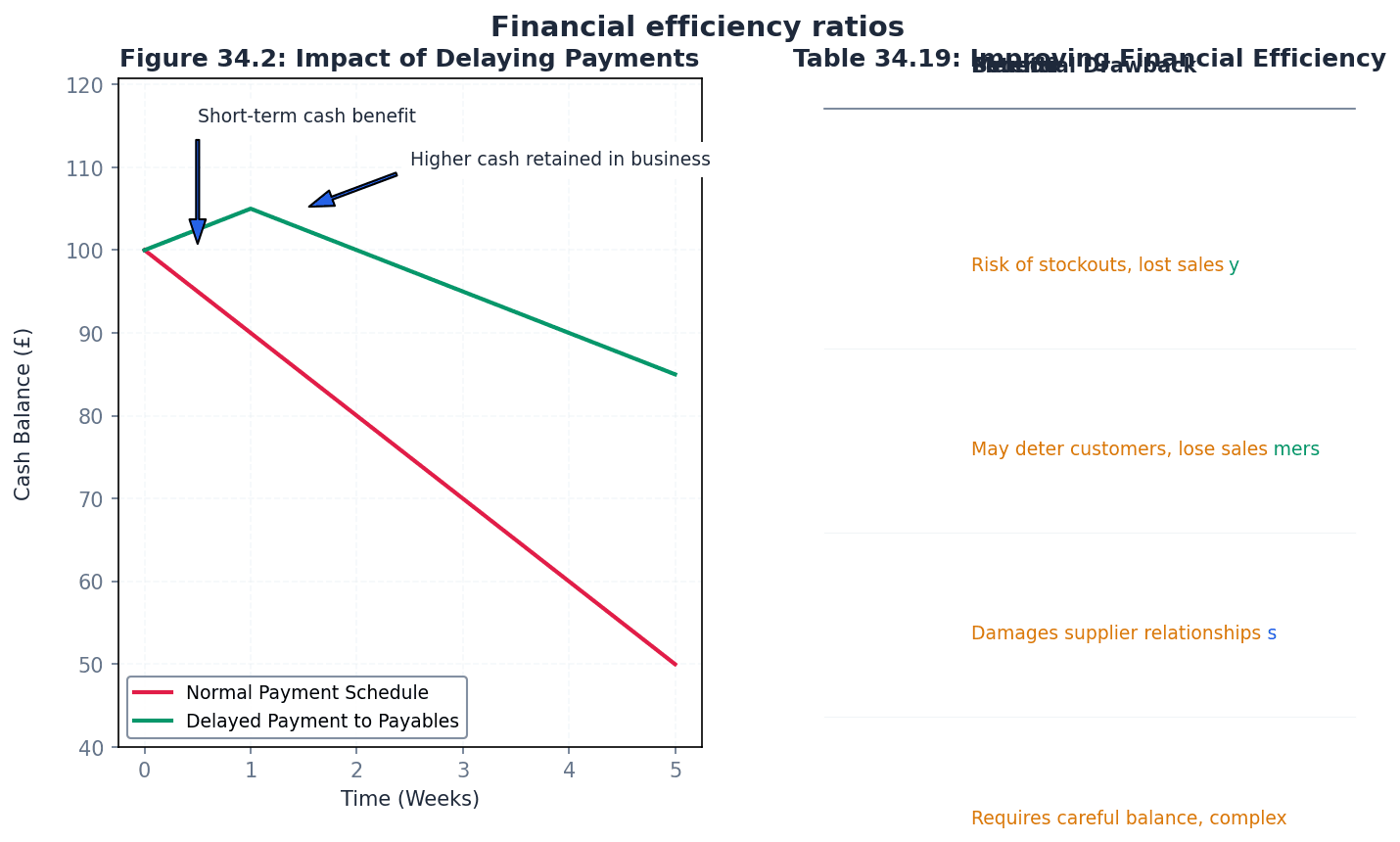
Gearing ratio — The gearing ratio measures the degree to which the capital of a business is financed from debts.
A higher ratio indicates greater reliance on loan capital, making the business 'highly geared' and potentially riskier, especially if profits fall or interest rates rise. It reflects the balance between debt and equity financing, similar to how much of your house is paid for by a mortgage versus your own equity.
Gearing ratio
Expressed as a percentage (%). A higher ratio indicates greater reliance on loan capital and potentially higher risk.
Students often think a low gearing ratio is always ideal, but actually it can also suggest management is not borrowing to invest in or expand the business, potentially missing growth opportunities.
When evaluating gearing, consider the economic conditions and interest rates; a high gearing ratio is riskier during recessions or periods of high interest.
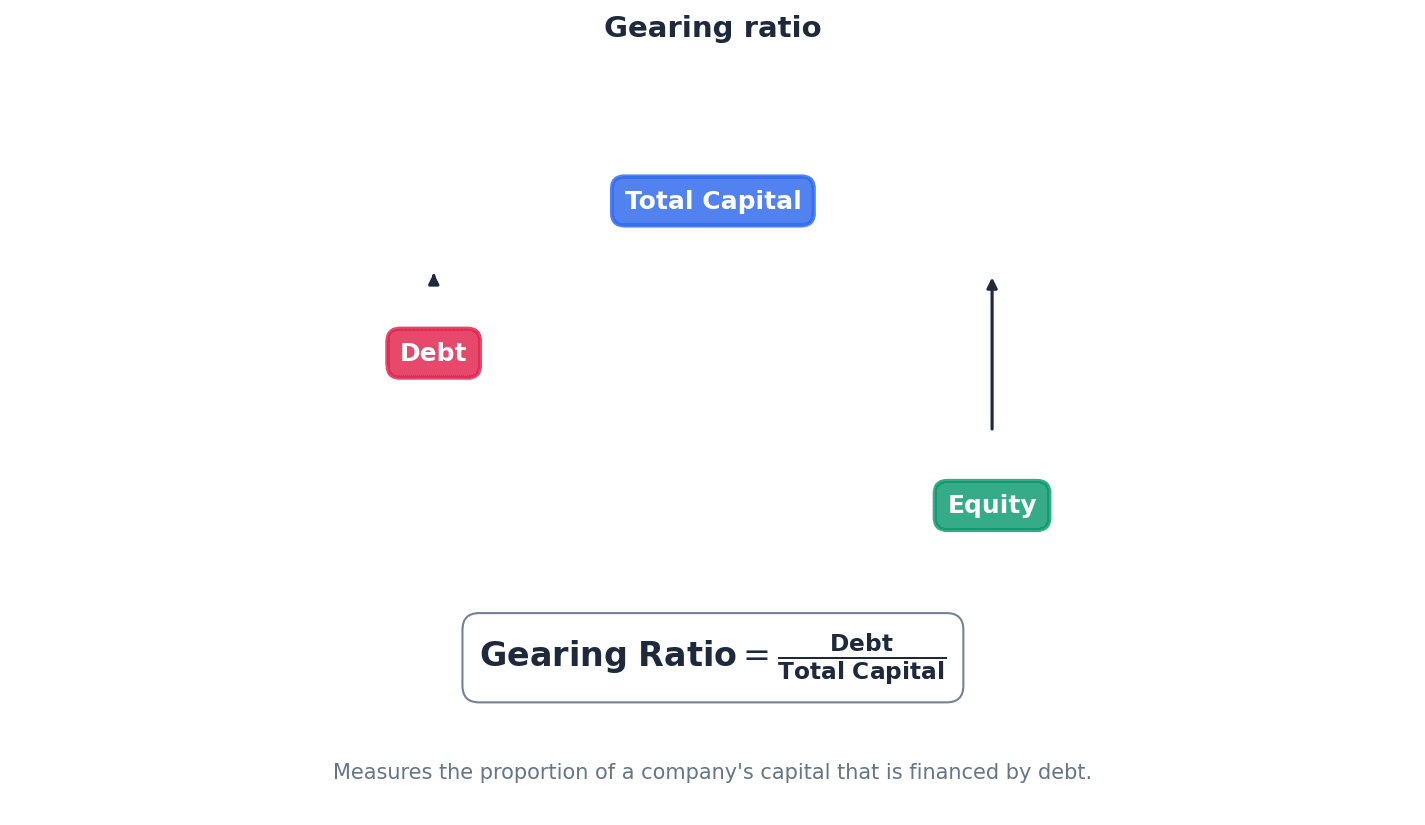
Dividend yield ratio — The dividend yield ratio measures the percentage rate of return a shareholder receives from the dividend per share at the current share price.
It helps investors compare the income return from shares with other investments. A higher yield can attract potential shareholders, but it also needs to be considered alongside share price trends, much like the interest rate on a savings account for shares.
Dividend yield ratio
Expressed as a percentage (%). Helps investors compare the income return from shares with other investments.
Dividend per share
Used in the dividend yield ratio calculation to determine the dividend paid per individual share.
Students often think a high dividend yield always indicates a good investment, but actually it could be high because the share price has recently fallen due to concerns about the company's long-term prospects.
Dividend cover ratio — The dividend cover ratio is the number of times the ordinary share dividend could be paid out of current profits after tax and interest (profit for the year).
A higher ratio indicates the company's strong ability to pay proposed dividends and suggests a considerable margin for re-investing profits back into the business. A low ratio might raise doubts about future dividend sustainability, similar to knowing how many times your income covers your rent.
Dividend cover ratio
Expressed as a number (e.g., 1.3). A higher ratio indicates a stronger ability to pay dividends and re-invest profits.
Students often think a low dividend cover ratio is always bad, but actually it might indicate that directors are prioritising shareholder returns over retaining profits for future investment.
Price/earnings ratio (P/E ratio) — The price/earnings ratio (P/E ratio) reflects the confidence that investors have in the future prospects of the business.
A high P/E ratio generally suggests investors expect higher earnings growth in the future. It measures how much investors are willing to pay for each $1 of current earnings, like how many years of current earnings it would take to 'pay back' the price of a share.
Price/earnings ratio (P/E ratio)
Expressed as a number (e.g., 7.1). A high P/E ratio generally suggests investors expect higher earnings growth.
Earnings per share
Used in the P/E ratio calculation to determine the profit attributable to each ordinary share.
Students often compare P/E ratios across different industries, but actually it is not useful as different industries have varying growth prospects and investor optimism.
When asked for methods to increase profitability, ensure your answer includes an evaluation of why the suggestion might not be effective, especially for RoCE.
Always show your full workings for any ratio calculation to secure partial marks, even if the final answer is incorrect.
A ratio is meaningless in isolation. To score analysis marks, you must compare it over time (e.g., year-on-year) or against a key competitor.
For evaluation, provide a balanced argument. For example, explain how a method to improve liquidity (e.g., reducing inventory) could negatively impact profitability (e.g., lost sales).
Advantages & Disadvantages
Improving Liquidity (e.g., reducing inventory)
Improving Profitability (e.g., increasing sales)
Evaluation Starters
Essay Structure Guide
Introduction
Begin by defining the key financial performance area (e.g., liquidity or profitability) and briefly state why it is important for a business. Outline the ratios you will use to analyse this area.
Conclusion
Summarise the main findings from your analysis and evaluation. Provide a reasoned judgment on the overall financial health or performance of the business in the area discussed, and offer a final recommendation, acknowledging any trade-offs.
This chapter introduces investment appraisal, a crucial process for businesses to assess the profitability of capital expenditure projects. It covers three quantitative methods: payback period, accounting rate of return (ARR), and net present value (NPV), while also highlighting the importance of qualitative factors and accurate forecasting in making informed investment decisions.
Investment — Purchasing capital goods, such as equipment, vehicles and new buildings, with the expectation of earning future profits.
Businesses undertake investment decisions to acquire assets that will generate returns over their useful life. These decisions often involve significant strategic issues and capital expenditure, much like buying a new, more efficient oven for a bakery with the expectation of increased sales and lower costs.
Students often think investment only refers to financial assets like stocks, but actually in business, it primarily means purchasing physical capital goods.
Investment appraisal — Assessing the profitability of an investment decision.
This process uses quantitative techniques to compare the expected future returns (cash inflows) against the costs (cash outflows) of a project. Qualitative factors are also considered to provide a comprehensive evaluation, similar to checking reviews and specifications before buying a new phone.
Ensure your answers include both quantitative and qualitative aspects when evaluating investment decisions, unless specifically asked for only one type.
Students often think investment appraisal is purely about numbers, but actually qualitative factors are also crucial in the final decision.
To appraise investment projects quantitatively, businesses need to forecast future cash flows, which can be challenging in uncertain environments. This involves estimating both the initial capital cost and the expected net cash inflows over the project's lifespan. The accuracy of these forecasts is paramount, as they form the basis for all quantitative appraisal methods.
Payback period — The length of time it takes for the net cash inflows to pay back the original capital cost of the investment.
This method focuses on the speed of return, which is important for businesses with liquidity concerns or those operating in uncertain environments. It helps managers compare projects and identify those that meet a specific cut-off time, much like how long it takes a friend to return money you lent them.
Additional months to payback
Used to calculate the exact month of payback when the payback period falls within a year, assuming cash flows are received evenly.
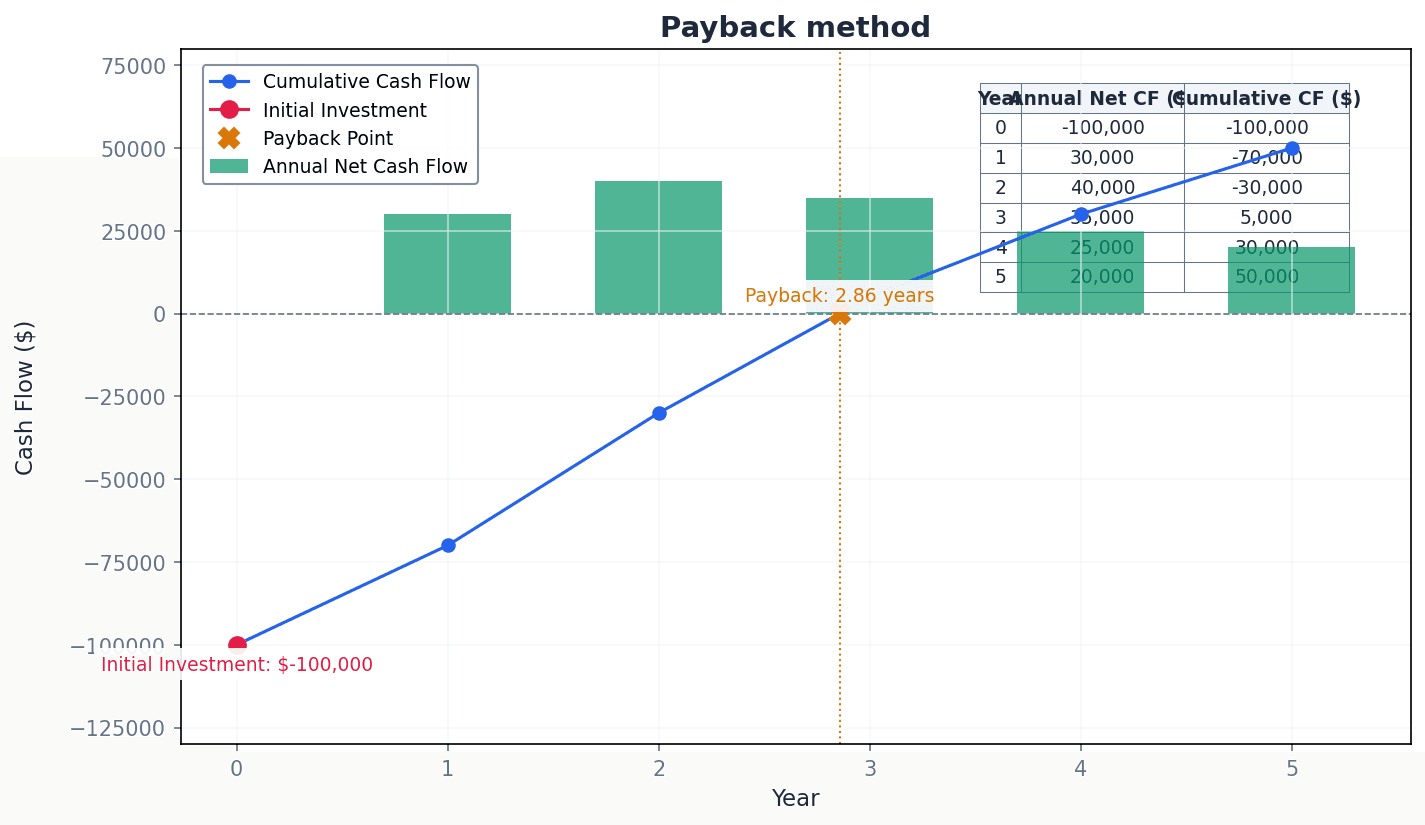
When calculating payback, remember to account for partial years by calculating the additional months needed, assuming cash flows are received evenly throughout the year.
Students often think a shorter payback period always means a better investment, but actually it ignores overall profitability and cash flows after the payback period.
Accounting rate of return (ARR) — A method of investment appraisal that measures the annual profit as a percentage of the average capital cost of the investment.
ARR uses all cash flows over the project's life and focuses on profitability, making it easy to compare with other projects or a business's minimum expected return (criterion rate). However, it ignores the timing of cash flows and the time value of money, similar to calculating the average annual percentage return on a savings account.
Accounting Rate of Return (ARR)
Measures the average annual profit as a percentage of the average capital invested. Ignores the time value of money.
When calculating ARR, ensure you correctly calculate the total profit (total net cash flows minus initial investment) and the average investment (initial cost + residual value / 2).
Students often think ARR considers the time value of money, but actually it treats all cash flows equally regardless of when they are received.
Criterion rate — The minimum expected return set by a business for new investment projects.
This rate acts as a benchmark against which the calculated ARR or NPV of a project is compared. If a project's return falls below this rate, it may be rejected, even if it appears profitable, much like a minimum passing grade for a project.
Students often think the criterion rate is always the market interest rate, but actually it can be a higher rate set by the business to reflect its risk tolerance or strategic objectives.
Discounting — The process of reducing the value of future cash flows to give them their value in today’s terms.
This process accounts for the time value of money, acknowledging that money received today is worth more than the same amount received in the future due to factors like immediate spending power, potential interest earnings, and uncertainty. It quantifies how much less a future sum is worth today, similar to preferring 100 next year.
Explain that the discount rate chosen for NPV calculations typically reflects the interest cost of borrowing capital or the opportunity cost of internal finance.
Students often think discounting is only about inflation, but actually it also accounts for the opportunity cost of money and the uncertainty of future cash flows.
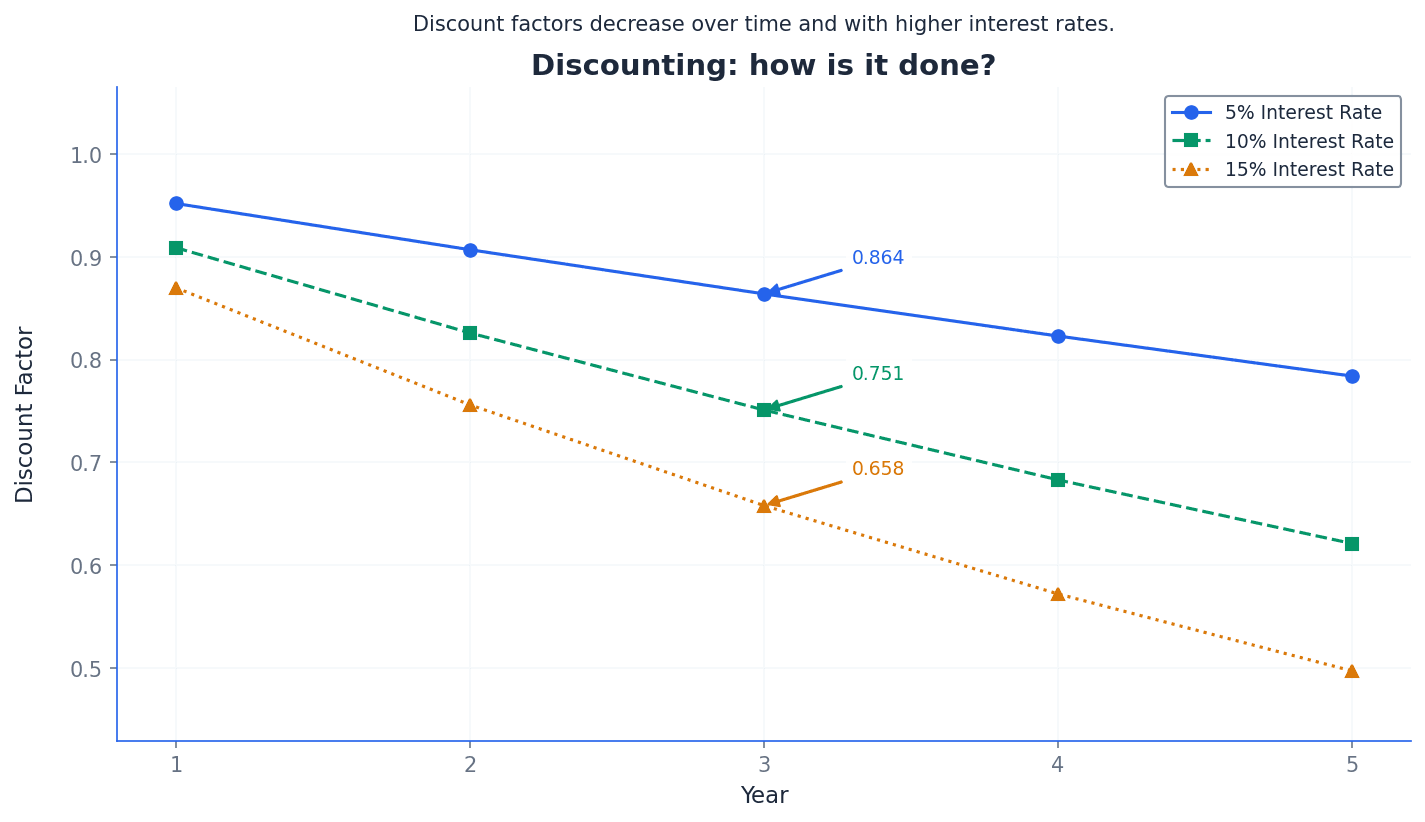
Discount factors — Multipliers used to calculate the present-day values of future cash flows, based on interest rates and time.
These factors are derived from interest rates and the number of years into the future a cash flow is expected. They are used to convert future cash flows into their equivalent value in today's money, acting like conversion rates for money across time.
When using discount tables, ensure you select the correct factor corresponding to both the interest rate and the specific year of the cash flow.
Students often think discount factors are fixed, but actually they vary depending on the interest rate and the specific year the cash flow is received.
Net present value (NPV) — The sum of the present-day values of all expected net cash flows minus the initial capital cost of the investment.
NPV considers both the size and timing of cash flows by discounting future cash flows to their present-day value, reflecting the time value of money. A positive NPV indicates a profitable project when financed at the discount rate, much like converting all future money from a project into today's money to see if it's more than the initial spend.
Net Present Value (NPV)
Calculates the present-day value of a project's net returns. A positive NPV indicates profitability at the given discount rate.
When using NPV, clearly state the discount rate used and explain its significance. Remember that cash flows in year 0 are not discounted as they are already present-day values.
Students often think a higher discount rate always leads to a higher NPV, but actually a higher discount rate reduces the present value of future cash flows, thus lowering the NPV.
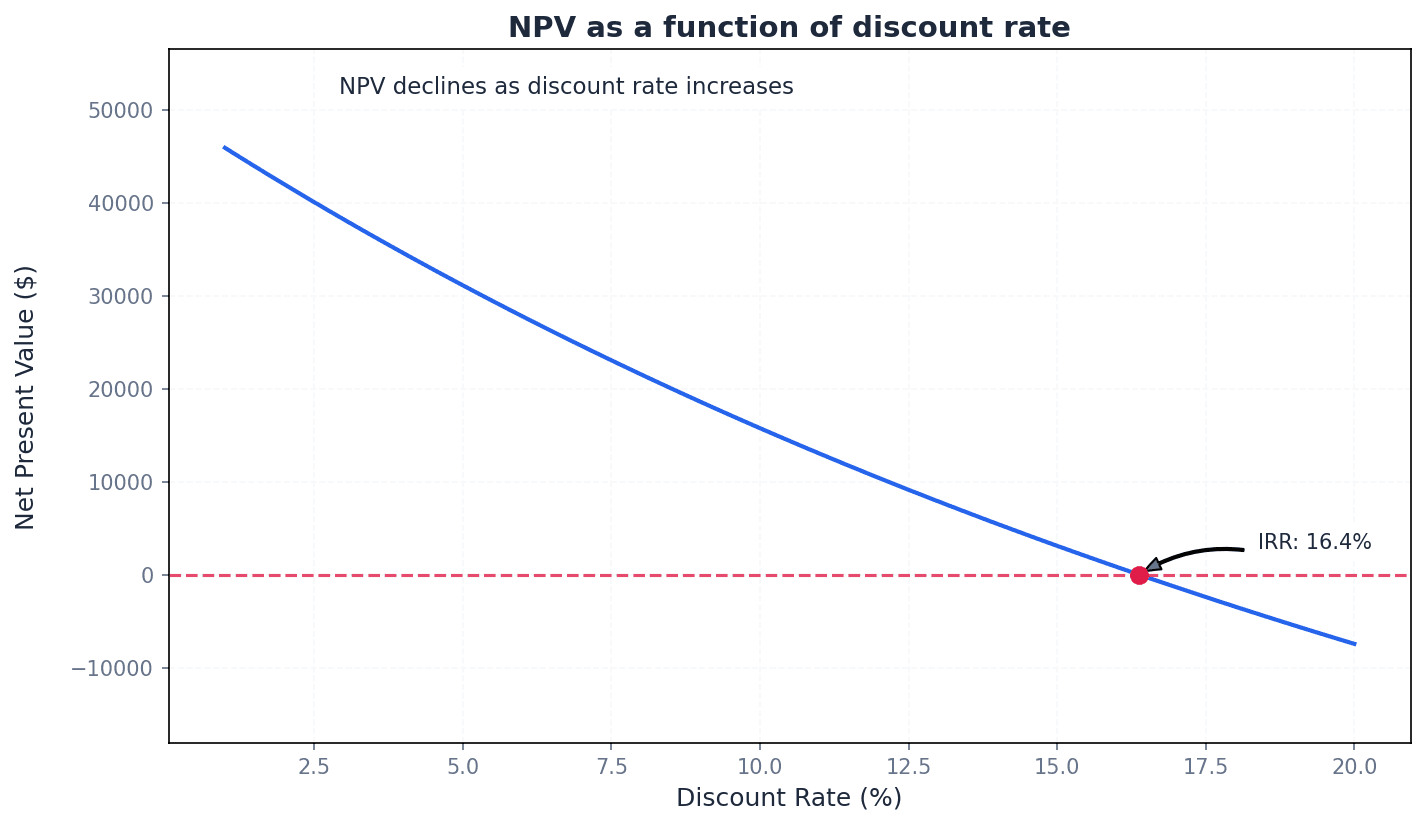
Investment appraisal decisions require a careful evaluation of both quantitative results and qualitative factors. While methods like Payback, ARR, and NPV provide numerical insights into profitability and liquidity, qualitative factors such as the project's impact on brand image, environmental sustainability, employee morale, and strategic fit are equally crucial. A holistic decision considers all these aspects to ensure long-term business success.
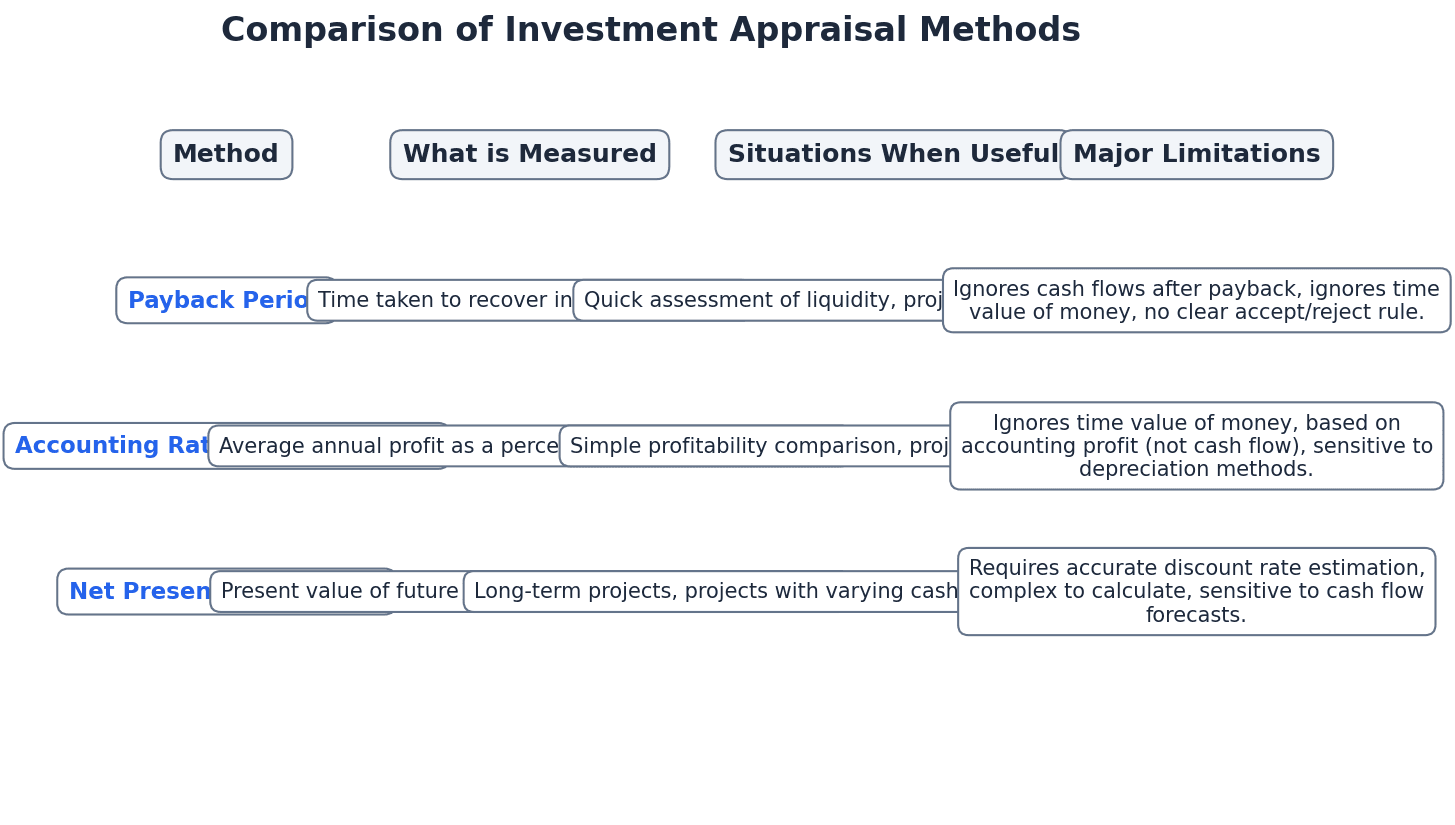
Always state the full formula before your calculation (e.g., ARR = (Average annual profit / Average investment) x 100) to secure method marks.
In your conclusion, directly compare the results of the different methods. For example, 'While Project A has a faster payback, Project B's positive NPV suggests it will add more long-term value to the business.'
For evaluation questions, always bring in qualitative factors. A balanced answer will argue that while the NPV might be positive, the project could be rejected due to negative environmental impacts or damage to the brand's reputation.
Advantages & Disadvantages
Payback Period
Accounting Rate of Return (ARR)
Evaluation Starters
Essay Structure Guide
Introduction
Begin by defining investment appraisal and briefly outlining its importance for capital expenditure decisions. State the purpose of the essay, e.g., to analyse and evaluate different quantitative methods and the role of qualitative factors.
Conclusion
Summarise the main arguments, reiterating the strengths and weaknesses of each method. Conclude with a reasoned judgment on how businesses should approach investment appraisal, stressing the need for a balanced and holistic approach that integrates both financial and non-financial considerations to make informed strategic decisions.
This chapter explores how accounting data and ratio analysis are vital for strategic decision-making, enabling businesses to assess performance over time and against competitors. It evaluates the impact of strategic choices like debt/equity decisions and dividend policies on financial ratios. The chapter also critically examines the usefulness and limitations of published accounts and ratio analysis, highlighting issues such as accuracy and comparability.
Window dressing — The deliberate manipulation of accounts to present a more favourable financial position than is actually the case.
This practice involves making accounting decisions that boost short-term performance or improve key ratios without necessarily breaking the law. It can be done to influence banks to lend money or encourage investors to buy shares, much like putting on your best clothes and tidying your room just before a guest arrives to make a good impression.
Students often think window dressing is always illegal, but actually it can involve legal accounting decisions that present a company in a very favourable light without breaking disclosure laws.
Trend analysis — The comparison of accounting ratios for a business over several previous time periods to identify patterns or changes.
This analysis helps managers and stakeholders assess whether profitability, liquidity, financial efficiency, or gearing are falling or rising over time, providing context for current performance. It's like tracking your grades over a school year to see if your performance is improving, declining, or staying consistent, rather than just looking at one test score.
Inter-firm comparison — The comparison of accounting ratios of one business with those of other companies in the same industry.
This allows managers and stakeholders to assess how a company's profitability, liquidity, efficiency, and gearing compare to its competitors, helping to identify competitive strengths and weaknesses. It's like comparing your sports team's win-loss record to other teams in the same league to see how well you're performing relative to the competition.
Students often think that one accounting ratio result alone is sufficient for analysis, but actually, ratios are only meaningful when compared over time (trend analysis) or with competitors (inter-firm comparison).
When evaluating business performance, always recommend using trend analysis (comparing ratios over time) in addition to inter-firm comparisons to provide a comprehensive assessment.
Accounting data is crucial for future strategic decision-making, not just for recording past performance. Businesses use financial statements and ratio analysis to evaluate performance over time and against competitors, which then informs the development of effective strategies. This data helps managers understand the current financial health and efficiency of the business, guiding choices about future investments, financing, and operational adjustments.
Ratio analysis allows for a systematic assessment of business performance by comparing key financial figures. This assessment is most effective when ratios are compared over several time periods (trend analysis) to identify patterns, or against competitors in the same industry (inter-firm comparison) to gauge relative strengths and weaknesses. Such comparisons provide context and highlight areas requiring strategic attention, such as declining profitability or liquidity issues.
Students often think comparing ratios across different industries is useful, but actually inter-firm comparisons are most effective when companies in the same industry are being compared due to differing industry norms.
In analysis questions, explicitly state the importance of comparing ratios with competitors in the same industry to draw meaningful conclusions about relative performance.
Strategic choices have a direct and predictable impact on financial ratios. For instance, decisions regarding debt versus equity financing significantly alter gearing ratios, while changes in dividend policy affect dividend yield and earnings per share. Business growth strategies, such as expansion or acquisitions, also influence various ratios, potentially increasing gearing in the short term or impacting liquidity, requiring careful consideration of their financial implications.
Published accounts, typically found in an annual report, provide stakeholders with essential financial information. They are useful for assessing a company's financial position, performance, and cash flow, aiding strategic decision-making and investment choices. However, these reports only contain the minimum information required by law, often omitting sensitive details like product profitability or R&D plans, which limits their comprehensiveness for in-depth strategic analysis.
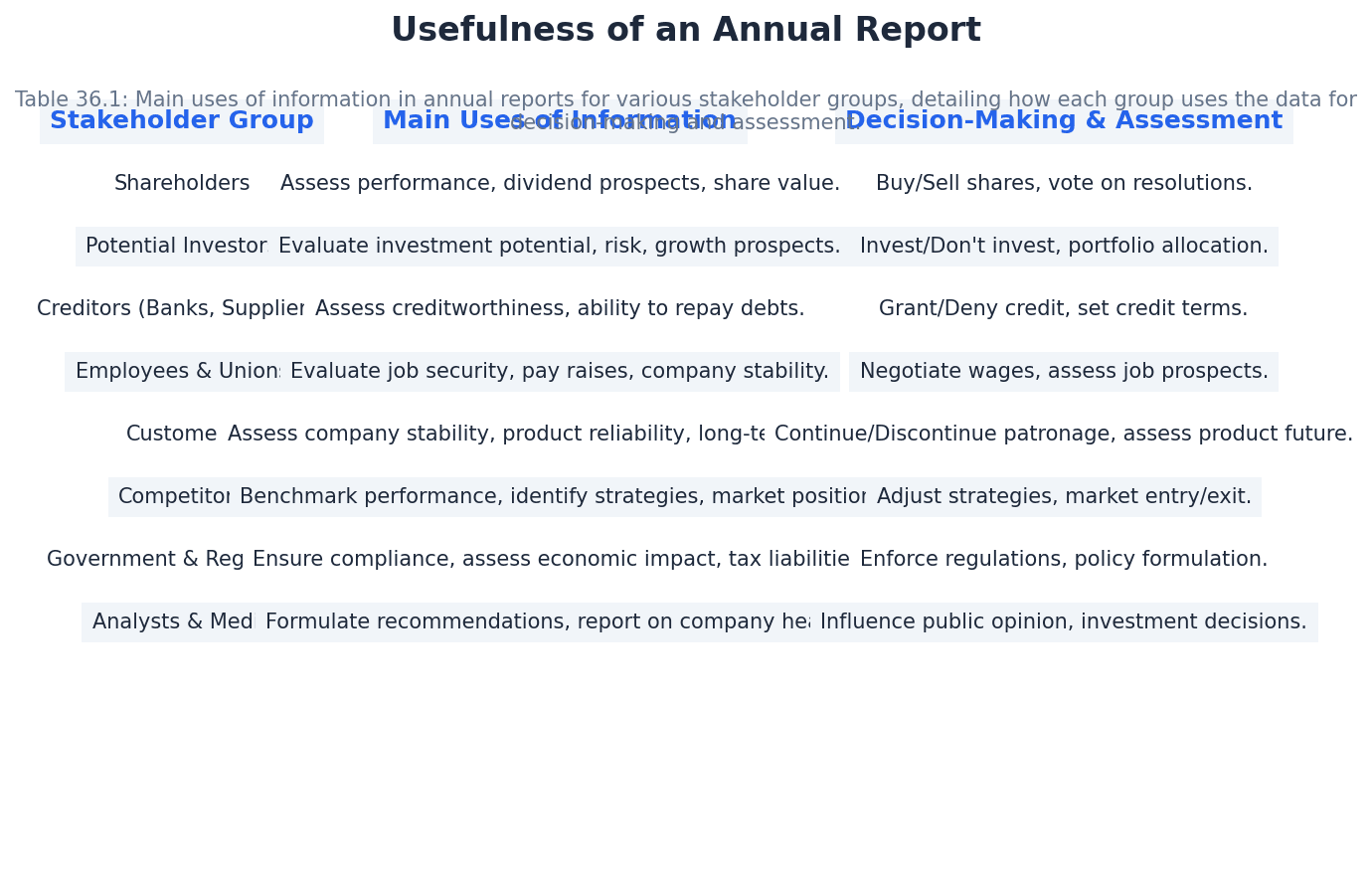
Students often think that published accounts are always perfectly accurate, but actually, accounting involves judgments and estimations, which can lead to 'window dressing' to present a more favourable financial position.
Students often think that all information about a company is published in its annual report, but actually, companies only publish the minimum required by law, omitting sensitive details like product profitability or R&D plans.
When evaluating the accuracy of accounts, discuss specific methods of window dressing (e.g., selling assets, reducing depreciation, ignoring bad debts) and their impact on ratios, distinguishing between short-term and long-term effects.
While powerful, ratio analysis has several limitations. It only highlights potential problems, such as falling profitability, but does not explain the underlying causes; managers must then identify these causes and develop effective strategies. Furthermore, ratio analysis relies on historical financial data, which may not accurately predict future performance, and it often overlooks crucial non-numerical aspects of business performance like customer loyalty, environmental policies, and human rights.
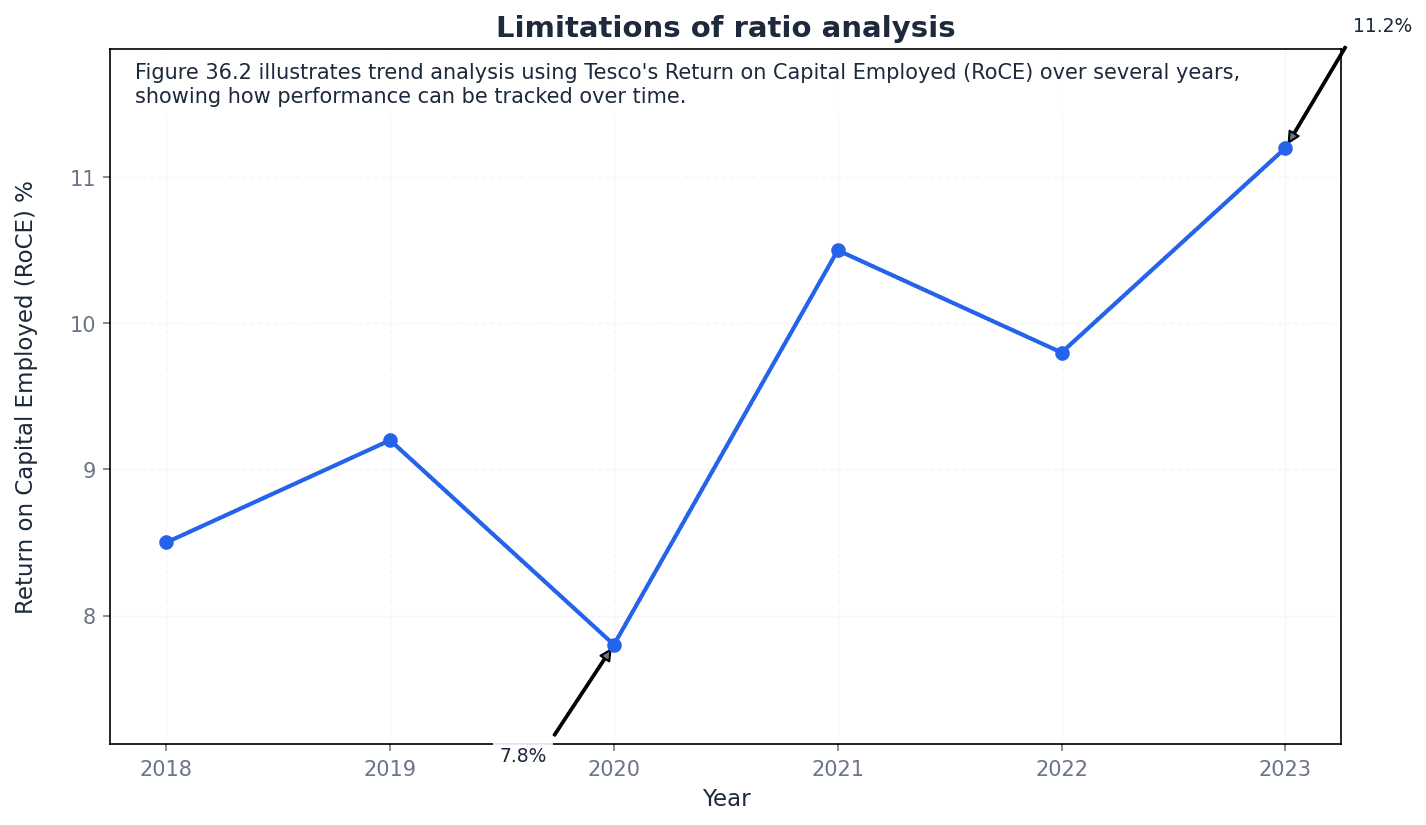
Students often think that ratio analysis provides solutions to business problems, but actually, it only highlights problems; managers must then identify the true causes and develop effective strategies.
Students often think that financial data is the only important aspect of business performance, but actually, non-numerical aspects like customer loyalty, environmental policies, and human rights are increasingly important.
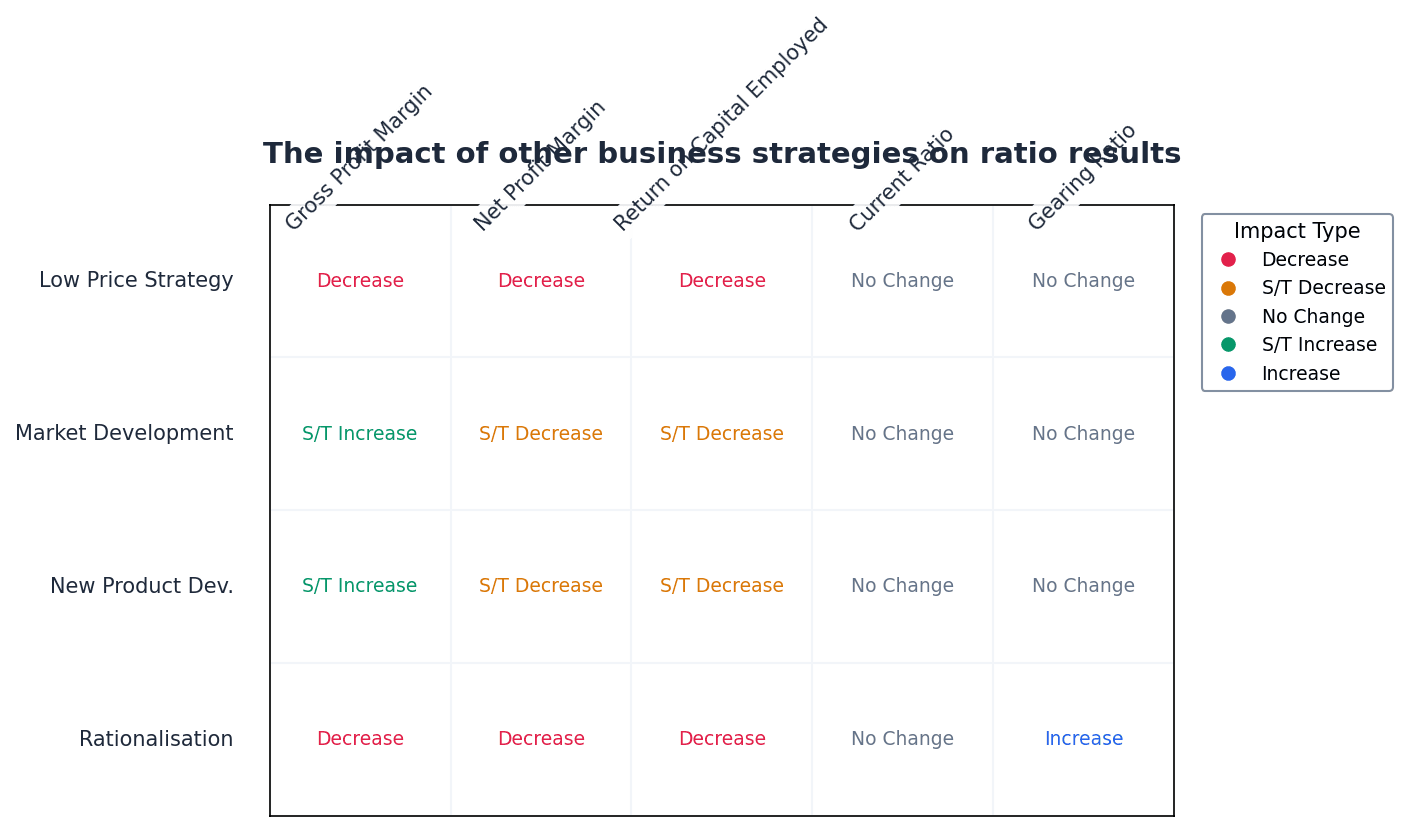
Always state your basis for comparison when using ratios: 'Compared to the previous year...' or 'Compared to the industry average...'.
To achieve evaluation, always discuss the limitations of the financial data provided, mentioning issues like 'window dressing' or the use of historical data.
Integrate non-financial information into your analysis. A strong answer will use financial data as evidence but also consider factors like brand reputation or market trends.
Advantages & Disadvantages
Using accounting data for strategic decision-making
Ratio analysis
Evaluation Starters
Essay Structure Guide
Introduction
Start by defining accounting data and ratio analysis, and briefly state their importance in strategic decision-making. Outline the key areas you will evaluate, such as usefulness, limitations, and impact of strategic choices.
Conclusion
Summarise your main arguments, reiterating the dual nature of accounting data and ratio analysis (both useful and limited). Provide a final, reasoned judgment on their overall importance in strategic decision-making, perhaps emphasising the need for a holistic approach that combines financial and non-financial information.
This chapter provides a comprehensive overview of the Cambridge International AS and A Level Business assessments, detailing the structure and weighting of each paper. It explains the four core assessment objectives: Knowledge and understanding, Application, Analysis, and Evaluation, offering guidance on how to demonstrate these skills. Additionally, the chapter offers practical advice on effective revision strategies and techniques for optimal performance in the assessment room.
Knowledge and understanding — The assessment objective requiring candidates to demonstrate relevant subject knowledge and understanding of that knowledge.
This skill is fundamental and forms the basis for all other assessment objectives. It's like knowing what bricks, cement, and wood are and their uses before you can build a house. While it's the sole focus for command words like 'identify' or 'define', it is also a foundational element required in all higher-order questions.
Students often think that knowledge and understanding are only tested by 'define' or 'identify' questions, but actually, they are a foundational element required in all higher-order questions.
For 'identify' or 'define' questions, provide only the requested information without explanation or application to avoid wasting time and potentially losing focus.
Application — The assessment objective requiring candidates to apply Business subject knowledge and understanding to different Business situations.
Application involves using your knowledge in specific contexts, much like using a hammer to drive a nail into a particular piece of wood. This can be demonstrated by referencing industry details from the question, making clear reference to a business context even if not explicitly given, or directly referencing a case study business, its data, or its issues.
Students often think that application is only relevant for case study questions, but actually, it can also be demonstrated in questions without a detailed case study by providing a relevant business context.
In case study questions, ensure direct and relevant references to the specific business, its data, or its decisions are made to demonstrate application effectively.
Analysis — The assessment objective requiring candidates to explore the impact or consequences of business issues.
Analysis goes beyond simply stating facts; it involves explaining the 'why' and 'what if' of a situation, showing cause and effect. For instance, if knowledge is knowing a car needs fuel, and application is putting fuel in a specific car, analysis is understanding how the fuel moves through the engine, ignites, and creates power, and what happens if there's a blockage. This skill is crucial for questions using command words like 'analyse', 'evaluate', 'assess', 'advise', and 'justify'.
Students often think that analysis is just listing points, but actually, it requires explaining the chain of consequences or impacts of those points.
To demonstrate analysis, focus on explaining the 'impact' or 'consequences' of your points, showing how one factor leads to another within a business context.
Evaluation — The assessment objective requiring candidates to make supported judgements or conclusions.
Evaluation is like being a judge in a court case: you listen to arguments for and against, weigh the evidence, consider the implications, and then deliver a reasoned verdict. This skill is essential for questions using command words like 'evaluate', 'assess', 'advise', and 'justify'. It involves weighing up different arguments, considering their relative importance, and arriving at a reasoned conclusion.
Students often think that evaluation is simply stating a conclusion, but actually, it requires a supported conclusion that considers different perspectives and their relative importance.
For evaluative questions, ensure your response includes an analysis of both advantages and disadvantages (or different sides of an argument) and culminates in a clear, supported conclusion.
The Cambridge International AS and A Level Business assessments are structured around four key assessment objectives: Knowledge and understanding, Application, Analysis, and Evaluation. While knowledge and understanding are foundational, candidates must also demonstrate their ability to apply this knowledge to different business situations, analyse the impacts and consequences of business issues, and make supported judgements or conclusions. Simply learning facts and figures is insufficient; the application, analysis, and evaluation of this knowledge are crucial for success.
Students often think that learning facts and figures is sufficient for AS and A Level, but actually, the application, analysis, and evaluation of this knowledge are crucial.
Business Concepts 1 — Paper 1 of the AS Level assessment, worth 40% of the AS qualification and 20% of the full A Level.
This paper serves as a foundational test for the AS Level, covering core ideas. It comprises two sections: Section A with four compulsory short answer questions, and Section B, where candidates choose one from two essay questions. It forms a significant part of the AS qualification and builds essential skills.
Students often think that Paper 1 is less important due to its lower percentage weighting for the full A Level, but actually, it forms a significant part of the AS qualification and builds essential skills.
Allocate time carefully between the short answer questions and the essay question in Paper 1, ensuring you provide sufficient depth for the essay.
Business Concepts 2 — Paper 2 of the AS Level assessment, worth 60% of the AS qualification and 30% of the full A Level.
This paper is the practical application test for the AS Level, requiring candidates to use their knowledge to interpret and respond to real-world business scenarios presented with data. It consists of two compulsory data response questions, demanding application, analysis, and sometimes evaluation based on the provided business data.
Students often think that data response questions only require extracting information, but actually, they demand application, analysis, and sometimes evaluation based on the data.
Spend the initial reading time carefully analysing the provided data and case study before attempting to answer the questions in Paper 2, as application to this context is crucial.
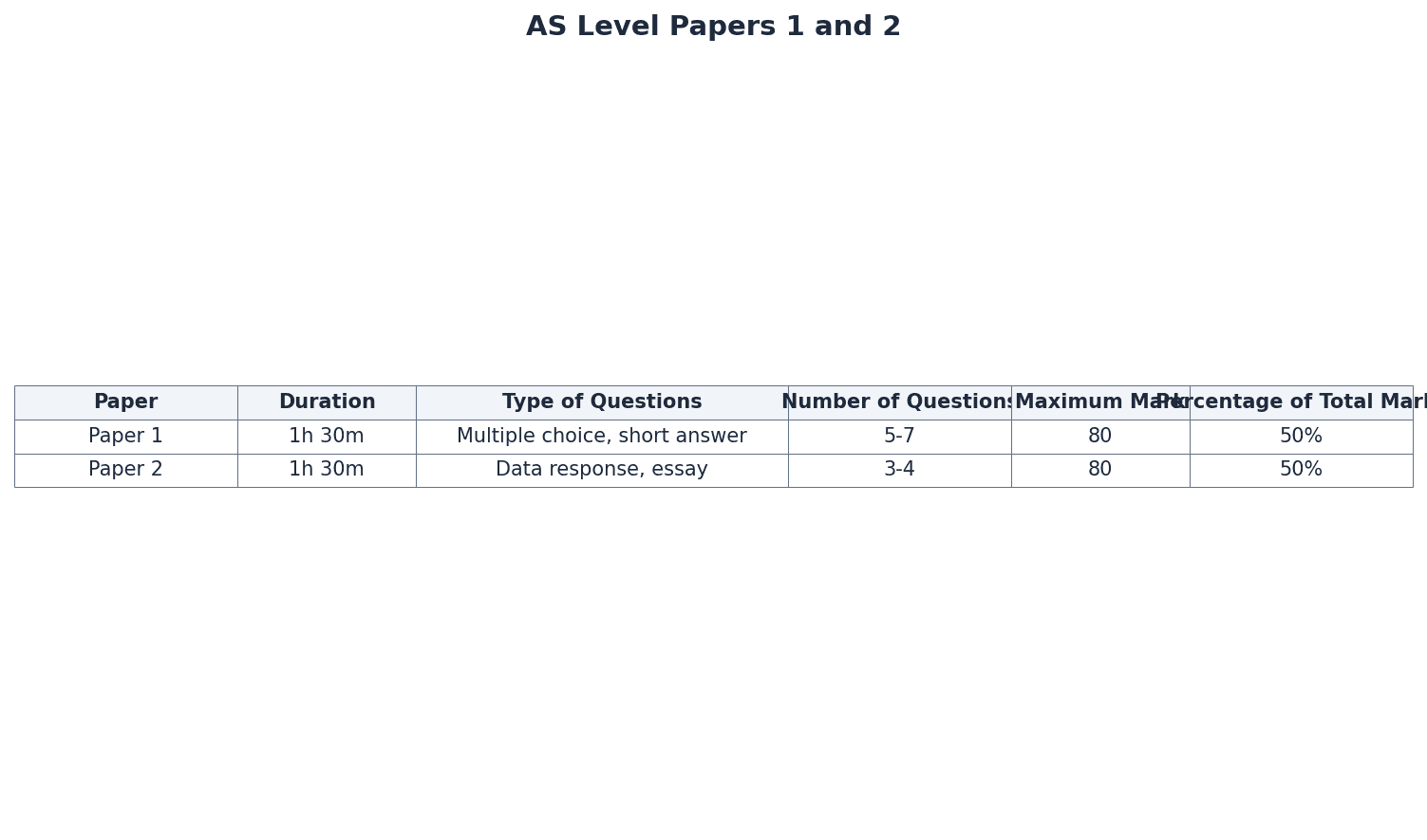
The Cambridge International AS Level assessments are divided into two papers: Paper 1 (Business Concepts 1) and Paper 2 (Business Concepts 2). Paper 1 focuses on short answer questions and a choice of essay, contributing 40% to the AS qualification. Paper 2, which accounts for 60% of the AS qualification, involves compulsory data response questions, requiring candidates to apply their knowledge and analytical skills to provided business data.
Business Decision Making — Paper 3 of the A Level qualification, worth 30% of the A Level qualification.
This paper is like being a business consultant, given a detailed company situation and asked to make and justify strategic recommendations based on data and analysis. It is a case study paper with five compulsory questions, some structured, requiring calculations and the use of results and other information to make business decisions. It requires integrating numerical results directly into the justification of business decisions.
Students often think that calculations are separate from decision-making, but actually, this paper requires integrating numerical results directly into the justification of business decisions.
For structured questions in Paper 3, ensure that the results from any calculations are explicitly used and referenced in the second part of the question to support your business decision.
Business Strategy — Paper 4 of the A Level qualification, worth 20% of the A Level qualification.
This paper is like being a CEO, reflecting on the outcomes of past major company choices and then charting the course for future growth and challenges. It contains two compulsory essay questions, both based on business strategy, with one focusing on the impact of past strategic decisions and the other on developing and choosing future strategies. These essays require application to business contexts and a deep understanding of strategic implications.
Students often think that strategy essays are purely theoretical, but actually, they require application to business contexts and a deep understanding of strategic implications.
Ensure your essays in Paper 4 demonstrate a clear understanding of strategic concepts and provide well-reasoned arguments, considering both the positive and negative impacts of strategic choices.
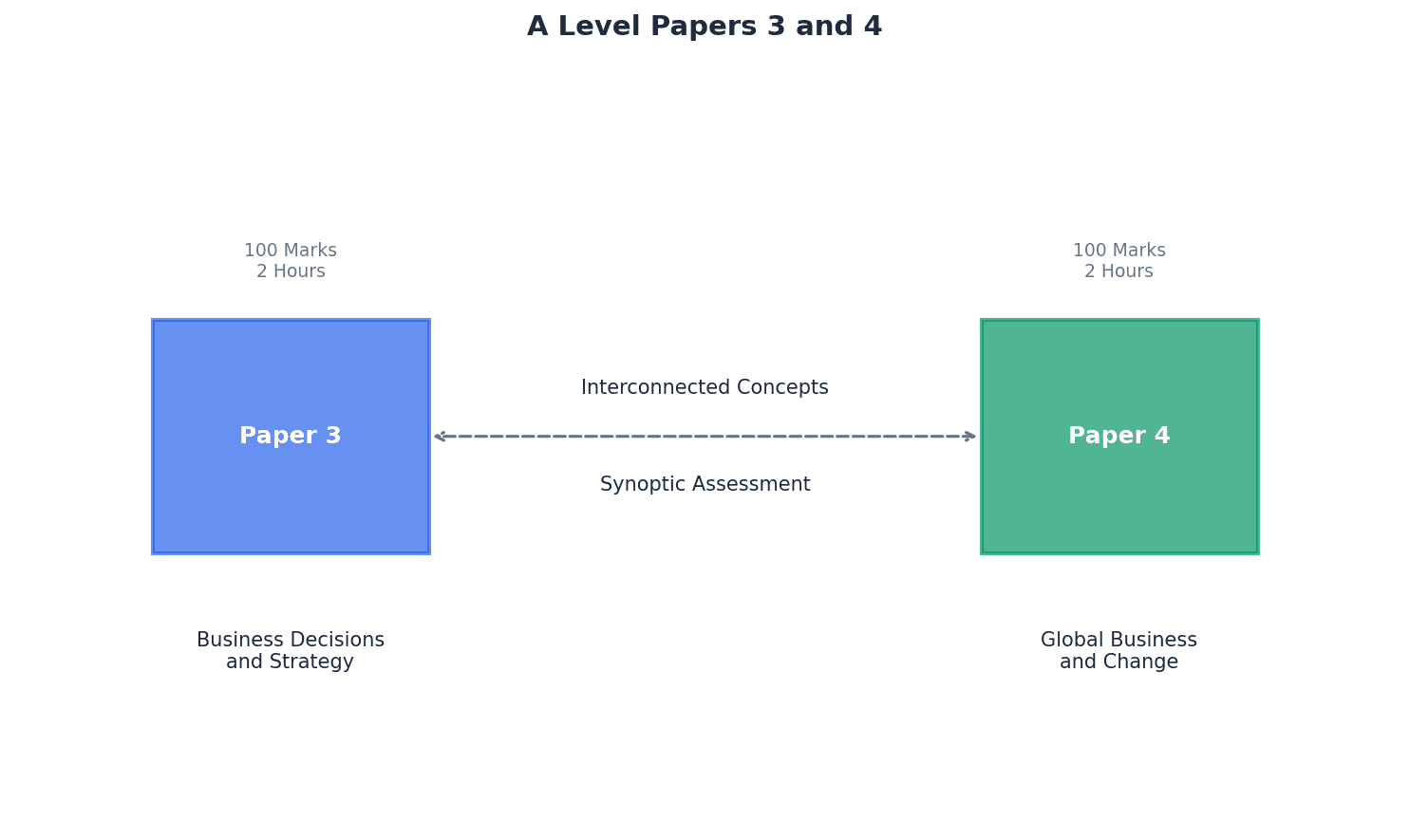
The A Level assessments build upon the AS Level, with Papers 3 (Business Decision Making) and 4 (Business Strategy) forming the full A Level qualification. Paper 3 is a case study paper with compulsory questions, often involving calculations and requiring candidates to integrate numerical results into business decisions. Paper 4 consists of two compulsory essay questions focused on business strategy, demanding a deep understanding of strategic concepts and their implications. Together, these papers assess a more advanced and integrated understanding of business principles.
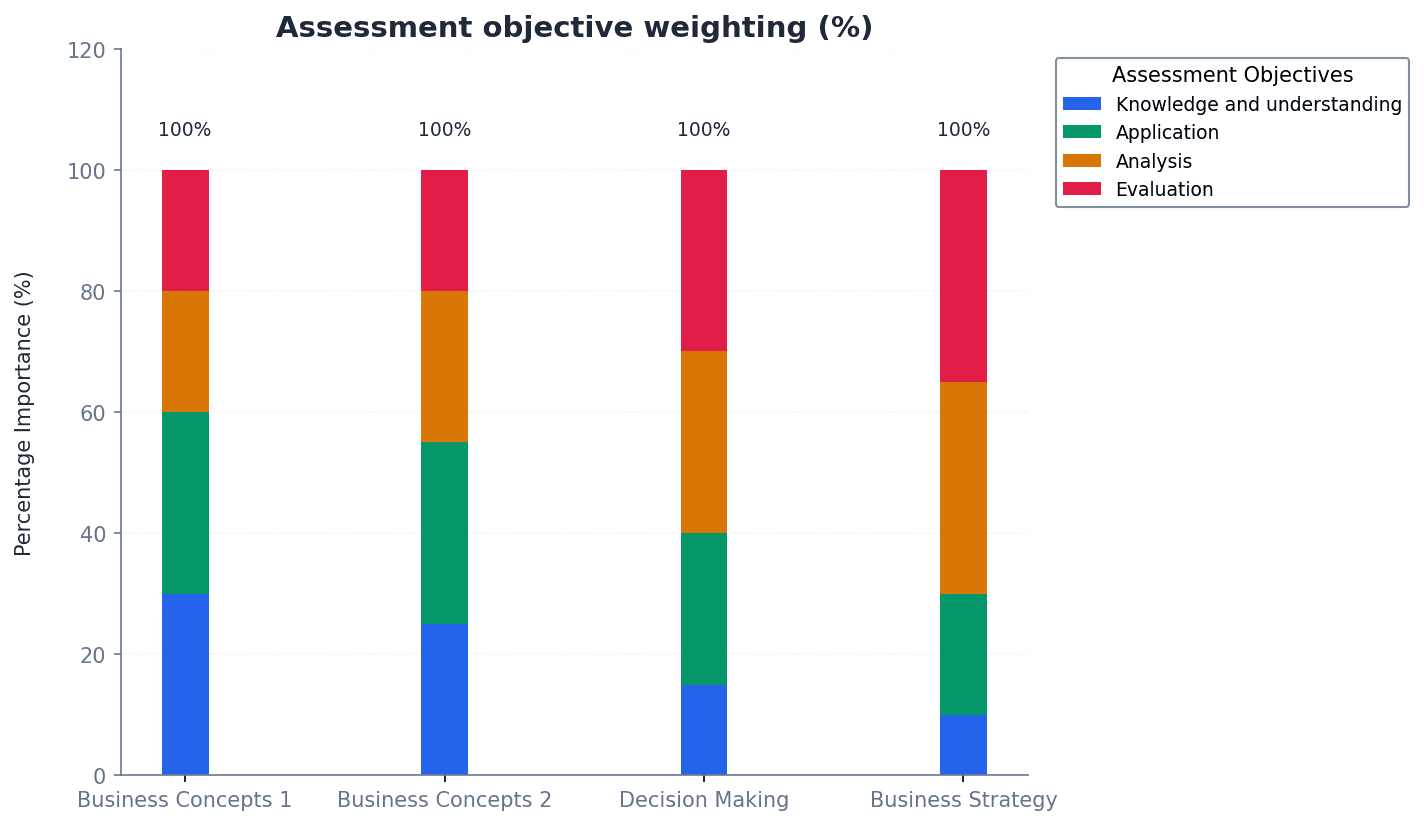
Effective revision is crucial for success. Instead of passive reading, engage in active revision techniques such as using flashcards or practice questions. It is more beneficial to work in lots of short, focused sessions rather than attempting one long cramming session. This approach helps in better retention and understanding of the material.
In the assessment room, managing your time effectively is paramount. Allocate time carefully based on the marks available for each question to ensure all parts are attempted. For higher-mark questions, always create a brief plan before writing your full answer. Finally, always leave time at the end to read through your answers and check for any errors, which can prevent losing easy marks.
Students often think that spending too long on the first question is acceptable, but actually, it is a common error that leads to being rushed and potentially incomplete answers for subsequent tasks.
average cost
Used to calculate the cost per unit of production.
break-even level of output
Used to determine the output level at which total costs equal total revenue.
rate of capacity utilisation
Measures the percentage of total capacity that is currently being used.
closing cash balance
Calculates the cash remaining at the end of a period.
labour productivity (number of units per worker)
Measures the output produced per worker.
margin of safety
Indicates how much sales can fall before the business reaches its break-even point.
market capitalisation
Represents the total value of a company's outstanding shares.
median value
Used to find the position of the median in an ordered set of data.
production over break-even point (%)
Calculates the margin of safety as a percentage of break-even output.
profit
Calculates the net profit after deducting overheads from total contribution.
range
Measures the spread of data by finding the difference between the maximum and minimum values.
revenue
Calculates the total value of sales made during a trading period.
section angle (pie graph)
Used to determine the angle for a section in a pie graph.
total contribution
Calculates the total contribution towards fixed costs and profit.
unit contribution
Calculates the contribution each unit makes towards covering fixed costs.
working capital
Measures a business's short-term liquidity, also referred to as net current assets.
absenteeism (%)
Measures the percentage of total workdays lost due to employee absence.
accounting rate of return (ARR)
Calculates the average annual profit as a percentage of the average investment.
acid test ratio
Measures a company's ability to pay off its current liabilities with its most liquid assets.
annual depreciation
Calculates the annual depreciation using the straight-line method.
average inventory
Calculates the average value of inventory held over a period.
average investment
Used in the calculation of Accounting Rate of Return.
capital employed (%)
Represents the total capital used in a business, often used in profitability ratios.
cost of sales
Calculates the direct costs attributable to the production of goods sold.
current ratio
Measures a company's ability to pay short-term and long-term obligations.
dividend cover ratio (×)
Indicates how many times a company's profit can cover its dividend payments.
dividend per share
Calculates the amount of dividend paid out for each ordinary share.
dividend yield ratio (%)
Measures the dividend income per share relative to the market price per share.
earnings per share (EPS)
Calculates the portion of a company's profit allocated to each outstanding share of common stock.
free float
Used in project management to determine the amount of time an activity can be delayed without delaying the start of any successor activity.
gearing ratio (%)
Measures the proportion of a company's capital that is financed by debt.
gross profit
Calculates the profit a company makes after deducting the costs associated with making and selling its products.
gross profit margin ratio (%)
Measures the percentage of revenue that is left after subtracting the cost of sales.
income elasticity of demand (IED)
Measures the responsiveness of the quantity demanded for a good or service to a change in consumer income.
liquid assets
Assets that can be converted into cash quickly, excluding inventory.
market share (%)
Measures a business's sales as a percentage of total market sales.
net book value
The current statement of financial position value of a non-current asset.
net realisable value
The estimated selling price in the ordinary course of business less the estimated costs of completion and the estimated costs necessary to make the sale.
operating profit margin ratio (%)
Measures the percentage of revenue that is left after subtracting operating expenses.
payback period - additional months
Calculates the additional months required to recover an investment after a full year of cash flow.
price/earnings (P/E) ratio
Compares a company's current share price to its earnings per share.
price elasticity of demand (PED)
Measures the responsiveness of the quantity demanded to a change in price.
promotional elasticity of demand (PED)
Measures the responsiveness of the quantity demanded for a good or service to a change in promotional spending.
rate of inventory turnover
Measures how many times inventory is sold and replaced over a period.
reserves
Represents the accumulated profits that have not been distributed to shareholders.
return on capital employed ratio (ROCE)
Measures how efficiently a company is using its capital to generate profits.
total float
Used in project management to determine the amount of time an activity can be delayed without delaying the project completion date.
total revenue
Calculates the total income generated from sales.
trade payables turnover (days)
Measures the average number of days it takes for a company to pay its suppliers.
trade receivables (days)
Measures the average number of days it takes for a company to collect its credit sales.
Manage your time strictly in the exam. Allocate time based on the number of marks for each question.
For high-mark questions, always create a brief plan before you start writing your full answer.
Always leave time at the end to read through your answers and check for errors.
Advantages & Disadvantages
Active Revision Techniques
Case Study Questions (Papers 2 and 3)
Evaluation Starters
Essay Structure Guide
Introduction
Begin with a brief introduction that defines key terms from the question and outlines the scope of your discussion. State your overall stance or the main arguments you will explore.
Conclusion
Conclude by summarising your main arguments and reiterating your supported judgement. Avoid introducing new information. Your conclusion should provide a clear, reasoned answer to the essay question, reflecting the depth of your analysis and evaluation.
Generated by Nexelia Academy · nexeliaacademy.com