
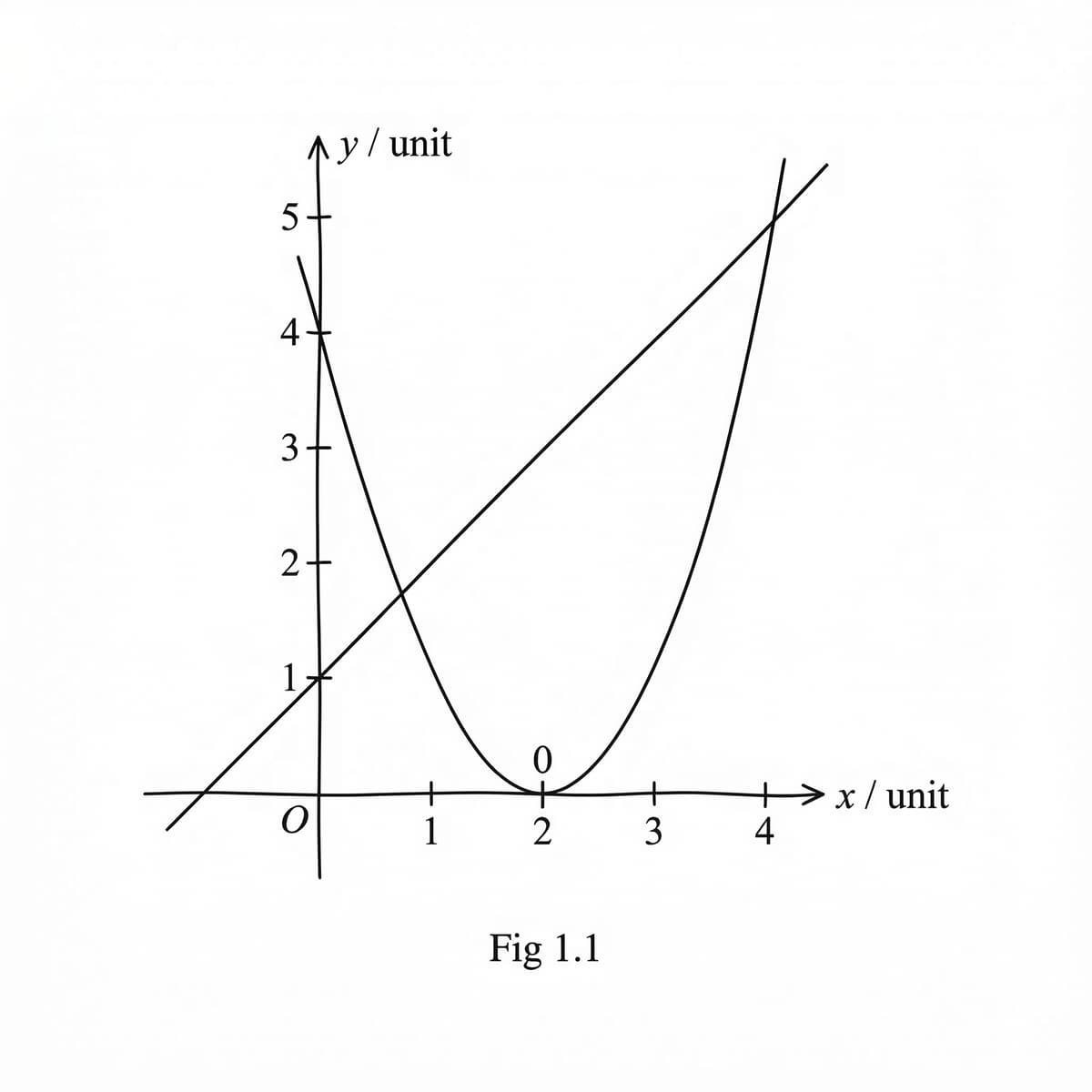
Fig 1.1 shows a parabola with equation y = x^2 - 4 and a straight line. (a) State the equation of the straight line shown in the figure. [2] (b) Calculate the y-coordinate of the point on the parabola where x = 0. [3] (c) Find the x-coordinates of the intersection points by solving the equations simultaneously, and compare your findings with the diagram. [4]
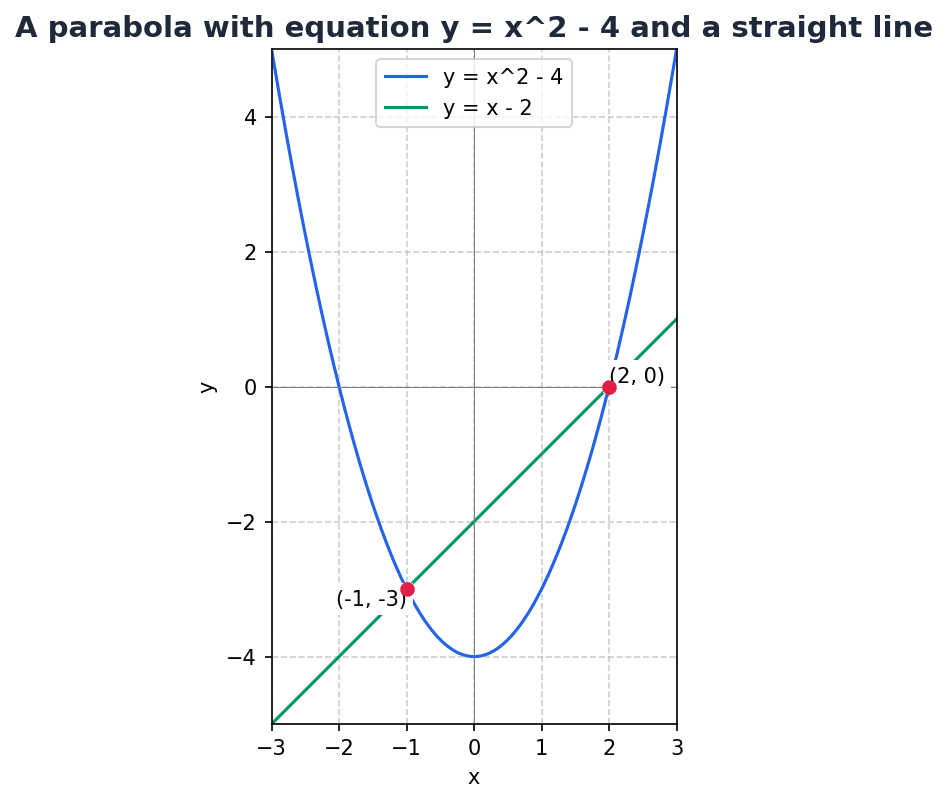
Fig 1.1 shows a parabola with equation y = x^2 - 4 and a straight line with equation y = 2x - 1. (a) Read the coordinates of the two points of intersection from the graph. (b) Verify algebraically that one of the points read in part (a) satisfies both equations y = x^2 - 4 and y = 2x - 1.
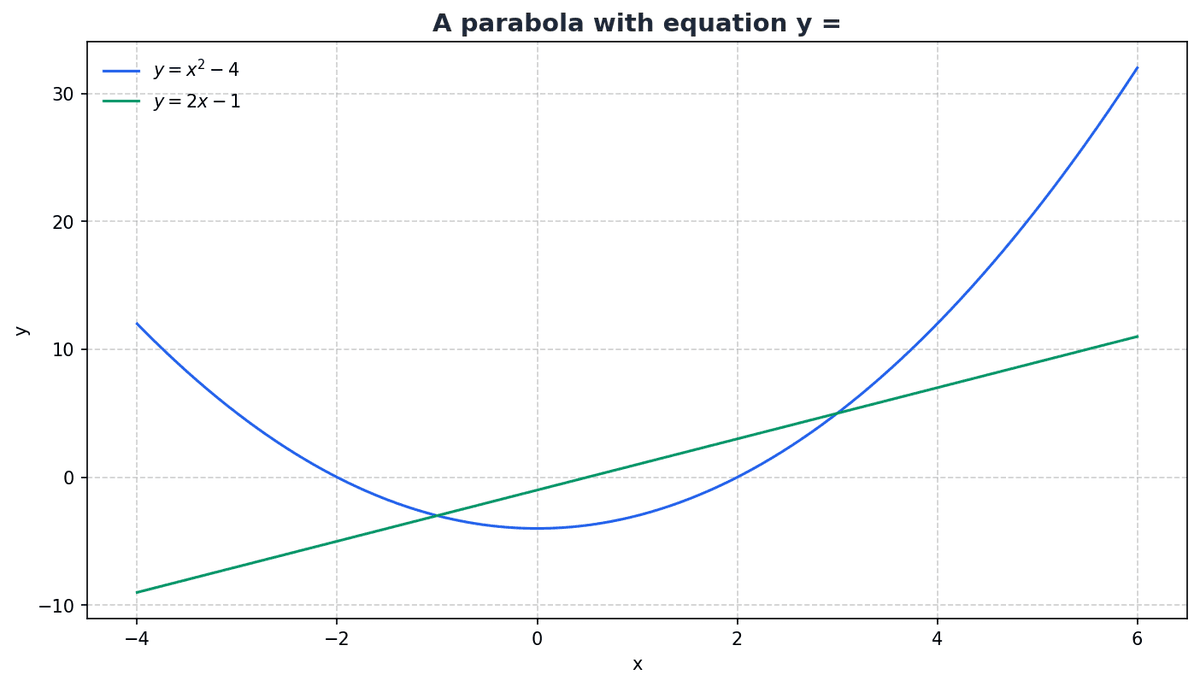
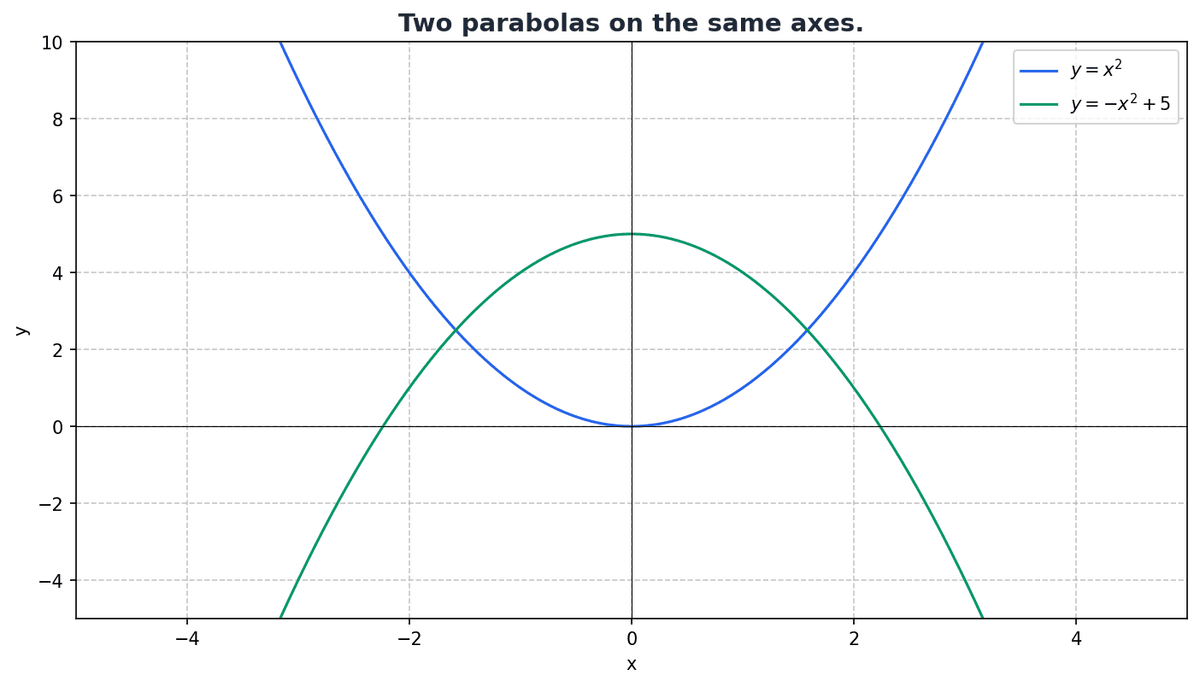
Fig 1.3 shows two parabolas on the same axes. (a) Read the coordinates of the minimum point of the U-shaped parabola and the maximum point of the inverted U-shaped parabola. [2] (b) Express the equation of the U-shaped parabola in the form y = p(x+q)^2+r, given its vertex and y-intercept. [4] (c) Compare the y-intercepts of both parabolas as shown in the diagram. [3]
A quadratic equation models the height of a ball thrown vertically upwards. Consider the equation 2x^2 - 5x + c = 0, where x represents time and c is a constant related to the initial height. (a) Determine the condition for the equation 2x^2 - 5x + c = 0 to have no real roots. [4] (b) Illustrate this condition graphically by sketching a parabola that satisfies it. [3]
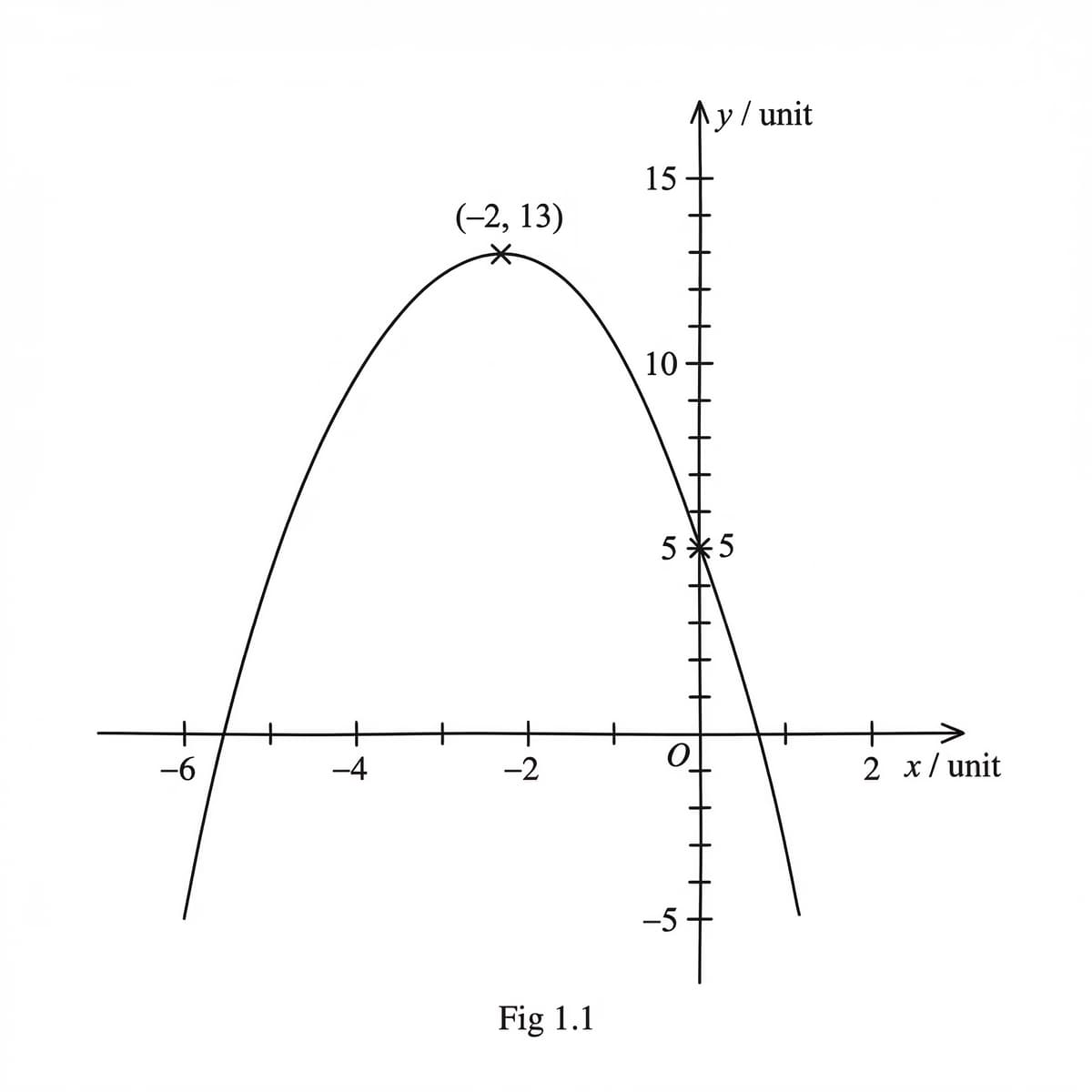
The path of a ball thrown into the air can be modelled by the quadratic function f(x) = -2x^2 - 8x + 5, where f(x) is the height of the ball and x is the horizontal distance from the thrower. The graph of this function is shown in Fig 1.1. (a) Find the maximum or minimum value of the function f(x) = -2x^2 - 8x + 5 and the x-coordinate where it occurs. [5] (b) Identify whether it is a maximum or minimum value. [2]
The general form of a quadratic function is y = ax^2 + bx + c. (a) Derive the formula for the x-coordinate of the vertex of a parabola y = ax^2 + bx + c using the method of completing the square. [6] (b) Evaluate the maximum value of the function h(x) = -3x^2 + 12x - 5 using the derived formula. [3] (c) Compare the efficiency of finding the vertex using the derived formula versus directly completing the square for a given quadratic. [3]
For a quadratic equation, the nature of its roots depends on the value of its discriminant. Consider the equation kx^2 + 6x + 2 = 0, where k is a constant. (a) Find the set of values of k for which the equation has two distinct real roots. [6]
Fig 1.4 shows six graphs of quadratic functions, labelled A to F. (a) Identify which graph represents a quadratic equation with two equal real roots. [2] (b) Deduce the sign of the discriminant for graph C and explain your reasoning. [3] (c) Determine the values of m for which the equation 2x^2 + 4x + m = 0 has no real roots, referring to similar graphs in the figure. [4]
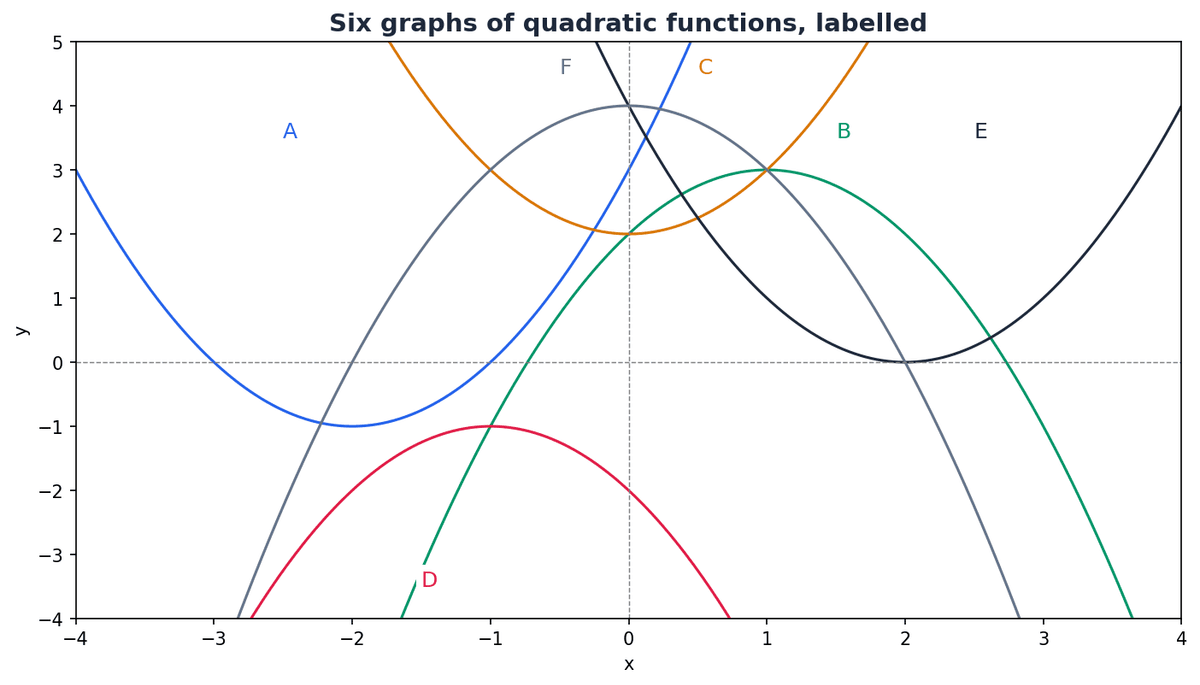
Fig 1.4 shows the graph of a quadratic function y = ax^2 + bx + c. (a) Interpret the meaning of the discriminant for the parabola shown in Fig 1.4. [3] (b) Explain how changing the constant term of the quadratic function in Fig 1.4 might affect the number of real roots. [3]
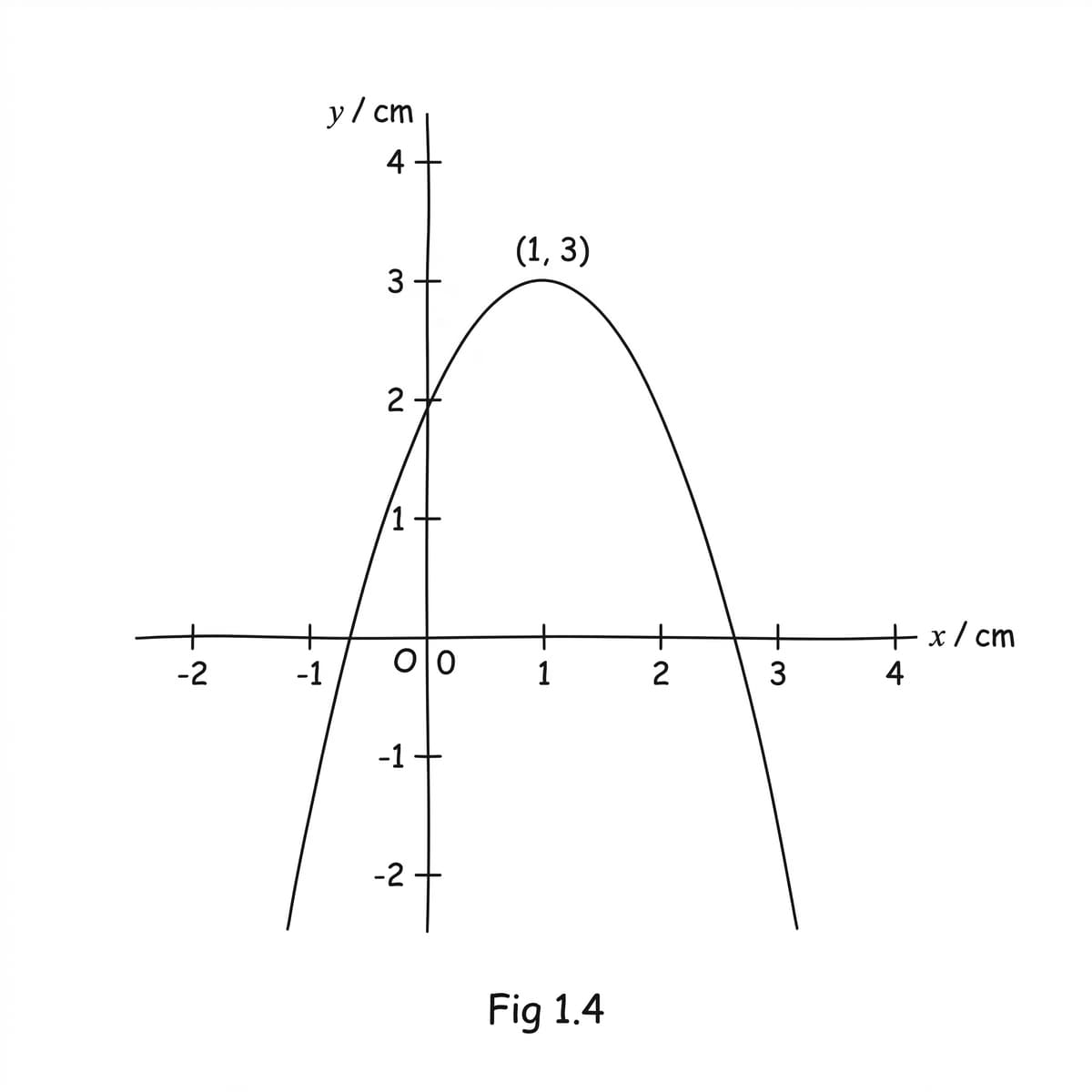
Fig 1.2 shows two parabolas on the same axes. (a) Read the coordinates of the vertex for the inverted U-shaped parabola. [2] (b) State whether the U-shaped parabola has a maximum or minimum value, and give this value. [2]
An algebraic expression is given by (x + 1)^2 + 3(x + 1) - 10 = 0. (a) Find all real solutions to the equation (x + 1)^2 + 3(x + 1) - 10 = 0. [5] (b) Verify one of your solutions by substituting it back into the original equation. [2]
Fig 1.3 shows six graphs of quadratic functions, labelled A to F. (a) Classify the nature of the roots for graph A and graph F, referring to their intersections with the x-axis. [3] (b) Explain why the discriminant is zero for graph B, given that its equation is y = (x - 3)^2. [4] (c) Derive the condition for the line y = mx + c to be tangent to the parabola y = x^2. [4]
A student is asked to solve a quadratic equation as part of a larger problem involving projectile motion. (a) Solve the equation 2x^2 + 4x - 3 = 0, giving your answers in exact surd form. [5] (b) Explain why factorisation might not be the preferred method for solving this equation. [3]
Fig 1.1 shows a parabola and a straight line on the same axes. (a) Derive the equation of the parabola in the form y = ax^2 + bx + c, given its vertex and one x-intercept. [4] (b) Solve the simultaneous equations y = x^2 - 4 and y = 2x - 1 algebraically. [3] (c) Interpret the significance of the solutions found in part (b) with reference to the diagram. [3]
A mathematical function is defined as y = (x^2 - x)^2 - 8(x^2 - x) + 12. Understanding its roots and graphical behaviour is important in certain optimisation problems. (a) Find the real roots of the equation (x^2 - x)^2 - 8(x^2 - x) + 12 = 0. [5] (b) Sketch a possible graph of y = (x^2 - x)^2 - 8(x^2 - x) + 12, indicating the x-intercepts. [3]
Fig 1.2 shows two parabolas on the same axes. (a) Identify the coordinates of the vertex of the inverted U-shaped parabola. (b) Write the equation of the inverted U-shaped parabola in the form y = a(x + b)^2 + c, given its vertex is (1, 3) and it crosses the y-axis at (0, 2).
A student is investigating the number of real roots for different quadratic equations. (a) Sketch the graph of a quadratic function that has no real roots. [3] (b) Explain how the discriminant value relates to your sketch in part (a). [3] (c) Calculate the discriminant for the equation x^2 + 2x + 5 = 0. [3]
Completing the square can be used both to rewrite quadratic expressions and to solve quadratic equations by isolating the variable. (a) Use the method of completing the square to express x^2 + 6x - 2 in the form (x + p)^2 + q. [4] (b) Hence, solve the equation x^2 + 6x - 2 = 0, leaving your answers in surd form. [3]
Fig 1.1 shows the graph of a quadratic function given by y = ax^2 + bx + c. The curve represents the trajectory of a ball thrown into the air. (a) Analyse Fig 1.1. State the coordinates of the vertex of the parabola. [4] (b) Compare the completed square form y = a(x - h)^2 + k with the graph, and evaluate the values of a, h, and k for the function shown in Fig 1.1. [8]
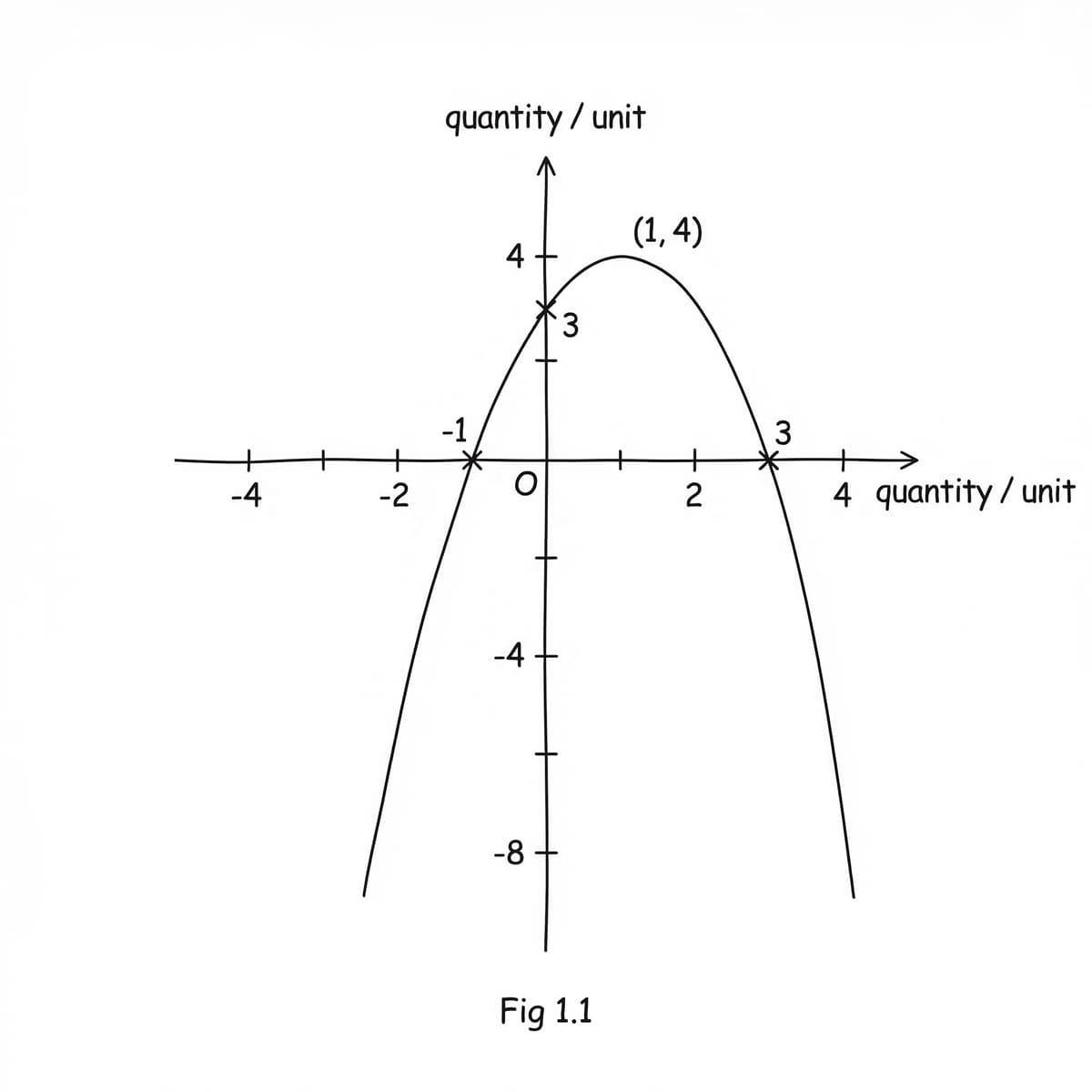
Fig 1.2 shows two parabolas on the same axes. (a) Identify the coordinates of the turning point for the U-shaped parabola. [2] (b) Determine the equation of the U-shaped parabola in the form y = x^2 + bx + c, given its vertex and y-intercept. [3] (c) The inverted U-shaped parabola has the equation y = -(x - 1)^2 + 3. Calculate the y-coordinate of this parabola when x = 0, and verify it matches the diagram. [3]
A civil engineer is designing a parabolic arch for a bridge. The shape of the arch can be modelled by a quadratic equation. (a) Find the values of x that satisfy the equation (x - 1)^2 = 2x + 5, giving your answers correct to 2 decimal places. [6] (b) Deduce the nature of the roots of the equation in part (a) based on your solutions. [4]
The number of real roots of a quadratic equation relates to how its graph intersects the x-axis. Consider the equation x^2 + (m - 2)x + 4 = 0. (a) Determine the value of m for which the equation has exactly one real root. [4] (b) Explain the geometric significance of having exactly one real root for a quadratic equation. [3]
A designer is modelling a parabolic arch for a bridge and a horizontal support beam. The arch is represented by the curve y = (x - 1)^2 + 2, and the support beam is represented by the line y = 4. (a) Find the coordinates of the points where the line y = 4 intersects the curve y = (x - 1)^2 + 2. [5] (b) Calculate the distance between these two points of intersection. [3]
Fig 1.1 shows a graph of the function y = 2x - 7√x + 3. (a) Solve the equation 2x - 7√x + 3 = 0, giving your answers in exact form. [7] (b) Show that one of the solutions is extraneous if we do not consider the domain of √x to be restricted to the principal (positive) square root. [2]
The method of completing the square is a powerful technique for rewriting quadratic expressions into a standard form that reveals important properties of the function. (a) Express x^2 - 8x + 19 in the form (x + a)^2 + b, where a and b are constants to be found. [5]
A straight line and a quadratic curve are given by the equations y = 2x + 1 and y = x^2 - 3x + 5 respectively. (a) Find the coordinates of the points of intersection of the line y = 2x + 1 and the curve y = x^2 - 3x + 5. [6]
The number of real roots of a quadratic equation can be determined by evaluating its discriminant. Consider the quadratic equation 3x^2 - 7x + 2 = 0. (a) Determine the number of distinct real roots for this equation. [4]
Fig 1.4 shows two parabolas on the same axes. (a) Deduce the equation of the line of symmetry for the U-shaped parabola. (b) Formulate the equation of the inverted U-shaped parabola, given its vertex (1, 3) and y-intercept (0, 2), in the form y = ax^2 + bx + c. (c) The equation of the U-shaped parabola is y = x^2 + 4x. Solve the equation formed by setting this quadratic function equal to the equation you found in part (b), to find their points of intersection, if any.
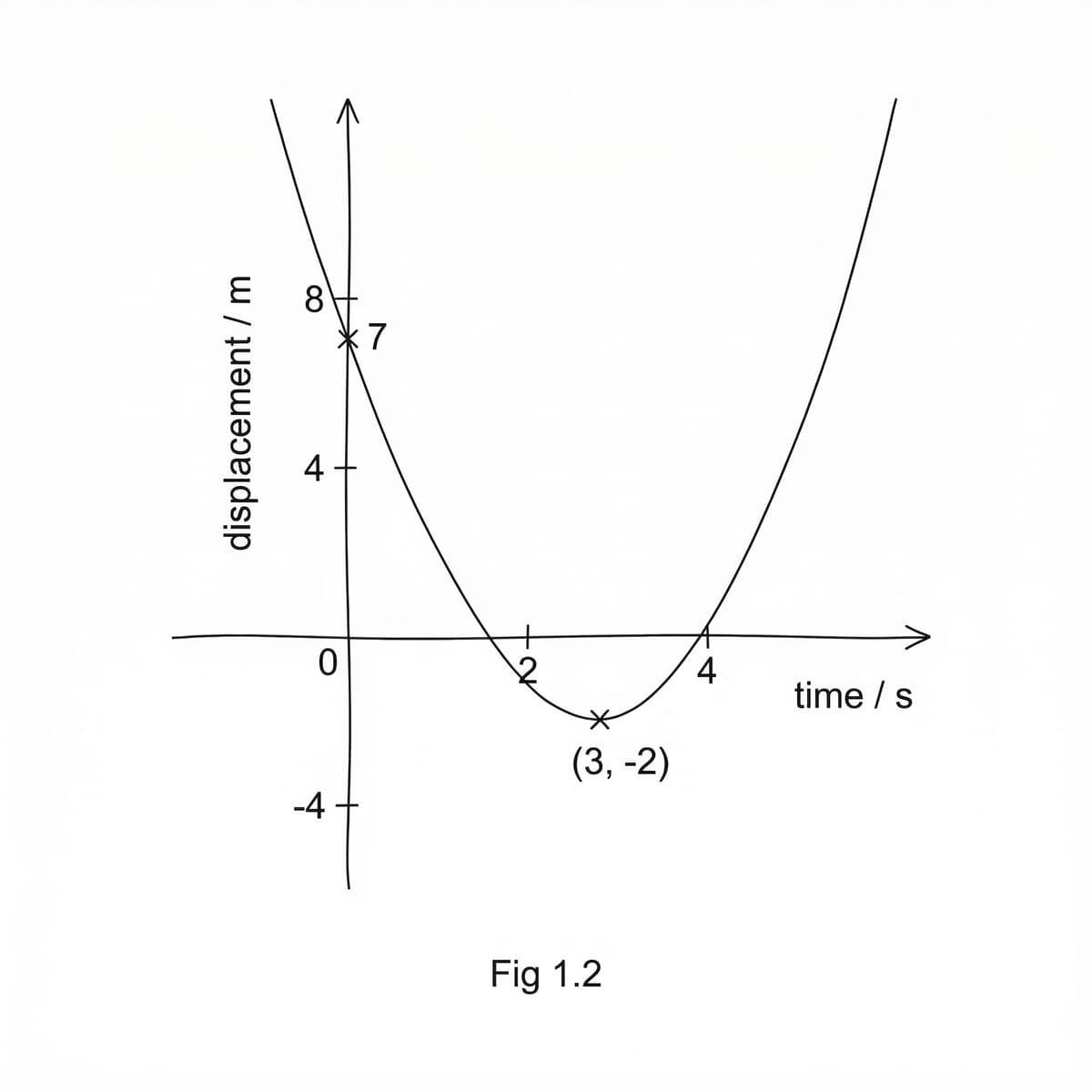
A quadratic function is given in the completed square form y = (x - h)^2 + k. Fig 1.2 shows the graph of such a function. (a) Identify the values of h and k from the graph in Fig 1.2. [3] (b) Explain how the vertex of a parabola relates to its completed square form. [3]
A line and a curve are defined by the equations y = 2x + 3 and y = x^2 + x - 1 respectively. (a) Calculate the coordinates where the line y = 2x + 3 intersects the curve y = x^2 + x - 1. [6]
Consider the equation x^4 - 5x^2 + 4 = 0. (a) Solve the equation x^4 - 5x^2 + 4 = 0. [5]
Fig 1.2 shows two parabolas on the same set of axes. (a) Identify the coordinates of the minimum point of the U-shaped parabola. (b) Determine the equation of the line of symmetry for the inverted U-shaped parabola. (c) State the y-intercept for the U-shaped parabola.
The height of a projectile, h metres, above the ground after t seconds is given by the expression h(t) = t^2 - 6t + 1. (a) Express t^2 - 6t + 1 in the form (t + a)^2 + b. [3] (b) State the minimum value of the expression and the value of t at which it occurs. [2]
A line and a curve are defined by the equations y = 3x + c and y = x^2 - x + 4, where c is a constant. (a) Find the values of c for which the line y = 3x + c is a tangent to the curve y = x^2 - x + 4. [5] (b) Show that for these values of c, there is only one point of intersection. [3] (c) Deduce the coordinates of the point of tangency for one of the values of c found in part (a). [3]
The nature of the roots of a quadratic equation is determined by its discriminant. Consider the equation (p + 1)x^2 + 4px + 9 = 0, where p is a constant. (a) Show that the equation has no real roots if p satisfies 9p^2 - 9p + 9 < 0. [5] (b) Find the range of values of p for which the equation has two equal real roots. [5]
A metal plate has an area that can be modelled by a quadratic expression. Understanding its factors is important for its design. (a) Find two linear factors of the expression 3x^2 - 10x - 8. [4] (b) Hence, solve the equation 3x^2 - 10x - 8 = 0. [3]
Fig 1.1 shows the graph of a straight line and a parabola. The equation of the line is y = x + 1 and the equation of the parabola is y = x^2 - 3x + 4. (a) Find the coordinates of the points of intersection of the line and the curve shown in Fig 1.1. [5] (b) Show that the x-coordinates of these points of intersection satisfy the equation x^2 - 4x + 3 = 0. [2]
A straight line with equation y = kx + 2 is tangent to the curve y = x^2 - 3x + 6. (a) Determine the values of the constant k for which the line is tangent to the curve. [6] (b) For the smaller value of k found in part (a), find the coordinates of the point of tangency. [4]
The trajectory of a projectile can be modelled by a quadratic curve, and a laser beam follows a straight line path. Consider a scenario where a laser beam given by the equation y = kx - 2 interacts with a parabolic trajectory given by the equation y = x^2 + 2x + 3. (a) Find the range of values of k for which the line y = kx - 2 does not intersect the curve y = x^2 + 2x + 3. [6] (b) Interpret your answer geometrically in terms of the positions of the line and the curve. [3]
A parabolic arch is modelled by the curve y = 3x^2 + 18x - 10. (a) Find the coordinates of the turning point of the curve y = 3x^2 + 18x - 10. [3] (b) Sketch the curve, clearly showing the turning point and y-intercept. [3]