
Economics · Scarcity, choice and opportunity cost
This chapter introduces the fundamental economic problem of scarcity, which arises because human wants are unlimited while resources are limited. This necessitates individuals, firms, and governments to make choices, leading to the concept of opportunity cost, defined as the next best alternative foregone. All economies must address three basic questions of resource allocation: what to produce, how to produce, and for whom to produce.
Resources — Inputs used to produce goods and services.
These are the factors of production available in an economy, such as land, labour, capital, and enterprise. Resources are finite, meaning there is a limited supply of them, which contributes to the fundamental economic problem. Think of resources like the ingredients in a kitchen; you only have a certain amount of flour, sugar, and eggs, so you can't bake every cake you want simultaneously.
Students often think resources are just money, but actually resources include all inputs like raw materials, labour, and machinery.
Needs — Things like food, shelter and clothing that are needed for survival.
Needs are basic requirements for human existence, forming the foundation of an individual's scale of preference. While essential, even needs can be satisfied in various ways, leading to choices. Needs are like the basic functions of a smartphone – calling, texting, internet access – without which it wouldn't be a phone.
Wants — Things that people desire, which are always likely to be something else whatever their income.
Wants are unlimited and continually expanding, developing, and changing, driven by factors like culture, upbringing, life experiences, and observing others. They are distinct from needs, which are essential for survival. Imagine a child in a toy store; they always want the next new toy, even after getting one. This endless desire for more is what economists mean by unlimited wants.
Students often confuse wants with needs, but needs are essential for survival while wants are desires that improve quality of life.
Clearly distinguish between 'wants' and 'needs' in your answers; using them interchangeably will lose marks as they have distinct economic meanings.
Scarcity — The fundamental economic problem that arises because resources are scarce while people’s wants are unlimited.
Scarcity means that society does not have enough resources to produce all the goods and services necessary to satisfy everyone's wants. This necessitates making choices about how to allocate limited resources. If you have a small garden plot (limited resources) but want to grow every type of fruit, vegetable, and flower imaginable (unlimited wants), you face scarcity and must choose what to plant.
Students often think scarcity means there is simply not enough of something, but it specifically means there isn't enough to satisfy all human wants.
When defining scarcity, always include both 'limited resources' and 'unlimited wants' to demonstrate a complete understanding of the concept.
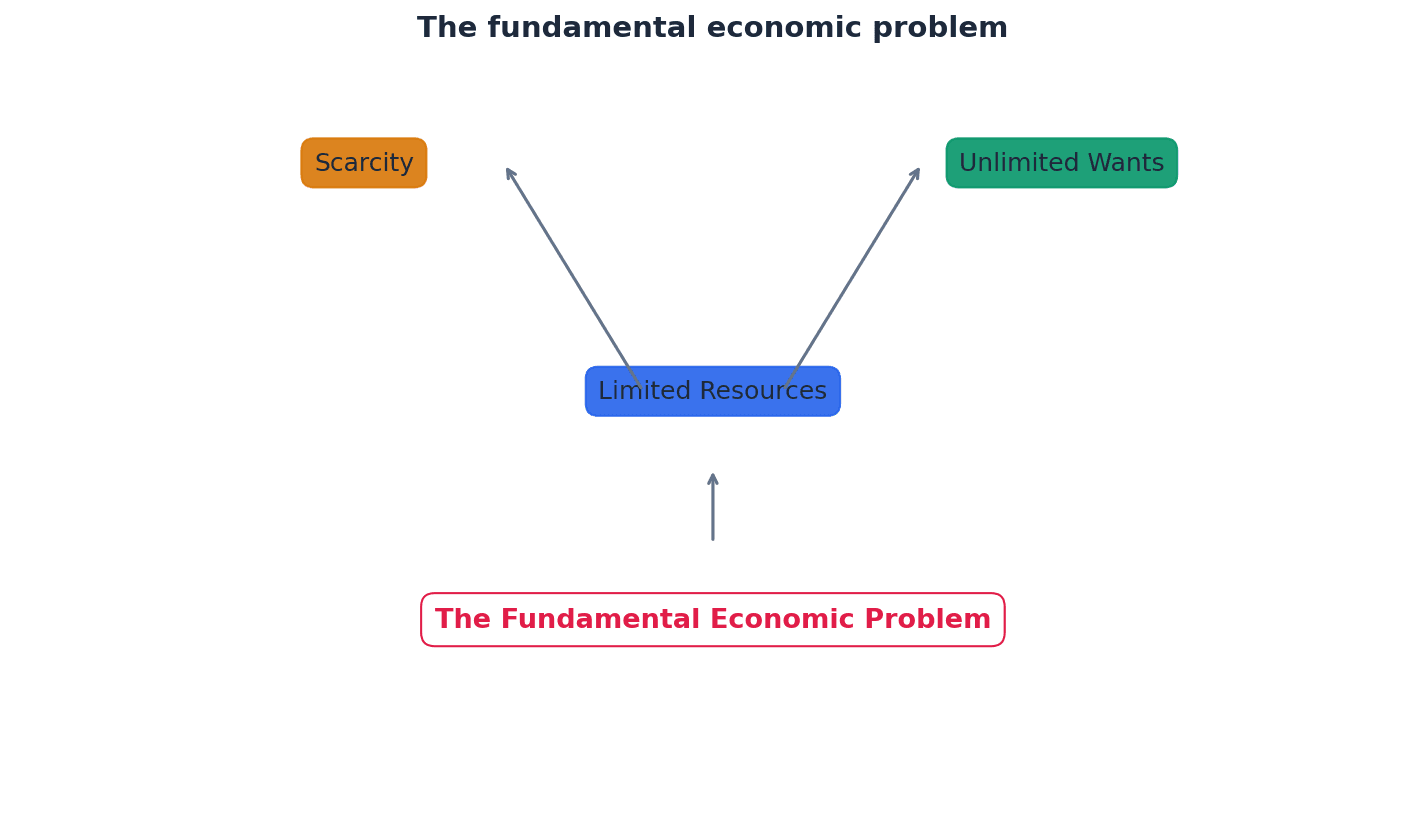
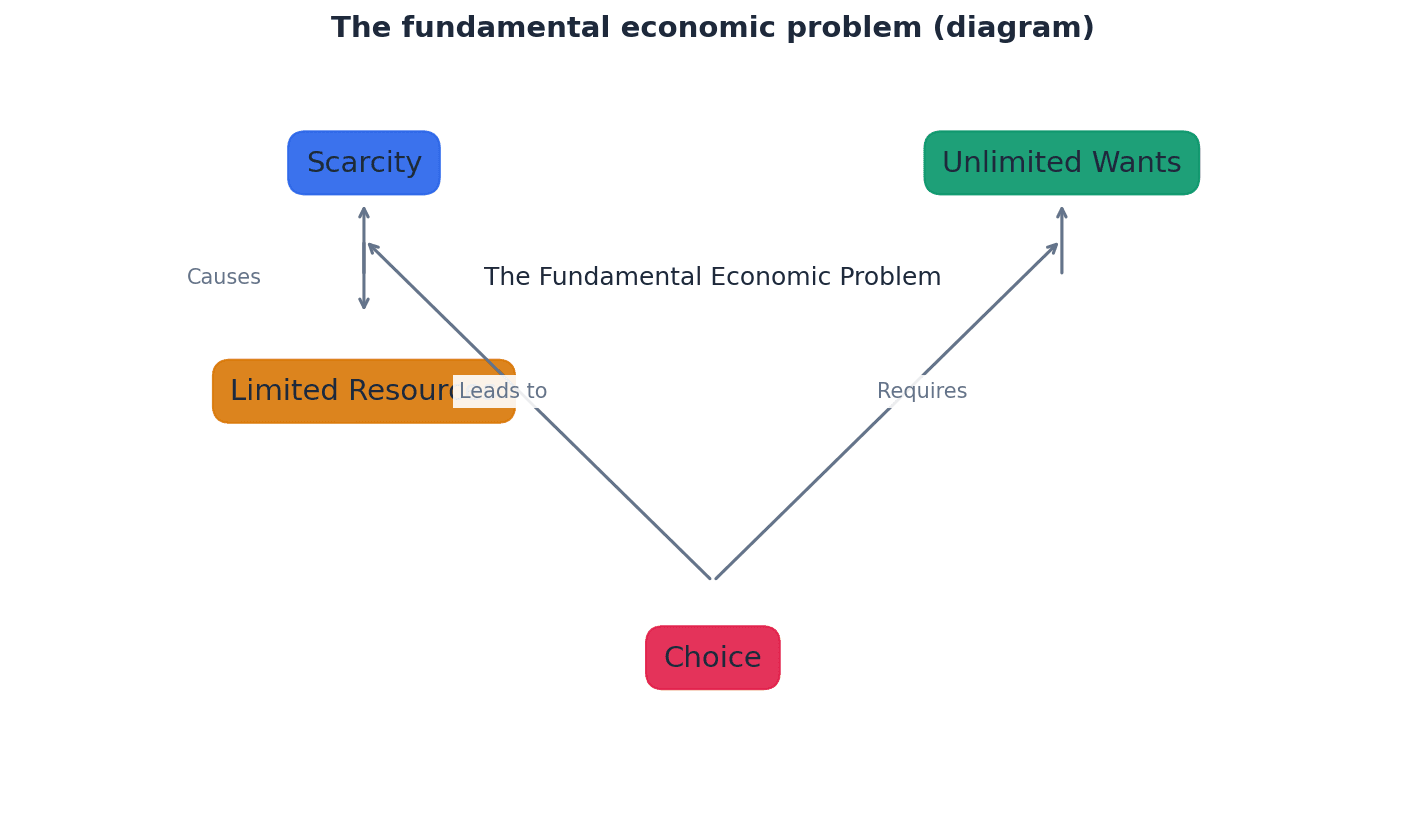
The fundamental economic problem stems from the reality that human wants are unlimited, while the resources available to satisfy these wants are limited. This inherent imbalance, known as scarcity, forces all economic agents – individuals, firms, and governments – to make choices about how to allocate their finite resources. Understanding why scarcity occurs is crucial to comprehending economic decision-making.
Choice — Taking decisions on how to allocate scarce resources between many competing uses.
Because resources are scarce and wants are unlimited, individuals, firms, and governments must make choices about which wants to satisfy. Every choice made implies foregoing other alternatives. Choosing what to watch on TV when there are many channels available means you are making a choice, and you cannot watch all shows simultaneously.
Students often think choice is simply picking something, but actually in economics, choice always implies a trade-off due to scarcity.
Opportunity cost — The cost of the choice in terms of the next best alternative.
Whenever a choice is made between alternatives due to scarcity, the opportunity cost is what is given up. It represents the real cost of a decision and is a recurring theme in economics. If you choose to spend your Saturday studying for an exam, the opportunity cost is the next best thing you could have done, like going to a football game with friends.
Students often think opportunity cost is all the alternatives foregone, but it is only the single next best alternative that is given up.
When calculating or identifying opportunity cost, ensure you specify the *next best* alternative, not just any alternative, to earn full marks.
The necessity of making choices due to scarcity directly leads to the concept of opportunity cost. Since resources are limited, satisfying one want means that another cannot be satisfied. The opportunity cost is the value of the next best alternative that is foregone when a choice is made. This concept applies to individuals, firms, and governments alike, as they all face resource constraints.
Scale of preference — Each individual’s scale of preference is a product of a set of influences, including culture, upbringing and life experiences, on which you place your more urgent wants at the top and the less urgent ones at the bottom.
This concept highlights that individuals prioritize their wants based on personal factors, leading to variations in what is considered essential or luxury. It explains why choices differ between people and how these preferences can evolve over time. Imagine making a shopping list for a limited budget. You'd put the absolute necessities like milk and bread at the top, and then less urgent items like a new gadget further down. Your friend's list might be completely different based on their own priorities.
Students often think everyone has the same scale of preference, but it is highly individual and influenced by personal circumstances and experiences.
Given the fundamental economic problem of scarcity, all economies, regardless of their structure, must answer three basic questions regarding the allocation of their limited resources. These questions are: What to produce? How to produce? and For whom to produce? The answers to these questions determine how a society addresses its economic challenges and satisfies its wants.
This question addresses which goods and services an economy will prioritize producing from its limited resources. Societies must decide between, for example, producing more consumer goods or more capital goods, or between public services like healthcare and private goods. These decisions reflect the collective choices and priorities of a society, often influenced by individual scales of preference.
This question concerns the methods and techniques used to produce the chosen goods and services. It involves decisions about the combination of resources (land, labour, capital, enterprise) to employ, the level of technology, and the organization of production. For instance, a society might choose between labour-intensive or capital-intensive production methods, considering efficiency and resource availability.
This question addresses how the goods and services produced will be distributed among the population. It involves decisions about income distribution, access to goods and services, and social equity. Societies must determine who benefits from production, whether it's based on income, need, or other criteria, which has significant implications for social welfare and economic equality.
Link 'choice' directly to 'scarcity' and 'opportunity cost' in your explanations, as these concepts are fundamentally interconnected.
When discussing basic economic problems, ensure you highlight that even after needs are met, wants remain unlimited, driving the problem of scarcity.
In case studies, actively look for examples of scarcity, the choices being made, and the resulting opportunity costs.
Advantages
Disadvantages
Advantages
Disadvantages
Advantages
Disadvantages
Advantages
Disadvantages
For 12+ mark questions, always evaluate both sides before reaching a judgement.
Adapt these for any 12+ mark question on this topic
Examiner tips
Introduction
Begin by defining the fundamental economic problem of scarcity, linking it to unlimited wants and limited resources. State that this problem necessitates choices and leads to opportunity cost, and that all economies must answer three basic questions.
Main Body
Evaluation
Evaluate the implications of scarcity and choice, considering how different societies or individuals might prioritize wants, or how the 'next best alternative' might be subjective. Discuss the challenges in answering the three basic questions.
Conclusion
Summarize the interconnectedness of scarcity, choice, and opportunity cost as core economic principles. Reiterate that these concepts are central to understanding how economies function and allocate resources.