
Mechanics 1 · Motion in a straight line
This chapter introduces the fundamental concepts of motion in a straight line, differentiating between scalar and vector quantities. It explains how to represent motion using various graphs and how to calculate key quantities like speed, velocity, and acceleration.
scalar — A quantity which has only size, or magnitude.
Scalar quantities are fully described by a numerical value and a unit. Examples include distance, speed, mass, and time. They do not have an associated direction in space, much like the temperature outside is just a number like 20°C without a direction.
vector — A quantity which has both magnitude and a direction in space.
Vector quantities require both a numerical value (magnitude) and a specified direction to be fully described. Examples include displacement, velocity, and acceleration. The direction is crucial for understanding the physical situation, similar to how giving directions requires specifying 'walk 5 km north' instead of just 'walk 5 km'.
Students often confuse scalar and vector quantities, particularly distance/displacement and speed/velocity. Remember that scalar quantities have magnitude only, while vector quantities have both magnitude and direction.
origin — A fixed reference point from which position is measured.
The origin serves as the zero point on a coordinate system. All positions are defined relative to this point. The choice of origin is arbitrary but must be consistent throughout a problem, much like the '0' mark on a ruler is the origin for all other measurements.
Students often think the origin must be the starting point of motion, but actually it can be any fixed point chosen for convenience.
positive direction — The chosen direction in which quantities like position, displacement, and velocity are considered positive.
Establishing a positive direction is crucial for consistently representing vector quantities with signs. For vertical motion, 'upwards' or 'downwards' can be chosen as positive. For horizontal motion, 'east' or 'right' are common choices, similar to deciding which way is positive on a number line.
Always clearly state your chosen origin and positive direction at the beginning of a problem to avoid ambiguity and ensure correct interpretation of signs for position, displacement, and velocity.
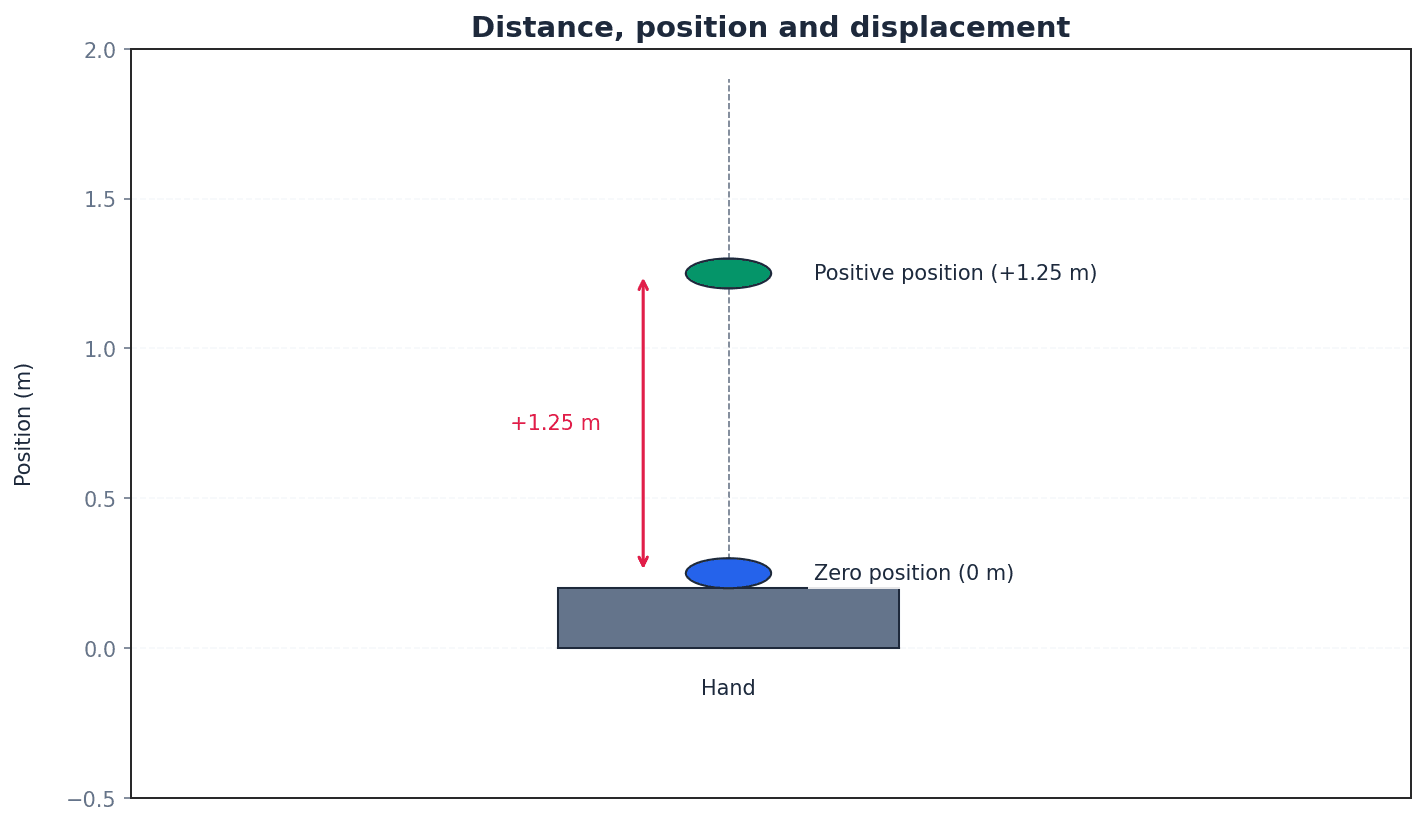
position — The distance of an object above a fixed origin, including its direction.
Position is a vector quantity that specifies an object's location relative to a chosen reference point, called the origin. It includes both magnitude (how far) and direction (where relative to the origin), like a house number on a street tells you where the house is relative to the start of the street.
negative position — A position that is in the opposite direction to the defined positive direction, relative to the origin.
If 'upwards' is positive, then a negative position means the object is below the origin. If 'east' is positive, a negative position means the object is west of the origin. It indicates location relative to the origin and the chosen positive direction. For example, if your house is '0' and 'east' is positive, a friend's house at '-50m' is 50m to the west of your house.
Students often think negative position means the object is moving backwards, but actually it just indicates its location relative to the origin and positive direction; the object could still be moving in the positive direction towards the origin.
distance — The total path length travelled by an object, irrespective of its direction.
Distance is a scalar quantity, meaning it only has magnitude. It measures how much ground an object has covered during its motion. It is always positive or zero. If you walk around a block and return to your starting point, your distance travelled is the perimeter of the block, not zero.
displacement — The change in position of an object, measured from any position.
Displacement is a vector quantity that describes the straight-line distance and direction from an object's initial position to its final position. It can be positive, negative, or zero. Unlike position, it doesn't require a fixed origin. For instance, if you walk 5m east and then 5m west, your total distance is 10m, but your displacement is 0m because you returned to your starting point.
Students often think distance and displacement are interchangeable, but actually distance is the total path length (scalar) while displacement is the change in position (vector).
speed — A scalar quantity that describes how fast an object is moving, without regard to direction.
Speed is the magnitude of velocity. It is calculated as the total distance travelled divided by the total time taken. Speed is always positive or zero. Your car's speedometer shows your speed, not your velocity, because it doesn't tell you which direction you're going.
velocity — A vector quantity that describes the rate at which the position of an object changes, including its direction.
Velocity is the rate of change of position. Its magnitude is the speed, but it also has a direction. A negative velocity indicates movement in the negative direction. A GPS tells you your velocity because it shows both how fast you're going and in what direction.
Students often think speed and velocity are the same, but actually speed is a scalar (magnitude only) while velocity is a vector (magnitude and direction).
Average speed
Used to calculate the overall speed over a journey, irrespective of direction changes. It is a scalar quantity.
Average velocity
Used to calculate the overall velocity over a journey, considering the net change in position. It is a vector quantity.
acceleration — A vector quantity that describes the rate at which the velocity of an object changes.
Acceleration occurs whenever there is a change in velocity, whether an object is speeding up, slowing down, or changing direction. It is represented by the gradient of a velocity-time graph and can be positive or negative. When you press the accelerator pedal in a car, you're changing its velocity, which is acceleration. Pressing the brake pedal also causes acceleration (deceleration).
Average acceleration
Used to calculate the overall rate of change of velocity over a period of time. It is a vector quantity.
Students often think acceleration only means speeding up, but actually it means any change in velocity, including slowing down (negative acceleration) or changing direction.
Students may think that negative velocity always means slowing down, but it only indicates movement in the negative direction.
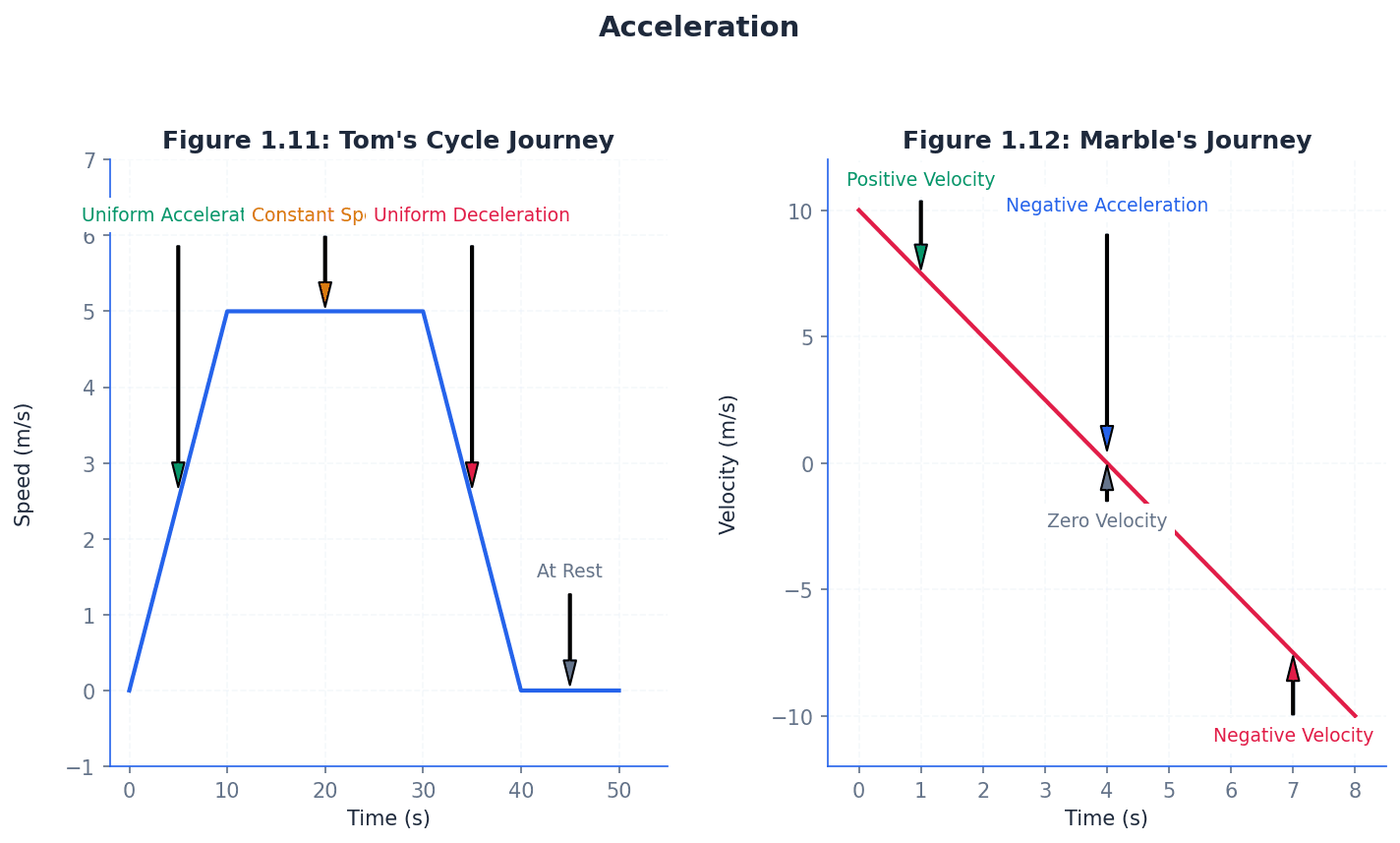
Motion in a straight line can be effectively represented using various graphs. Position-time graphs show an object's location over time, while distance-time graphs illustrate the total path length covered. Speed-time and velocity-time graphs are crucial for understanding how an object's speed or velocity changes over time, allowing for the calculation of other quantities.
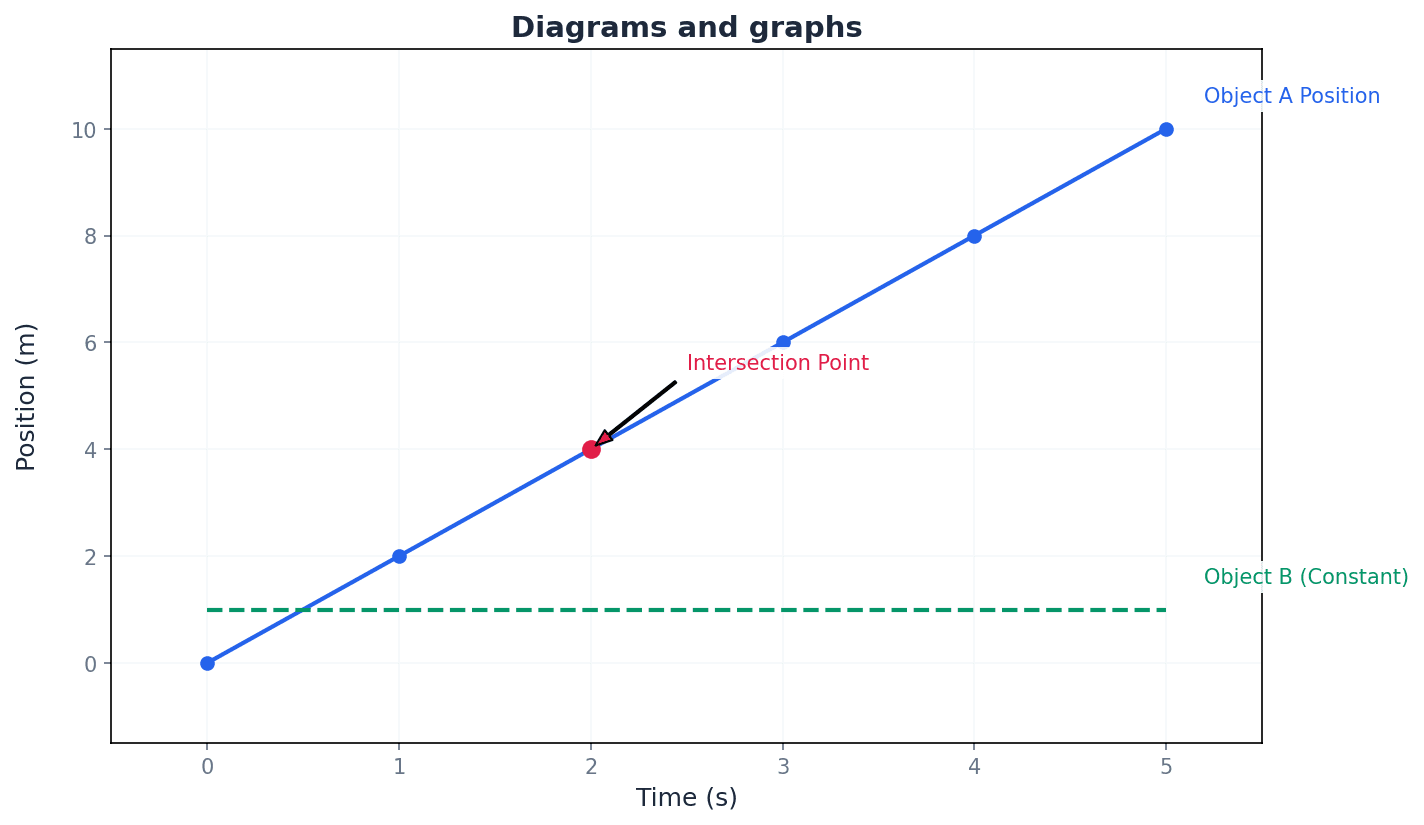
The gradient of a position-time graph represents velocity, while the gradient of a velocity-time graph represents acceleration. The area under a speed-time graph gives the total distance travelled. Crucially, the area under a velocity-time graph represents the displacement, taking into account the direction of motion.
Area of a rectangle (under speed-time graph)
Represents the distance travelled when speed is constant.
Area of a trapezium (under speed-time graph)
Represents the distance travelled when speed changes uniformly.
Area of a triangle (under speed-time graph)
Represents the distance travelled when speed increases uniformly from rest.
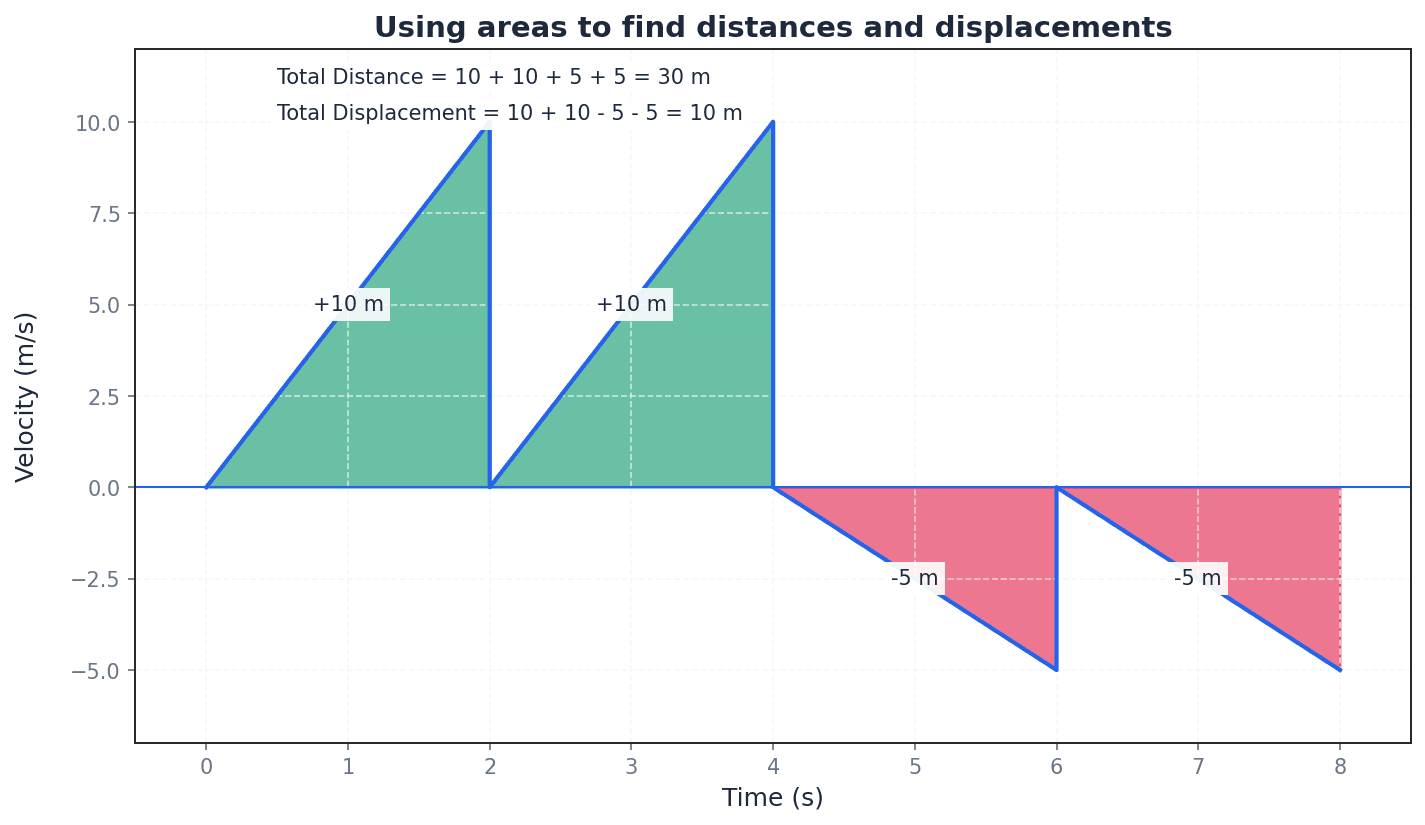
Students may incorrectly interpret the area under a velocity-time graph as total distance instead of displacement, especially when velocity is negative. Remember to add the absolute values of all areas for total distance.
When calculating vector quantities like displacement or velocity, always include the direction (e.g., +5 m, -10 m/s, 5 m/s upwards) or indicate it with a sign if a positive direction has been defined.
Sketch a velocity-time graph whenever possible. It helps visualize the motion and allows you to find acceleration (gradient) and displacement (area) easily.
Read the question carefully. If it asks for 'velocity', your answer needs a sign or direction. If it asks for 'speed', it's just the magnitude.
For multi-stage journeys, remember that average speed is the *total* distance divided by the *total* time, not the average of the speeds.
Method Frameworks
Common Errors
| Common mistake | How to fix it |
|---|---|
| Confusing distance with displacement, and speed with velocity. | Remember that distance and speed are scalar (magnitude only), while displacement and velocity are vector (magnitude and direction). Displacement is the net change in position, not the total path length. |
| Thinking negative velocity always means slowing down. | Negative velocity simply indicates movement in the chosen negative direction. An object can have negative velocity and still be speeding up (if acceleration is also negative). |
| Believing acceleration only means speeding up. | Acceleration is any change in velocity, including slowing down (deceleration, which is negative acceleration in the positive direction) or changing direction. |
| Calculating displacement from a velocity-time graph when the question asks for total distance. | For total distance, you must add the absolute values of all areas under the velocity-time graph (treat areas below the axis as positive). For displacement, areas below the axis are negative. |
| Assuming the origin must be the starting point of motion. | The origin is simply a fixed reference point chosen for convenience. It does not have to be where the motion begins. |
| Failing to specify the positive direction when dealing with vector quantities. | Always clearly state your chosen positive direction at the start of any problem involving vector quantities to ensure consistency in signs for position, displacement, velocity, and acceleration. |
Technique Selection
| When you see... | Use... |
|---|---|
| When asked for 'how fast' without direction, or total path length. | Use scalar quantities: speed and distance. Calculate average speed using total distance / total time. |
| When asked for 'how fast and in what direction', or net change in position. | Use vector quantities: velocity and displacement. Calculate average velocity using displacement / time taken. |
| To find acceleration or instantaneous velocity from a position-time or velocity-time graph. | Calculate the gradient of the graph at the relevant point or section. |
| To find distance travelled from a speed-time graph, or displacement from a velocity-time graph. | Calculate the area under the graph. Remember to consider signs for displacement. |
| When dealing with multi-stage journeys or non-uniform motion. | Break the journey into sections. Use graphs (especially velocity-time) to visualize and calculate quantities for each section, then sum as appropriate. |
Mark Scheme Notes