
Pure Mathematics 1 · Quadratics
This chapter explores quadratic equations and functions, covering various methods for solving them, including factorisation, completing the square, and the quadratic formula. It also delves into quadratic inequalities, simultaneous equations involving quadratics, and understanding the graphical properties of quadratic functions.
parabola — The shape of the graph of a quadratic function f(x) = ax^2 + bx + c.
A parabola is a symmetrical curve that opens either upwards (if a > 0) or downwards (if a < 0). It has a single turning point called the vertex, which is either a maximum or minimum. Imagine the path a ball takes when thrown through the air; this trajectory is a parabola.
vertex — The maximum or minimum point of a parabola.
The vertex is the turning point of the parabola, where the gradient is zero. It lies on the line of symmetry of the parabola and represents the extreme value (maximum or minimum) of the quadratic function. Think of the peak of a mountain or the bottom of a valley; the vertex is the highest or lowest point on the curve.
stationary point — A point where the gradient of a curve is zero.
For a quadratic function, the stationary point is always the vertex, which is either a maximum or minimum. More generally, for other functions, stationary points can also be points of inflection. Imagine a car momentarily stopping at the top of a hill or the bottom of a dip; at that exact moment, its vertical speed (gradient) is zero.
Students often think a stationary point is always a turning point, but actually it can also be a point of inflection where the curve changes concavity without turning.
turning point — A point where the gradient of a curve is zero and the curve changes direction (from increasing to decreasing or vice versa).
For a quadratic function, the turning point is the vertex, which is either a maximum or minimum. It is where the function reaches its extreme value. Similar to a stationary point, it's where a roller coaster reaches its highest or lowest point before changing direction.
Students often confuse turning points with x-intercepts, but actually turning points relate to the maximum/minimum value of the function, not where it crosses the x-axis.
roots — The solutions to the equation f(x) = 0 for a function f(x).
For a quadratic equation ax^2 + bx + c = 0, the roots are the values of x that satisfy the equation. Graphically, these are the x-coordinates where the curve y = f(x) intersects the x-axis. Think of the roots of a tree; they are the fundamental points where the tree connects to the ground, just as the roots of an equation are the fundamental x-values where the graph touches the x-axis.
Students often confuse roots with the vertex, but actually roots are where the graph crosses the x-axis, while the vertex is the maximum or minimum point of the curve.
Quadratic Formula
Used to solve quadratic equations of the form ax^2 + bx + c = 0.
Discriminant
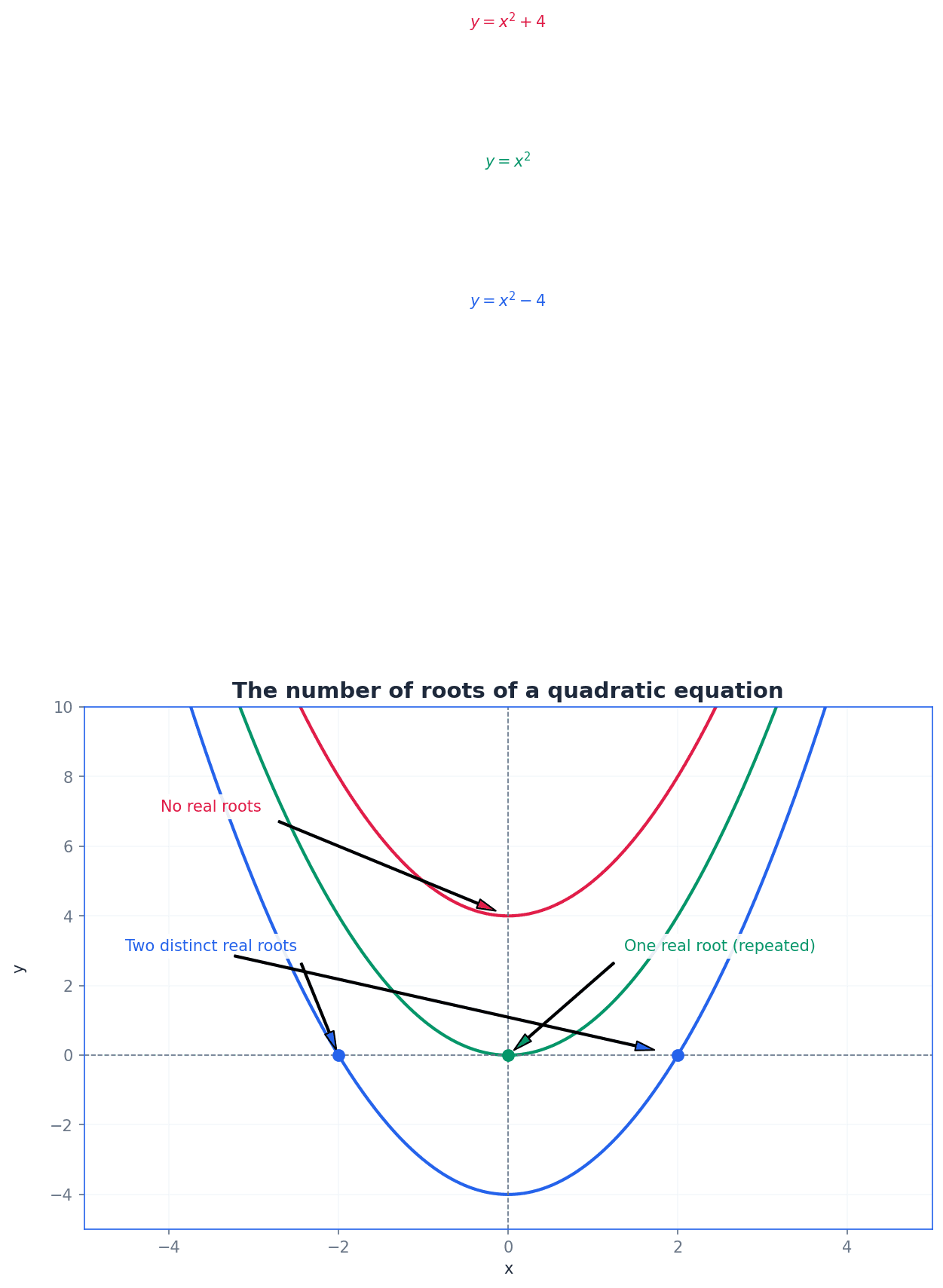
Determines the nature of the roots of a quadratic equation ax^2 + bx + c = 0. If Δ > 0, two distinct real roots; if Δ = 0, two equal real roots; if Δ < 0, no real roots.
discriminant — The part of the quadratic formula underneath the square root sign, b^2 - 4ac.
The sign of the discriminant (positive, zero, or negative) determines the nature and number of real roots of a quadratic equation. It indicates whether there are two distinct real roots, two equal real roots, or no real roots. Consider the discriminant as a 'root detector' for quadratic equations; it tells you what kind of roots to expect without fully solving the equation.
Students often forget to consider the case where a=0 when using the discriminant, but actually the discriminant only applies to quadratic equations (where a ≠ 0).
two distinct real roots — A condition for a quadratic equation where the discriminant is positive (b^2 - 4ac > 0), resulting in two different real number solutions.
Graphically, this means the parabola intersects the x-axis at two separate points. Algebraically, the quadratic formula will yield two different real values for x. Imagine a river splitting into two separate streams; each stream represents a distinct real root.
Students often confuse 'two distinct real roots' (b^2 - 4ac > 0) with 'real roots' (b^2 - 4ac ≥ 0), but actually 'distinct' specifically means the two roots are different values.
two equal real roots — A condition for a quadratic equation where the discriminant is zero (b^2 - 4ac = 0), resulting in exactly one real number solution (a repeated root).
Graphically, this means the parabola touches the x-axis at exactly one point, which is its vertex. Algebraically, the quadratic formula yields the same real value for x twice. Think of a car just touching a speed bump at its highest point; it makes contact at only one specific spot.
Students often think 'two equal roots' means no roots, but actually it means there is one unique real root that appears twice in the solution set.
no real roots — A condition for a quadratic equation where the discriminant is negative (b^2 - 4ac < 0), meaning there are no real number solutions.
Graphically, this means the parabola does not intersect the x-axis at all; it is either entirely above or entirely below the x-axis. Algebraically, taking the square root of a negative number results in imaginary solutions, not real ones. Imagine a bridge that never touches the water below; it exists entirely above the surface, just as a curve with no real roots exists entirely above or below the x-axis.
Students often think 'no real roots' means no solutions at all, but actually it means no solutions within the set of real numbers; there are still complex (non-real) solutions.
Quadratic equations, in the form ax^2 + bx + c = 0, can be solved using several methods. Factorisation is often the quickest if possible, by expressing the quadratic as a product of linear factors. If factorisation is not straightforward, completing the square or using the quadratic formula are reliable alternatives. The quadratic formula is universally applicable for any quadratic equation.
Always check if factorisation is possible before resorting to the quadratic formula or completing the square.
Completing the square is a method to transform a quadratic polynomial ax^2 + bx + c into the form a(x+p)^2 + q. This form is particularly useful for identifying the vertex of the parabola and solving equations that are not easily factorised. The vertex of the parabola is given by (-p, q).
When completing the square, ensure you correctly handle the coefficient 'a' if it's not 1.
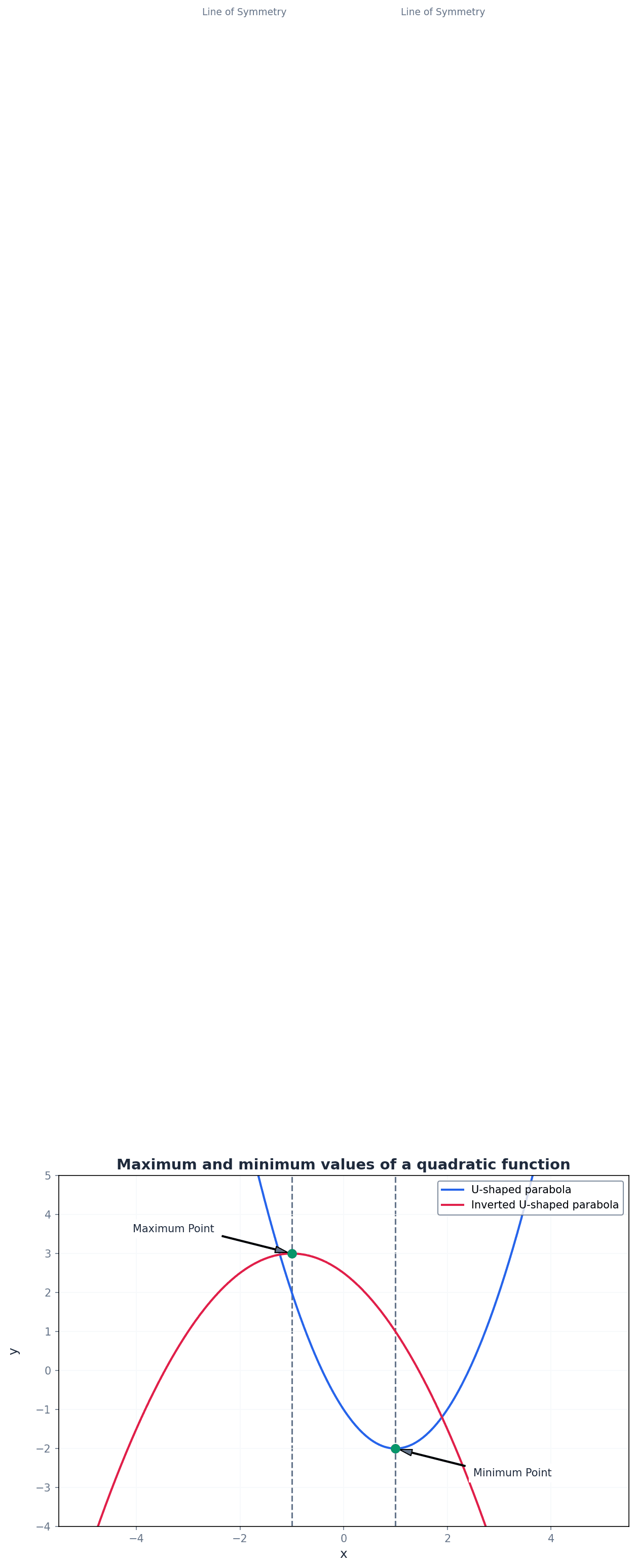
line of symmetry — A vertical line that passes through the vertex of a parabola, dividing it into two mirror-image halves.
For a quadratic function f(x) = a(x-h)^2 + k, the line of symmetry is x = h. For f(x) = ax^2 + bx + c, the line of symmetry is x = -b/(2a). Think of folding a piece of paper in half so that both sides match perfectly; the fold line is the line of symmetry.
Students often confuse the line of symmetry with the x-axis, but actually the line of symmetry is a vertical line passing through the vertex, not necessarily the x-axis.
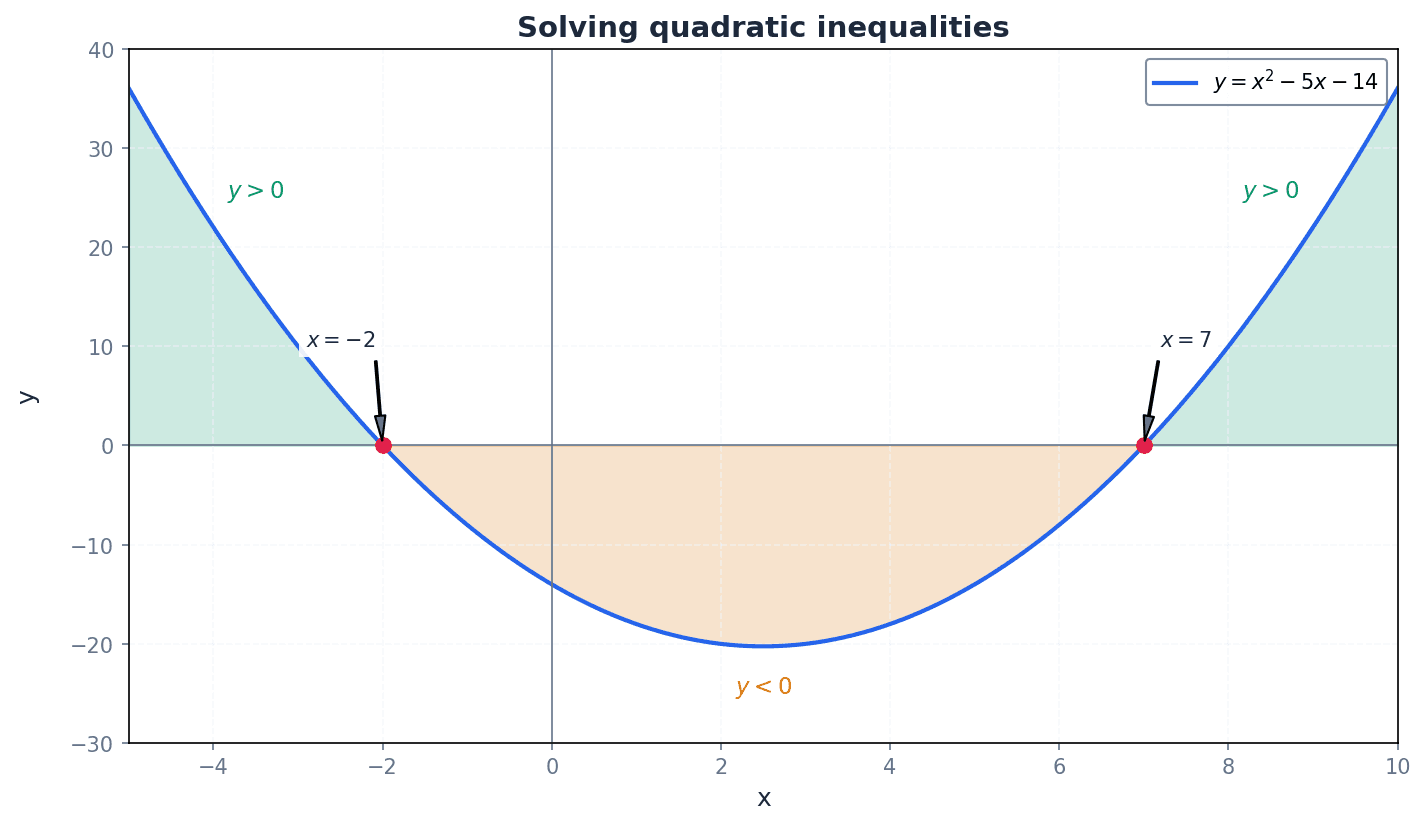
Solving quadratic inequalities involves finding the range of x-values for which a quadratic expression is greater than or less than zero. This typically involves finding the roots of the associated quadratic equation (critical values) and then using a sketch of the parabola to determine the regions that satisfy the inequality.
curve is positive — The range of x-values for which the y-values of a function are greater than zero (y > 0).
Graphically, this corresponds to the parts of the curve that lie above the x-axis. When solving inequalities like f(x) > 0, you are looking for these regions. Imagine a roller coaster track; the parts of the track that are above ground level represent where the curve is positive.
Students often confuse 'curve is positive' with 'positive gradient', but actually 'curve is positive' refers to the y-value being positive, while 'positive gradient' refers to the slope of the curve.
For quadratic inequalities, sketching the parabola helps visualise the solution set and avoid errors.
Students often forget to reverse the inequality sign when multiplying or dividing both sides of an inequality by a negative number.
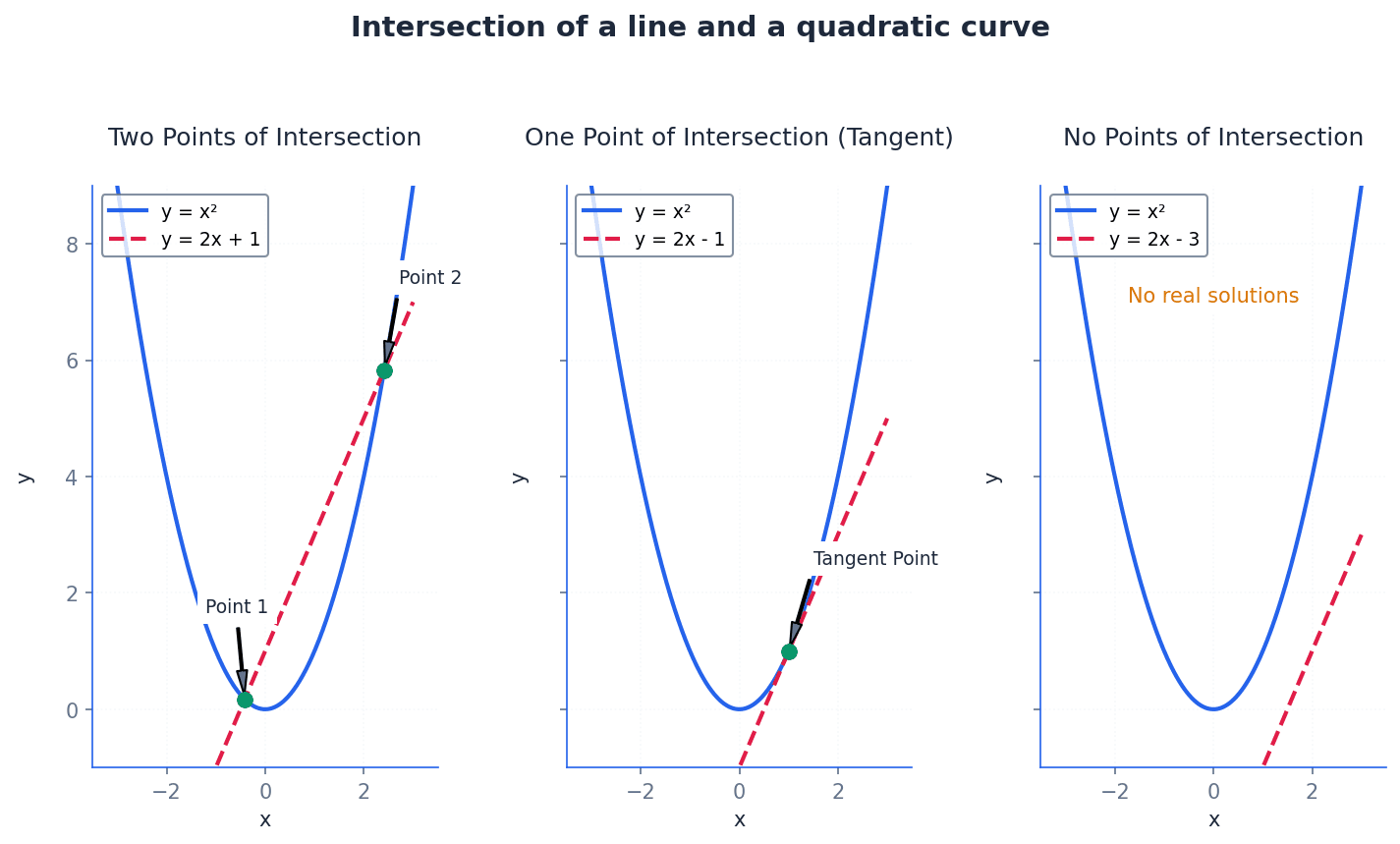
To find the points of intersection between a linear equation and a quadratic equation, substitute the linear equation into the quadratic one. This results in a single quadratic equation in one variable, which can then be solved. The solutions for x are the x-coordinates of the intersection points, and these must be substituted back into the linear equation to find the corresponding y-coordinates.
points of intersection — The coordinates where two or more graphs meet.
For a line and a quadratic curve, these points are found by solving their equations simultaneously. The number of real solutions corresponds to the number of points of intersection. Imagine two roads crossing each other; the points where they cross are the points of intersection.
Students often only find the x-coordinates when solving simultaneous equations for points of intersection, forgetting to find the corresponding y-coordinates.
When solving simultaneous equations, substitute the linear equation into the quadratic one to form a single quadratic equation.
When asked for a 'turning point', ensure you provide both the x and y coordinates. Completing the square is an efficient method to find the coordinates of the turning point for a quadratic.
Always verify your solutions by substituting them back into the original equations, especially for simultaneous equations.
Method Frameworks
Common Errors
| Common mistake | How to fix it |
|---|---|
| Incorrectly dividing by a variable (e.g., x) when solving equations. | Always factorise out common variables instead of dividing, to avoid losing valid solutions (e.g., in 3x^2 + 15x = 0, factorise to 3x(x + 5) = 0, which gives x=0 and x=-5). |
| Forgetting to reverse the inequality sign when multiplying or dividing by a negative number. | Be vigilant when manipulating inequalities. If you multiply or divide both sides by a negative number, the inequality sign must be flipped. |
| Only finding x-coordinates when solving simultaneous equations for points of intersection. | After finding the x-values, always substitute them back into the simpler (usually linear) original equation to find the corresponding y-values. Points of intersection require both x and y coordinates. |
| Confusing 'two distinct real roots' (b^2 - 4ac > 0) with 'real roots' (b^2 - 4ac ≥ 0). | Remember that 'distinct' specifically means the two roots are different values, requiring a strict inequality (>). 'Real roots' includes the case where the roots are equal. |
| Forgetting that for an equation to be quadratic, the coefficient of x^2 (a) cannot be zero. | When solving for conditions involving a variable (e.g., k) in ax^2 + bx + c = 0, always consider the case where a=0 separately, as it would no longer be a quadratic equation. |
| Confusing the vertex of a parabola with its x-intercepts (roots). | The vertex is the maximum or minimum point of the curve, while the x-intercepts are where the curve crosses the x-axis (where y=0). |
Technique Selection
| When you see... | Use... |
|---|---|
| Equation is easily factorisable (e.g., common factor, simple trinomials). | Factorisation |
| Question asks for maximum/minimum point, line of symmetry, or to express in a(x+p)^2+q form. | Completing the square |
| Equation is not easily factorisable, or question asks for exact answers in surd form. | Quadratic formula |
| Question asks about the number or nature of real roots, or tangency of a line to a curve. | Discriminant (b^2 - 4ac) |
| Solving equations involving fractions with x in the denominator, or equations quadratic in some function of x (e.g., x^4, e^(2x)). | Rearrange to standard quadratic form (ax^2 + bx + c = 0) then apply other methods. |
| Finding where a line and a curve meet. | Solve simultaneous equations (substitute linear into quadratic). |
| Solving inequalities (e.g., ax^2 + bx + c > 0). | Find critical values (roots) and sketch the parabola. |
Mark Scheme Notes