A number line showing 0 at the center. A point at 3 is labeled 'x = 3' with an arrow pointing from 0 to 3, labeled 'distance = 3'. Another point at -3 is labeled 'x = -3' with an arrow pointing from 0 to -3, labeled 'distance = 3'.
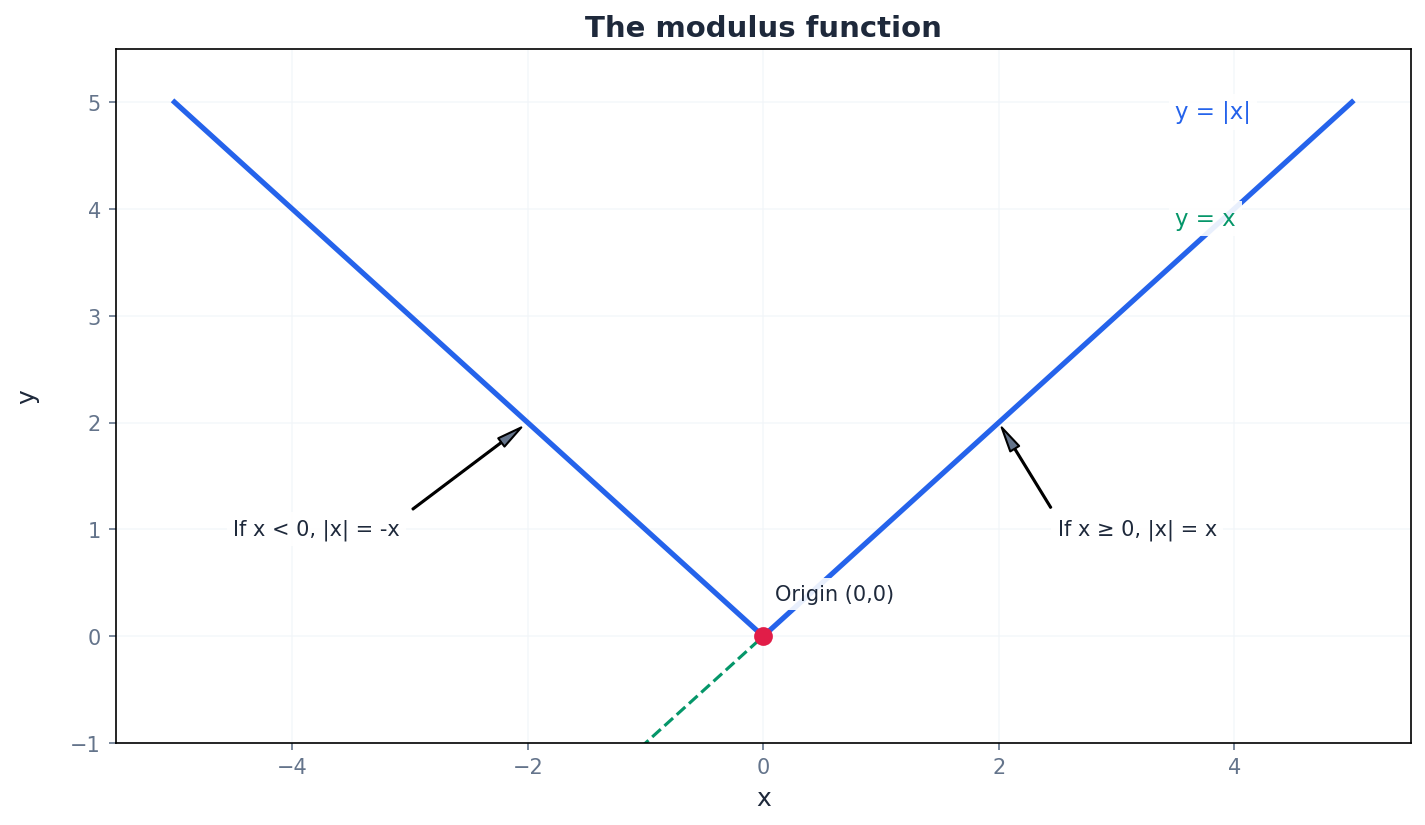
The of a number is its non-negative value.
It represents the distance of a number from zero on the number line.
Denoted by vertical bars, e.g., |x|.
Always results in a positive or zero value.
Examiner Tip
Students often think that |x| can be negative, but actually the modulus function always returns a non-negative value. This is a common source of error in solving equations and inequalities.
In physics, the modulus is used to represent the magnitude of vectors, such as velocity or force, where direction is separate from strength.
A number line showing 0 at the center. A point at 3 is labeled 'x = 3' with an arrow pointing from 0 to 3, labeled 'distance = 3'. Another point at -3 is labeled 'x = -3' with an arrow pointing from 0 to -3, labeled 'distance = 3'.
The of a number is its non-negative value.
It represents the distance of a number from zero on the number line.
Denoted by vertical bars, e.g., |x|.
Always results in a positive or zero value.
Examiner Tip
Students often think that |x| can be negative, but actually the modulus function always returns a non-negative value. This is a common source of error in solving equations and inequalities.
In physics, the modulus is used to represent the magnitude of vectors, such as velocity or force, where direction is separate from strength.